Mammoplasty: Types, Indications, Contraindications, Surgery Stages, and Potential Complications
Polina S.Dermatologist, aesthetician, MD
13 min read·September 17, 2026
This article is for informational purposes only
The content on this website, including text, graphics, and other materials, is provided for informational purposes only. It is not intended as advice or guidance. Regarding your specific medical condition or treatment, please consult your healthcare provider.
Mammoplasty is the surgical correction of the shape, volume, position, and symmetry of the breasts, including breast augmentation, breast reduction, and mastopexy. It is one of the most commonly performed procedures in aesthetic surgery as it can address a wide range of cosmetic concerns simultaneously, ranging from insufficient or excessive breast volume and asymmetry to age-related or postpartum tissue ptosis.
As demonstrated by studies evaluating patient satisfaction following surgery, the popularity of mammoplasty is also associated with its potential to improve body image, self-esteem, and psychosocial well-being. The choice of surgical technique and extent of correction should be based on the patient’s individual anatomical features, overall health status, expectations, and the balance between potential benefits and possible risks.
3D Animation: Augmentation Mammoplasty
Types of Mammoplasty
Augmentation Mammoplasty (Breast Enlargement)
This is a surgical procedure performed to correct insufficient breast volume and shape using silicone breast implants (endoprostheses) or fat grafting (autologous fat transfer).
Reduction Mammoplasty (Breast Reduction)
This procedure involves surgical excision of excess glandular tissue, adipose tissue, and skin in cases of macromastia or gigantomastia to reduce physical strain and restore anatomical proportions.
Mastopexy (Breast Lift)
During the procedure, excess skin is excised and the the nipple-areolar complex is repositioned to its anatomically appropriate location in order to correct breast ptosis without altering breast volume.
A total or subtotal breast defect following radical mastectomy is restored using tissue expanders, implants, or transferred autologous tissue flaps.
Indications for Mammoplasty
Aesthetic Indications
Micromastia and hypoplasia: congenital underdevelopment or genetically determined small breast volume.
Post-lactational involutional atrophy: reduction in breast volume, loss of firmness, and thinning of glandular tissue following cessation of breastfeeding or significant weight loss.
Gravitational ptosis: descent of breast tissue and displacement of the nipple-areolar complex below the inframammary fold as a result of age-related changes.
Marked breast asymmetry: significant differences (greater than one cup size) between the right and left breasts in shape, volume, or position.
Congenital developmental anomalies: structural abnormalities including tubular breast deformity, Poland syndrome, or amastia.
Medical (Functional) and Reconstructive Indications
Macromastia and gigantomastia: excessive hypertrophy of breast tissue causing chronic pain in the cervical and thoracic spine, postural abnormalities, degenerative spinal changes, and dermatitis (intertrigo) within the inframammary folds.
Post-mastectomy defect: total or subtotal absence of breast tissue following radical surgical treatment for breast cancer.
Post-traumatic deformity: scarring, asymmetry, or loss of breast volume resulting from mechanical trauma, burns, or previously unsuccessful surgical procedures.
Capsular contracture syndrome: a specific complication following primary breast augmentation that may require revision mammoplasty, capsulectomy, or implant replacement.
Contraindications to Surgery
Absolute Contraindications
Active malignancy: the presence of malignant neoplasms of any location (with the exception of immediate breast reconstruction after mastectomy when approved by a multidisciplinary oncologic team).
Severe decompensated systemic disease: decompensated cardiovascular, renal, hepatic, or respiratory failure.
Infectious diseases: systemic infections, active tuberculosis, HIV infection in the AIDS stage, syphilis, and acute septic conditions.
Coagulation disorders (hemostatic abnormalities): congenital or acquired coagulopathies (e.g., hemophilia) associated with a high risk of uncontrolled intraoperative bleeding.
Psychiatric disorders: severe mental health conditions, including major depressive disorder, schizophrenia, and body dysmorphic disorder (pathological dissatisfaction with physical appearance that cannot be corrected surgically).
Relative Contraindications
Pregnancy and lactation: surgery is postponed throughout pregnancy. Mammoplasty is generally recommended no earlier than 6 months after complete cessation of breastfeeding.
Age under 18 years: until full development of the breast tissue and skeletal system has been completed, except in urgent reconstructive cases.
Diabetes mellitus and endocrine disorders: surgery may be performed only when the condition is well controlled with medical therapy and glycated hemoglobin levels are appropriately managed.
Chronic diseases during exacerbation: any systemic or autoimmune disorder (e.g., systemic lupus erythematosus or rheumatoid arthritis) until stable remission has been achieved.
Acute infectious and inflammatory conditions: respiratory infections (including viral upper respiratory infections and influenza), as well as localized inflammation of the skin and subcutaneous tissues within the planned surgical field.
Implant Placement Techniques
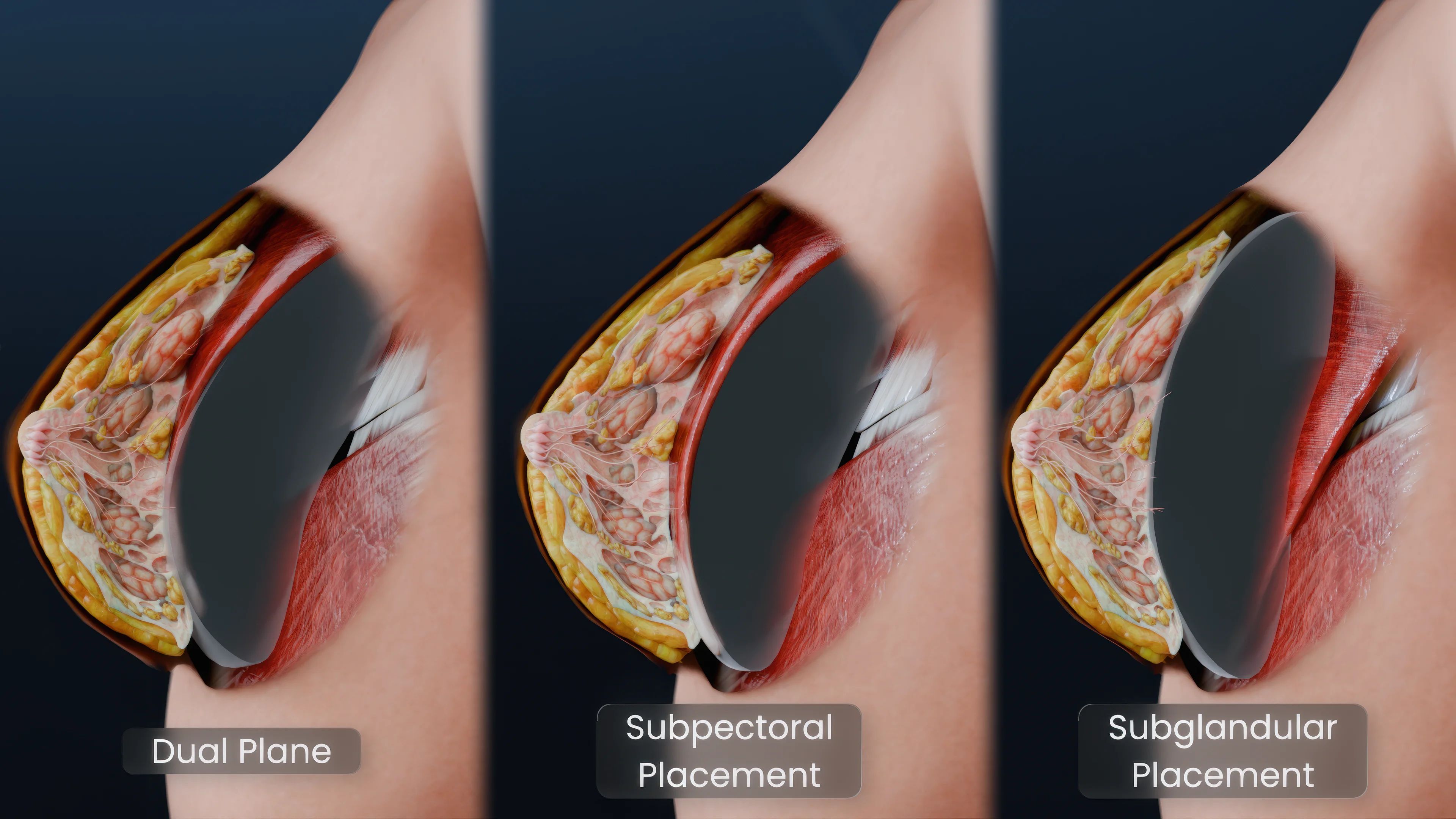
Subglandular Placement (Over-the-Muscle)
The implant is placed directly beneath the breast tissue and above the pectoralis major muscle.
Advantages: faster recovery, no postoperative muscle pain, the implant moves naturally with the breast tissue.
Disadvantages: higher risk of implant visibility and palpable rippling in thin patients, greater risk of breast ptosis over time.
The implant is completely or partially (in its lower portion) covered by the pectoralis major muscle.
Advantages: highly natural appearance, implant edges are less palpable, reduced risk of capsular contracture.
Disadvantages: more painful recovery, risk of animation deformity (implant displacement during contraction of the pectoral muscles).
Dual-Plane Placement
This is a combined approach and currently the most commonly used technique. The upper portion of the implant is positioned beneath the pectoralis major muscle, while the lower portion remains beneath the breast tissue.
Advantages: this technique provides an optimal balance between aesthetics and tissue coverage, creates a soft, natural-looking upper pole of the breast, preserves natural contour and movement of the lower pole. The implant is less susceptible to deformation during muscle contraction.
Disadvantages: the procedure should be performed only by a highly experienced healthcare professional.
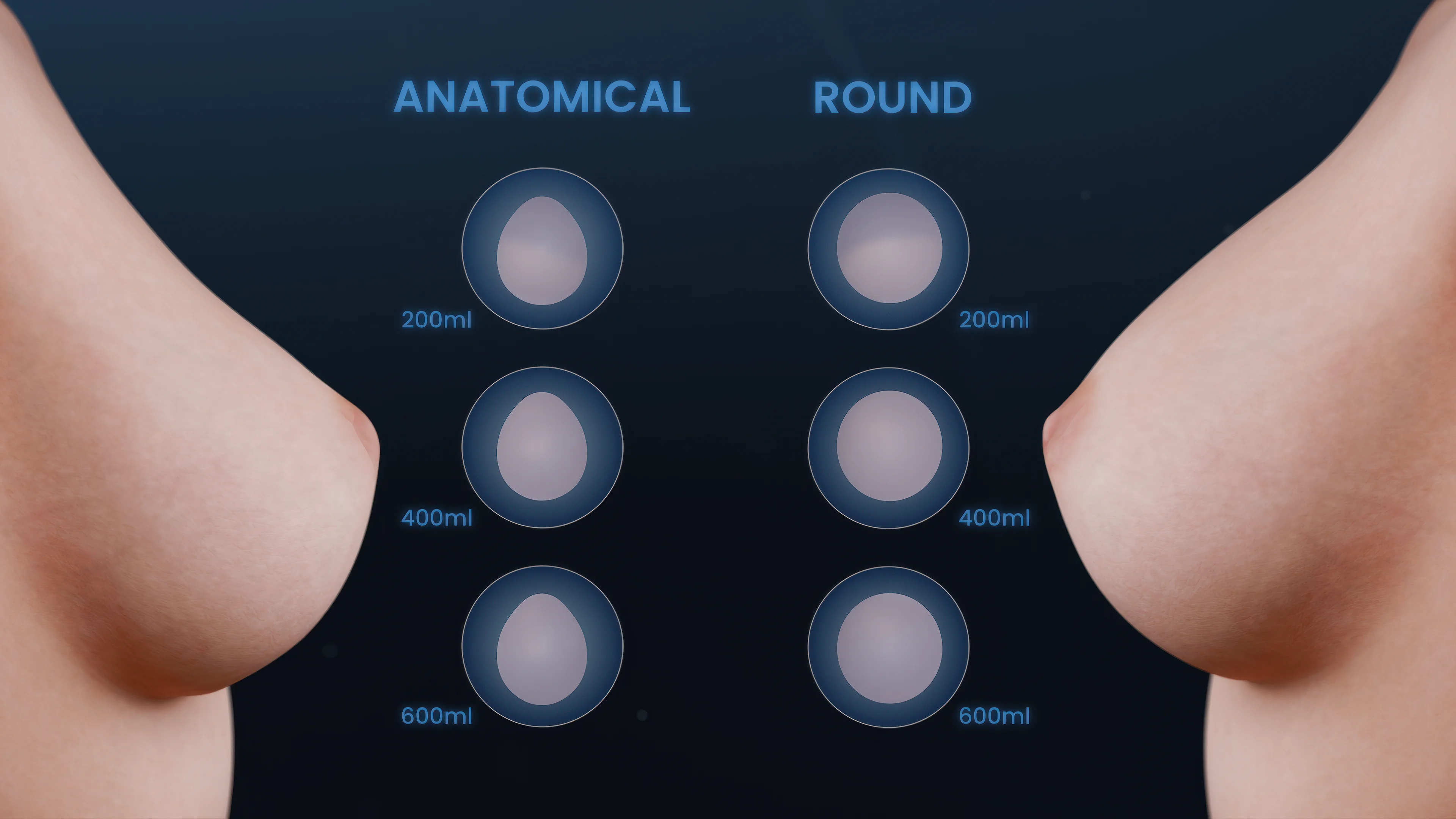
Round implants produce maximum upper-pole fullness (a “push-up” effect). They are suitable for correcting asymmetry and mild ptosis.
Anatomical (teardrop-shaped) implants mimic the natural breast contour, with a gentle upper slope and greater fullness in the lower pole.
Ergonomic implants alter their shape according to body position, appearing more rounded when the patient is lying down and more teardrop-shaped when standing.
Types of Breast Implants by Shape
By Filler Material
Breast implants may be filled with:
Silicone (cohesive) gel, the most widely used filler material. It possesses shape memory. Even if the implant shell is damaged, it generally retains its form.
Saline solution, consisting of sterile salt water. This filler is used less frequently because of a greater risk of fluid movement and rapid loss of shape.
By Shell Surface Texture
Two main surface types are available:
Textured implants have a roughened surface that promotes tissue adherence. This helps reduce the risk of implant displacement.
Smooth implants feel softer but are associated with a higher risk of displacement and capsular contracture.
Main Stages
Preoperative marking and anesthesia: the surgeon marks the breasts with a surgical skin marker, and the patient undergoes general anesthesia.
Incision: the selected surgical approach is performed.
Creation of the implant pocket: the surgeon creates a pocket either beneath the pectoralis major muscle or beneath the mammary tissue.
Implant placement: the implant is inserted into the pocket and positioned to achieve optimal symmetry.
Closure: the tissues are adjusted, cosmetic sutures are placed, and a compression garment is applied.
Postoperative Period
First 3 days: the patient usually remains in the hospital for approximately 24 hours. Marked swelling, a sensation of tightness, and moderate pain are common and are typically controlled with analgesics.
First 2 weeks: most swelling and bruising gradually resolve. Patients can usually return to light daily activities and office-based work. Sutures are removed on postoperative days 10–14 if nonabsorbable sutures were used.
Up to 3–6 months: the implants gradually settle into their final position within the implant pockets, the tissues soften, breast contour becomes more natural, and scars progressively fade.
Find more scientifically accurate content on our social media
Subscribe and don’t miss out the latest resources
Complications After Mammoplasty
Early Complications (First Weeks)
Hematoma or seroma: accumulation of blood or serous fluid around the implant. Drainage may be required.
Infection: inflammation of tissues surrounding the implant pocket. Treatment includes antibiotics, and severe cases may require temporary implant removal.
Wound-edge necrosis: compromised blood supply to the tissues, occurring more frequently in smokers or when excessive skin tension is present.
Wound dehiscence: separation of the wound edges caused by excessive physical activity or individual variations in wound healing.
Late Complications (Months to Years Later)
Capsular contracture: excessive fibrotic capsule formation around the implant, resulting in firmness and breast deformity.
Implant displacement or rotation: migration of the implant, particularly anatomical implants, which may necessitate revision surgery.
Rippling: visible waves or folds of the breast skin caused by insufficient soft tissue coverage.
Altered sensation: temporary or, rarely, permanent numbness of the nipples or breast skin resulting from injury to small sensory nerves.
Symmastia: medial confluence of the breasts caused by implant pockets created too close to the midline.
FAQ
1. What is mammoplasty, and which procedures does it include?
Mammoplasty refers to a group of surgical procedures designed to alter or restore the shape, volume, and position of the breasts. These procedures include augmentation, reduction, mastopexy (breast lift), and reconstructive mammoplasty.
2. What is augmentation mammoplasty, and what results can it achieve?
Augmentation mammoplasty is a surgical procedure performed to increase breast volume and improve breast shape. It can be used to correct asymmetry, restore volume lost after pregnancy or significant weight loss, and create more harmonious body proportions. As a result, the breasts may appear fuller, more projected, and aesthetically enhanced.
3. In which cases is circumareolar augmentation mammoplasty performed?
The primary indication is mild to moderate breast ptosis combined with volume loss. The procedure allows simultaneous placement of silicone implants and lifting of the breast tissues through a periareolar mastopexy performed via a circumareolar incision. This approach may eliminate the need for longer vertical or inverted-T (anchor-pattern) incisions.
4. How does breast augmentation differ from mastopexy?
In augmentation mammoplasty, breast volume is increased using implants or autologous fat transfer. Mastopexy is primarily intended to correct breast ptosis and reposition the nipple-areolar complex. When indicated, both procedures can be performed together.
5. Who is a suitable candidate for breast augmentation without a lift?
This approach is most appropriate for patients seeking additional breast volume or improved shape without significant tissue ptosis. The main requirements are good skin elasticity and the absence of substantial breast sagging. When significant ptosis is present, implants alone may increase breast weight and compromise the aesthetic outcome.
6. What are modern breast implants made of, and do they need to be replaced after 10 years?
Modern breast implants consist of a durable silicone shell, which may be textured or smooth, and are typically filled with highly cohesive silicone gel that generally retains its shape even if the shell is compromised. Many manufacturers provide long-term warranties. Routine replacement after 10–15 years is not necessarily required and is usually performed only when clinically indicated.
7. How long does it take to recover after mammoplasty, and what restrictions should be observed?
Most swelling, bruising, and tightness resolve within 7–14 days, and sutures are generally removed after 10–14 days when nonabsorbable sutures are used. During the first month, strenuous physical activity should be avoided, and patients are typically advised not to sleep on their side or stomach. Compression garments are generally worn continuously during the early recovery period. Complete tissue healing and final implant positioning usually occur within 3–6 months.
8. Is breastfeeding possible after mammoplasty?
The ability to breastfeed depends on the type of procedure, the location of incisions, and the degree of disruption to glandular tissue, milk ducts, and nerves. Lactation is often preserved after implant placement; however, periareolar procedures, breast reduction surgery, or substantial repositioning of the nipple-areolar complex may impair milk production or milk flow.
9. What specific risks and late complications may occur after mammoplasty?
Rare procedure-specific complications include capsular contracture, characterized by excessive fibrous capsule formation around the implant, resulting in breast firmness and deformity; rotation of an anatomical implant, which may alter breast shape; and symmastia, the appearance of merging of the breasts across the midline. The risk of these complications can be minimized through appropriate surgical planning, proper pocket selection, meticulous operative technique, and adherence to postoperative recommendations.
References
1.
VOKA 3D Anatomy & Pathology – Complete Anatomy and Pathology 3D Atlas. VOKA 3D Anatomy & Pathology.
Available from: https://catalog.voka.io/
2.
Graf R, LeBlanc D. Tissue Preservation in Primary Breast Augmentation: From Founding Concepts to Early Evidence. Aesthet Surg J. 2026 Aug 11;46(Supplement_2):S93-S95. doi: 10.1093/asj/sjag114. PMID: 42579314; PMCID: PMC13459502.
3.
Pittman TA, Steve A, Zeidler K, Chidester JR, Calobrace MB. Minimally Invasive, Tissue-Preserving Breast Augmentation: Insights From a Large Case Series, Technique and Surgical Pearls. Aesthet Surg J. 2026 Aug 11;46(Supplement_2):S117-S126. doi: 10.1093/asj/sjag113. PMID: 42579316.
4.
Ors S. Nipple Dimensions After Augmentation Mammoplasty, Mastopexy and Reduction Mammoplasty: A Comparative Clinical Study. Aesthetic Plast Surg. 2020 Dec;44(6):2089-2093. doi: 10.1007/s00266-020-01861-5. Epub 2020 Jul 15. PMID: 32671450.
50 Franklin Street, STE 203 Boston, MA 02110 United States
Thank you!
Your message is sent! Our experts will contact you shortly. If you have any additional questions, please contact us at info@voka.io
Cookie Consent
We use cookies to enhance your browsing experience, analyze site traffic, and deliver content. Please choose whether you accept all cookies or wish to reject non-essential tracking.
Cookie Preferences
Manage your cookie preferences below:
Essential cookies enable basic functions and are necessary for the proper function of the website.
Name
Description
Duration
Geolocation Config
This cookie is used to store the consent settings based on the visitor's location.
30 days
Cookie Preferences
This cookie is used to store the user's cookie consent preferences.
30 days
Google reCAPTCHA helps protect websites from spam and abuse by verifying user interactions through challenges.
Name
Description
Duration
_GRECAPTCHA
Google reCAPTCHA sets a necessary cookie (_GRECAPTCHA) when executed for the purpose of providing its risk analysis.
179 days
Statistics cookies collect information anonymously. This information helps us understand how visitors use our website.
Google Analytics is a powerful tool that tracks and analyzes website traffic for informed marketing decisions.
Used to monitor number of Google Analytics server requests
10 minutes
__utmb
Used to distinguish new sessions and visits. This cookie is set when the GA.js javascript library is loaded and there is no existing __utmb cookie. The cookie is updated every time data is sent to the Google Analytics server.
30 minutes after last activity
__utmc
Used only with old Urchin versions of Google Analytics and not with GA.js. Was used to distinguish between new sessions and visits at the end of a session.
End of session (browser)
__utmz
Contains information about the traffic source or campaign that directed user to the website. The cookie is set when the GA.js javascript is loaded and updated when data is sent to the Google Anaytics server
6 months after last activity
__utmv
Contains custom information set by the web developer via the _setCustomVar method in Google Analytics. This cookie is updated every time new data is sent to the Google Analytics server.
2 years after last activity
__utmx
Used to determine whether a user is included in an A / B or Multivariate test.
18 months
_ga
ID used to identify users
2 years
_gali
Used by Google Analytics to determine which links on a page are being clicked
30 seconds
_ga_
ID used to identify users
2 years
_gid
ID used to identify users for 24 hours after last activity
24 hours
_gat
Used to monitor number of Google Analytics server requests when using Google Tag Manager
1 minute
_gac_
Contains information related to marketing campaigns of the user. These are shared with Google AdWords / Google Ads when the Google Ads and Google Analytics accounts are linked together.
90 days
__utma
ID used to identify users and sessions
2 years after last activity
Clarity is a web analytics service that tracks and reports website traffic.