Odontogenic Sinusitis: Classification, Etiology, Clinical Presentation, Diagnosis, and Treatment
A detailed overview of odontogenic maxillary sinusitis: causes, symptoms of acute and chronic inflammation, diagnosis, and modern treatment approaches.


Anesthesia
Pain management and sedation techniques

Angiology
Arterial and venous pathologies

Cardiology
Acquired and congenital heart diseases

Dentistry
Diseases of teeth, gums, and the oral cavity

Dermatology
Disorders of the skin and subcutaneous tissue

Embryology
Stages of embryogenesis and congenital anomalies

Endocrinology
Disorders of the glands and hormonal imbalance

Gastroenterology
Stomach, intestinal, and digestive diseases

Gynecology
Diseases of female reproductive organs

Hematology
Hematopoiesis and blood-related disorders

Hepatology
Liver, gallbladder, and biliary tract diseases

Histology
Microscopic tissue and cell structures

Infectious diseases
Bacterial, viral, and parasitic infections

Neurology
Brain, spinal cord, and peripheral nerve disorders

Obstetrics
Pregnancy complications and abnormal fetal positions

Oncology
Cancer types, benign and malignant tumors

Ophthalmology
Conditions affecting the eyes and vision

Orthopedics
Bone, joint, and soft tissue disorders

Otorhinolaryngology
Ear, nose, and throat diseases

Pediatrics
Child health, development, and clinical conditions

Physiology
Biological processes within organs and systems

Plastic surgery
Reconstructive and aesthetic procedures

Pulmonology
Lung and respiratory tract diseases

Traumatology
Acute injuries and musculoskeletal trauma

Urology
Urinary tract and male reproductive disorders
Anesthesia
Pain management and sedation techniques
Angiology
Arterial and venous pathologies
Cardiology
Acquired and congenital heart diseases
Dentistry
Diseases of teeth, gums, and the oral cavity
Dermatology
Disorders of the skin and subcutaneous tissue
Embryology
Stages of embryogenesis and congenital anomalies
Endocrinology
Disorders of the glands and hormonal imbalance
Gastroenterology
Stomach, intestinal, and digestive diseases
Gynecology
Diseases of female reproductive organs
Hematology
Hematopoiesis and blood-related disorders
Hepatology
Liver, gallbladder, and biliary tract diseases
Histology
Microscopic tissue and cell structures
Infectious diseases
Bacterial, viral, and parasitic infections
Neurology
Brain, spinal cord, and peripheral nerve disorders
Obstetrics
Pregnancy complications and abnormal fetal positions
Oncology
Cancer types, benign and malignant tumors
Ophthalmology
Conditions affecting the eyes and vision
Orthopedics
Bone, joint, and soft tissue disorders
Otorhinolaryngology
Ear, nose, and throat diseases
Pediatrics
Child health, development, and clinical conditions
Physiology
Biological processes within organs and systems
Plastic surgery
Reconstructive and aesthetic procedures
Pulmonology
Lung and respiratory tract diseases
Traumatology
Acute injuries and musculoskeletal trauma
Urology
Urinary tract and male reproductive disorders
Specialties
AnesthesiaAngiologyCardiologyDentistryDermatologyEmbryologyEndocrinologyGastroenterologyGynecologyHematologyHepatologyHistologyInfectious diseasesNeurologyObstetricsOncologyOphthalmologyOrthopedicsOtorhinolaryngologyPediatricsPhysiologyPlastic surgeryPulmonologyTraumatologyUrology
This article is for informational purposes only
The content on this website, including text, graphics, and other materials, is provided for informational purposes only. It is not intended as advice or guidance. Regarding your specific medical condition or treatment, please consult your healthcare provider.
Acute tonsillitis is the inflammation of the palatine tonsils, which can manifest in various clinical forms. Atypical forms of tonsillitis differ in their etiology, course, as well as features of local and general symptoms.
The following forms of acute tonsillitis are distinguished:
Comparative characterization of atypical forms of tonsillitis
| Form of tonsillitis | Etiology | Clinical Manifestations | Diagnosis | Treatment |
|---|---|---|---|---|
| Herpetic sore throat | Coxsackie viruses, echoviruses, adenoviruses | Vesicular rashes on the soft palate, fever, headache, mild sore throat | Clinical picture, PCR of throat swab, IgM in blood | Symptom treatment (antipyretics, antiseptic gargling) |
| Phlegmonous tonsillitis | Group A beta-hemolytic streptococcus (BHSA) | Unilateral lesion, purulent melting of the tonsil, high fever, severe pain | Pharyngoscopy, tonsil puncture | Abscess incision and drainage, antibiotics (penicillins, macrolides), NSAIDs |
| Ulcerative-membranous angina | Symbiosis of fusobacteria and spirochetes | Unilateral necrosis of the tonsil with easily removable plaque, bad breath | Bacterial culture of plaque samples | Antibiotics (penicillins, cephalosporins), local antiseptics |
| Fungal tonsillitis | Candida spp. (less commonly Aspergillus, Penicillium) | Cottage cheese-like coatings on tonsils, itching, burning, dry mouth | Microscopy and fungal culture | Antifungal medications (local and systemic) |
| Tonsillitis in diphtheria | Corynebacterium diphtheriae (Löffler’s bacillus) | Dense gray films on tonsils, “bull’s neck” (swelling of the neck), severe intoxication | Bacterioscopy, culture, determination of toxigenicity | Diphtheria antitoxin serum, antibiotics (penicillins), inpatient treatment |
| Tonsillitis with measles | Measles virus (Morbillivirus) | Belsky-Filatov-Koplik spots, measles rash, conjunctivitis, rhinitis | Serology (IgM), PCR of throat swab | Symptomatic treatment, vaccination for prevention |
| Tonsillitis in scarlet fever | Group A beta-hemolytic streptococcus (BHSA) | “Strawberry” tongue, pinpoint rash, hyperemia of throat, skin peeling | Strep test, throat culture | Antibiotics (penicillins), antiseptic gargling |
| Tonsillitis in mononucleosis | Epstein-Barr virus (EBV) | Thick plaques on tonsils, lymphadenopathy, enlargement of liver and spleen | Blood test (atypical lymphocytes), serology (IgM to EBV) | Symptomatic treatment, corticosteroids for severe cases |
| Tonsillitis in syphilis | Treponema pallidum (pale treponema) | Hard chancre (stage 1), papular sore throat (stage 2), gummas (stage 3) | Antibody tests (RW, ELISA, TPHA) | Antibiotics (penicillin G), treatment of sexual partners |
Herpetic angina (herpangina) is caused by Coxsackie viruses, retroviruses, enteroviruses, and adenoviruses. The name “herpetic angina” is due to the vesicular rash resembling herpes infection rash. Herpetic sore throat occurs most often in children.
In herpangina, vesicular rashes are found on the soft palate and palatine arches against a background of hyperemic pharynx. The palatine tonsils are slightly hyperemic and edematous, sometimes covered with whitish vesicles.
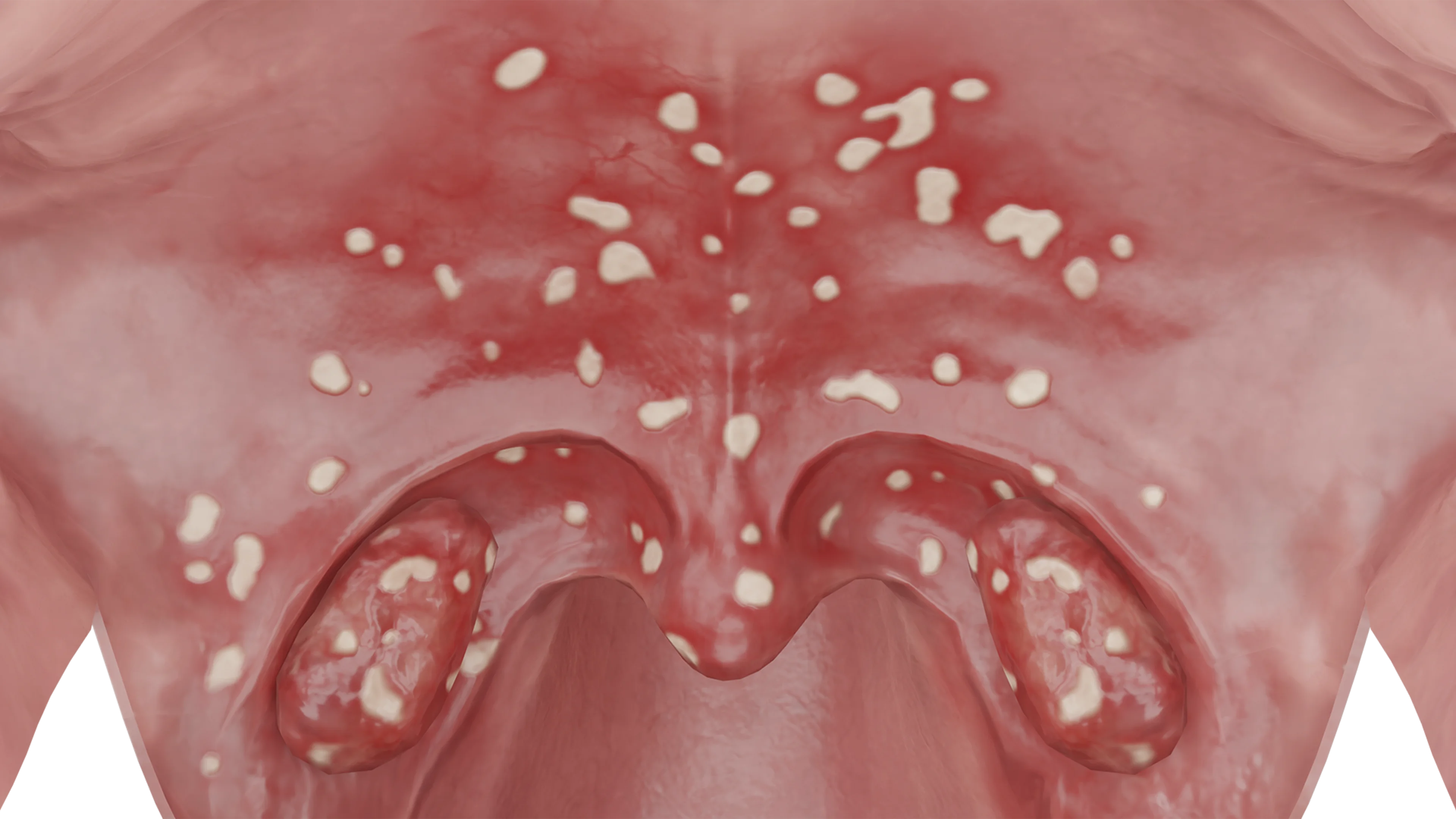
Herpangina is characterized by predominant general symptoms over localized ones. There is a significant fever with high temperature, headache, and muscle pain. The disease usually resolves on its own after 3-4 days. Mild throat pain is observed, and children may refuse to eat.
Diagnosis is based on a typical clinical picture. For laboratory diagnosis, blood is tested for antibodies (IgM), or an oropharyngeal swab is taken to detect pathogen RNA by PCR. A general blood test to assess intoxication severity and measure C-reactive protein levels is also recommended.
Symptomatic therapy is used in treating herpangina: antipyretics and regular antiseptic mouth rinses are applied.
The name herpetic sore throat is consonant with the herpes virus because of the similar vesicular rashes that characterize the disease. The article “Acute inflammatory pharyngeal diseases: classification, clinical manifestations, treatment“. Beta-hemolytic streptococcus group A (BHSA) is the most common.
In phlegmonous tonsillitis, there is purulent melting of tissue within the palatine tonsil. The disease develops against the backdrop of classical acute tonsillitis and usually affects one tonsil. The affected tonsil is infiltrated, hyperemic, tense, and bulging. In its center, a purulent focus of dissolution is formed, which can drain independently through the tonsil lacunae. Surrounding tissues of the oropharynx are markedly hyperemic. Asymmetry of the pharynx is noted. Regional lymph nodes are enlarged on the affected side.
This form of the disease is characterized by the presence of a second wave of fever, which develops 3-4 days after the onset of the disease. The body temperature rises to 39–41°C. There is severe throat pain, which worsens with swallowing, talking, and moving the tongue. Bad breath, hypersalivation, and difficulty swallowing and speaking are observed. The patient finds it difficult to open the mouth.
Diagnosis is similar to that of the usual form of tonsillitis. For therapeutic and diagnostic purposes, puncture of the affected tonsil is performed.
Patients undergo incision and drainage of the intratonsillar abscess. In the following days, the abscess is re-examined. For conservative treatment, penicillin antibiotics are used for 10 days; in case of allergy, cephalosporins or macrolides are used. In addition to antibiotics, non-steroidal anti-inflammatory drugs are prescribed, and local rinsing with antiseptic solutions.
The causative agent of ulcerative-membranous angina (Vincent’s angina) is a symbiosis of fusobacteria and spirochetes.
Ulcerative-membranous angina is characterized by unilateral palatine tonsil involvement, manifested by deep necrosis zone at the upper pole with a whitish plaque easily detachable from the tissue. The process can spread to the soft palate, cheek and gingiva.

Simanowsky-Plaut-Vensan angina is characterized by unilateral lesions of the palatine tonsil and the absence of general symptoms. Patients note discomfort and slight pain in the throat on the affected side, as well as bad breath. Lymph nodes located along the sternoclavicular-papillary muscle are enlarged. Fever is not characteristic.
Diagnosis is established on the basis of a typical clinical picture and the results of pharyngoscopy. Bacteriological examination of oropharyngeal discharge with determination of antibiotic sensitivity is obligatory.
For treatment, antibacterial drugs from the penicillin group or cephalosporins are used for 7–10 days. The oral mucosa is also treated with antiseptic solutions.
The fungal form of tonsillitis (tonsillomycosis) is caused by yeast fungi of the genus Candida (in most cases C. albicans, less frequently C. tropicalis, C. krusei, C. glabrata). In rare cases, mold fungi of the genus Geotrichum, Aspergillus, Penicillium can be found.
Tonsillomycosis occurs in young children, the elderly, and individuals who have been using antibacterial or hormonal drugs for prolonged periods (including topical or aerosolized), immunodeficient patients (including HIV-infected), diabetics, and cancer patients receiving chemotherapy.
In tonsillomycosis, the acute phase is characterized by the presence of white-gray curdy plaques on enlarged, hyperemic palatine tonsils. Often these plaques spread to the mucous membrane of the oral cavity. When plaques are removed, bleeding foci remain; the affected mucosa is brightly hyperemic and has a varnished appearance.
Fungal tonsillitis presents only local manifestations, such as itching, burning, and dryness in the oral cavity, with bad breath. There may be soreness when eating, but it is expressed moderately. The process often becomes chronic.
A microbiological study of oral mucosal discharge for the presence of fungal infection is performed.
Standard therapy of tonsillomycosis includes treatment of the oral cavity with antifungal agents.
Diphtheria is a highly contagious anthroponotic disease with high lethality. It is caused by the gram-positive bacteria Corynebacterium diphtheriae (Löffler’s bacillus).
Upon entering the body, diphtheria bacilli cause local changes in the oropharyngeal mucosa and exert general effects on the body via the diphtheria exotoxin. Depending on the severity (stage) of the process, the palatine tonsils, larynx, trachea, and bronchi are affected.
In the localized form, dense white-gray fibrin films form on the surface of the tonsils. In the widespread form, they spread to the uvula, palatoglossal arches, and larynx. The films are difficult to separate and leave a bleeding surface. However, films spreading into the larynx are easily detached into its lumen and cause asphyxia. The tonsil is infiltrated, hyperemic, tense and bulging. There is a reaction from the regional lymph nodes, which sharply increase in size. The penetration of exotoxin into the general bloodstream leads to damage to target organs (heart, peripheral nervous system, kidneys).
In diphtheria, there is a pronounced fever, a rise in temperature to 39-40°C, tachycardia, excessive sweating, and headache. Against the background of general symptoms, there is a sore throat, intensified by swallowing, bad breath, and plaque on the tonsils. Enlarged lymph nodes in the neck become sharply painful, and the neck may swell significantly (“bull neck”).
The examination is similar to that in acute tonsillitis. The diagnosis is established based on the characteristic clinical picture and the results of pharyngoscopy. Determination of the level of leukocytes, C-reactive protein, and rheumatoid factor in the blood, urinalysis, as well as a bacteriological examination of the discharge or a strepto-test for BHSA diagnosis is performed.
Treatment of diphtheria is carried out strictly in a hospital. Anti-diphtheria serum is immediately administered to neutralize the diphtheria toxin. Simultaneously with the serum, antibacterial drugs (penicillin class) are prescribed for a course of 7–10 days. In some cases, the introduction of systemic corticosteroids is indicated. Topical rinsing with antiseptic solutions is recommended. Vaccination against diphtheria is of great importance for prophylaxis.
Measles is a highly contagious disease with a high degree of lethality caused by a paramyxovirus of the genus Morbillivirus.
In measles infection, even in the prodromal period, a pronounced hyperemia of the pharynx is characteristic. Large red spots appear on the soft palate, which may merge together. Later, plaques appear on the palatine tonsils (as in lacunar tonsillitis), and the oropharyngeal tissues become moderately infiltrated. There is hypertrophy of the entire lymphoepithelial pharyngeal ring.
A distinctive feature of measles is the appearance of characteristic Belsky-Filatov-Koplik spots on the cheek mucosa: whitish spots with a bright red edge, 2–3 mm in diameter, not merging with each other.
Measles infection usually manifests with local changes in the oropharynx, conjunctivitis, rhinitis. Then body temperature rises to high values (39-40°C), body aches, photophobia, general intoxication are observed. On the 4th-5th day from the onset of the disease, a pathognomonic patchy-papular rash appears, spreading from top to bottom and tending to coalesce. The rash is localized on the face and neck on the first day, on the trunk on the second day, and reaches the extremities by the third day. After emergence, the rash is pigmented and diminishes in the same order. Due to the increase in lymphoid tissue in the pharynx, complications such as otitis media and sinusitis often occur (see article “Acute Otitis Media: Classification, Etiology, Diagnosis, and Treatment“.
For the diagnosis of measles, blood is tested for IgM antibodies, and these antibodies are also determined in saliva. It should be noted that measles antibodies appear in the blood not immediately but within 72 hours to 4 days from the onset of the disease. The determination of measles virus RNA using PCR in oropharyngeal swabs is possible.
There is no specific therapy for measles at the moment, and only symptomatic treatment is used. Vaccination remains the most important preventive measure.
Scarlet fever is caused by group A beta-hemolytic streptococcus (BHSA).
In scarlet fever, classical tonsillitis develops: swelling and hyperemia of the palatine tonsils with deposits (from follicular to membranous), and in severe cases, ulceration of the oral mucosa is possible. In addition, specific changes develop that are characteristic only of scarlet fever. These include a sharply delineated hyperemia of the oropharynx, which usually ends at the hard palate. On the tongue, dense white deposits form, which disappear after 2–3 days, leaving the tongue bright red, lacquered with protruding papillae, referred to as “strawberry tongue.”
This infectious disease is characterized by general intoxication, a rise in temperature to 38–40°C, an increase in regional lymph nodes, and vomiting and diarrhea are possible. Against the background of local changes in the oropharynx, a fine rash develops on the hyperemic skin. The rash spreads from top to bottom, tends to merge and intensify in the natural folds (elbows, knees, groin area). A distinctive feature is an unaffected nasolabial triangle, which remains white against the bright red face. During recovery, changes in the oropharynx, deposits, and rash resolve, but there is peelable desquamation on the palms and soles.
The diagnosis is established based on the typical clinical picture, medical history, and epidemiological situation. A microbiological study of the discharge from the oropharynx is carried out to identify the pathogen and determine its sensitivity to antibacterial drugs. The use of a strepto-test is possible.
Penicillin antibiotics are administered systematically for 7-10 days. Meticulous oral care is important, and antiseptic mouthwash is recommended. Bed rest and a high-calorie diet are prescribed to accelerate recovery.
It is caused by the Epstein–Barr virus, a type 4 herpes virus (EBV). More commonly affects children.
The Epstein–Barr virus causes pronounced changes in the oropharynx. The palatine tonsils and the posterior pharyngeal wall become brightly hyperemic and edematous. Their surface is covered with dense fibrin deposits. Enlarged lymphoid granules are observed on the posterior pharyngeal wall.
As with other infectious diseases, infectious mononucleosis manifests with a rise in body temperature to febrile levels, up to 41°C. Against the background of hyperthermia, headache and severe fatigue are noted, which can persist for up to a month. Local changes in the oropharynx are accompanied by severe sore throat and difficulty swallowing. Different groups of lymph nodes (more often cervical) symmetrically increase and are moderately painful. Hepatosplenomegaly is noted, in severe cases — with splenic capsule rupture. Transient hypertransaminasemia is observed in the hepatobiliary system. An unjustified prescription of penicillin antibiotics results in a pseudoallergic rash of a patchy-papular nature on the body.
The diagnosis is made based on a typical clinical picture. In the complete blood count, characteristic features are noted: initially, leukopenia is observed, followed by an increase in leukocytosis. About half of the leukocytes are represented by atypical mononuclears. Blood is also tested for the presence of antibodies to EBV.
There is no specific treatment for infectious mononucleosis. Symptomatic therapy, including anti-inflammatory drugs, is prescribed. In severe cases, the prescription of corticosteroids is justified.
The causative agent of this disease is the spirochete pale treponema (Treponema pallidum). The spirochete spreads to the body via contact through mucosal surfaces or skin, then penetrates the lymphatic system and disperses throughout the body.
Syphilis progresses through three stages, with each stage manifesting specific changes in the oropharynx. The first stage is characterized by the formation of a hard chancre on the palatine tonsil, soft palate, inner surface of the cheeks, or uvula. Initially, this lesion is a papule, which then ulcerates. Siphiloma, or chancre, is a painless ulcer with a weeping surface, from which fluid containing a large number of spirochetes oozes. The base of the chancre is lacquer-like, shiny, bright red, firm, and painless on palpation. Sizes can range from a few millimeters to 1.5 cm. When the chancre is located on the tonsil, it becomes bright red, enlarged, and firm.
The secondary stage of syphilis in the oropharynx is characterized by matte-pale spots surrounded by a rim of hyperemia on the bright red mucous membrane of the soft palate, tonsils, uvula; the hard palate remains intact. Subsequently, the spots transform into dark red papules, which tend to merge, forming the so-called papular angina.
In tertiary syphilis, gummata may form in the oropharynx. They are most often found on the soft or hard palate, as well as the posterior pharyngeal wall. These formations are dense, large nodules located deep in the tissue, which eventually disintegrate. After disintegration, transparent thick content is secreted into the oropharynx through a narrow fistulous tract. Upon healing, dense scars form that contract the surrounding tissues.
Pathological changes of the primary stage of syphilis develop at the site of primary contact of the treponema with the mucous membrane. Within 3-4 weeks after the pathogen enters the body, a hard chancre forms, which usually leads to further infection of the surrounding areas. Localized sore throat may be noted, which worsens with swallowing. Regional lymph nodes enlarge; they are usually painless. Fever is not characteristic. Within 1-3 months, the chancre heals, and an extended latent period ensues.
Three to four months after the appearance of the chancre, the second stage begins, characterized by persistent fever, weakness, headache, a widespread rash of varying nature, and lymph node enlargement. Local changes in the oropharynx also occur. Another latent stage then occurs.
Tertiary syphilis develops 3-15 years after the onset of the disease and affects various systems; however, it is currently very rare. When syphilitic gummas form in the oropharynx, complaints of throat discomfort, swallowing problems, changes in speech, and breathing difficulties are noted. The most severe outcome is observed in neurosyphilis, in which the vessels or membranes of the brain and the substance of the brain or spinal cord become inflamed.
For screening, blood or cerebrospinal fluid tests for syphilis (a serological reagin test, an anti-cardiolipin test, the Wassermann reaction) are used. In this test, antibodies to the pathogen formed in the patient’s body bind to lipid antigens (cardiolipin of bovine heart). However, this test can give false-positive results and is not highly specific.
If the reagin test is positive, treponemal tests are conducted to determine the qualitative presence of antibodies in the blood or cerebrospinal fluid. These include enzyme-linked immunosorbent assay, passive hemagglutination reaction, microhemagglutination for antibodies, and fluorescent treponemal antibody absorption test.
It should be noted that there is a seronegative window lasting 3–6 weeks post-infection during which syphilis will not be diagnosed by any method.
Find more scientifically accurate content on our social media


The patient is prescribed benzathine benzylpenicillin systemically for 2 weeks. Treatment of sexual partners is mandatory.
1. What are the atypical forms of acute tonsillitis?
2. What characterizes herpetic angina and how is it treated?
3. What is phlegmonous tonsillitis and how is it recognized?
4. How does ulcerative-membranous angina manifest, and how is it treated?
5. What causes fungal tonsillitis and how is it treated?
6. What are the features of tonsillitis in diphtheria?
7. How does tonsillitis in measles manifest, and how is it treated?
8. What distinguishes tonsillitis in scarlet fever?
9. What are the signs of tonsillitis in infectious mononucleosis?
10. How does syphilitic tonsillitis manifest and how is it diagnosed?
References
1.
VOKA 3D Anatomy & Pathology – Complete Anatomy and Pathology 3D Atlas. VOKA 3D Anatomy & Pathology.
Available from: https://catalog.voka.io/
2.
Sclafani AP, Dyleski RA, Pitman MJ, Schantz SP. Total otolaryngology—head and neck surgery. New York: Thieme Medical Publishers; 2015. ISBN: 978-1-60406-646-3.
3.
Behrbohm H, Kaschke O, Nawka T, Swift A. Ear, Nose, and Throat Diseases 2nd ed. Moscow: MEDpress-inform; 2016. 776 p. [In Russian.] ISBN 978-5-00030-322-1.
4.
Corsino CB, Ali R, Linklater DR Herpangina [Internet] StatPearls – NCBI Bookshelf. 2023.
Available from: https://www.ncbi.nlm.nih.gov/books/NBK507792/
5.
Ulualp SO, Koral K, Margraf L, Deskin R. Management of intratonsillar abscess in children Pediatr Int 2013 Aug;55(4):455-60 https://doi.org/10.1111/ped.12141 PMID: 23701269.
6.
Gebhardt B, Herrmann K, Roessner A, Vorwerk U. Differenzialdiagnostik der nekrotisierenden Tonsillitis [Differential diagnosis of unilateral necrotic tonsillitis] Laryngorhinootologie 2010 May;89(5):266-9. German doi: 10.1055/s-0029-1243192. Epub 2010 May 10. PMID: 20458657.
7.
Sharma NC, Efstratiou A, Mokrousov I, Mutreja A, Das B, Ramamurthy T. Diphtheria Nat Rev Dis Primers. 2019 Dec 5;5(1):81. doi: 10.1038/s41572-019-0131-y PMID: 31804499.
8.
Sabir S, Nguyen AD Scarlet Fever [Internet] StatPearls – NCBI Bookshelf. 2026.
Available from: https://www.ncbi.nlm.nih.gov/books/NBK507889/?utm_source=chatgpt.com
9.
Mohseni M, Boniface MP, Graham C. Mononucleosis [Updated 2023 Aug 8]. In: StatPearls [Internet]. Treasure Island (FL): StatPearls Publishing; 2025 Jan-.
Available from: https://www.ncbi.nlm.nih.gov/books/NBK470387/
Make VOKA your preferred source
See more VOKA articles in Google Search
Table of Contents









Summarize article with AI
Choose your preferable AI assistant:
Link successfully copied to clipboard
Thank you!
Your message is sent!
Our experts will contact you shortly. If you have any additional questions, please contact us at info@voka.io