Nasal bone anatomy quiz
The quiz covers the systemic anatomy of the nasal bone: structure, articulations, blood supply, innervation, and topographic relationships.
1/20
bold
text
1. According to the classification, to which group of bones of cranium does the nasal bone belong?
-
Neurocranium bone
The nasal bone (os nasale) is part of the viscerocranium and is a paired bone of the facial skeleton.
-
Viscerocranium bone
The nasal bone (os nasale) is part of the viscerocranium and is a paired bone of the facial skeleton.
-
Cranial base bone
The nasal bone (os nasale) is part of the viscerocranium and is a paired bone of the facial skeleton.
-
Mixed bone of cranium
The nasal bone (os nasale) is part of the viscerocranium and is a paired bone of the facial skeleton.
-
I find it difficult to answer
The nasal bone (os nasale) is part of the viscerocranium and is a paired bone of the facial skeleton.
2. Is the nasal bone a paired or unpaired structure?
-
Unpaired bone
The nasal bone is paired; the right and left nasal bones join along the median line, forming the nasal dorsum.
-
Paired bone
The nasal bone is paired; the right and left nasal bones join along the median line, forming the nasal dorsum.
-
Fuses into a single unpaired bone in adults
The nasal bone is paired; the right and left nasal bones join along the median line, forming the nasal dorsum.
-
Is a cartilaginous structure rather than a bone
The nasal bone is paired; the right and left nasal bones join along the median line, forming the nasal dorsum.
-
I find it difficult to answer
The nasal bone is paired; the right and left nasal bones join along the median line, forming the nasal dorsum.
3. With which bone does the nasal bone articulate via the nasofrontal suture (sutura nasofrontalis)?
-
With the ethmoid bone
The superior border of the nasal bone articulates with the nasal part of the frontal bone, forming the sutura nasofrontalis.
-
With the frontal bone
The superior border of the nasal bone articulates with the nasal part of the frontal bone, forming the sutura nasofrontalis.
-
With the maxilla
The superior border of the nasal bone articulates with the nasal part of the frontal bone, forming the sutura nasofrontalis.
-
With the sphenoid bone
The superior border of the nasal bone articulates with the nasal part of the frontal bone, forming the sutura nasofrontalis.
-
I find it difficult to answer
The superior border of the nasal bone articulates with the nasal part of the frontal bone, forming the sutura nasofrontalis.
4. Which foramen is typically located on the external surface of the nasal bone?
-
Round foramen
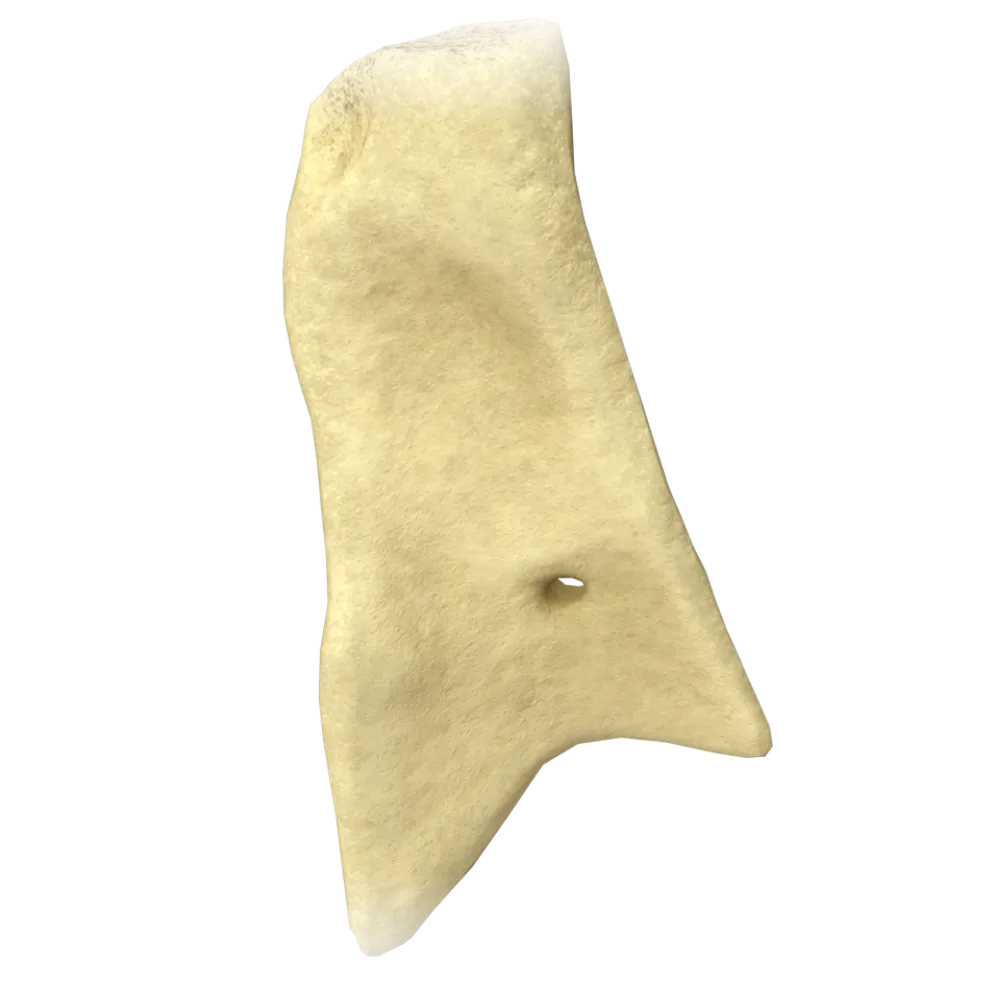
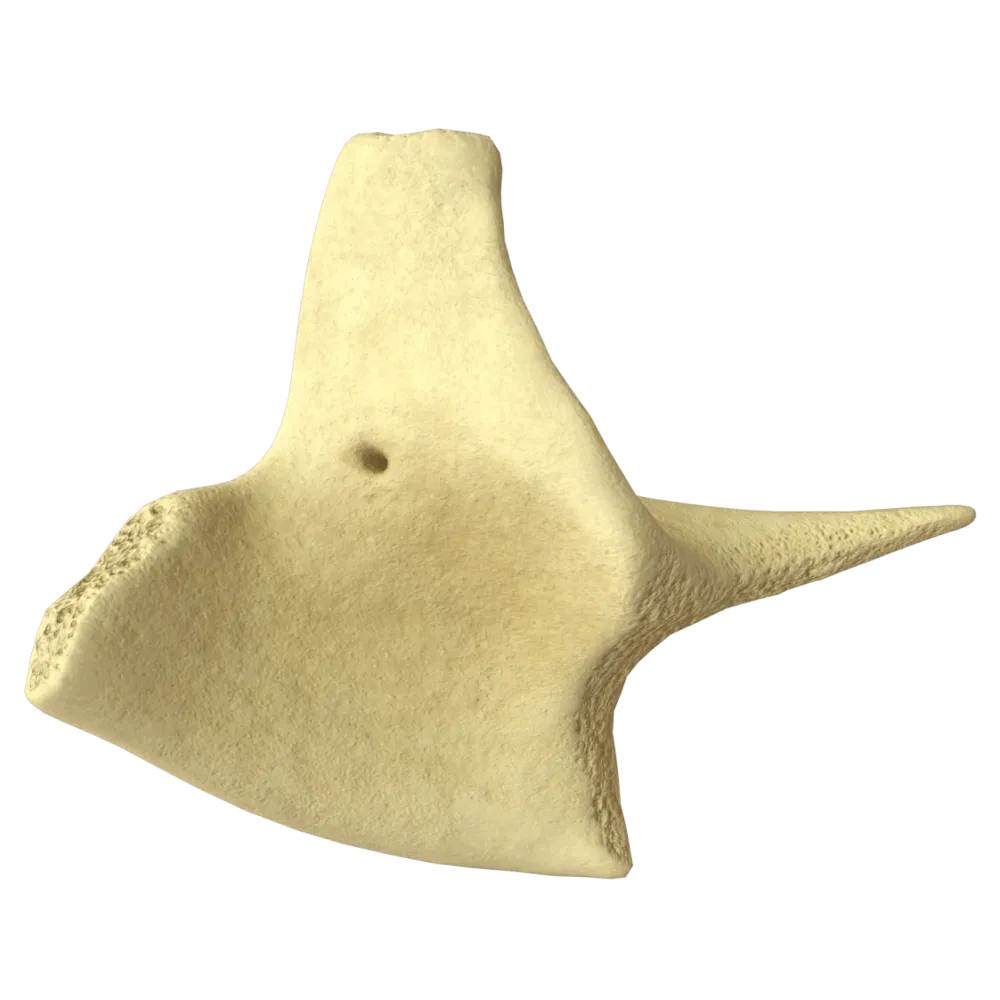
The foramen nasale is located on the external surface of the nasal bone; it is a small foramen for the passage of vessels and nerves.
-
Nasal foramen
The foramen nasale is located on the external surface of the nasal bone; it is a small foramen for the passage of vessels and nerves.
-
Ethmoidal foramen
The foramen nasale is located on the external surface of the nasal bone; it is a small foramen for the passage of vessels and nerves.
-
Infraorbital foramen
The foramen nasale is located on the external surface of the nasal bone; it is a small foramen for the passage of vessels and nerves.
-
I find it difficult to answer
The foramen nasale is located on the external surface of the nasal bone; it is a small foramen for the passage of vessels and nerves.
5. With which structure of the maxilla does the nasal bone form the sutura nasomaxillaris?
-
With the alveolar border
The lateral border of the nasal bone articulates with the nasal border of the frontal process of the maxilla, forming the sutura nasomaxillaris.
-
With the nasal border of the frontal process of the maxilla
The lateral border of the nasal bone articulates with the nasal border of the frontal process of the maxilla, forming the sutura nasomaxillaris.
-
With the infraorbital border
The lateral border of the nasal bone articulates with the nasal border of the frontal process of the maxilla, forming the sutura nasomaxillaris.
-
With the palatine process
The lateral border of the nasal bone articulates with the nasal border of the frontal process of the maxilla, forming the sutura nasomaxillaris.
-
I find it difficult to answer
The lateral border of the nasal bone articulates with the nasal border of the frontal process of the maxilla, forming the sutura nasomaxillaris.
6. Which surface of the nasal bone faces the nasal cavity?
-
External surface
The facies interna (internal, or posterior surface) of the nasal bone faces the nasal cavity.
-
Internal surface
The facies interna (internal, or posterior surface) of the nasal bone faces the nasal cavity.
-
Inferior surface
The facies interna (internal, or posterior surface) of the nasal bone faces the nasal cavity.
-
Superior surface
The facies interna (internal, or posterior surface) of the nasal bone faces the nasal cavity.
-
I find it difficult to answer
The facies interna (internal, or posterior surface) of the nasal bone faces the nasal cavity.
7. What is the groove located on the internal surface of the nasal bone (os nasale) called?
-
Infraorbital groove (sulcus infraorbitalis)
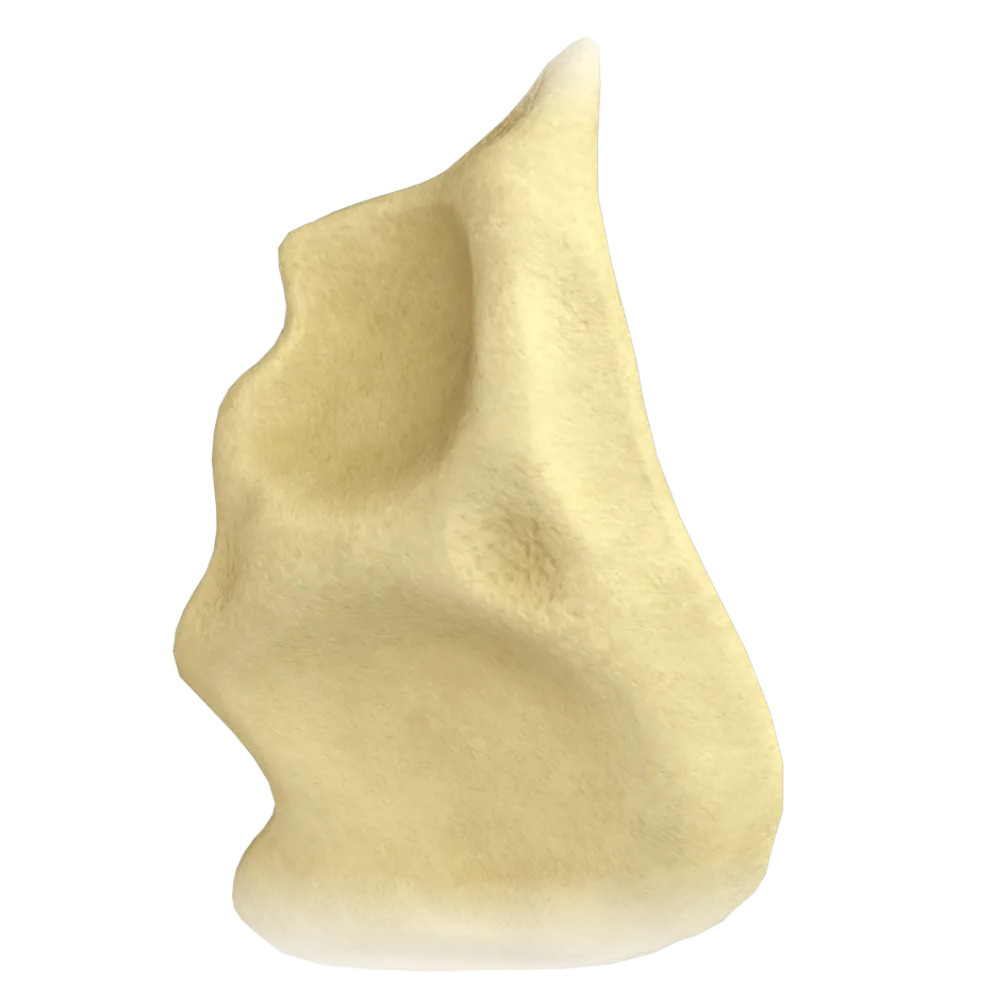
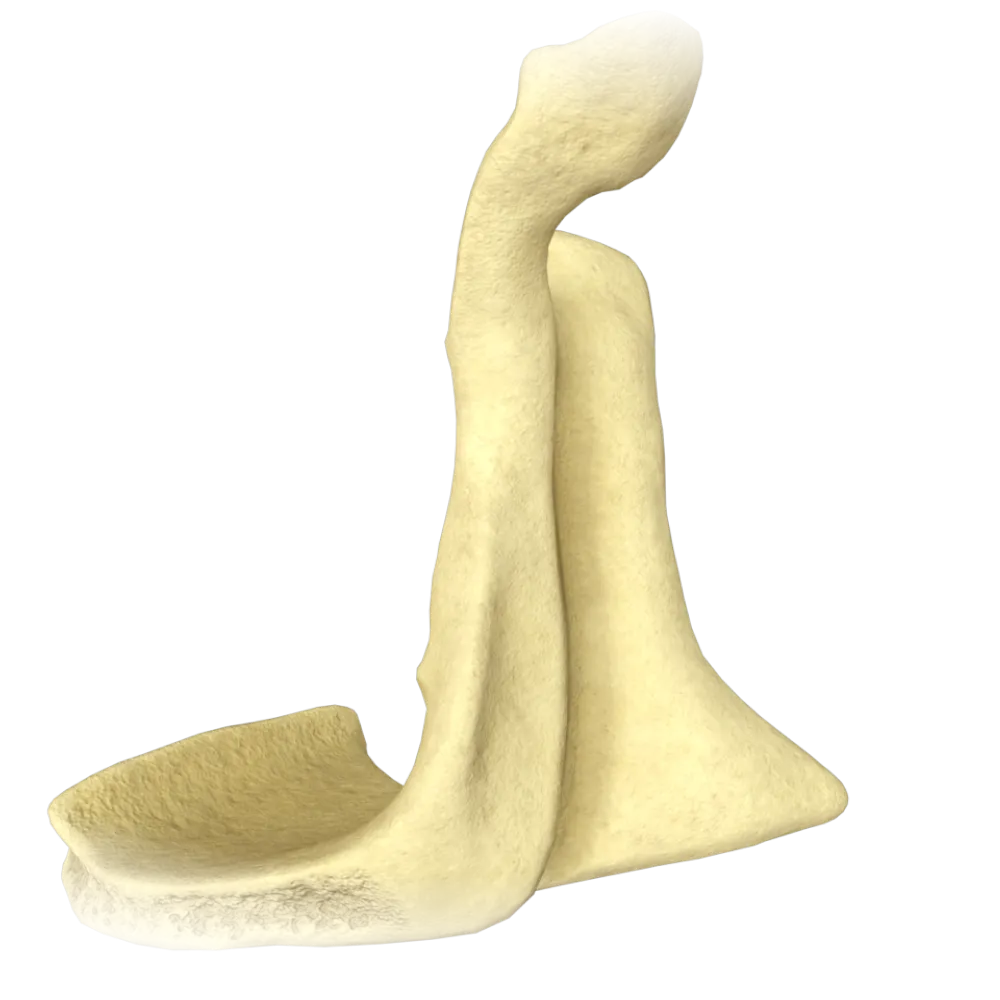
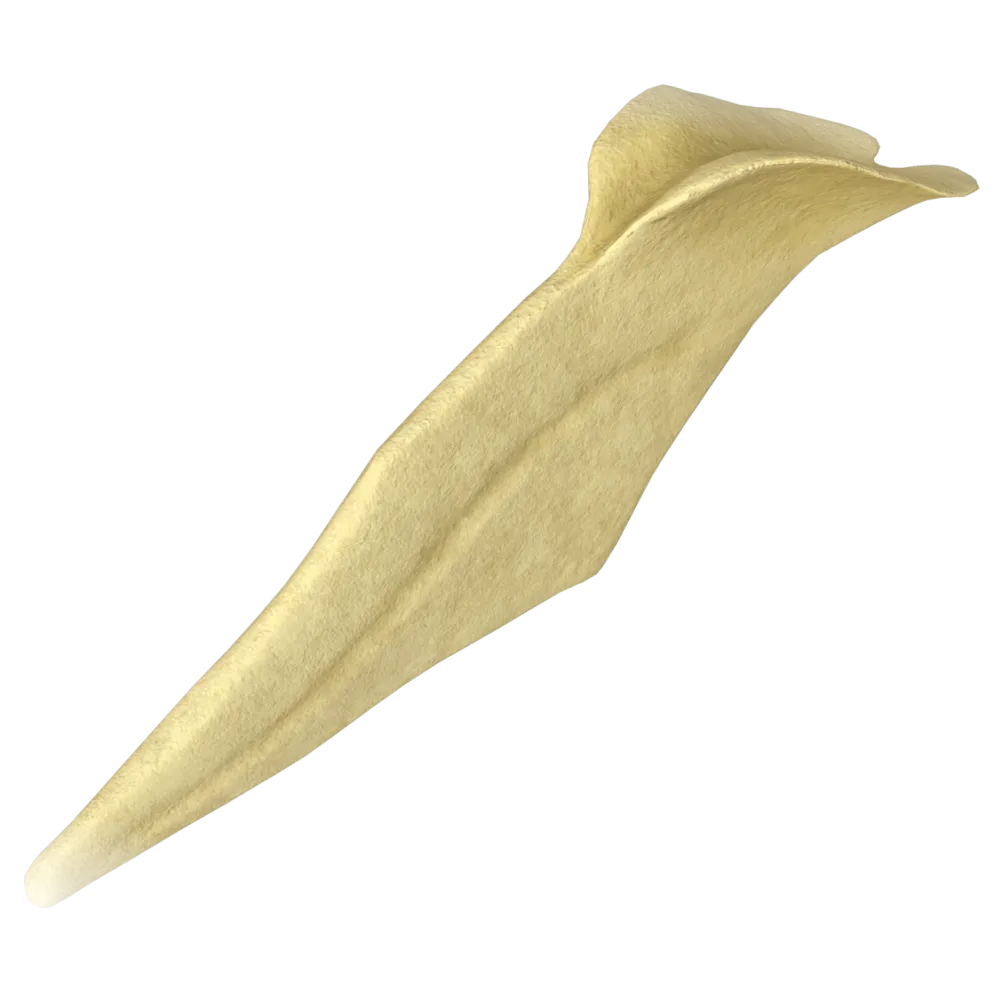
A vertically oriented ethmoidal groove (sulcus ethmoidalis) runs along the concave internal surface of the nasal bone. The anterior ethmoidal nerve (n. ethmoidalis anterior), a branch of the nasociliary nerve (from V1 of the trigeminal nerve), lies in this groove and innervates the skin of the nasal dorsum and apex.
-
Ethmoidal groove (sulcus ethmoidalis)
A vertically oriented ethmoidal groove (sulcus ethmoidalis) runs along the concave internal surface of the nasal bone. The anterior ethmoidal nerve (n. ethmoidalis anterior), a branch of the nasociliary nerve (from V1 of the trigeminal nerve), lies in this groove and innervates the skin of the nasal dorsum and apex.
-
Lacrimal groove (sulcus lacrimalis)
A vertically oriented ethmoidal groove (sulcus ethmoidalis) runs along the concave internal surface of the nasal bone. The anterior ethmoidal nerve (n. ethmoidalis anterior), a branch of the nasociliary nerve (from V1 of the trigeminal nerve), lies in this groove and innervates the skin of the nasal dorsum and apex.
-
Palatine groove (sulcus palatinus)
A vertically oriented ethmoidal groove (sulcus ethmoidalis) runs along the concave internal surface of the nasal bone. The anterior ethmoidal nerve (n. ethmoidalis anterior), a branch of the nasociliary nerve (from V1 of the trigeminal nerve), lies in this groove and innervates the skin of the nasal dorsum and apex.
-
I find it difficult to answer
A vertically oriented ethmoidal groove (sulcus ethmoidalis) runs along the concave internal surface of the nasal bone. The anterior ethmoidal nerve (n. ethmoidalis anterior), a branch of the nasociliary nerve (from V1 of the trigeminal nerve), lies in this groove and innervates the skin of the nasal dorsum and apex.
8. Which cartilage lies directly on the inferior border of the nasal bone?
-
Nasal septal cartilage = Septal nasal cartilage
The inferior border of the nasal bone joins the superior border of the lateral nasal cartilage—cartilago nasi lateralis—forming the osteocartilaginous framework of the nasal dorsum.
-
Lateral nasal cartilage
The inferior border of the nasal bone joins the superior border of the lateral nasal cartilage—cartilago nasi lateralis—forming the osteocartilaginous framework of the nasal dorsum.
-
Major alar cartilage
The inferior border of the nasal bone joins the superior border of the lateral nasal cartilage—cartilago nasi lateralis—forming the osteocartilaginous framework of the nasal dorsum.
-
Minor alar cartilage
The inferior border of the nasal bone joins the superior border of the lateral nasal cartilage—cartilago nasi lateralis—forming the osteocartilaginous framework of the nasal dorsum.
-
I find it difficult to answer
The inferior border of the nasal bone joins the superior border of the lateral nasal cartilage—cartilago nasi lateralis—forming the osteocartilaginous framework of the nasal dorsum.
9. In the formation of which of the following anatomical structures does the nasal bone (os nasale) directly participate?
-
Infraorbital nerve niche
The paired nasal bone (os nasale) joins its contralateral counterpart at the midline, forming the bony nasal dorsum.
-
Bony nasal dorsum
The paired nasal bone (os nasale) joins its contralateral counterpart at the midline, forming the bony nasal dorsum.
-
Lateral wall of the orbit
The paired nasal bone (os nasale) joins its contralateral counterpart at the midline, forming the bony nasal dorsum.
-
Nasal septum
The paired nasal bone (os nasale) joins its contralateral counterpart at the midline, forming the bony nasal dorsum.
-
I find it difficult to answer
The paired nasal bone (os nasale) joins its contralateral counterpart at the midline, forming the bony nasal dorsum.
10. By which suture do the two nasal bones join each other at the midline?
-
Squamous suture
The two nasal bones join each other along the median line via the sutura internasalis—the internasal suture.
-
Internasal suture
The two nasal bones join each other along the median line via the sutura internasalis—the internasal suture.
-
Coronal suture
The two nasal bones join each other along the median line via the sutura internasalis—the internasal suture.
-
Lambdoid suture
The two nasal bones join each other along the median line via the sutura internasalis—the internasal suture.
-
I find it difficult to answer
The two nasal bones join each other along the median line via the sutura internasalis—the internasal suture.
11. Which structure of the ethmoid bone contacts the posterior surface of the nasal bone?
-
Cock's comb
The posterior (internal) surface of the nasal bone contacts the perpendicular plate of the ethmoid bone (lamina perpendicularis), which participates in forming the nasal septum.
-
Perpendicular plate of the ethmoid bone
The posterior (internal) surface of the nasal bone contacts the perpendicular plate of the ethmoid bone (lamina perpendicularis), which participates in forming the nasal septum.
-
Ethmoidal labyrinth
The posterior (internal) surface of the nasal bone contacts the perpendicular plate of the ethmoid bone (lamina perpendicularis), which participates in forming the nasal septum.
-
Cribriform plate
The posterior (internal) surface of the nasal bone contacts the perpendicular plate of the ethmoid bone (lamina perpendicularis), which participates in forming the nasal septum.
-
I find it difficult to answer
The posterior (internal) surface of the nasal bone contacts the perpendicular plate of the ethmoid bone (lamina perpendicularis), which participates in forming the nasal septum.
12. Which bony structures form the bony part of the nasal dorsum (dorsum nasi)?
-
Vomer and perpendicular plate of the ethmoid bone
The bony part of the nasal dorsum is formed by the nasal bones (os nasale) together with the frontal processes of the maxillae (processus frontalis maxillae).
-
Nasal bones and frontal processes of the maxillae
The bony part of the nasal dorsum is formed by the nasal bones (os nasale) together with the frontal processes of the maxillae (processus frontalis maxillae).
-
Lacrimal bones and nasal part of the frontal bone
The bony part of the nasal dorsum is formed by the nasal bones (os nasale) together with the frontal processes of the maxillae (processus frontalis maxillae).
-
Orbital plates of the ethmoid bone and zygomatic bones
The bony part of the nasal dorsum is formed by the nasal bones (os nasale) together with the frontal processes of the maxillae (processus frontalis maxillae).
-
I find it difficult to answer
The bony part of the nasal dorsum is formed by the nasal bones (os nasale) together with the frontal processes of the maxillae (processus frontalis maxillae).
13. Is the nasal foramen (foramen nasale) on the anterior surface of the nasal bone a constant anatomical structure?
-
No, it occurs extremely rarely and is considered a developmental anomaly
A nasal foramen (foramen nasale) is located on the anterior (convex) surface of each nasal bone. It is a constant anatomical structure.
-
No, it is an inconstant structure present in fewer than 10% of cases
A nasal foramen (foramen nasale) is located on the anterior (convex) surface of each nasal bone. It is a constant anatomical structure.
-
Yes, it is a constant foramen that transmits vessels and nerves
A nasal foramen (foramen nasale) is located on the anterior (convex) surface of each nasal bone. It is a constant anatomical structure.
-
No, it forms only in old age as a result of bone resorption
A nasal foramen (foramen nasale) is located on the anterior (convex) surface of each nasal bone. It is a constant anatomical structure.
-
I find it difficult to answer
A nasal foramen (foramen nasale) is located on the anterior (convex) surface of each nasal bone. It is a constant anatomical structure.
14. With which specific part of the frontal bone (os frontale) does the superior border of the nasal bone (os nasale) articulate?
-
Squamous part (pars squamosa)
The frontal bone consists of three principal parts: squamous, orbital, and nasal. It is specifically the nasal part of the frontal bone (pars nasalis ossis frontalis) that articulates with the superior border of each nasal bone. Their junction forms the nasofrontal suture (sutura nasofrontalis).
-
Nasal part (pars nasalis)
The frontal bone consists of three principal parts: squamous, orbital, and nasal. It is specifically the nasal part of the frontal bone (pars nasalis ossis frontalis) that articulates with the superior border of each nasal bone. Their junction forms the nasofrontal suture (sutura nasofrontalis).
-
Orbital part (pars orbitalis)
The frontal bone consists of three principal parts: squamous, orbital, and nasal. It is specifically the nasal part of the frontal bone (pars nasalis ossis frontalis) that articulates with the superior border of each nasal bone. Their junction forms the nasofrontal suture (sutura nasofrontalis).
-
Zygomatic process (processus zygomaticus)
The frontal bone consists of three principal parts: squamous, orbital, and nasal. It is specifically the nasal part of the frontal bone (pars nasalis ossis frontalis) that articulates with the superior border of each nasal bone. Their junction forms the nasofrontal suture (sutura nasofrontalis).
-
I find it difficult to answer
The frontal bone consists of three principal parts: squamous, orbital, and nasal. It is specifically the nasal part of the frontal bone (pars nasalis ossis frontalis) that articulates with the superior border of each nasal bone. Their junction forms the nasofrontal suture (sutura nasofrontalis).
15. Does the nasal bone (os nasale) contribute to the boundary of the piriform aperture (apertura piriformis) of the nasal cavity, and which border does it form?
-
No, the piriform aperture is bounded exclusively by the maxillae
The piriform aperture (apertura piriformis) is the anterior bony entrance to the nasal cavity in the viscerocranium. Two bones participate in forming its boundaries: the superior boundary is formed by the free (inferior) borders of the right and left nasal bones, while the lateral and inferior boundaries are formed by the nasal notches and anterior nasal spine of the maxillae.
-
Yes, the inferior free borders of the nasal bones bound the piriform aperture superiorly
The piriform aperture (apertura piriformis) is the anterior bony entrance to the nasal cavity in the viscerocranium. Two bones participate in forming its boundaries: the superior boundary is formed by the free (inferior) borders of the right and left nasal bones, while the lateral and inferior boundaries are formed by the nasal notches and anterior nasal spine of the maxillae.
-
Yes, the nasal bones form the lateral (side) borders of the piriform aperture
The piriform aperture (apertura piriformis) is the anterior bony entrance to the nasal cavity in the viscerocranium. Two bones participate in forming its boundaries: the superior boundary is formed by the free (inferior) borders of the right and left nasal bones, while the lateral and inferior boundaries are formed by the nasal notches and anterior nasal spine of the maxillae.
-
No, the piriform aperture is formed by the ethmoid bone and vomer
The piriform aperture (apertura piriformis) is the anterior bony entrance to the nasal cavity in the viscerocranium. Two bones participate in forming its boundaries: the superior boundary is formed by the free (inferior) borders of the right and left nasal bones, while the lateral and inferior boundaries are formed by the nasal notches and anterior nasal spine of the maxillae.
-
I find it difficult to answer
The piriform aperture (apertura piriformis) is the anterior bony entrance to the nasal cavity in the viscerocranium. Two bones participate in forming its boundaries: the superior boundary is formed by the free (inferior) borders of the right and left nasal bones, while the lateral and inferior boundaries are formed by the nasal notches and anterior nasal spine of the maxillae.
16. Which nerve passes through the nasal foramen (foramen nasale) of the nasal bone toward the skin of the external nose?
-
Infraorbital nerve (n. infraorbitalis)
The nasal foramen (foramen nasale) is located on the anterior surface of the nasal bone. The external nasal branch of the anterior ethmoidal nerve (ramus nasalis externus) passes through this foramen together with the homonymous artery and vein.
-
Nasopalatine nerve (n. nasopalatinus)
The nasal foramen (foramen nasale) is located on the anterior surface of the nasal bone. The external nasal branch of the anterior ethmoidal nerve (ramus nasalis externus) passes through this foramen together with the homonymous artery and vein.
-
External nasal branch of the anterior ethmoidal nerve (ramus nasalis externus n. ethmoidalis anterioris)
The nasal foramen (foramen nasale) is located on the anterior surface of the nasal bone. The external nasal branch of the anterior ethmoidal nerve (ramus nasalis externus) passes through this foramen together with the homonymous artery and vein.
-
Supratrochlear nerve (n. supratrochlearis)
The nasal foramen (foramen nasale) is located on the anterior surface of the nasal bone. The external nasal branch of the anterior ethmoidal nerve (ramus nasalis externus) passes through this foramen together with the homonymous artery and vein.
-
I find it difficult to answer
The nasal foramen (foramen nasale) is located on the anterior surface of the nasal bone. The external nasal branch of the anterior ethmoidal nerve (ramus nasalis externus) passes through this foramen together with the homonymous artery and vein.
17. Which of the following structures is NOT an immediate anatomical neighbor of the nasal bone?
-
Frontal bone (os frontale)
The zygomatic bone is not an immediate neighbor of the nasal bone; the nasal bone borders the frontal bone, frontal process of the maxilla, and ethmoid bone.
-
Frontal process of the maxilla (processus frontalis maxillae)
The zygomatic bone is not an immediate neighbor of the nasal bone; the nasal bone borders the frontal bone, frontal process of the maxilla, and ethmoid bone.
-
Zygomatic bone (os zygomaticum)
The zygomatic bone is not an immediate neighbor of the nasal bone; the nasal bone borders the frontal bone, frontal process of the maxilla, and ethmoid bone.
-
Perpendicular plate of ethmoid bone
The zygomatic bone is not an immediate neighbor of the nasal bone; the nasal bone borders the frontal bone, frontal process of the maxilla, and ethmoid bone.
-
I find it difficult to answer
The zygomatic bone is not an immediate neighbor of the nasal bone; the nasal bone borders the frontal bone, frontal process of the maxilla, and ethmoid bone.
18. What is the angle formed by the two nasal bones in their superior part where they articulate with the frontal bone called?
-
Angle of the mandible
The junction of the nasal bones with the frontal bone along the median line is termed the nasion—an anthropometric point corresponding to the superior end of the internasal suture.
-
Nasofrontal angle (nasion)
The junction of the nasal bones with the frontal bone along the median line is termed the nasion—an anthropometric point corresponding to the superior end of the internasal suture.
-
Mastoid angle
The junction of the nasal bones with the frontal bone along the median line is termed the nasion—an anthropometric point corresponding to the superior end of the internasal suture.
-
Sphenoidal angle
The junction of the nasal bones with the frontal bone along the median line is termed the nasion—an anthropometric point corresponding to the superior end of the internasal suture.
-
I find it difficult to answer
The junction of the nasal bones with the frontal bone along the median line is termed the nasion—an anthropometric point corresponding to the superior end of the internasal suture.
19. From how many primary points (centers) of ossification does each nasal bone (os nasale) develop?
-
From one center
Each nasal bone develops from one primary ossification center.
-
From two centers
Each nasal bone develops from one primary ossification center.
-
From three centers
Each nasal bone develops from one primary ossification center.
-
From four centers
Each nasal bone develops from one primary ossification center.
-
I find it difficult to answer
Each nasal bone develops from one primary ossification center.
20. What type of bone is the nasal bone according to its structure?
-
Long tubular bone
According to the classification, the nasal bone is a flat bone: it has minimal thickness, a compact type of structure, and no medullary cavity.
-
Flat bone
According to the classification, the nasal bone is a flat bone: it has minimal thickness, a compact type of structure, and no medullary cavity.
-
Cancellous bone
According to the classification, the nasal bone is a flat bone: it has minimal thickness, a compact type of structure, and no medullary cavity.
-
Pneumatic bone
According to the classification, the nasal bone is a flat bone: it has minimal thickness, a compact type of structure, and no medullary cavity.
-
I find it difficult to answer
According to the classification, the nasal bone is a flat bone: it has minimal thickness, a compact type of structure, and no medullary cavity.
Retake this quiz?
Your current progress will be reset.