Hand Bones in the Skeletal System Quiz
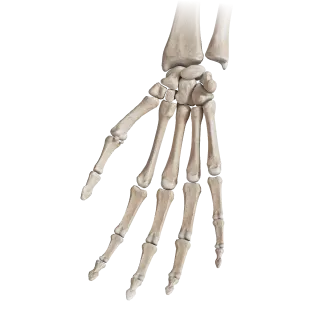
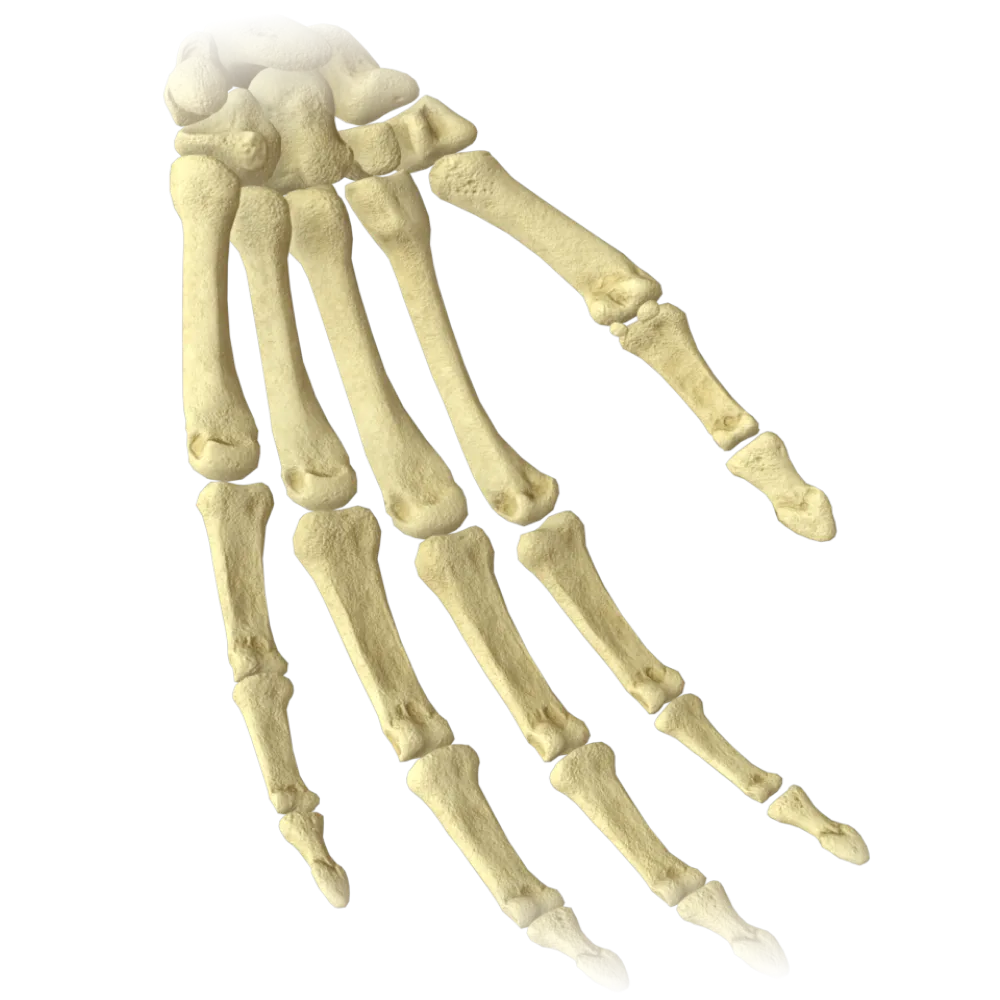
Hand bones in the skeletal system quiz: structure, classification, topography, and anatomical relationships of the carpal bones, metacarpals, and phalanges.
1/20
bold
text
1. How many bones comprise the wrist (carpus) in an adult?
-
6
The wrist consists of 8 short cancellous bones, arranged in two rows of 4 bones each.
-
8
The wrist consists of 8 short cancellous bones, arranged in two rows of 4 bones each.
-
10
The wrist consists of 8 short cancellous bones, arranged in two rows of 4 bones each.
-
12
The wrist consists of 8 short cancellous bones, arranged in two rows of 4 bones each.
-
I find it difficult to answer
The wrist consists of 8 short cancellous bones, arranged in two rows of 4 bones each.
2. Which carpal bone is the largest and occupies a central position in the distal row?
-
Trapezium
Os capitatum (capitate bone) is the largest carpal bone; it is located in the center of the distal row and articulates with os lunatum and os scaphoideum.
-
Os trapezoideum
Os capitatum (capitate bone) is the largest carpal bone; it is located in the center of the distal row and articulates with os lunatum and os scaphoideum.
-
Os capitatum
Os capitatum (capitate bone) is the largest carpal bone; it is located in the center of the distal row and articulates with os lunatum and os scaphoideum.
-
Os hamatum
Os capitatum (capitate bone) is the largest carpal bone; it is located in the center of the distal row and articulates with os lunatum and os scaphoideum.
-
I find it difficult to answer
Os capitatum (capitate bone) is the largest carpal bone; it is located in the center of the distal row and articulates with os lunatum and os scaphoideum.
3. The proximal row of carpal bones comprises the following bones (in the radioulnar direction):
-
Scaphoid, lunate, triquetrum, pisiform
The proximal row of the wrist (from the radial to the ulnar side): scaphoid, lunate, triquetral, and pisiform bones.
-
Trapezium, trapezoid, capitate, hamate
The proximal row of the wrist (from the radial to the ulnar side): scaphoid, lunate, triquetral, and pisiform bones.
-
Scaphoid, trapezium, capitate, pisiform
The proximal row of the wrist (from the radial to the ulnar side): scaphoid, lunate, triquetral, and pisiform bones.
-
Lunate, triquetrum, hamate, trapezoid
The proximal row of the wrist (from the radial to the ulnar side): scaphoid, lunate, triquetral, and pisiform bones.
-
I find it difficult to answer
The proximal row of the wrist (from the radial to the ulnar side): scaphoid, lunate, triquetral, and pisiform bones.
4. Which carpal bone is sesamoid and lies within the tendon of m. flexor carpi ulnaris?
-
Os triquetrum
Os pisiforme (pisiform bone) is the only sesamoid bone of the wrist; it is located in the flexor carpi ulnaris tendon and articulates only with the triquetral bone.
-
Os pisiforme
Os pisiforme (pisiform bone) is the only sesamoid bone of the wrist; it is located in the flexor carpi ulnaris tendon and articulates only with the triquetral bone.
-
Os hamatum
Os pisiforme (pisiform bone) is the only sesamoid bone of the wrist; it is located in the flexor carpi ulnaris tendon and articulates only with the triquetral bone.
-
Os lunatum
Os pisiforme (pisiform bone) is the only sesamoid bone of the wrist; it is located in the flexor carpi ulnaris tendon and articulates only with the triquetral bone.
-
I find it difficult to answer
Os pisiforme (pisiform bone) is the only sesamoid bone of the wrist; it is located in the flexor carpi ulnaris tendon and articulates only with the triquetral bone.
5. Which bone forms the hook (hamulus), which is a medial landmark of the carpal tunnel?
-
Trapezium
Os hamatum (uncinate bone) comprises a characteristic bony process—the hamulus ossis hamati—which forms the medial wall of the carpal tunnel.
-
Os capitatum
Os hamatum (uncinate bone) comprises a characteristic bony process—the hamulus ossis hamati—which forms the medial wall of the carpal tunnel.
-
Os trapezoideum
Os hamatum (uncinate bone) comprises a characteristic bony process—the hamulus ossis hamati—which forms the medial wall of the carpal tunnel.
-
Os hamatum
Os hamatum (uncinate bone) comprises a characteristic bony process—the hamulus ossis hamati—which forms the medial wall of the carpal tunnel.
-
I find it difficult to answer
Os hamatum (uncinate bone) comprises a characteristic bony process—the hamulus ossis hamati—which forms the medial wall of the carpal tunnel.
6. Tuberculum ossis scaphoidei is a landmark of which border of the carpal tunnel?
-
Medial
The tubercle of the scaphoid bone (tuberculum ossis scaphoidei) and the crest of the trapezium form the lateral wall (lateral border) of the carpal tunnel.
-
Lateral
The tubercle of the scaphoid bone (tuberculum ossis scaphoidei) and the crest of the trapezium form the lateral wall (lateral border) of the carpal tunnel.
-
Proximal
The tubercle of the scaphoid bone (tuberculum ossis scaphoidei) and the crest of the trapezium form the lateral wall (lateral border) of the carpal tunnel.
-
Distal
The tubercle of the scaphoid bone (tuberculum ossis scaphoidei) and the crest of the trapezium form the lateral wall (lateral border) of the carpal tunnel.
-
I find it difficult to answer
The tubercle of the scaphoid bone (tuberculum ossis scaphoidei) and the crest of the trapezium form the lateral wall (lateral border) of the carpal tunnel.
7. How many metacarpal bones (ossa metacarpi) are present in the skeleton of the hand?
-
4
The metacarpus is formed by 5 tubular bones—ossa metacarpi I–V—each of which comprises a base, body, and head.
-
5
The metacarpus is formed by 5 tubular bones—ossa metacarpi I–V—each of which comprises a base, body, and head.
-
6
The metacarpus is formed by 5 tubular bones—ossa metacarpi I–V—each of which comprises a base, body, and head.
-
7
The metacarpus is formed by 5 tubular bones—ossa metacarpi I–V—each of which comprises a base, body, and head.
-
I find it difficult to answer
The metacarpus is formed by 5 tubular bones—ossa metacarpi I–V—each of which comprises a base, body, and head.
8. Which part of a metacarpal bone articulates with the carpal bones?
-
Head
The base (basis) of a metacarpal bone articulates with the bones of the distal carpal row, forming the carpometacarpal joints (articulationes carpometacarpales).
-
Shaft
The base (basis) of a metacarpal bone articulates with the bones of the distal carpal row, forming the carpometacarpal joints (articulationes carpometacarpales).
-
Base
The base (basis) of a metacarpal bone articulates with the bones of the distal carpal row, forming the carpometacarpal joints (articulationes carpometacarpales).
-
Tuberosity
The base (basis) of a metacarpal bone articulates with the bones of the distal carpal row, forming the carpometacarpal joints (articulationes carpometacarpales).
-
I find it difficult to answer
The base (basis) of a metacarpal bone articulates with the bones of the distal carpal row, forming the carpometacarpal joints (articulationes carpometacarpales).
9. Which feature of the first metacarpal distinguishes it from the other metacarpal bones?
-
It is longer than all the others
The first metacarpal is shorter and more robust than the others; its proximal articular end comprises a saddle-shaped articular surface that enables extensive mobility of the thumb.
-
It comprises two saddle-shaped articular ends
The first metacarpal is shorter and more robust than the others; its proximal articular end comprises a saddle-shaped articular surface that enables extensive mobility of the thumb.
-
Its body is triangular in cross-section
The first metacarpal is shorter and more robust than the others; its proximal articular end comprises a saddle-shaped articular surface that enables extensive mobility of the thumb.
-
It does not comprise a base
The first metacarpal is shorter and more robust than the others; its proximal articular end comprises a saddle-shaped articular surface that enables extensive mobility of the thumb.
-
I find it difficult to answer
The first metacarpal is shorter and more robust than the others; its proximal articular end comprises a saddle-shaped articular surface that enables extensive mobility of the thumb.
10. How many phalanges does the thumb (pollex) have?
-
One
The thumb comprises only two phalanges—the proximal phalanx (phalanx proximalis) and distal phalanx (phalanx distalis)—unlike the other digits, which have three.
-
Two
The thumb comprises only two phalanges—the proximal phalanx (phalanx proximalis) and distal phalanx (phalanx distalis)—unlike the other digits, which have three.
-
Three
The thumb comprises only two phalanges—the proximal phalanx (phalanx proximalis) and distal phalanx (phalanx distalis)—unlike the other digits, which have three.
-
Four
The thumb comprises only two phalanges—the proximal phalanx (phalanx proximalis) and distal phalanx (phalanx distalis)—unlike the other digits, which have three.
-
I find it difficult to answer
The thumb comprises only two phalanges—the proximal phalanx (phalanx proximalis) and distal phalanx (phalanx distalis)—unlike the other digits, which have three.
11. What is the distal phalanx of a digit called in standard anatomical nomenclature?
-
Middle phalanx
According to Terminologia Anatomica, the distal phalanx is designated phalanx distalis. The term phalanx ungularis is an obsolete synonym.
-
Distal phalanx
According to Terminologia Anatomica, the distal phalanx is designated phalanx distalis. The term phalanx ungularis is an obsolete synonym.
-
Ungual phalanx
According to Terminologia Anatomica, the distal phalanx is designated phalanx distalis. The term phalanx ungularis is an obsolete synonym.
-
Terminal phalanx
According to Terminologia Anatomica, the distal phalanx is designated phalanx distalis. The term phalanx ungularis is an obsolete synonym.
-
I find it difficult to answer
According to Terminologia Anatomica, the distal phalanx is designated phalanx distalis. The term phalanx ungularis is an obsolete synonym.
12. Which part of a phalanx bears the articular fovea for articulation with the head of the proximally adjacent bone?
-
Head of phalanx
The base of a phalanx (basis phalangis) comprises an articular fovea (fovea articularis) that articulates with the head of a metacarpal bone or the proximally adjacent phalanx.
-
Shaft of phalanx
The base of a phalanx (basis phalangis) comprises an articular fovea (fovea articularis) that articulates with the head of a metacarpal bone or the proximally adjacent phalanx.
-
Base of phalanx
The base of a phalanx (basis phalangis) comprises an articular fovea (fovea articularis) that articulates with the head of a metacarpal bone or the proximally adjacent phalanx.
-
Tuberosity of distal phalanx
The base of a phalanx (basis phalangis) comprises an articular fovea (fovea articularis) that articulates with the head of a metacarpal bone or the proximally adjacent phalanx.
-
I find it difficult to answer
The base of a phalanx (basis phalangis) comprises an articular fovea (fovea articularis) that articulates with the head of a metacarpal bone or the proximally adjacent phalanx.
13. How many phalanges does the index finger have?
-
3 phalanges
The index finger comprises 3 phalanges—proximal, middle, and distal.
-
1 phalanx
The index finger comprises 3 phalanges—proximal, middle, and distal.
-
2 phalanges
The index finger comprises 3 phalanges—proximal, middle, and distal.
-
4 phalanges
The index finger comprises 3 phalanges—proximal, middle, and distal.
-
I find it difficult to answer
The index finger comprises 3 phalanges—proximal, middle, and distal.
14. According to anatomical classification, to which group of bones by shape do the carpal bones belong?
-
Long tubular bones
Carpal bones are classified as ossa brevia (short cancellous bones): they are approximately equal in all dimensions and contain cancellous bone covered by a thin cortical layer.
-
Flat bones
Carpal bones are classified as ossa brevia (short cancellous bones): they are approximately equal in all dimensions and contain cancellous bone covered by a thin cortical layer.
-
Short cancellous bones
Carpal bones are classified as ossa brevia (short cancellous bones): they are approximately equal in all dimensions and contain cancellous bone covered by a thin cortical layer.
-
Air-filled bones
Carpal bones are classified as ossa brevia (short cancellous bones): they are approximately equal in all dimensions and contain cancellous bone covered by a thin cortical layer.
-
I find it difficult to answer
Carpal bones are classified as ossa brevia (short cancellous bones): they are approximately equal in all dimensions and contain cancellous bone covered by a thin cortical layer.
15. With which carpal bones does os lunatum articulate?
-
With the radius, scaphoid, and triquetral bones, as well as the capitate and uncinate bones
Os lunatum articulates proximally with the radius and articular disc, laterally with the scaphoid, medially with the triquetral, and distally with the capitate and uncinate bones.
-
Only with the radius and scaphoid bone
Os lunatum articulates proximally with the radius and articular disc, laterally with the scaphoid, medially with the triquetral, and distally with the capitate and uncinate bones.
-
With the radius, ulna, scaphoid, and triquetral bones
Os lunatum articulates proximally with the radius and articular disc, laterally with the scaphoid, medially with the triquetral, and distally with the capitate and uncinate bones.
-
With the scaphoid, triquetral, and capitate bones, without articulation with the radius
Os lunatum articulates proximally with the radius and articular disc, laterally with the scaphoid, medially with the triquetral, and distally with the capitate and uncinate bones.
-
I find it difficult to answer
Os lunatum articulates proximally with the radius and articular disc, laterally with the scaphoid, medially with the triquetral, and distally with the capitate and uncinate bones.
16. Which carpal bone articulates with the first and second metacarpal bones and os trapezoideum?
-
Os hamatum
Os trapezium (trapezium bone) articulates distally with the first metacarpal bone (saddle joint), partially with the second metacarpal, and also with os trapezoideum and os scaphoideum.
-
Os capitatum
Os trapezium (trapezium bone) articulates distally with the first metacarpal bone (saddle joint), partially with the second metacarpal, and also with os trapezoideum and os scaphoideum.
-
Trapezium
Os trapezium (trapezium bone) articulates distally with the first metacarpal bone (saddle joint), partially with the second metacarpal, and also with os trapezoideum and os scaphoideum.
-
Os scaphoideum
Os trapezium (trapezium bone) articulates distally with the first metacarpal bone (saddle joint), partially with the second metacarpal, and also with os trapezoideum and os scaphoideum.
-
I find it difficult to answer
Os trapezium (trapezium bone) articulates distally with the first metacarpal bone (saddle joint), partially with the second metacarpal, and also with os trapezoideum and os scaphoideum.
17. Which joint is formed between os trapezium and the first metacarpal bone?
-
Ellipsoid joint
Articulatio carpometacarpalis pollicis is a typical saddle (sellaris) joint that permits abduction, adduction, flexion, extension, and opposition of the thumb.
-
Saddle joint
Articulatio carpometacarpalis pollicis is a typical saddle (sellaris) joint that permits abduction, adduction, flexion, extension, and opposition of the thumb.
-
Ball-and-socket joint
Articulatio carpometacarpalis pollicis is a typical saddle (sellaris) joint that permits abduction, adduction, flexion, extension, and opposition of the thumb.
-
Hinge joint
Articulatio carpometacarpalis pollicis is a typical saddle (sellaris) joint that permits abduction, adduction, flexion, extension, and opposition of the thumb.
-
I find it difficult to answer
Articulatio carpometacarpalis pollicis is a typical saddle (sellaris) joint that permits abduction, adduction, flexion, extension, and opposition of the thumb.
18. How many bones are present in total in the skeleton of the adult hand (manus), excluding sesamoid bones?
-
25
Skeleton of the hand: 8 carpal bones + 5 metacarpal bones + 14 phalanges (2 in the first digit and 3 in each of digits II–V) = 27 bones (excluding variable sesamoid bones).
-
27
Skeleton of the hand: 8 carpal bones + 5 metacarpal bones + 14 phalanges (2 in the first digit and 3 in each of digits II–V) = 27 bones (excluding variable sesamoid bones).
-
29
Skeleton of the hand: 8 carpal bones + 5 metacarpal bones + 14 phalanges (2 in the first digit and 3 in each of digits II–V) = 27 bones (excluding variable sesamoid bones).
-
32
Skeleton of the hand: 8 carpal bones + 5 metacarpal bones + 14 phalanges (2 in the first digit and 3 in each of digits II–V) = 27 bones (excluding variable sesamoid bones).
-
I find it difficult to answer
Skeleton of the hand: 8 carpal bones + 5 metacarpal bones + 14 phalanges (2 in the first digit and 3 in each of digits II–V) = 27 bones (excluding variable sesamoid bones).
19. Which of the following features is exclusive to os scaphoideum?
-
Presence of a hook-shaped process
The scaphoid comprises tuberculum ossis scaphoidei on its palmar surface and articulates with three bones of the distal row (trapezium, trapezoid, and capitate), as well as with the radius and lunate bone.
-
Presence of a tubercle on the palmar surface and articulation with three bones of the distal row
The scaphoid comprises tuberculum ossis scaphoidei on its palmar surface and articulates with three bones of the distal row (trapezium, trapezoid, and capitate), as well as with the radius and lunate bone.
-
Absence of articulation with the radius
The scaphoid comprises tuberculum ossis scaphoidei on its palmar surface and articulates with three bones of the distal row (trapezium, trapezoid, and capitate), as well as with the radius and lunate bone.
-
Articulation only with the lunate and triquetral bones
The scaphoid comprises tuberculum ossis scaphoidei on its palmar surface and articulates with three bones of the distal row (trapezium, trapezoid, and capitate), as well as with the radius and lunate bone.
-
I find it difficult to answer
The scaphoid comprises tuberculum ossis scaphoidei on its palmar surface and articulates with three bones of the distal row (trapezium, trapezoid, and capitate), as well as with the radius and lunate bone.
20. How many phalanges does the skeleton of the hand contain in total (all five digits)?
-
12
The thumb comprises 2 phalanges, and each of the other four digits comprises 3. Total: 2 + (4×3) = 14 phalanges in the skeleton of the hand.
-
14
The thumb comprises 2 phalanges, and each of the other four digits comprises 3. Total: 2 + (4×3) = 14 phalanges in the skeleton of the hand.
-
15
The thumb comprises 2 phalanges, and each of the other four digits comprises 3. Total: 2 + (4×3) = 14 phalanges in the skeleton of the hand.
-
16
The thumb comprises 2 phalanges, and each of the other four digits comprises 3. Total: 2 + (4×3) = 14 phalanges in the skeleton of the hand.
-
I find it difficult to answer
The thumb comprises 2 phalanges, and each of the other four digits comprises 3. Total: 2 + (4×3) = 14 phalanges in the skeleton of the hand.
Retake this quiz?
Your current progress will be reset.