Clavicle anatomy quiz
The quiz covers the structure, joints, muscles, vessels, and nerves of the clavicle in systemic anatomy.
1/20
bold
text
1. To which division of the skeleton does the clavicle belong?
-
Skeleton of the free upper limb
The clavicle (clavicula), together with the scapula, forms part of the pectoral girdle (cingulum membri superioris).
-
Pectoral girdle
The clavicle (clavicula), together with the scapula, forms part of the pectoral girdle (cingulum membri superioris).
-
Thorax
The clavicle (clavicula), together with the scapula, forms part of the pectoral girdle (cingulum membri superioris).
-
Skeleton of the neck
The clavicle (clavicula), together with the scapula, forms part of the pectoral girdle (cingulum membri superioris).
-
I find it difficult to answer
The clavicle (clavicula), together with the scapula, forms part of the pectoral girdle (cingulum membri superioris).
2. What shape does the clavicle comprise when viewed from above?
-
Straight
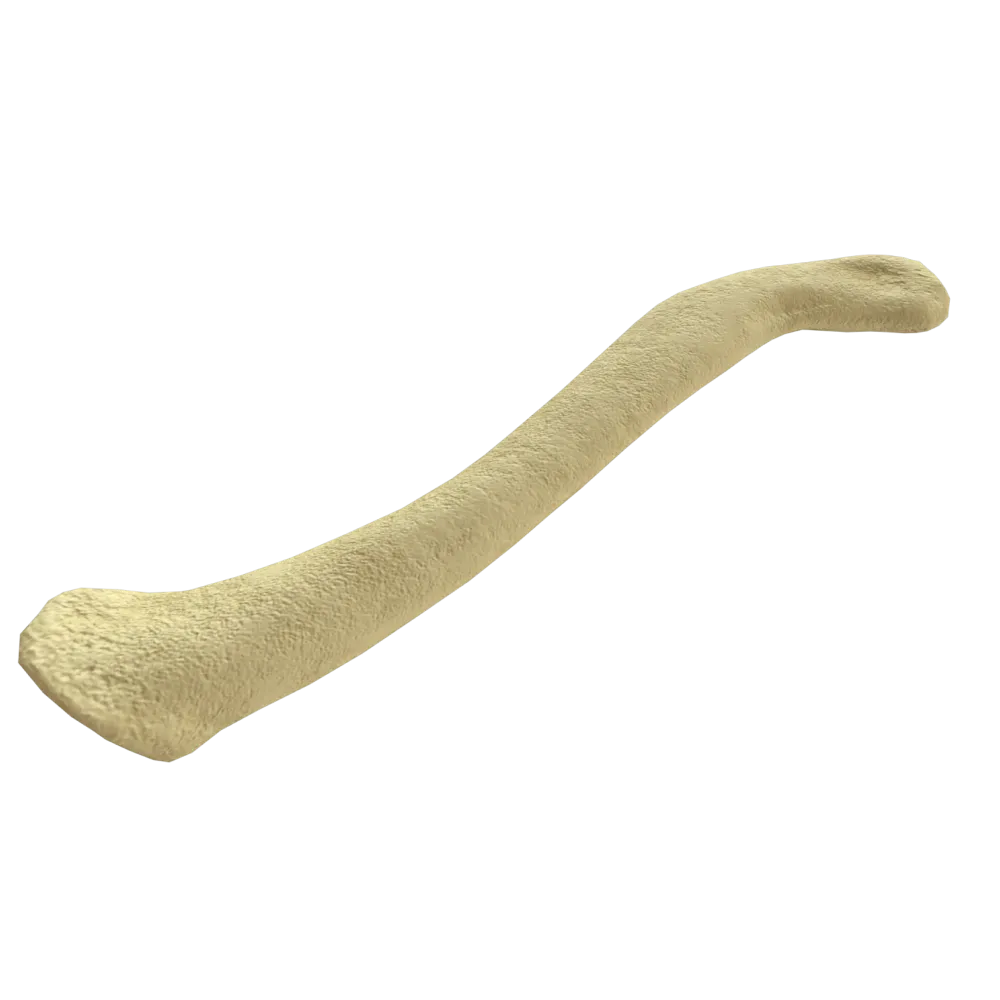
The clavicle is S-shaped: the medial part is convex anteriorly, whereas the lateral part is concave anteriorly, providing the bone with spring-like properties.
-
S-shaped
The clavicle is S-shaped: the medial part is convex anteriorly, whereas the lateral part is concave anteriorly, providing the bone with spring-like properties.
-
Arched anteriorly
The clavicle is S-shaped: the medial part is convex anteriorly, whereas the lateral part is concave anteriorly, providing the bone with spring-like properties.
-
Spirally twisted
The clavicle is S-shaped: the medial part is convex anteriorly, whereas the lateral part is concave anteriorly, providing the bone with spring-like properties.
-
I find it difficult to answer
The clavicle is S-shaped: the medial part is convex anteriorly, whereas the lateral part is concave anteriorly, providing the bone with spring-like properties.
3. Which end of the clavicle articulates with the manubrium of the sternum?
-
Acromial end
The sternal (medial) end of the clavicle (extremitas sternalis) forms the sternoclavicular joint with the clavicular notch of the manubrium of the sternum.
-
Sternal end
The sternal (medial) end of the clavicle (extremitas sternalis) forms the sternoclavicular joint with the clavicular notch of the manubrium of the sternum.
-
Diaphyseal segment
The sternal (medial) end of the clavicle (extremitas sternalis) forms the sternoclavicular joint with the clavicular notch of the manubrium of the sternum.
-
Inferior surface
The sternal (medial) end of the clavicle (extremitas sternalis) forms the sternoclavicular joint with the clavicular notch of the manubrium of the sternum.
-
I find it difficult to answer
The sternal (medial) end of the clavicle (extremitas sternalis) forms the sternoclavicular joint with the clavicular notch of the manubrium of the sternum.
4. Which bony landmark is located on the inferior surface of the acromial end of the clavicle and serves as an attachment site for ligaments?
-
Conoid tubercle and trapezoid line
The conoid tubercle (tuberculum conoideum) and trapezoid line (linea trapezoidea) are located on the inferior surface of the lateral end of the clavicle and serve as attachment sites for the coracoclavicular ligament.
-
Groove for subclavian muscle
The conoid tubercle (tuberculum conoideum) and trapezoid line (linea trapezoidea) are located on the inferior surface of the lateral end of the clavicle and serve as attachment sites for the coracoclavicular ligament.
-
Clavicular fossa
The conoid tubercle (tuberculum conoideum) and trapezoid line (linea trapezoidea) are located on the inferior surface of the lateral end of the clavicle and serve as attachment sites for the coracoclavicular ligament.
-
Subclavian fossa
The conoid tubercle (tuberculum conoideum) and trapezoid line (linea trapezoidea) are located on the inferior surface of the lateral end of the clavicle and serve as attachment sites for the coracoclavicular ligament.
-
I find it difficult to answer
The conoid tubercle (tuberculum conoideum) and trapezoid line (linea trapezoidea) are located on the inferior surface of the lateral end of the clavicle and serve as attachment sites for the coracoclavicular ligament.
5. Where on the clavicle is the impression for the costoclavicular ligament (impressio ligamenti costoclavicularis) located?
-
On the superior surface of the sternal end
The impression for the costoclavicular ligament (impressio ligamenti costoclavicularis) is located on the inferior surface of the medial end of the clavicle and serves as the attachment site for the ligament of the same name.
-
On the inferior surface of the sternal end
The impression for the costoclavicular ligament (impressio ligamenti costoclavicularis) is located on the inferior surface of the medial end of the clavicle and serves as the attachment site for the ligament of the same name.
-
On the inferior surface of the acromial end
The impression for the costoclavicular ligament (impressio ligamenti costoclavicularis) is located on the inferior surface of the medial end of the clavicle and serves as the attachment site for the ligament of the same name.
-
On the anterior surface of the body of the clavicle
The impression for the costoclavicular ligament (impressio ligamenti costoclavicularis) is located on the inferior surface of the medial end of the clavicle and serves as the attachment site for the ligament of the same name.
-
I find it difficult to answer
The impression for the costoclavicular ligament (impressio ligamenti costoclavicularis) is located on the inferior surface of the medial end of the clavicle and serves as the attachment site for the ligament of the same name.
6. What cross-sectional shape does the body of the clavicle comprise in its lateral third?
-
Rounded
The lateral third of the shaft of the clavicle is flattened in the anteroposterior direction (flattened cross-sectional shape), whereas the medial two-thirds have a triangular cross-sectional shape.
-
Triangular
The lateral third of the shaft of the clavicle is flattened in the anteroposterior direction (flattened cross-sectional shape), whereas the medial two-thirds have a triangular cross-sectional shape.
-
Flattened
The lateral third of the shaft of the clavicle is flattened in the anteroposterior direction (flattened cross-sectional shape), whereas the medial two-thirds have a triangular cross-sectional shape.
-
Quadrangular
The lateral third of the shaft of the clavicle is flattened in the anteroposterior direction (flattened cross-sectional shape), whereas the medial two-thirds have a triangular cross-sectional shape.
-
I find it difficult to answer
The lateral third of the shaft of the clavicle is flattened in the anteroposterior direction (flattened cross-sectional shape), whereas the medial two-thirds have a triangular cross-sectional shape.
7. Which joint is formed by the acromial end of the clavicle?
-
Sternoclavicular joint
The acromial end of the clavicle (extremitas acromialis) articulates with the acromion of the scapula, forming the Acromioclavicular joint (articulatio acromioclavicularis).
-
Acromioclavicular joint
The acromial end of the clavicle (extremitas acromialis) articulates with the acromion of the scapula, forming the Acromioclavicular joint (articulatio acromioclavicularis).
-
Coracoclavicular joint
The acromial end of the clavicle (extremitas acromialis) articulates with the acromion of the scapula, forming the Acromioclavicular joint (articulatio acromioclavicularis).
-
Glenohumeral joint (right)
The acromial end of the clavicle (extremitas acromialis) articulates with the acromion of the scapula, forming the Acromioclavicular joint (articulatio acromioclavicularis).
-
I find it difficult to answer
The acromial end of the clavicle (extremitas acromialis) articulates with the acromion of the scapula, forming the Acromioclavicular joint (articulatio acromioclavicularis).
8. Which type of articular surface is characteristic of the Sternoclavicular joint?
-
Ball-and-socket
The Sternoclavicular joint (articulatio sternoclavicularis) is saddle-shaped (sellar) with respect to the shape of its articular surfaces, allowing movement in several planes.
-
Ellipsoidal
The Sternoclavicular joint (articulatio sternoclavicularis) is saddle-shaped (sellar) with respect to the shape of its articular surfaces, allowing movement in several planes.
-
Saddle-shaped
The Sternoclavicular joint (articulatio sternoclavicularis) is saddle-shaped (sellar) with respect to the shape of its articular surfaces, allowing movement in several planes.
-
Flat
The Sternoclavicular joint (articulatio sternoclavicularis) is saddle-shaped (sellar) with respect to the shape of its articular surfaces, allowing movement in several planes.
-
I find it difficult to answer
The Sternoclavicular joint (articulatio sternoclavicularis) is saddle-shaped (sellar) with respect to the shape of its articular surfaces, allowing movement in several planes.
9. Which structure divides the cavity of the Sternoclavicular joint into two compartments?
-
Glenoid labrum
The cavity of the Sternoclavicular joint contains an articular disc (discus articularis), which completely divides the joint cavity into two compartments and compensates for the incongruity of the articular surfaces.
-
Articular disc
The cavity of the Sternoclavicular joint contains an articular disc (discus articularis), which completely divides the joint cavity into two compartments and compensates for the incongruity of the articular surfaces.
-
Articular meniscus
The cavity of the Sternoclavicular joint contains an articular disc (discus articularis), which completely divides the joint cavity into two compartments and compensates for the incongruity of the articular surfaces.
-
Synovial fold
The cavity of the Sternoclavicular joint contains an articular disc (discus articularis), which completely divides the joint cavity into two compartments and compensates for the incongruity of the articular surfaces.
-
I find it difficult to answer
The cavity of the Sternoclavicular joint contains an articular disc (discus articularis), which completely divides the joint cavity into two compartments and compensates for the incongruity of the articular surfaces.
10. Which muscle attaches to the groove on the inferior surface of the body of the clavicle?
-
Pectoralis major muscle
The subclavius muscle (m. subclavius) originates from the first rib and its cartilage and attaches to the sulcus musculi subclavii, the groove on the inferior surface of the body of the clavicle.
-
Subclavius muscle
The subclavius muscle (m. subclavius) originates from the first rib and its cartilage and attaches to the sulcus musculi subclavii, the groove on the inferior surface of the body of the clavicle.
-
Deltoid muscle
The subclavius muscle (m. subclavius) originates from the first rib and its cartilage and attaches to the sulcus musculi subclavii, the groove on the inferior surface of the body of the clavicle.
-
Sternocleidomastoid muscle
The subclavius muscle (m. subclavius) originates from the first rib and its cartilage and attaches to the sulcus musculi subclavii, the groove on the inferior surface of the body of the clavicle.
-
I find it difficult to answer
The subclavius muscle (m. subclavius) originates from the first rib and its cartilage and attaches to the sulcus musculi subclavii, the groove on the inferior surface of the body of the clavicle.
11. To which surface of the medial part of the clavicle does the sternocleidomastoid muscle attach?
-
To the inferior surface
The clavicular head of the sternocleidomastoid muscle (m. sternocleidomastoideus) attaches to the superior surface (facies superior) of the medial part of the clavicle.
-
To the posterior surface
The clavicular head of the sternocleidomastoid muscle (m. sternocleidomastoideus) attaches to the superior surface (facies superior) of the medial part of the clavicle.
-
To the superior surface
The clavicular head of the sternocleidomastoid muscle (m. sternocleidomastoideus) attaches to the superior surface (facies superior) of the medial part of the clavicle.
-
To the anterior surface
The clavicular head of the sternocleidomastoid muscle (m. sternocleidomastoideus) attaches to the superior surface (facies superior) of the medial part of the clavicle.
-
I find it difficult to answer
The clavicular head of the sternocleidomastoid muscle (m. sternocleidomastoideus) attaches to the superior surface (facies superior) of the medial part of the clavicle.
12. Which muscle attaches to the deltoid tuberosity (tuberositas deltoidea) of the clavicle?
-
Trapezius muscle
The clavicular fibers of the deltoid muscle (m. deltoideus) attach to the deltoid tuberosity (tuberositas deltoidea) on the anterior border of the lateral third of the clavicle.
-
Deltoid muscle
The clavicular fibers of the deltoid muscle (m. deltoideus) attach to the deltoid tuberosity (tuberositas deltoidea) on the anterior border of the lateral third of the clavicle.
-
Pectoralis minor muscle
The clavicular fibers of the deltoid muscle (m. deltoideus) attach to the deltoid tuberosity (tuberositas deltoidea) on the anterior border of the lateral third of the clavicle.
-
Supraspinatus muscle
The clavicular fibers of the deltoid muscle (m. deltoideus) attach to the deltoid tuberosity (tuberositas deltoidea) on the anterior border of the lateral third of the clavicle.
-
I find it difficult to answer
The clavicular fibers of the deltoid muscle (m. deltoideus) attach to the deltoid tuberosity (tuberositas deltoidea) on the anterior border of the lateral third of the clavicle.
13. The trapezius muscle attaches to the clavicle in the region of the:
-
Medial third along the superior border
The trapezius muscle (m. trapezius) attaches to the posterior border of the lateral third of the clavicle (margo posterior), producing retraction and elevation of the pectoral girdle.
-
Entire length along the inferior border
The trapezius muscle (m. trapezius) attaches to the posterior border of the lateral third of the clavicle (margo posterior), producing retraction and elevation of the pectoral girdle.
-
Lateral third along the posterior border
The trapezius muscle (m. trapezius) attaches to the posterior border of the lateral third of the clavicle (margo posterior), producing retraction and elevation of the pectoral girdle.
-
Sternal end along the anterior surface
The trapezius muscle (m. trapezius) attaches to the posterior border of the lateral third of the clavicle (margo posterior), producing retraction and elevation of the pectoral girdle.
-
I find it difficult to answer
The trapezius muscle (m. trapezius) attaches to the posterior border of the lateral third of the clavicle (margo posterior), producing retraction and elevation of the pectoral girdle.
14. Which major vein passes immediately posterior to the medial end of the clavicle?
-
External jugular vein
The Subclavian vein (v. subclavia) passes posterior to the medial part of the clavicle in the subclavian groove and joins the internal jugular vein to form the brachiocephalic vein (Pirogov's angle).
-
Subclavian vein
The Subclavian vein (v. subclavia) passes posterior to the medial part of the clavicle in the subclavian groove and joins the internal jugular vein to form the brachiocephalic vein (Pirogov's angle).
-
Internal jugular vein
The Subclavian vein (v. subclavia) passes posterior to the medial part of the clavicle in the subclavian groove and joins the internal jugular vein to form the brachiocephalic vein (Pirogov's angle).
-
Brachiocephalic vein
The Subclavian vein (v. subclavia) passes posterior to the medial part of the clavicle in the subclavian groove and joins the internal jugular vein to form the brachiocephalic vein (Pirogov's angle).
-
I find it difficult to answer
The Subclavian vein (v. subclavia) passes posterior to the medial part of the clavicle in the subclavian groove and joins the internal jugular vein to form the brachiocephalic vein (Pirogov's angle).
15. Which nerve of the Brachial plexus is located posterior to the clavicle and innervates the subclavius muscle?
-
Subscapular nerve
The nerve to subclavius (n. subclavius, C5–C6) arises from the Superior trunk of brachial plexus and innervates the subclavius muscle, which attaches to the clavicle.
-
Nerve to subclavius (n. subclavius)
The nerve to subclavius (n. subclavius, C5–C6) arises from the Superior trunk of brachial plexus and innervates the subclavius muscle, which attaches to the clavicle.
-
Long thoracic nerve
The nerve to subclavius (n. subclavius, C5–C6) arises from the Superior trunk of brachial plexus and innervates the subclavius muscle, which attaches to the clavicle.
-
Lateral pectoral nerve
The nerve to subclavius (n. subclavius, C5–C6) arises from the Superior trunk of brachial plexus and innervates the subclavius muscle, which attaches to the clavicle.
-
I find it difficult to answer
The nerve to subclavius (n. subclavius, C5–C6) arises from the Superior trunk of brachial plexus and innervates the subclavius muscle, which attaches to the clavicle.
16. Which source predominantly supplies blood to the clavicle in the diaphyseal region?
-
Branches of the Subclavian artery
The diaphysis of the clavicle is supplied by nutrient arteries (aa. nutrientes), which are branches of the thoracoacromial artery (a. thoracoacromialis), itself a branch of the Axillary artery.
-
Nutrient arteries from the thoracoacromial artery
The diaphysis of the clavicle is supplied by nutrient arteries (aa. nutrientes), which are branches of the thoracoacromial artery (a. thoracoacromialis), itself a branch of the Axillary artery.
-
Branches of the Axillary artery
The diaphysis of the clavicle is supplied by nutrient arteries (aa. nutrientes), which are branches of the thoracoacromial artery (a. thoracoacromialis), itself a branch of the Axillary artery.
-
Branches of the Internal thoracic artery
The diaphysis of the clavicle is supplied by nutrient arteries (aa. nutrientes), which are branches of the thoracoacromial artery (a. thoracoacromialis), itself a branch of the Axillary artery.
-
I find it difficult to answer
The diaphysis of the clavicle is supplied by nutrient arteries (aa. nutrientes), which are branches of the thoracoacromial artery (a. thoracoacromialis), itself a branch of the Axillary artery.
17. Which ligament directly connects the clavicle to the coracoid process of the scapula?
-
Acromioclavicular ligament
The coracoclavicular ligament (lig. coracoclaviculare) connects the coracoid process of the scapula to the inferior surface of the acromial end of the clavicle and consists of trapezoid and conoid parts.
-
Coracoclavicular ligament
The coracoclavicular ligament (lig. coracoclaviculare) connects the coracoid process of the scapula to the inferior surface of the acromial end of the clavicle and consists of trapezoid and conoid parts.
-
Costoclavicular ligament
The coracoclavicular ligament (lig. coracoclaviculare) connects the coracoid process of the scapula to the inferior surface of the acromial end of the clavicle and consists of trapezoid and conoid parts.
-
Interclavicular ligament
The coracoclavicular ligament (lig. coracoclaviculare) connects the coracoid process of the scapula to the inferior surface of the acromial end of the clavicle and consists of trapezoid and conoid parts.
-
I find it difficult to answer
The coracoclavicular ligament (lig. coracoclaviculare) connects the coracoid process of the scapula to the inferior surface of the acromial end of the clavicle and consists of trapezoid and conoid parts.
18. Which ligament connects the medial ends of the two clavicles?
-
Costoclavicular ligament
The Interclavicular ligament (lig. interclaviculare) extends between the sternal ends of both clavicles above the jugular notch of the sternum, reinforcing the Sternoclavicular joint superiorly.
-
Interclavicular ligament
The Interclavicular ligament (lig. interclaviculare) extends between the sternal ends of both clavicles above the jugular notch of the sternum, reinforcing the Sternoclavicular joint superiorly.
-
Sternoclavicular ligament
The Interclavicular ligament (lig. interclaviculare) extends between the sternal ends of both clavicles above the jugular notch of the sternum, reinforcing the Sternoclavicular joint superiorly.
-
Anterior sternoclavicular ligament
The Interclavicular ligament (lig. interclaviculare) extends between the sternal ends of both clavicles above the jugular notch of the sternum, reinforcing the Sternoclavicular joint superiorly.
-
I find it difficult to answer
The Interclavicular ligament (lig. interclaviculare) extends between the sternal ends of both clavicles above the jugular notch of the sternum, reinforcing the Sternoclavicular joint superiorly.
19. Which movement of the pectoral girdle is IMPOSSIBLE in isolation at the Sternoclavicular joint?
-
Elevation and depression of the pectoral girdle
The Sternoclavicular joint permits elevation–depression, protraction–retraction, and axial rotation of the clavicle; however, isolated flexion–extension through a range exceeding 90° is impossible because of its saddle shape and ligamentous apparatus.
-
Forward and backward movement (protraction and retraction)
The Sternoclavicular joint permits elevation–depression, protraction–retraction, and axial rotation of the clavicle; however, isolated flexion–extension through a range exceeding 90° is impossible because of its saddle shape and ligamentous apparatus.
-
Rotation of the clavicle around its longitudinal axis
The Sternoclavicular joint permits elevation–depression, protraction–retraction, and axial rotation of the clavicle; however, isolated flexion–extension through a range exceeding 90° is impossible because of its saddle shape and ligamentous apparatus.
-
Flexion and extension in the sagittal plane through a range exceeding 90°
The Sternoclavicular joint permits elevation–depression, protraction–retraction, and axial rotation of the clavicle; however, isolated flexion–extension through a range exceeding 90° is impossible because of its saddle shape and ligamentous apparatus.
-
I find it difficult to answer
The Sternoclavicular joint permits elevation–depression, protraction–retraction, and axial rotation of the clavicle; however, isolated flexion–extension through a range exceeding 90° is impossible because of its saddle shape and ligamentous apparatus.
20. The pectoralis major muscle attaches to the clavicle in the region of the:
-
Entire length of the inferior border
The clavicular part of the pectoralis major muscle (pars clavicularis m. pectoralis majoris) originates from the medial half of the anterior surface (facies anterior) of the clavicle.
-
Medial half of the anterior surface
The clavicular part of the pectoralis major muscle (pars clavicularis m. pectoralis majoris) originates from the medial half of the anterior surface (facies anterior) of the clavicle.
-
Lateral third of the superior surface
The clavicular part of the pectoralis major muscle (pars clavicularis m. pectoralis majoris) originates from the medial half of the anterior surface (facies anterior) of the clavicle.
-
Acromial end along the inferior surface
The clavicular part of the pectoralis major muscle (pars clavicularis m. pectoralis majoris) originates from the medial half of the anterior surface (facies anterior) of the clavicle.
-
I find it difficult to answer
The clavicular part of the pectoralis major muscle (pars clavicularis m. pectoralis majoris) originates from the medial half of the anterior surface (facies anterior) of the clavicle.
Retake this quiz?
Your current progress will be reset.