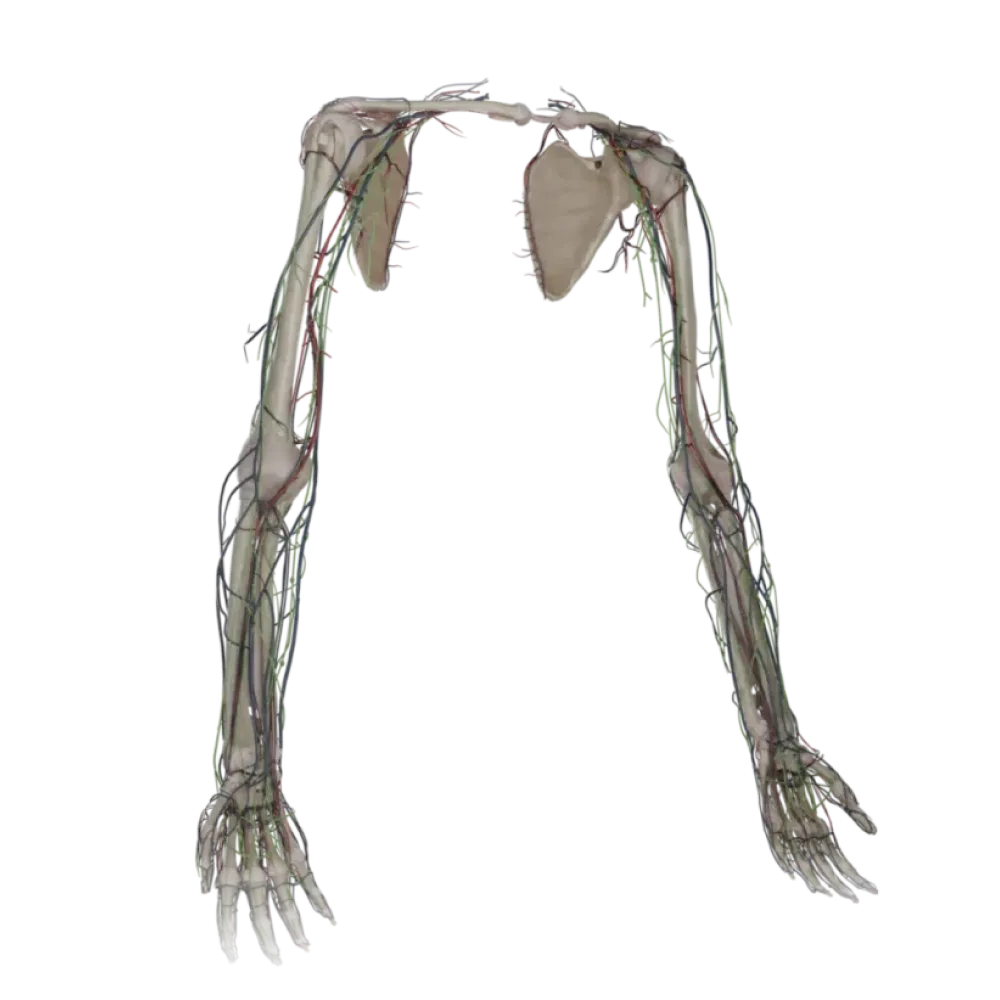

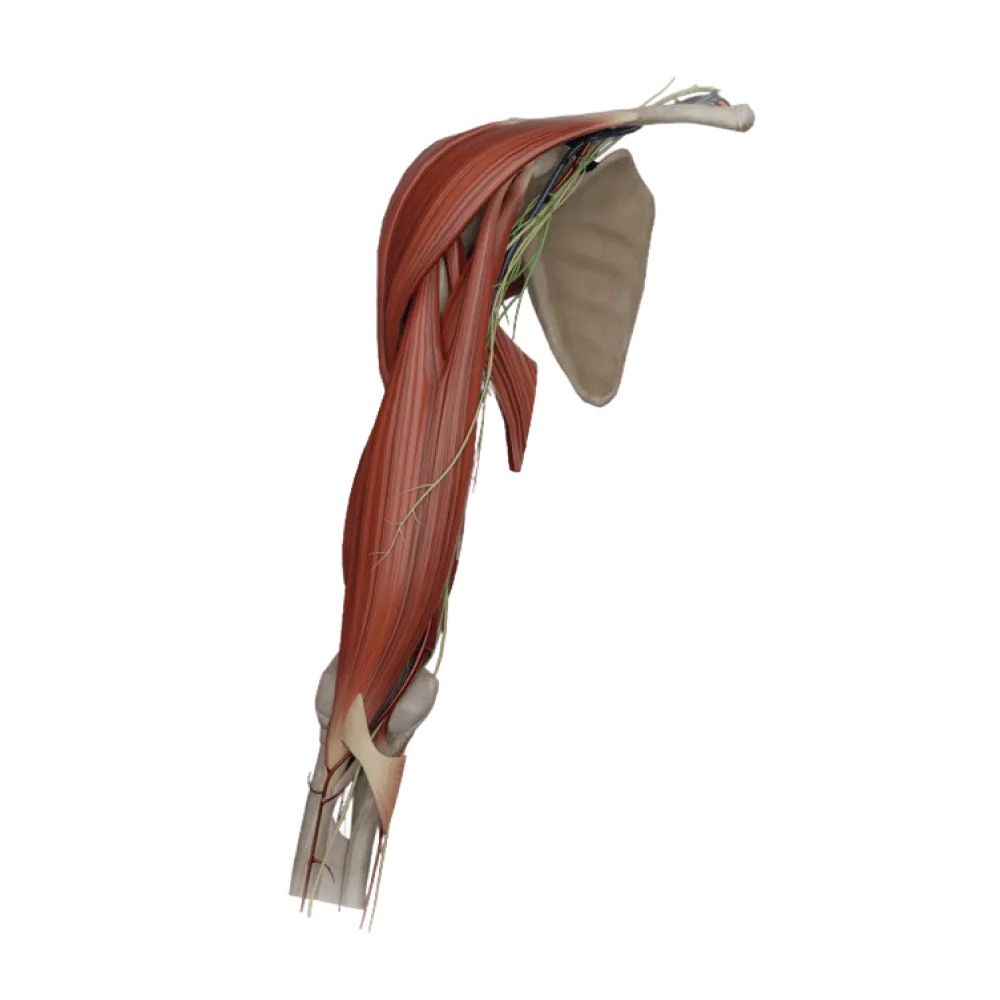
Anatomy test of the arteries of the forearm and hand.
Check your knowledge of the topography, branching, and blood supply zones of the arteries of the forearm and hand. The test covers palmar arches and their anastomoses.
1/20
bold
text
1. At what level does the brachial artery typically divide into the radial and ulnar arteries?
-
At the level of the medial epicondyle of the humerus
The brachial artery usually bifurcates in the cubital fossa at the level of the neck of the radius.
-
At the level of the neck of the radius
The brachial artery usually bifurcates in the cubital fossa at the level of the neck of the radius.
-
In the upper third of the arm
The brachial artery usually bifurcates in the cubital fossa at the level of the neck of the radius.
-
At the level of the ulnar styloid process
The brachial artery usually bifurcates in the cubital fossa at the level of the neck of the radius.
-
I find it difficult to answer
The brachial artery usually bifurcates in the cubital fossa at the level of the neck of the radius.
2. Which of the listed arteries is NOT a branch of the radial artery in the forearm?
-
Radial recurrent artery
The common interosseous artery is a branch of the ulnar artery.
-
Superficial palmar branch
The common interosseous artery is a branch of the ulnar artery.
-
Common interosseous artery
The common interosseous artery is a branch of the ulnar artery.
-
Palmar carpal branch
The common interosseous artery is a branch of the ulnar artery.
-
I find it difficult to answer
The common interosseous artery is a branch of the ulnar artery.
3. The formation of the deep palmar arch involves:
-
The terminal part of the ulnar artery and the superficial palmar branch of the radial artery
The deep palmar arch is formed by the anastomosis of the terminal part of the radial artery with the deep palmar branch of the ulnar artery.
-
The principal artery of the thumb and the radial artery of the index finger
The deep palmar arch is formed by the anastomosis of the terminal part of the radial artery with the deep palmar branch of the ulnar artery.
-
Anterior and posterior interosseous arteries
The deep palmar arch is formed by the anastomosis of the terminal part of the radial artery with the deep palmar branch of the ulnar artery.
-
Terminal part of the radial artery and deep palmar branch of the ulnar artery
The deep palmar arch is formed by the anastomosis of the terminal part of the radial artery with the deep palmar branch of the ulnar artery.
-
I find it difficult to answer
The deep palmar arch is formed by the anastomosis of the terminal part of the radial artery with the deep palmar branch of the ulnar artery.
4. On which muscle does the ulnar artery rest in the lower half of the forearm?
-
Flexor digitorum profundus
In the lower half of the forearm, the ulnar artery lies on the deep flexor of the fingers, covered by the flexor carpi ulnaris.
-
Flexor digitorum superficialis
In the lower half of the forearm, the ulnar artery lies on the deep flexor of the fingers, covered by the flexor carpi ulnaris.
-
Pronator quadratus
In the lower half of the forearm, the ulnar artery lies on the deep flexor of the fingers, covered by the flexor carpi ulnaris.
-
Brachioradialis muscle
In the lower half of the forearm, the ulnar artery lies on the deep flexor of the fingers, covered by the flexor carpi ulnaris.
-
I find it difficult to answer
In the lower half of the forearm, the ulnar artery lies on the deep flexor of the fingers, covered by the flexor carpi ulnaris.
5. Where is the superficial palmar arch located?
-
Under the tendons of the deep flexor of the fingers on the interosseous muscles
The superficial palmar arch lies directly under the palmar aponeurosis, anterior to the flexor tendons of the fingers.
-
Between the tendons of the superficial and deep flexors of the fingers
The superficial palmar arch lies directly under the palmar aponeurosis, anterior to the flexor tendons of the fingers.
-
Under the palmar aponeurosis above the flexor tendons of the fingers
The superficial palmar arch lies directly under the palmar aponeurosis, anterior to the flexor tendons of the fingers.
-
In the subcutaneous tissue of the hand
The superficial palmar arch lies directly under the palmar aponeurosis, anterior to the flexor tendons of the fingers.
-
I find it difficult to answer
The superficial palmar arch lies directly under the palmar aponeurosis, anterior to the flexor tendons of the fingers.
6. Which vessels branch from the convex side of the superficial palmar arch?
-
Palmar metacarpal arteries
From the superficial palmar arch branch common palmar digital arteries, which then divide into proper ones.
-
Common palmar digital arteries
From the superficial palmar arch branch common palmar digital arteries, which then divide into proper ones.
-
Proper palmar digital arteries
From the superficial palmar arch branch common palmar digital arteries, which then divide into proper ones.
-
Perforating branches
From the superficial palmar arch branch common palmar digital arteries, which then divide into proper ones.
-
I find it difficult to answer
From the superficial palmar arch branch common palmar digital arteries, which then divide into proper ones.
7. Which arteries branch from the deep palmar arch?
-
Common palmar digital arteries
From the deep palmar arch branch the palmar metacarpal arteries, which anastomose with the common palmar digital arteries.
-
The principal artery of the thumb
From the deep palmar arch branch the palmar metacarpal arteries, which anastomose with the common palmar digital arteries.
-
Dorsal metacarpal arteries
From the deep palmar arch branch the palmar metacarpal arteries, which anastomose with the common palmar digital arteries.
-
Palmar metacarpal arteries
From the deep palmar arch branch the palmar metacarpal arteries, which anastomose with the common palmar digital arteries.
-
I find it difficult to answer
From the deep palmar arch branch the palmar metacarpal arteries, which anastomose with the common palmar digital arteries.
8. Which artery primarily serves as the branch for the principal artery of the thumb (a. princeps pollicis)?
-
Radial artery
The principal artery of the thumb departs from the radial artery after it emerges onto the palm through the first metacarpal space.
-
Superficial palmar arch
The principal artery of the thumb departs from the radial artery after it emerges onto the palm through the first metacarpal space.
-
Ulnar artery
The principal artery of the thumb departs from the radial artery after it emerges onto the palm through the first metacarpal space.
-
Anterior interosseous artery
The principal artery of the thumb departs from the radial artery after it emerges onto the palm through the first metacarpal space.
-
I find it difficult to answer
The principal artery of the thumb departs from the radial artery after it emerges onto the palm through the first metacarpal space.
9. Through which anatomical area does the radial artery transition to the dorsal hand?
-
Carpal canal
The radial artery encircles the styloid process of the radius and passes through the anatomical snuffbox to the back of the hand.
-
Guyon's canal
The radial artery encircles the styloid process of the radius and passes through the anatomical snuffbox to the back of the hand.
-
Anatomical snuffbox
The radial artery encircles the styloid process of the radius and passes through the anatomical snuffbox to the back of the hand.
-
Cubital fossa
The radial artery encircles the styloid process of the radius and passes through the anatomical snuffbox to the back of the hand.
-
I find it difficult to answer
The radial artery encircles the styloid process of the radius and passes through the anatomical snuffbox to the back of the hand.
10. From which artery does the common interosseous artery (a. interossea communis) originate?
-
Radial artery
The common interosseous artery is a short and thick branch of the ulnar artery, arising from it in the upper third of the forearm.
-
Ulnar artery
The common interosseous artery is a short and thick branch of the ulnar artery, arising from it in the upper third of the forearm.
-
Brachial artery
The common interosseous artery is a short and thick branch of the ulnar artery, arising from it in the upper third of the forearm.
-
Axillary artery
The common interosseous artery is a short and thick branch of the ulnar artery, arising from it in the upper third of the forearm.
-
I find it difficult to answer
The common interosseous artery is a short and thick branch of the ulnar artery, arising from it in the upper third of the forearm.
11. In which structure does the ulnar artery pass at the level of the wrist joint when transitioning to the hand?
-
Wrist canal (canalis carpi)
The ulnar artery, along with the eponymous nerve, passes into the hand through the ulnar wrist canal (Guyon's canal).
-
Anatomical snuffbox
The ulnar artery, along with the eponymous nerve, passes into the hand through the ulnar wrist canal (Guyon's canal).
-
Radial wrist canal
The ulnar artery, along with the eponymous nerve, passes into the hand through the ulnar wrist canal (Guyon's canal).
-
Ulnar wrist canal (Guyon's canal)
The ulnar artery, along with the eponymous nerve, passes into the hand through the ulnar wrist canal (Guyon's canal).
-
I find it difficult to answer
The ulnar artery, along with the eponymous nerve, passes into the hand through the ulnar wrist canal (Guyon's canal).
12. On which surface of the interosseous membrane of the forearm does the anterior interosseous artery descend?
-
On the anterior surface
The anterior interosseous artery runs on the anterior surface of the interosseous membrane between the deep flexor of the fingers and the long flexor of the thumb.
-
In the thickness of the membrane itself
The anterior interosseous artery runs on the anterior surface of the interosseous membrane between the deep flexor of the fingers and the long flexor of the thumb.
-
On the posterior surface
The anterior interosseous artery runs on the anterior surface of the interosseous membrane between the deep flexor of the fingers and the long flexor of the thumb.
-
Between the deep flexor of the fingers and the ulna
The anterior interosseous artery runs on the anterior surface of the interosseous membrane between the deep flexor of the fingers and the long flexor of the thumb.
-
I find it difficult to answer
The anterior interosseous artery runs on the anterior surface of the interosseous membrane between the deep flexor of the fingers and the long flexor of the thumb.
13. Which arteries mainly participate in the formation of the dorsal hand network?
-
Only anterior and posterior interosseous arteries
The formation of the dorsal carpal network involves r. Carpalis dorsalis (from the radial and ulnar arteries) and branches a. Interossea anterior et posterior.
-
Dorsal carpal branches of the radial and ulnar arteries, as well as the anterior and posterior interosseous arteries
The formation of the dorsal carpal network involves r. Carpalis dorsalis (from the radial and ulnar arteries) and branches a. Interossea anterior et posterior.
-
Superficial and deep palmar branches
The formation of the dorsal carpal network involves r. Carpalis dorsalis (from the radial and ulnar arteries) and branches a. Interossea anterior et posterior.
-
Perforating branches of the deep palmar arch
The formation of the dorsal carpal network involves r. Carpalis dorsalis (from the radial and ulnar arteries) and branches a. Interossea anterior et posterior.
-
I find it difficult to answer
The formation of the dorsal carpal network involves r. Carpalis dorsalis (from the radial and ulnar arteries) and branches a. Interossea anterior et posterior.
14. With which arteries do the palmar metacarpal arteries (from the deep arch) anastomose?
-
With proper palmar digital arteries
Palmar metacarpal arteries enter common palmar digital arteries, linking the deep and superficial palmar arches.
-
With the principal artery of the thumb
Palmar metacarpal arteries enter common palmar digital arteries, linking the deep and superficial palmar arches.
-
With the dorsal metacarpal arteries
Palmar metacarpal arteries enter common palmar digital arteries, linking the deep and superficial palmar arches.
-
With common palmar digital arteries
Palmar metacarpal arteries enter common palmar digital arteries, linking the deep and superficial palmar arches.
-
I find it difficult to answer
Palmar metacarpal arteries enter common palmar digital arteries, linking the deep and superficial palmar arches.
15. In the formation of which arterial network does the ulnar recurrent artery participate?
-
Wrist arterial network
The ulnar recurrent artery anastomoses with collateral ulnar arteries, participating in the formation of the ulnar articular network.
-
Palmar network
The ulnar recurrent artery anastomoses with collateral ulnar arteries, participating in the formation of the ulnar articular network.
-
Ulnar articular network (rete articulare cubiti)
The ulnar recurrent artery anastomoses with collateral ulnar arteries, participating in the formation of the ulnar articular network.
-
Acromial network
The ulnar recurrent artery anastomoses with collateral ulnar arteries, participating in the formation of the ulnar articular network.
-
I find it difficult to answer
The ulnar recurrent artery anastomoses with collateral ulnar arteries, participating in the formation of the ulnar articular network.
16. With which artery does the radial recurrent artery anastomose in the area of the elbow joint?
-
Radial collateral artery
The radial recurrent artery ascends and anastomoses with the radial collateral artery (a branch of the deep brachial artery).
-
Inferior collateral ulnar artery
The radial recurrent artery ascends and anastomoses with the radial collateral artery (a branch of the deep brachial artery).
-
Superior collateral ulnar artery
The radial recurrent artery ascends and anastomoses with the radial collateral artery (a branch of the deep brachial artery).
-
Middle collateral artery
The radial recurrent artery ascends and anastomoses with the radial collateral artery (a branch of the deep brachial artery).
-
I find it difficult to answer
The radial recurrent artery ascends and anastomoses with the radial collateral artery (a branch of the deep brachial artery).
17. Through which anatomical structure does the posterior interosseous artery transition to the posterior forearm surface?
-
Through the cubital fossa, encircling the neck of the radius
The posterior interosseous artery pierces the interosseous membrane in its upper part and exits onto the posterior (dorsal) surface of the forearm.
-
Below the pronator quadratus
The posterior interosseous artery pierces the interosseous membrane in its upper part and exits onto the posterior (dorsal) surface of the forearm.
-
Through the supinator canal
The posterior interosseous artery pierces the interosseous membrane in its upper part and exits onto the posterior (dorsal) surface of the forearm.
-
Through the upper opening of the interosseous membrane
The posterior interosseous artery pierces the interosseous membrane in its upper part and exits onto the posterior (dorsal) surface of the forearm.
-
I find it difficult to answer
The posterior interosseous artery pierces the interosseous membrane in its upper part and exits onto the posterior (dorsal) surface of the forearm.
18. Which artery usually supplies the radial side of the index finger?
-
First common palmar digital artery
The radial artery of the index finger usually originates from the radial artery or the principal artery of the thumb and supplies the radial border of the second finger.
-
Radial artery of the index finger (a. radialis indicis)
The radial artery of the index finger usually originates from the radial artery or the principal artery of the thumb and supplies the radial border of the second finger.
-
Second dorsal metacarpal artery
The radial artery of the index finger usually originates from the radial artery or the principal artery of the thumb and supplies the radial border of the second finger.
-
Perforating artery
The radial artery of the index finger usually originates from the radial artery or the principal artery of the thumb and supplies the radial border of the second finger.
-
I find it difficult to answer
The radial artery of the index finger usually originates from the radial artery or the principal artery of the thumb and supplies the radial border of the second finger.
19. In which groove of the forearm is the radial artery located in its upper and middle thirds?
-
In the radial groove (sulcus radialis)
The radial artery passes through the radial groove of the forearm, bounded by the brachioradialis muscle and the radial flexor of the wrist.
-
In the median groove (sulcus medianus)
The radial artery passes through the radial groove of the forearm, bounded by the brachioradialis muscle and the radial flexor of the wrist.
-
In the ulnar groove (sulcus ulnaris)
The radial artery passes through the radial groove of the forearm, bounded by the brachioradialis muscle and the radial flexor of the wrist.
-
In the carpal canal (canalis carpi)
The radial artery passes through the radial groove of the forearm, bounded by the brachioradialis muscle and the radial flexor of the wrist.
-
I find it difficult to answer
The radial artery passes through the radial groove of the forearm, bounded by the brachioradialis muscle and the radial flexor of the wrist.
20. Which arteries connect the dorsal metacarpal arteries with the palmar arterial arches?
-
Recurrent interosseous arteries
The perforating branches pass through the intermetacarpal spaces, linking the vessels of the dorsum of the hand with the deep palmar arch.
-
Common palmar digital arteries
The perforating branches pass through the intermetacarpal spaces, linking the vessels of the dorsum of the hand with the deep palmar arch.
-
Perforating branches (rr. perforantes)
The perforating branches pass through the intermetacarpal spaces, linking the vessels of the dorsum of the hand with the deep palmar arch.
-
Proper palmar digital arteries
The perforating branches pass through the intermetacarpal spaces, linking the vessels of the dorsum of the hand with the deep palmar arch.
-
I find it difficult to answer
The perforating branches pass through the intermetacarpal spaces, linking the vessels of the dorsum of the hand with the deep palmar arch.
Retake this quiz?
Your current progress will be reset.