
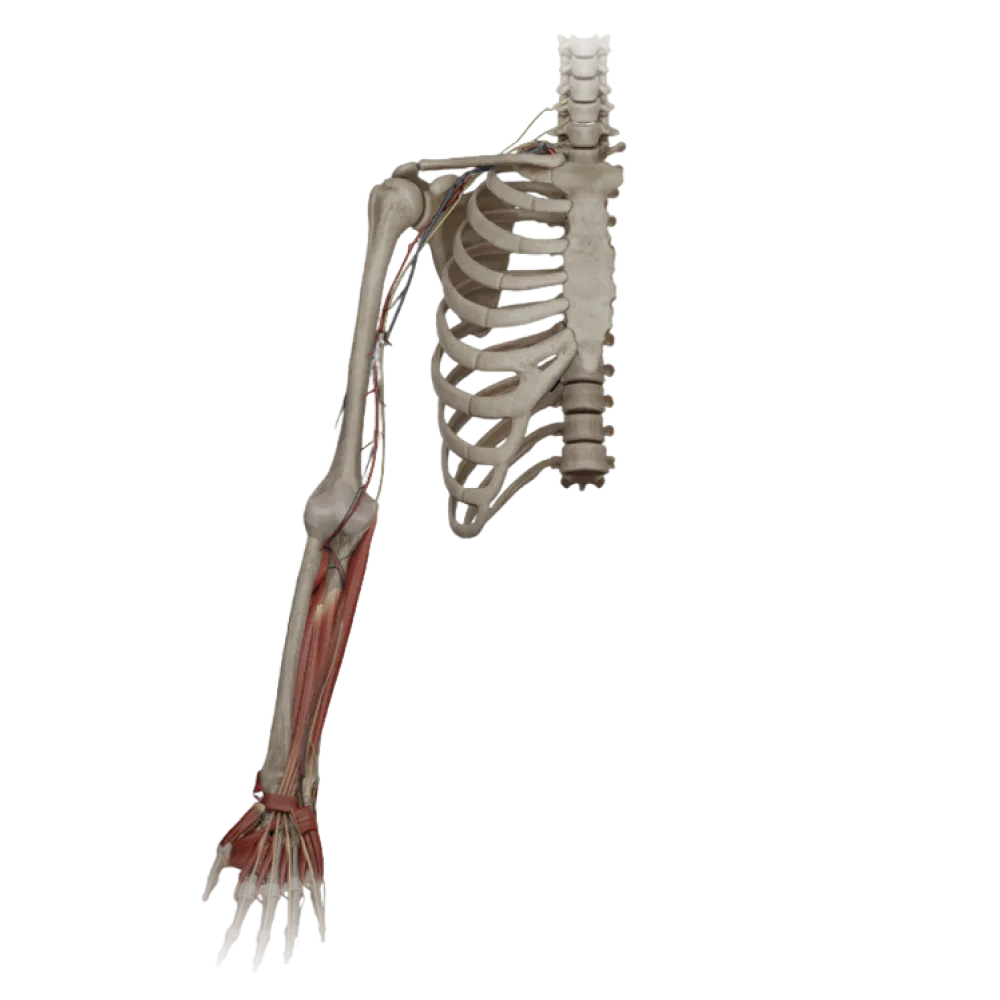
Radial nerve anatomy test
Evaluate the knowledge of radial nerve anatomy. The test assesses its topography, branches, target muscles, and areas of sensory innervation.
1/20
bold
text
1. From which trunk of the brachial plexus does the radial nerve originate?
-
Lateral
The radial nerve is a direct continuation of the posterior cord of the brachial plexus.
-
Medial
The radial nerve is a direct continuation of the posterior cord of the brachial plexus.
-
Posterior
The radial nerve is a direct continuation of the posterior cord of the brachial plexus.
-
Anterior
The radial nerve is a direct continuation of the posterior cord of the brachial plexus.
-
I find it difficult to answer
The radial nerve is a direct continuation of the posterior cord of the brachial plexus.
2. Through which canal in the arm does the radial nerve pass?
-
Humeromuscular canal
The radial nerve courses in the spiral (humeromuscular) canal between the humerus and the heads of the triceps muscle.
-
Carpal canal
The radial nerve courses in the spiral (humeromuscular) canal between the humerus and the heads of the triceps muscle.
-
Ulnar nerve canal
The radial nerve courses in the spiral (humeromuscular) canal between the humerus and the heads of the triceps muscle.
-
Supinator canal
The radial nerve courses in the spiral (humeromuscular) canal between the humerus and the heads of the triceps muscle.
-
I find it difficult to answer
The radial nerve courses in the spiral (humeromuscular) canal between the humerus and the heads of the triceps muscle.
3. Which artery accompanies the radial nerve in the brachial canal?
-
Brachial artery
In the humeromuscular canal, the radial nerve travels together with the deep brachial artery.
-
A. collateralis ulnaris superior
In the humeromuscular canal, the radial nerve travels together with the deep brachial artery.
-
A. recurrens radialis
In the humeromuscular canal, the radial nerve travels together with the deep brachial artery.
-
Deep brachial artery
In the humeromuscular canal, the radial nerve travels together with the deep brachial artery.
-
I find it difficult to answer
In the humeromuscular canal, the radial nerve travels together with the deep brachial artery.
4. Which arm muscle is innervated by the radial nerve?
-
M. biceps brachii
The radial nerve innervates the posterior group of arm muscles, which includes the triceps brachii.
-
M. triceps brachii
The radial nerve innervates the posterior group of arm muscles, which includes the triceps brachii.
-
Coracobrachialis
The radial nerve innervates the posterior group of arm muscles, which includes the triceps brachii.
-
M. brachialis
The radial nerve innervates the posterior group of arm muscles, which includes the triceps brachii.
-
I find it difficult to answer
The radial nerve innervates the posterior group of arm muscles, which includes the triceps brachii.
5. In which topographical region does the radial nerve divide into superficial and deep branches?
-
Cubital fossa
The radial nerve divides into terminal branches in the cubital fossa, between the brachialis and brachioradialis muscles.
-
Axillary fossa
The radial nerve divides into terminal branches in the cubital fossa, between the brachialis and brachioradialis muscles.
-
Middle third of the arm
The radial nerve divides into terminal branches in the cubital fossa, between the brachialis and brachioradialis muscles.
-
Wrist canal
The radial nerve divides into terminal branches in the cubital fossa, between the brachialis and brachioradialis muscles.
-
I find it difficult to answer
The radial nerve divides into terminal branches in the cubital fossa, between the brachialis and brachioradialis muscles.
6. Which nerve serves as a cutaneous branch of the radial nerve in the forearm?
-
Medial cutaneous nerve of the forearm
The posterior cutaneous nerve of the forearm branches from the radial nerve and innervates the skin of the posterior surface of the forearm.
-
Lateral cutaneous nerve of the forearm
The posterior cutaneous nerve of the forearm branches from the radial nerve and innervates the skin of the posterior surface of the forearm.
-
Posterior cutaneous nerve of the forearm
The posterior cutaneous nerve of the forearm branches from the radial nerve and innervates the skin of the posterior surface of the forearm.
-
Posterior cutaneous nerve of the arm
The posterior cutaneous nerve of the forearm branches from the radial nerve and innervates the skin of the posterior surface of the forearm.
-
I find it difficult to answer
The posterior cutaneous nerve of the forearm branches from the radial nerve and innervates the skin of the posterior surface of the forearm.
7. Which branch of the radial nerve passes through the supinator canal?
-
Superficial branch
The deep branch of the radial nerve pierces the supinator, passing through the supinator canal.
-
Posterior cutaneous nerve of the forearm
The deep branch of the radial nerve pierces the supinator, passing through the supinator canal.
-
Anterior interosseous nerve
The deep branch of the radial nerve pierces the supinator, passing through the supinator canal.
-
Deep branch
The deep branch of the radial nerve pierces the supinator, passing through the supinator canal.
-
I find it difficult to answer
The deep branch of the radial nerve pierces the supinator, passing through the supinator canal.
8. Which of the listed forearm muscles is NOT innervated by the radial nerve?
-
Extensor digitorum
The pronator teres is innervated by the median nerve, while the other muscles listed are innervated by the radial nerve.
-
Pronator teres
The pronator teres is innervated by the median nerve, while the other muscles listed are innervated by the radial nerve.
-
M. brachioradialis
The pronator teres is innervated by the median nerve, while the other muscles listed are innervated by the radial nerve.
-
Supinator
The pronator teres is innervated by the median nerve, while the other muscles listed are innervated by the radial nerve.
-
I find it difficult to answer
The pronator teres is innervated by the median nerve, while the other muscles listed are innervated by the radial nerve.
9. Which fingers' skin on the dorsum of the hand is innervated by the superficial branch of the radial nerve?
-
Fingers I, II, and the radial half of III
The superficial branch of the radial nerve innervates the skin of the radial 2.5 fingers on the dorsum of the hand.
-
Fingers V, IV, and the ulnar half of III
The superficial branch of the radial nerve innervates the skin of the radial 2.5 fingers on the dorsum of the hand.
-
Only fingers I and II
The superficial branch of the radial nerve innervates the skin of the radial 2.5 fingers on the dorsum of the hand.
-
All five fingers
The superficial branch of the radial nerve innervates the skin of the radial 2.5 fingers on the dorsum of the hand.
-
I find it difficult to answer
The superficial branch of the radial nerve innervates the skin of the radial 2.5 fingers on the dorsum of the hand.
10. What is the name of the continuation of the deep branch of the radial nerve in the forearm after emerging from the supinator muscle?
-
Anterior interosseous nerve
The deep branch of the radial nerve becomes the posterior interosseous nerve of the forearm.
-
Posterior cutaneous nerve of the forearm
The deep branch of the radial nerve becomes the posterior interosseous nerve of the forearm.
-
Dorsal branch n. ulnaris
The deep branch of the radial nerve becomes the posterior interosseous nerve of the forearm.
-
Posterior interosseous nerve
The deep branch of the radial nerve becomes the posterior interosseous nerve of the forearm.
-
I find it difficult to answer
The deep branch of the radial nerve becomes the posterior interosseous nerve of the forearm.
11. With which artery does the superficial branch of the radial nerve travel in the upper third of the forearm?
-
Ulnar artery
In the upper and middle thirds of the forearm, the superficial branch of the radial nerve accompanies the radial artery.
-
Common interosseous artery
In the upper and middle thirds of the forearm, the superficial branch of the radial nerve accompanies the radial artery.
-
Radial artery
In the upper and middle thirds of the forearm, the superficial branch of the radial nerve accompanies the radial artery.
-
Brachial artery
In the upper and middle thirds of the forearm, the superficial branch of the radial nerve accompanies the radial artery.
-
I find it difficult to answer
In the upper and middle thirds of the forearm, the superficial branch of the radial nerve accompanies the radial artery.
12. How is the superficial branch of the radial nerve positioned relative to the radial artery in the forearm?
-
Medial to the artery
The superficial branch of the radial nerve descends along the forearm lateral to the radial artery.
-
Lateral to the artery
The superficial branch of the radial nerve descends along the forearm lateral to the radial artery.
-
Superficial to the artery
The superficial branch of the radial nerve descends along the forearm lateral to the radial artery.
-
Deeper than the artery
The superficial branch of the radial nerve descends along the forearm lateral to the radial artery.
-
I find it difficult to answer
The superficial branch of the radial nerve descends along the forearm lateral to the radial artery.
13. Posterior to which artery does the radial nerve lie as it exits the brachial plexus in the axillary fossa?
-
Axillary artery
In the axillary fossa, the radial nerve, as a derivative of the posterior cord, lies posterior to the axillary artery.
-
A. subclavia
In the axillary fossa, the radial nerve, as a derivative of the posterior cord, lies posterior to the axillary artery.
-
Brachial artery
In the axillary fossa, the radial nerve, as a derivative of the posterior cord, lies posterior to the axillary artery.
-
Deep brachial artery
In the axillary fossa, the radial nerve, as a derivative of the posterior cord, lies posterior to the axillary artery.
-
I find it difficult to answer
In the axillary fossa, the radial nerve, as a derivative of the posterior cord, lies posterior to the axillary artery.
14. Through which intermuscular septum of the arm does the radial nerve bypass while leaving the humeromuscular canal?
-
Medial
The radial nerve penetrates the lateral intermuscular septum of the arm, entering the anterior cubital groove.
-
Anterior.
The radial nerve penetrates the lateral intermuscular septum of the arm, entering the anterior cubital groove.
-
Posterior
The radial nerve penetrates the lateral intermuscular septum of the arm, entering the anterior cubital groove.
-
Lateral.
The radial nerve penetrates the lateral intermuscular septum of the arm, entering the anterior cubital groove.
-
I find it difficult to answer
The radial nerve penetrates the lateral intermuscular septum of the arm, entering the anterior cubital groove.
15. Which spinal roots form the radial nerve?
-
C5-C6
The radial nerve contains nerve fibers from all roots of the brachial plexus (C5-T1).
-
C5-T1
The radial nerve contains nerve fibers from all roots of the brachial plexus (C5-T1).
-
C8-T1
The radial nerve contains nerve fibers from all roots of the brachial plexus (C5-T1).
-
C7-T1
The radial nerve contains nerve fibers from all roots of the brachial plexus (C5-T1).
-
I find it difficult to answer
The radial nerve contains nerve fibers from all roots of the brachial plexus (C5-T1).
16. In which topographical area does the posterior cutaneous nerve of the arm (n. cutaneus brachii posterior) branch from the radial nerve?
-
In the humeromuscular canal
The posterior cutaneous nerve of the arm branches from the radial nerve in the axillary fossa, before entering the humeromuscular canal.
-
In the cubital fossa
The posterior cutaneous nerve of the arm branches from the radial nerve in the axillary fossa, before entering the humeromuscular canal.
-
In the axillary fossa
The posterior cutaneous nerve of the arm branches from the radial nerve in the axillary fossa, before entering the humeromuscular canal.
-
In the supinator canal
The posterior cutaneous nerve of the arm branches from the radial nerve in the axillary fossa, before entering the humeromuscular canal.
-
I find it difficult to answer
The posterior cutaneous nerve of the arm branches from the radial nerve in the axillary fossa, before entering the humeromuscular canal.
17. Which forearm muscle is innervated by the posterior interosseous nerve?
-
Extensor indicis
The posterior interosseous nerve innervates the deep layer of the posterior forearm muscle group, including the extensor indicis.
-
Flexor pollicis longus
The posterior interosseous nerve innervates the deep layer of the posterior forearm muscle group, including the extensor indicis.
-
Palmaris longus
The posterior interosseous nerve innervates the deep layer of the posterior forearm muscle group, including the extensor indicis.
-
Flexor digitorum profundus
The posterior interosseous nerve innervates the deep layer of the posterior forearm muscle group, including the extensor indicis.
-
I find it difficult to answer
The posterior interosseous nerve innervates the deep layer of the posterior forearm muscle group, including the extensor indicis.
18. Where does the superficial branch of the radial nerve turn toward the dorsum of the hand?
-
Under the flexor retinaculum
In the lower third of the forearm, the superficial branch deviates towards the dorsum, passing beneath the tendon of m. brachioradialis
-
Through the anatomical snuffbox
In the lower third of the forearm, the superficial branch deviates towards the dorsum, passing beneath the tendon of m. brachioradialis
-
Through the carpal canal
In the lower third of the forearm, the superficial branch deviates towards the dorsum, passing beneath the tendon of m. brachioradialis
-
Beneath the tendon of the brachioradialis muscle in the lower third of the forearm
In the lower third of the forearm, the superficial branch deviates towards the dorsum, passing beneath the tendon of m. brachioradialis
-
I find it difficult to answer
In the lower third of the forearm, the superficial branch deviates towards the dorsum, passing beneath the tendon of m. brachioradialis
19. From which part of the radial nerve does the anconeus muscle (m. anconeus) receive innervation?
-
From the superficial branch of the radial nerve.
The branch to the anconeus muscle originates from the main trunk of the radial nerve, along with the branches to the triceps brachii.
-
Directly from the trunk in the arm.
The branch to the anconeus muscle originates from the main trunk of the radial nerve, along with the branches to the triceps brachii.
-
From the posterior interosseous nerve.
The branch to the anconeus muscle originates from the main trunk of the radial nerve, along with the branches to the triceps brachii.
-
From the posterior cutaneous nerve of the forearm.
The branch to the anconeus muscle originates from the main trunk of the radial nerve, along with the branches to the triceps brachii.
-
I find it difficult to answer
The branch to the anconeus muscle originates from the main trunk of the radial nerve, along with the branches to the triceps brachii.
20. Which thenar muscle is innervated by the radial nerve?
-
M. abductor pollicis brevis
Thenar muscles are innervated by the median and ulnar nerves; the radial nerve does not innervate the intrinsic muscles of the hand.
-
M. opponens pollicis
Thenar muscles are innervated by the median and ulnar nerves; the radial nerve does not innervate the intrinsic muscles of the hand.
-
None of the listed options
Thenar muscles are innervated by the median and ulnar nerves; the radial nerve does not innervate the intrinsic muscles of the hand.
-
M. flexor pollicis brevis
Thenar muscles are innervated by the median and ulnar nerves; the radial nerve does not innervate the intrinsic muscles of the hand.
-
I find it difficult to answer
Thenar muscles are innervated by the median and ulnar nerves; the radial nerve does not innervate the intrinsic muscles of the hand.
Retake this quiz?
Your current progress will be reset.