
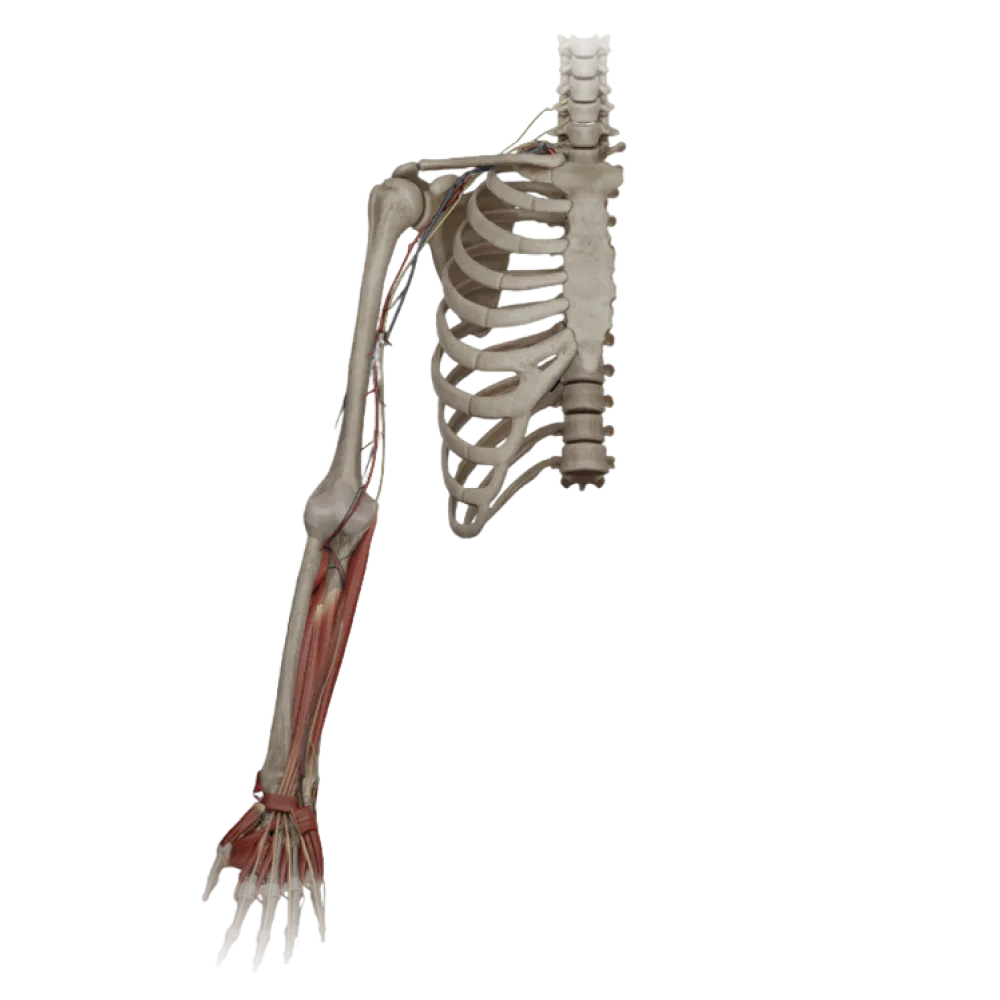
Median nerve anatomy test
Evaluate your knowledge of median nerve anatomy. The test covers its topography, branches, and areas of innervation in the forearm and hand.
1/20
bold
text
1. From which bundles of the brachial plexus is the median nerve formed?
-
Posterior and lateral
The median nerve is formed by the merging of lateral and medial roots, emanating from the respective bundles of the brachial plexus.
-
Lateral and medial
The median nerve is formed by the merging of lateral and medial roots, emanating from the respective bundles of the brachial plexus.
-
Only medial
The median nerve is formed by the merging of lateral and medial roots, emanating from the respective bundles of the brachial plexus.
-
Medial and posterior
The median nerve is formed by the merging of lateral and medial roots, emanating from the respective bundles of the brachial plexus.
-
I find it difficult to answer
The median nerve is formed by the merging of lateral and medial roots, emanating from the respective bundles of the brachial plexus.
2. How is the median nerve positioned in relation to the axillary artery in the axillary fossa?
-
In front of the artery.
The trunk of the median nerve is formed on the anterior surface of the axillary artery, encircling it in the form of the letter 'V'.
-
Behind the artery
The trunk of the median nerve is formed on the anterior surface of the axillary artery, encircling it in the form of the letter 'V'.
-
Medial to the artery
The trunk of the median nerve is formed on the anterior surface of the axillary artery, encircling it in the form of the letter 'V'.
-
Lateral to the artery
The trunk of the median nerve is formed on the anterior surface of the axillary artery, encircling it in the form of the letter 'V'.
-
I find it difficult to answer
The trunk of the median nerve is formed on the anterior surface of the axillary artery, encircling it in the form of the letter 'V'.
3. In which topographical structure of the arm does the median nerve pass?
-
In the humeromuscular canal
In the arm, the median nerve travels in the medial bicipital groove along with the brachial artery and accompanying veins.
-
In the lateral bicipital groove
In the arm, the median nerve travels in the medial bicipital groove along with the brachial artery and accompanying veins.
-
In the radial nerve groove
In the arm, the median nerve travels in the medial bicipital groove along with the brachial artery and accompanying veins.
-
In the medial bicipital groove
In the arm, the median nerve travels in the medial bicipital groove along with the brachial artery and accompanying veins.
-
I find it difficult to answer
In the arm, the median nerve travels in the medial bicipital groove along with the brachial artery and accompanying veins.
4. Which muscles does the median nerve innervate at the level of the arm?
-
It does not innervate muscles on the arm
At the arm level, the median nerve does not give off motor and sensory branches except for fine sympathetic branches to the brachial artery.
-
The brachialis muscle
At the arm level, the median nerve does not give off motor and sensory branches except for fine sympathetic branches to the brachial artery.
-
The coracobrachialis muscle
At the arm level, the median nerve does not give off motor and sensory branches except for fine sympathetic branches to the brachial artery.
-
The biceps brachii
At the arm level, the median nerve does not give off motor and sensory branches except for fine sympathetic branches to the brachial artery.
-
I find it difficult to answer
At the arm level, the median nerve does not give off motor and sensory branches except for fine sympathetic branches to the brachial artery.
5. Where is the median nerve positioned in relation to the brachial artery in the cubital fossa?
-
Lateral to the artery
In the cubital fossa, the median nerve is located medial to the brachial artery, beneath the bicipital aponeurosis.
-
Medial to the artery
In the cubital fossa, the median nerve is located medial to the brachial artery, beneath the bicipital aponeurosis.
-
Behind the artery
In the cubital fossa, the median nerve is located medial to the brachial artery, beneath the bicipital aponeurosis.
-
In front of the artery.
In the cubital fossa, the median nerve is located medial to the brachial artery, beneath the bicipital aponeurosis.
-
I find it difficult to answer
In the cubital fossa, the median nerve is located medial to the brachial artery, beneath the bicipital aponeurosis.
6. Between which muscular structures does the median nerve emerge in the forearm?
-
Between the brachialis muscle and brachioradialis muscle
Leaving the cubital fossa, the median nerve passes between the humeral and ulnar heads of the pronator teres.
-
Between the heads of the flexor carpi ulnaris
Leaving the cubital fossa, the median nerve passes between the humeral and ulnar heads of the pronator teres.
-
Between the heads of the pronator teres
Leaving the cubital fossa, the median nerve passes between the humeral and ulnar heads of the pronator teres.
-
Between the superficial and deep flexors of the fingers
Leaving the cubital fossa, the median nerve passes between the humeral and ulnar heads of the pronator teres.
-
I find it difficult to answer
Leaving the cubital fossa, the median nerve passes between the humeral and ulnar heads of the pronator teres.
7. Which forearm muscle is NOT innervated by the median nerve?
-
Flexor carpi radialis
The flexor carpi ulnaris is innervated by the ulnar nerve, while most other muscles of the forearm's anterior group are innervated by the median.
-
Flexor digitorum superficialis
The flexor carpi ulnaris is innervated by the ulnar nerve, while most other muscles of the forearm's anterior group are innervated by the median.
-
Palmaris longus muscle
The flexor carpi ulnaris is innervated by the ulnar nerve, while most other muscles of the forearm's anterior group are innervated by the median.
-
Flexor carpi ulnaris
The flexor carpi ulnaris is innervated by the ulnar nerve, while most other muscles of the forearm's anterior group are innervated by the median.
-
I find it difficult to answer
The flexor carpi ulnaris is innervated by the ulnar nerve, while most other muscles of the forearm's anterior group are innervated by the median.
8. Between which muscles does the trunk of the median nerve pass in the middle third of the forearm?
-
Between the superficial and deep flexors of the fingers
In the forearm, the nerve descends strictly in the middle, positioned between the superficial and deep flexors of the fingers.
-
Between the pronator teres and flexor carpi radialis
In the forearm, the nerve descends strictly in the middle, positioned between the superficial and deep flexors of the fingers.
-
Between the brachioradialis and flexor pollicis longus
In the forearm, the nerve descends strictly in the middle, positioned between the superficial and deep flexors of the fingers.
-
Beneath the flexor digitorum profundus on the interosseous membrane
In the forearm, the nerve descends strictly in the middle, positioned between the superficial and deep flexors of the fingers.
-
I find it difficult to answer
In the forearm, the nerve descends strictly in the middle, positioned between the superficial and deep flexors of the fingers.
9. What structure does the anterior interosseous nerve of the forearm innervate?
-
Abductor pollicis brevis
The anterior interosseous nerve (a branch of the median) innervates the deep muscles of the anterior group of the forearm, including the pronator quadratus.
-
Ulnar part of the flexor digitorum profundus
The anterior interosseous nerve (a branch of the median) innervates the deep muscles of the anterior group of the forearm, including the pronator quadratus.
-
Supinator
The anterior interosseous nerve (a branch of the median) innervates the deep muscles of the anterior group of the forearm, including the pronator quadratus.
-
Pronator quadratus
The anterior interosseous nerve (a branch of the median) innervates the deep muscles of the anterior group of the forearm, including the pronator quadratus.
-
I find it difficult to answer
The anterior interosseous nerve (a branch of the median) innervates the deep muscles of the anterior group of the forearm, including the pronator quadratus.
10. Which part of the flexor digitorum profundus receives innervation from the median nerve?
-
The entire muscle as a whole
The median nerve innervates the lateral (radial) portion of the flexor digitorum profundus, while the medial portion is innervated by the ulnar nerve.
-
The ulnar part for the IV and V fingers
The median nerve innervates the lateral (radial) portion of the flexor digitorum profundus, while the medial portion is innervated by the ulnar nerve.
-
The radial part for the II and III fingers
The median nerve innervates the lateral (radial) portion of the flexor digitorum profundus, while the medial portion is innervated by the ulnar nerve.
-
The muscle is not innervated by the median nerve
The median nerve innervates the lateral (radial) portion of the flexor digitorum profundus, while the medial portion is innervated by the ulnar nerve.
-
I find it difficult to answer
The median nerve innervates the lateral (radial) portion of the flexor digitorum profundus, while the medial portion is innervated by the ulnar nerve.
11. Where does the palmar branch of the median nerve branch off?
-
Within the carpal tunnel
The palmar branch divides before the nerve enters the carpal canal and moves over the flexor retinaculum, innervating the skin at the base of the palm.
-
At the level of the lower third of the forearm above the flexor retinaculum
The palmar branch divides before the nerve enters the carpal canal and moves over the flexor retinaculum, innervating the skin at the base of the palm.
-
On the palm after exiting the carpal tunnel
The palmar branch divides before the nerve enters the carpal canal and moves over the flexor retinaculum, innervating the skin at the base of the palm.
-
In the cubital fossa
The palmar branch divides before the nerve enters the carpal canal and moves over the flexor retinaculum, innervating the skin at the base of the palm.
-
I find it difficult to answer
The palmar branch divides before the nerve enters the carpal canal and moves over the flexor retinaculum, innervating the skin at the base of the palm.
12. Which tendons accompany the median nerve within the carpal tunnel?
-
Tendons of the superficial, deep flexors of the fingers, and flexor pollicis longus
In the carpal canal, the median nerve is situated alongside nine flexor tendons (4 superficial, 4 deep, and 1 of the flexor pollicis longus)
-
The tendon of the flexor carpi ulnaris muscle
In the carpal canal, the median nerve is situated alongside nine flexor tendons (4 superficial, 4 deep, and 1 of the flexor pollicis longus)
-
Tendons of the extensor digitorum
In the carpal canal, the median nerve is situated alongside nine flexor tendons (4 superficial, 4 deep, and 1 of the flexor pollicis longus)
-
Tendon of the brachioradialis
In the carpal canal, the median nerve is situated alongside nine flexor tendons (4 superficial, 4 deep, and 1 of the flexor pollicis longus)
-
I find it difficult to answer
In the carpal canal, the median nerve is situated alongside nine flexor tendons (4 superficial, 4 deep, and 1 of the flexor pollicis longus)
13. Which of the following muscles of the thenar eminence is innervated by the median nerve?
-
Adductor pollicis muscle
The median nerve innervates the abductor pollicis brevis, the opponens pollicis, and the superficial head of the short flexor of the thumb.
-
The deep head of the short flexor of the thumb
The median nerve innervates the abductor pollicis brevis, the opponens pollicis, and the superficial head of the short flexor of the thumb.
-
The first dorsal interosseous muscle
The median nerve innervates the abductor pollicis brevis, the opponens pollicis, and the superficial head of the short flexor of the thumb.
-
Abductor pollicis brevis
The median nerve innervates the abductor pollicis brevis, the opponens pollicis, and the superficial head of the short flexor of the thumb.
-
I find it difficult to answer
The median nerve innervates the abductor pollicis brevis, the opponens pollicis, and the superficial head of the short flexor of the thumb.
14. Which lumbrical muscles of the hand are innervated by branches of the median nerve?
-
All four lumbrical muscles
The first and second (lateral) lumbrical muscles are innervated by the median nerve, while the third and fourth are innervated by the ulnar nerve.
-
First and second
The first and second (lateral) lumbrical muscles are innervated by the median nerve, while the third and fourth are innervated by the ulnar nerve.
-
Third and fourth
The first and second (lateral) lumbrical muscles are innervated by the median nerve, while the third and fourth are innervated by the ulnar nerve.
-
Only the first
The first and second (lateral) lumbrical muscles are innervated by the median nerve, while the third and fourth are innervated by the ulnar nerve.
-
I find it difficult to answer
The first and second (lateral) lumbrical muscles are innervated by the median nerve, while the third and fourth are innervated by the ulnar nerve.
15. What is the zone of sensory innervation of the median nerve on the palmar surface of the hand?
-
All fingers of the hand
The median nerve provides sensory innervation to the skin of the lateral 3.5 fingers on the palmar side of the hand.
-
Palmar surface of the V and ulnar half of the IV fingers
The median nerve provides sensory innervation to the skin of the lateral 3.5 fingers on the palmar side of the hand.
-
Palmar surface of the I, II, and III fingers, and the radial half of the IV finger
The median nerve provides sensory innervation to the skin of the lateral 3.5 fingers on the palmar side of the hand.
-
Only the I and II fingers
The median nerve provides sensory innervation to the skin of the lateral 3.5 fingers on the palmar side of the hand.
-
I find it difficult to answer
The median nerve provides sensory innervation to the skin of the lateral 3.5 fingers on the palmar side of the hand.
16. What is the zone of sensory innervation of the median nerve on the dorsal surface of the hand?
-
Distal phalanges of the II, III, and radial half of the IV fingers
Common palmar digital nerves give off branches that pass to the dorsum and innervate the skin of the middle and distal phalanges of the II, III, and radial half of the IV fingers.
-
Dorsal surface of the I, II, and III fingers entirely
Common palmar digital nerves give off branches that pass to the dorsum and innervate the skin of the middle and distal phalanges of the II, III, and radial half of the IV fingers.
-
Dorsal surface of the entire hand
Common palmar digital nerves give off branches that pass to the dorsum and innervate the skin of the middle and distal phalanges of the II, III, and radial half of the IV fingers.
-
The median nerve does not give branches to the dorsum of the hand
Common palmar digital nerves give off branches that pass to the dorsum and innervate the skin of the middle and distal phalanges of the II, III, and radial half of the IV fingers.
-
I find it difficult to answer
Common palmar digital nerves give off branches that pass to the dorsum and innervate the skin of the middle and distal phalanges of the II, III, and radial half of the IV fingers.
17. Into which terminal branches does the median nerve divide upon exiting the carpal tunnel?
-
Anterior and posterior interosseous nerves
On the palm, beneath the palmar aponeurosis, the median nerve divides into three common palmar digital nerves and these then divide into proper digital nerves.
-
Common palmar digital nerves
On the palm, beneath the palmar aponeurosis, the median nerve divides into three common palmar digital nerves and these then divide into proper digital nerves.
-
Superficial and deep branches
On the palm, beneath the palmar aponeurosis, the median nerve divides into three common palmar digital nerves and these then divide into proper digital nerves.
-
Dorsal digital nerves
On the palm, beneath the palmar aponeurosis, the median nerve divides into three common palmar digital nerves and these then divide into proper digital nerves.
-
I find it difficult to answer
On the palm, beneath the palmar aponeurosis, the median nerve divides into three common palmar digital nerves and these then divide into proper digital nerves.
18. Which branch of the median nerve runs along the interosseous membrane of the forearm?
-
Posterior interosseous nerve
The anterior interosseous nerve descends along the anterior surface of the interosseous membrane of the forearm accompanied by the artery of the same name.
-
Ulnar nerve
The anterior interosseous nerve descends along the anterior surface of the interosseous membrane of the forearm accompanied by the artery of the same name.
-
Musculocutaneous nerve
The anterior interosseous nerve descends along the anterior surface of the interosseous membrane of the forearm accompanied by the artery of the same name.
-
Anterior interosseous nerve
The anterior interosseous nerve descends along the anterior surface of the interosseous membrane of the forearm accompanied by the artery of the same name.
-
I find it difficult to answer
The anterior interosseous nerve descends along the anterior surface of the interosseous membrane of the forearm accompanied by the artery of the same name.
19. What is the typical anatomical anastomosis in the forearm between the branches of the median and ulnar nerves called?
-
Riolan's anastomosis
The Martin-Gruber anastomosis is a normal anatomical connection of motor fibers between the median and ulnar nerves in the forearm.
-
Galen's loop
The Martin-Gruber anastomosis is a normal anatomical connection of motor fibers between the median and ulnar nerves in the forearm.
-
Martin-Gruber anastomosis
The Martin-Gruber anastomosis is a normal anatomical connection of motor fibers between the median and ulnar nerves in the forearm.
-
Jacquemain's anastomosis
The Martin-Gruber anastomosis is a normal anatomical connection of motor fibers between the median and ulnar nerves in the forearm.
-
I find it difficult to answer
The Martin-Gruber anastomosis is a normal anatomical connection of motor fibers between the median and ulnar nerves in the forearm.
20. Which artery does the median nerve cross on the arm?
-
With the brachial artery
On the arm, the median nerve crosses the brachial artery anteriorly, moving from its lateral side to the medial as it descends toward the cubital fossa.
-
With the superior ulnar collateral artery
On the arm, the median nerve crosses the brachial artery anteriorly, moving from its lateral side to the medial as it descends toward the cubital fossa.
-
With the deep brachial artery
On the arm, the median nerve crosses the brachial artery anteriorly, moving from its lateral side to the medial as it descends toward the cubital fossa.
-
With the axillary artery
On the arm, the median nerve crosses the brachial artery anteriorly, moving from its lateral side to the medial as it descends toward the cubital fossa.
-
I find it difficult to answer
On the arm, the median nerve crosses the brachial artery anteriorly, moving from its lateral side to the medial as it descends toward the cubital fossa.
Retake this quiz?
Your current progress will be reset.