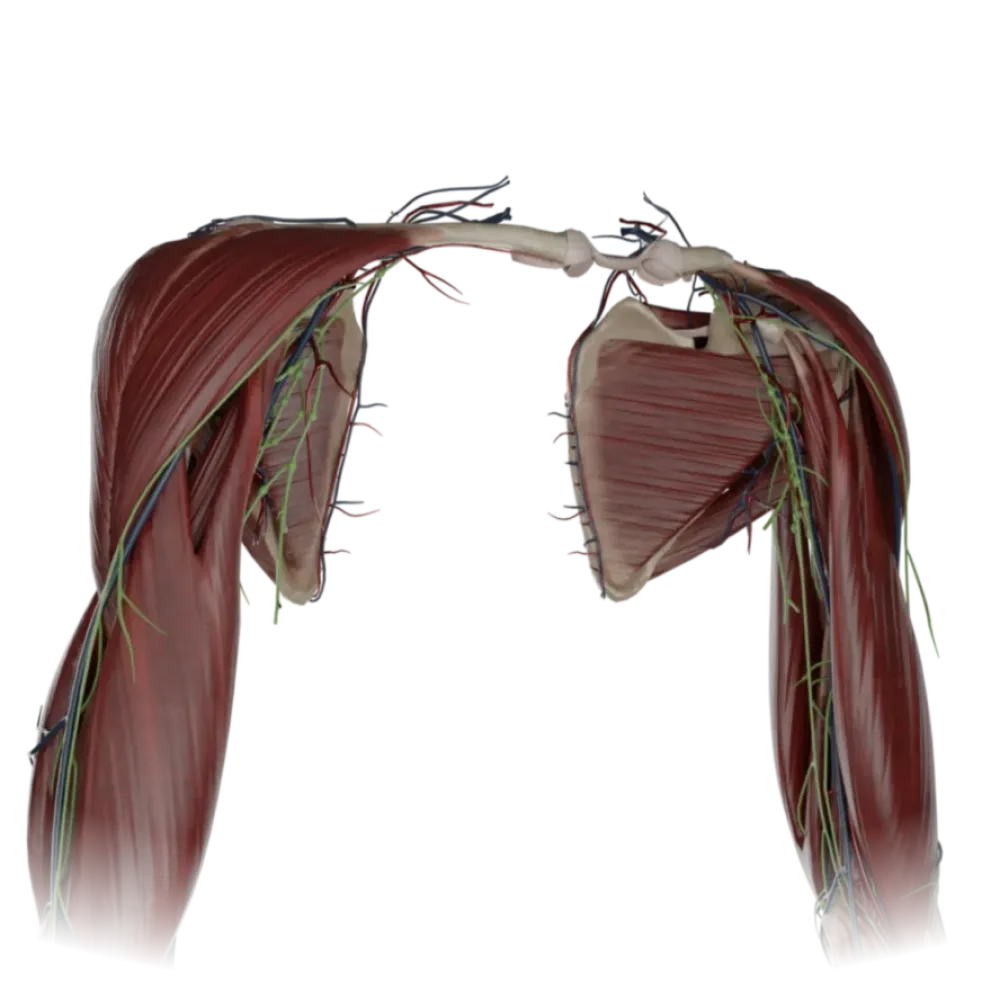
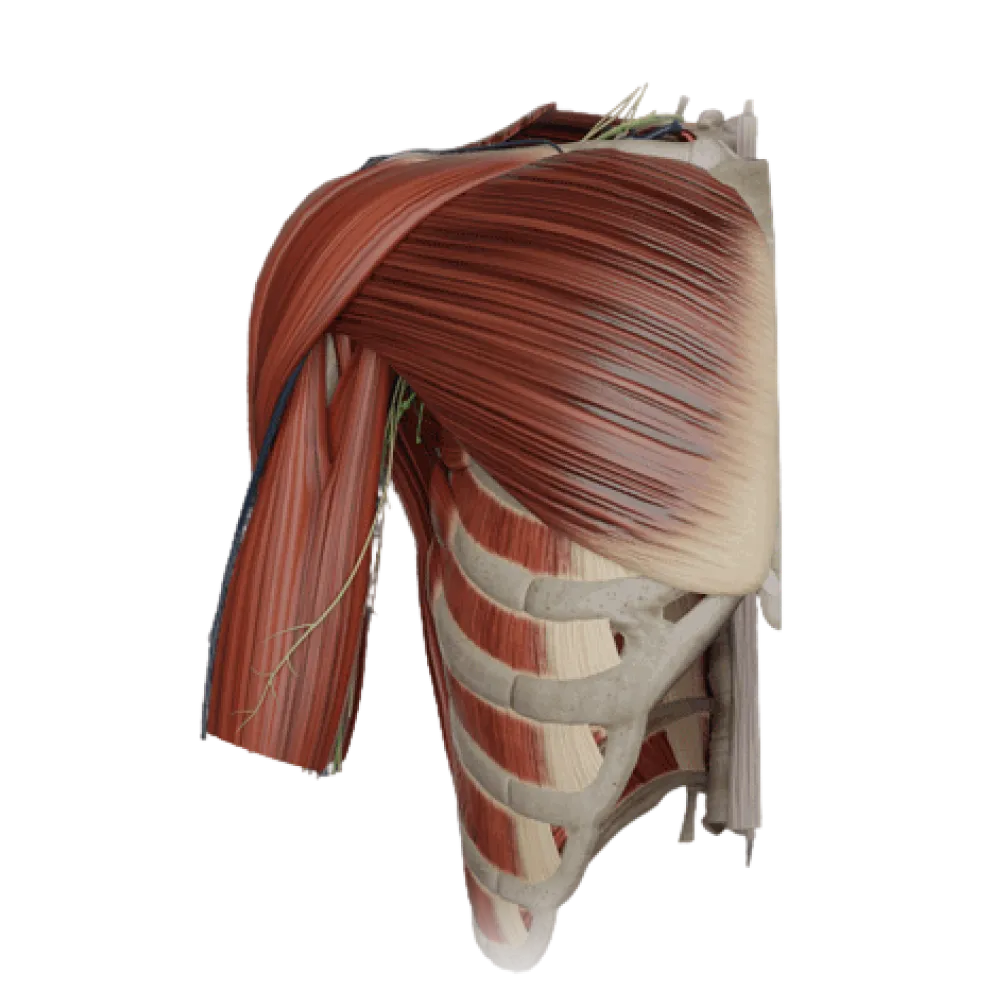
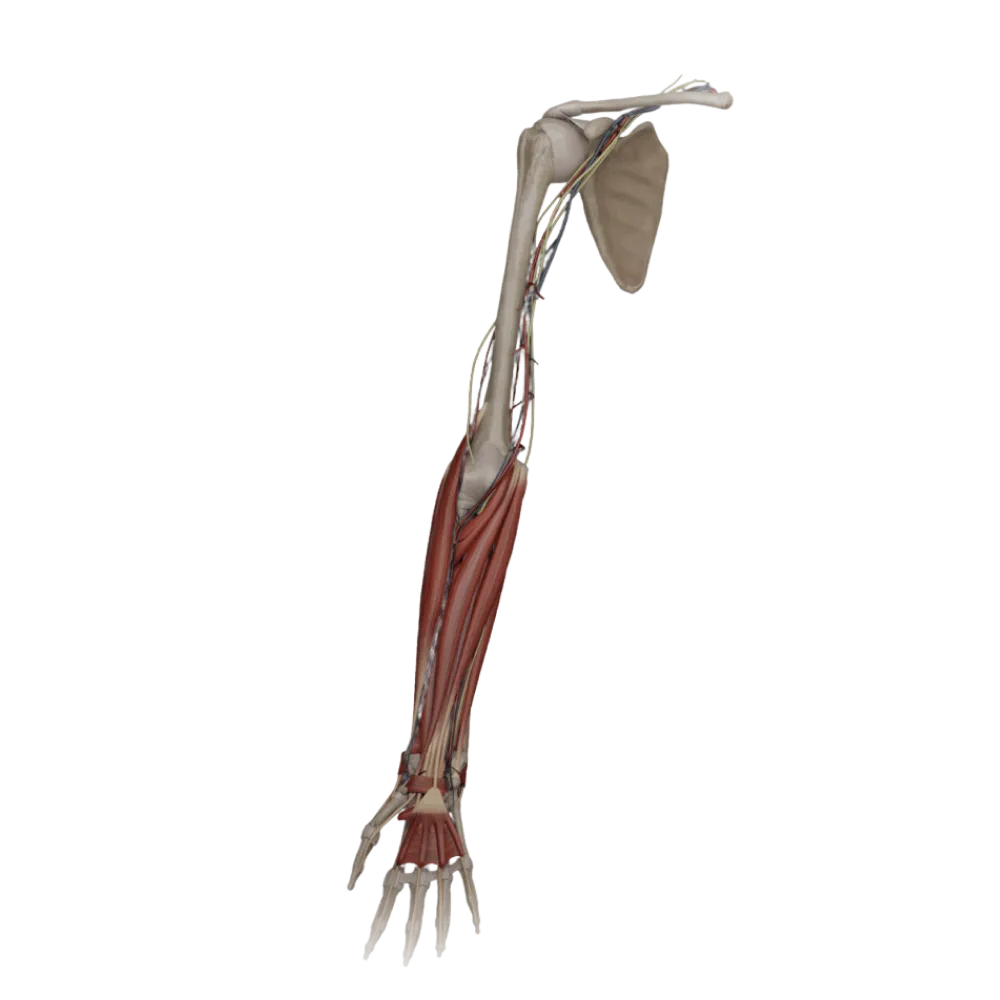
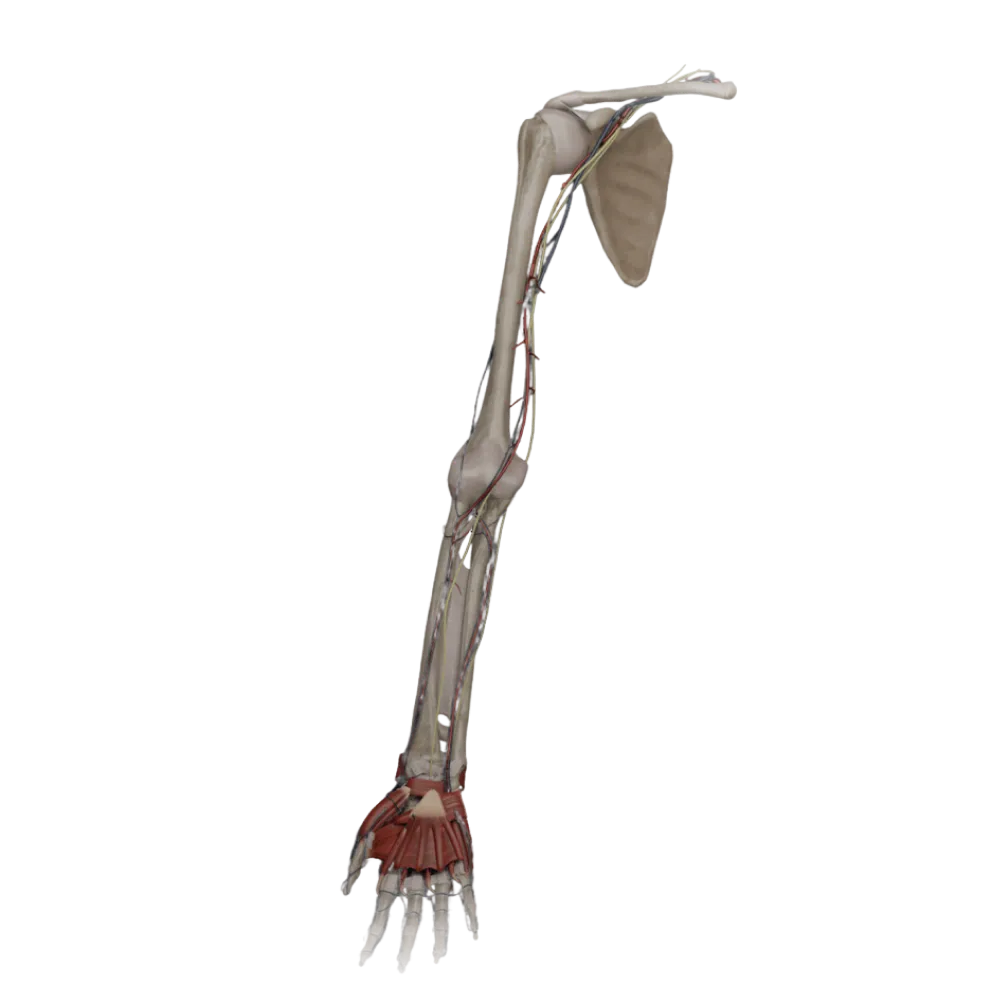

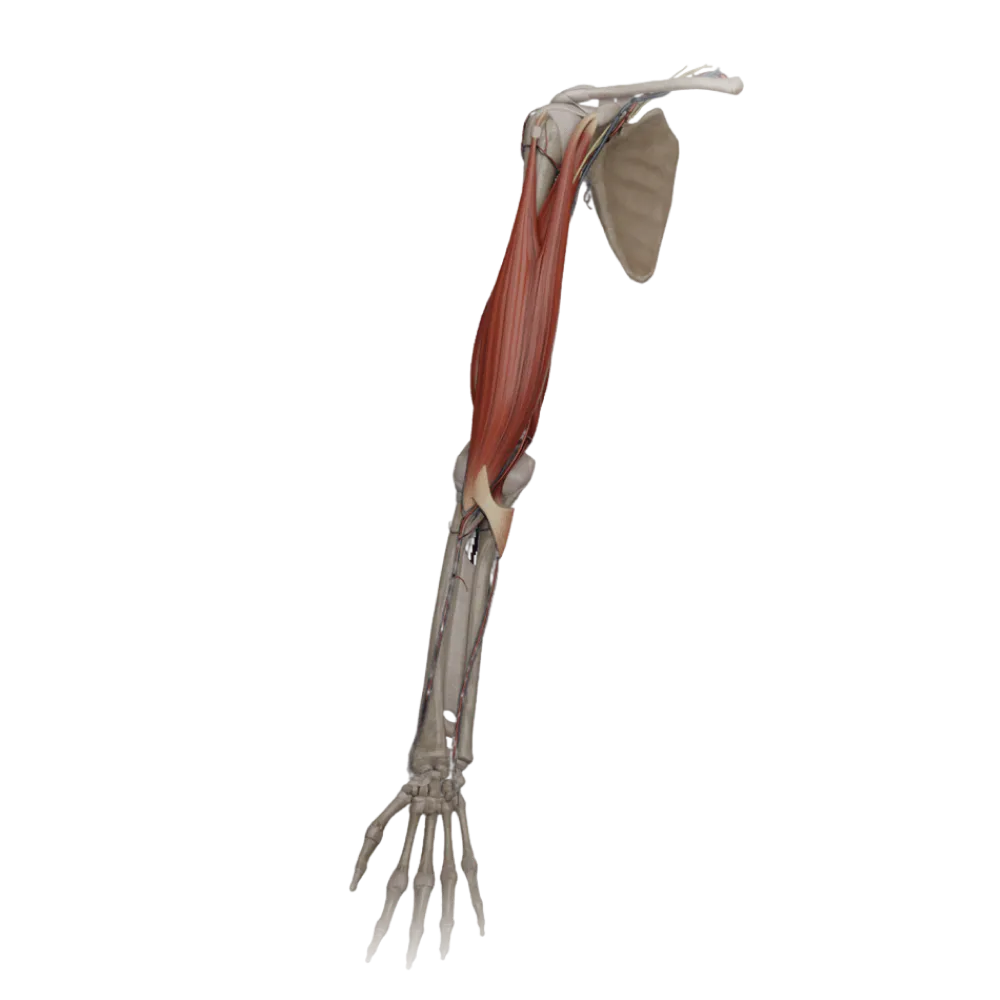

Anatomy test of shoulder muscles
Assess your knowledge of shoulder muscle anatomy. The test assesses their topography, sources of blood supply, zones of innervation, and fascial compartments.
1/20
bold
text
1. Which nerve innervates the anterior group muscles of the arm?
-
Musculocutaneous nerve
The musculocutaneous nerve (n. musculocutaneus) innervates the biceps brachii, brachialis, and coracobrachialis muscles of the arm's anterior group.
-
Median nerve
The musculocutaneous nerve (n. musculocutaneus) innervates the biceps brachii, brachialis, and coracobrachialis muscles of the arm's anterior group.
-
Ulnar nerve
The musculocutaneous nerve (n. musculocutaneus) innervates the biceps brachii, brachialis, and coracobrachialis muscles of the arm's anterior group.
-
Radial nerve
The musculocutaneous nerve (n. musculocutaneus) innervates the biceps brachii, brachialis, and coracobrachialis muscles of the arm's anterior group.
-
I find it difficult to answer
The musculocutaneous nerve (n. musculocutaneus) innervates the biceps brachii, brachialis, and coracobrachialis muscles of the arm's anterior group.
2. Which artery is the main source of blood supply to the triceps brachii muscle?
-
Superior ulnar collateral artery
The deep brachial artery (a. profunda brachii) originates from the brachial artery, runs in the brachial canal, and supplies the posterior group muscles of the arm.
-
Inferior ulnar collateral artery
The deep brachial artery (a. profunda brachii) originates from the brachial artery, runs in the brachial canal, and supplies the posterior group muscles of the arm.
-
Deep brachial artery
The deep brachial artery (a. profunda brachii) originates from the brachial artery, runs in the brachial canal, and supplies the posterior group muscles of the arm.
-
Anterior circumflex humeral artery
The deep brachial artery (a. profunda brachii) originates from the brachial artery, runs in the brachial canal, and supplies the posterior group muscles of the arm.
-
I find it difficult to answer
The deep brachial artery (a. profunda brachii) originates from the brachial artery, runs in the brachial canal, and supplies the posterior group muscles of the arm.
3. Which nerve pierces the coracobrachialis muscle?
-
Axillary nerve
The musculocutaneous nerve pierces the coracobrachialis muscle (m. coracobrachialis) and then positions itself between the biceps brachii and brachialis muscles.
-
Radial nerve
The musculocutaneous nerve pierces the coracobrachialis muscle (m. coracobrachialis) and then positions itself between the biceps brachii and brachialis muscles.
-
Median nerve
The musculocutaneous nerve pierces the coracobrachialis muscle (m. coracobrachialis) and then positions itself between the biceps brachii and brachialis muscles.
-
Musculocutaneous nerve
The musculocutaneous nerve pierces the coracobrachialis muscle (m. coracobrachialis) and then positions itself between the biceps brachii and brachialis muscles.
-
I find it difficult to answer
The musculocutaneous nerve pierces the coracobrachialis muscle (m. coracobrachialis) and then positions itself between the biceps brachii and brachialis muscles.
4. Which of the listed arm muscles has dual innervation (by the musculocutaneous and radial nerves)?
-
Biceps brachii
The brachialis muscle (m. brachialis) is primarily innervated by the musculocutaneous nerve, although its lateral part receives branches from the radial nerve.
-
Brachialis muscle
The brachialis muscle (m. brachialis) is primarily innervated by the musculocutaneous nerve, although its lateral part receives branches from the radial nerve.
-
Coracobrachialis muscle
The brachialis muscle (m. brachialis) is primarily innervated by the musculocutaneous nerve, although its lateral part receives branches from the radial nerve.
-
Triceps brachii muscle
The brachialis muscle (m. brachialis) is primarily innervated by the musculocutaneous nerve, although its lateral part receives branches from the radial nerve.
-
I find it difficult to answer
The brachialis muscle (m. brachialis) is primarily innervated by the musculocutaneous nerve, although its lateral part receives branches from the radial nerve.
5. Which artery accompanies the radial nerve in the brachial canal?
-
Superior ulnar collateral artery
In the brachial (spiral) canal, the radial nerve topographically passes along with the deep brachial artery and its accompanying veins.
-
Deep brachial artery
In the brachial (spiral) canal, the radial nerve topographically passes along with the deep brachial artery and its accompanying veins.
-
Brachial artery
In the brachial (spiral) canal, the radial nerve topographically passes along with the deep brachial artery and its accompanying veins.
-
Radial recurrent artery
In the brachial (spiral) canal, the radial nerve topographically passes along with the deep brachial artery and its accompanying veins.
-
I find it difficult to answer
In the brachial (spiral) canal, the radial nerve topographically passes along with the deep brachial artery and its accompanying veins.
6. Which arm muscles are innervated by branches of the median nerve at the arm level?
-
Only the biceps brachii
The median nerve (n. medianus) at the arm level gives no motor branches but passes in transit to the forearm.
-
Only the triceps brachii muscle
The median nerve (n. medianus) at the arm level gives no motor branches but passes in transit to the forearm.
-
Muscles of the posterior arm group
The median nerve (n. medianus) at the arm level gives no motor branches but passes in transit to the forearm.
-
None of the arm muscles
The median nerve (n. medianus) at the arm level gives no motor branches but passes in transit to the forearm.
-
I find it difficult to answer
The median nerve (n. medianus) at the arm level gives no motor branches but passes in transit to the forearm.
7. Which nerve provides motor innervation to the anconeus muscle (m. anconeus)?
-
Ulnar nerve
The anconeus muscle is topographically and functionally closely associated with the triceps brachii muscle and is innervated by the radial nerve.
-
Median nerve
The anconeus muscle is topographically and functionally closely associated with the triceps brachii muscle and is innervated by the radial nerve.
-
Radial nerve
The anconeus muscle is topographically and functionally closely associated with the triceps brachii muscle and is innervated by the radial nerve.
-
Axillary nerve
The anconeus muscle is topographically and functionally closely associated with the triceps brachii muscle and is innervated by the radial nerve.
-
I find it difficult to answer
The anconeus muscle is topographically and functionally closely associated with the triceps brachii muscle and is innervated by the radial nerve.
8. Which vessel's direct branch is usually the artery supplying the coracobrachialis muscle?
-
Brachial artery
The blood supply to the coracobrachialis muscle is provided by muscular branches that arise directly from the brachial artery trunk.
-
Subclavian artery
The blood supply to the coracobrachialis muscle is provided by muscular branches that arise directly from the brachial artery trunk.
-
Deep brachial artery
The blood supply to the coracobrachialis muscle is provided by muscular branches that arise directly from the brachial artery trunk.
-
Radial artery
The blood supply to the coracobrachialis muscle is provided by muscular branches that arise directly from the brachial artery trunk.
-
I find it difficult to answer
The blood supply to the coracobrachialis muscle is provided by muscular branches that arise directly from the brachial artery trunk.
9. Which artery accompanies the ulnar nerve in the middle third of the arm?
-
Deep brachial artery
The superior ulnar collateral artery (a. collateralis ulnaris superior) branches out from the brachial artery and accompanies the ulnar nerve.
-
Superior ulnar collateral artery
The superior ulnar collateral artery (a. collateralis ulnaris superior) branches out from the brachial artery and accompanies the ulnar nerve.
-
Inferior ulnar collateral artery
The superior ulnar collateral artery (a. collateralis ulnaris superior) branches out from the brachial artery and accompanies the ulnar nerve.
-
Middle collateral artery
The superior ulnar collateral artery (a. collateralis ulnaris superior) branches out from the brachial artery and accompanies the ulnar nerve.
-
I find it difficult to answer
The superior ulnar collateral artery (a. collateralis ulnaris superior) branches out from the brachial artery and accompanies the ulnar nerve.
10. Which nerve branches innervate the long head of the triceps brachii muscle?
-
Axillary nerve
All three heads of the triceps brachii muscle, including the long, lateral, and medial, are innervated by muscle branches of the radial nerve.
-
Ulnar nerve
All three heads of the triceps brachii muscle, including the long, lateral, and medial, are innervated by muscle branches of the radial nerve.
-
Radial nerve
All three heads of the triceps brachii muscle, including the long, lateral, and medial, are innervated by muscle branches of the radial nerve.
-
Thoracodorsal nerve
All three heads of the triceps brachii muscle, including the long, lateral, and medial, are innervated by muscle branches of the radial nerve.
-
I find it difficult to answer
All three heads of the triceps brachii muscle, including the long, lateral, and medial, are innervated by muscle branches of the radial nerve.
11. Which arm muscle attaches to the radial tuberosity and intertwines into the forearm fascia?
-
Coracobrachialis muscle
The biceps tendon attaches to the tuberositas radii, and its aponeurosis (aponeurosis m. bicipitis brachii) interweaves into the forearm fascia (Pirogov's fascia).
-
Brachioradialis muscle
The biceps tendon attaches to the tuberositas radii, and its aponeurosis (aponeurosis m. bicipitis brachii) interweaves into the forearm fascia (Pirogov's fascia).
-
Brachialis muscle
The biceps tendon attaches to the tuberositas radii, and its aponeurosis (aponeurosis m. bicipitis brachii) interweaves into the forearm fascia (Pirogov's fascia).
-
Biceps brachii
The biceps tendon attaches to the tuberositas radii, and its aponeurosis (aponeurosis m. bicipitis brachii) interweaves into the forearm fascia (Pirogov's fascia).
-
I find it difficult to answer
The biceps tendon attaches to the tuberositas radii, and its aponeurosis (aponeurosis m. bicipitis brachii) interweaves into the forearm fascia (Pirogov's fascia).
12. The lateral cutaneous nerve of the forearm is a continuation of which arm nerve?
-
Median nerve
After innervating the anterior group muscles of the arm, the musculocutaneous nerve emerges beneath the fascia and continues as the lateral cutaneous nerve of the forearm.
-
Radial nerve
After innervating the anterior group muscles of the arm, the musculocutaneous nerve emerges beneath the fascia and continues as the lateral cutaneous nerve of the forearm.
-
Musculocutaneous nerve
After innervating the anterior group muscles of the arm, the musculocutaneous nerve emerges beneath the fascia and continues as the lateral cutaneous nerve of the forearm.
-
Axillary nerve
After innervating the anterior group muscles of the arm, the musculocutaneous nerve emerges beneath the fascia and continues as the lateral cutaneous nerve of the forearm.
-
I find it difficult to answer
After innervating the anterior group muscles of the arm, the musculocutaneous nerve emerges beneath the fascia and continues as the lateral cutaneous nerve of the forearm.
13. From which bundle of the brachial plexus is the nerve innervating the posterior group muscles of the arm primarily formed?
-
Lateral cord
The posterior group muscles of the arm are innervated by the radial nerve, which originates from the posterior cord of the brachial plexus (fasciculus posterior).
-
Posterior cord
The posterior group muscles of the arm are innervated by the radial nerve, which originates from the posterior cord of the brachial plexus (fasciculus posterior).
-
Medial cord
The posterior group muscles of the arm are innervated by the radial nerve, which originates from the posterior cord of the brachial plexus (fasciculus posterior).
-
Anterior cord
The posterior group muscles of the arm are innervated by the radial nerve, which originates from the posterior cord of the brachial plexus (fasciculus posterior).
-
I find it difficult to answer
The posterior group muscles of the arm are innervated by the radial nerve, which originates from the posterior cord of the brachial plexus (fasciculus posterior).
14. Into which two terminal branches does the deep brachial artery divide before exiting the brachial canal?
-
Radial and ulnar collateral arteries
The deep brachial artery divides its trunk into two terminal branches: a. collateralis media and a. collateralis radialis, which participate in the arterial network of the elbow joint.
-
Superior and inferior ulnar collateral arteries
The deep brachial artery divides its trunk into two terminal branches: a. collateralis media and a. collateralis radialis, which participate in the arterial network of the elbow joint.
-
Anterior and posterior circumflex humeral arteries
The deep brachial artery divides its trunk into two terminal branches: a. collateralis media and a. collateralis radialis, which participate in the arterial network of the elbow joint.
-
Middle and radial collateral arteries
The deep brachial artery divides its trunk into two terminal branches: a. collateralis media and a. collateralis radialis, which participate in the arterial network of the elbow joint.
-
I find it difficult to answer
The deep brachial artery divides its trunk into two terminal branches: a. collateralis media and a. collateralis radialis, which participate in the arterial network of the elbow joint.
15. Which anatomical structure separates the anterior fascial compartment of the arm from the posterior one medially?
-
Lateral intermuscular septum of the arm
The medial intermuscular septum of the arm (septum intermusculare brachii mediale) is a fascial sheet that divides the anterior and posterior muscle groups.
-
Biceps brachii
The medial intermuscular septum of the arm (septum intermusculare brachii mediale) is a fascial sheet that divides the anterior and posterior muscle groups.
-
Medial intermuscular septum of the arm
The medial intermuscular septum of the arm (septum intermusculare brachii mediale) is a fascial sheet that divides the anterior and posterior muscle groups.
-
Humerus
The medial intermuscular septum of the arm (septum intermusculare brachii mediale) is a fascial sheet that divides the anterior and posterior muscle groups.
-
I find it difficult to answer
The medial intermuscular septum of the arm (septum intermusculare brachii mediale) is a fascial sheet that divides the anterior and posterior muscle groups.
16. Which artery anastomoses with the radial collateral artery in the anterior lateral elbow groove?
-
Recurrent interosseous artery
The radial collateral artery (a branch of the deep brachial artery) forms an anastomosis with the radial recurrent artery (a branch of the radial artery).
-
Radial recurrent artery
The radial collateral artery (a branch of the deep brachial artery) forms an anastomosis with the radial recurrent artery (a branch of the radial artery).
-
Posterior ulnar recurrent artery
The radial collateral artery (a branch of the deep brachial artery) forms an anastomosis with the radial recurrent artery (a branch of the radial artery).
-
Anterior ulnar recurrent artery
The radial collateral artery (a branch of the deep brachial artery) forms an anastomosis with the radial recurrent artery (a branch of the radial artery).
-
I find it difficult to answer
The radial collateral artery (a branch of the deep brachial artery) forms an anastomosis with the radial recurrent artery (a branch of the radial artery).
17. In which topographic space does the trunk of the musculocutaneous nerve go after piercing the coracobrachialis muscle?
-
Between the biceps brachii and brachialis muscles
After piercing m. coracobrachialis, the musculocutaneous nerve is located in the cellular space between m. biceps brachii (anteriorly) and m. brachialis (posteriorly).
-
In the humeromuscular canal
After piercing m. coracobrachialis, the musculocutaneous nerve is located in the cellular space between m. biceps brachii (anteriorly) and m. brachialis (posteriorly).
-
In the medial bicipital groove
After piercing m. coracobrachialis, the musculocutaneous nerve is located in the cellular space between m. biceps brachii (anteriorly) and m. brachialis (posteriorly).
-
In the lateral bicipital groove
After piercing m. coracobrachialis, the musculocutaneous nerve is located in the cellular space between m. biceps brachii (anteriorly) and m. brachialis (posteriorly).
-
I find it difficult to answer
After piercing m. coracobrachialis, the musculocutaneous nerve is located in the cellular space between m. biceps brachii (anteriorly) and m. brachialis (posteriorly).
18. Which arm muscles originate from the apex of the coracoid process of the scapula?
-
Short head of the biceps and coracobrachialis muscle
From the coracoid process of the scapula (processus coracoideus), the common tendon originates: caput breve m. bicipitis brachii and m. coracobrachialis.
-
Long head of the biceps brachii
From the coracoid process of the scapula (processus coracoideus), the common tendon originates: caput breve m. bicipitis brachii and m. coracobrachialis.
-
Brachialis muscle
From the coracoid process of the scapula (processus coracoideus), the common tendon originates: caput breve m. bicipitis brachii and m. coracobrachialis.
-
Long head of the triceps brachii
From the coracoid process of the scapula (processus coracoideus), the common tendon originates: caput breve m. bicipitis brachii and m. coracobrachialis.
-
I find it difficult to answer
From the coracoid process of the scapula (processus coracoideus), the common tendon originates: caput breve m. bicipitis brachii and m. coracobrachialis.
19. What are the topographic features of the ulnar nerve's course in the lower third of the arm?
-
Passes strictly in the anterior fascial compartment
In the lower third of the arm, the ulnar nerve pierces the septum intermusculare brachii mediale, transitions into the posterior fascial compartment, and lies in the sulcus nervi ulnaris.
-
Passes in the spiral canal of the humerus
In the lower third of the arm, the ulnar nerve pierces the septum intermusculare brachii mediale, transitions into the posterior fascial compartment, and lies in the sulcus nervi ulnaris.
-
Pierces the medial intermuscular septum and moves to the posterior compartment
In the lower third of the arm, the ulnar nerve pierces the septum intermusculare brachii mediale, transitions into the posterior fascial compartment, and lies in the sulcus nervi ulnaris.
-
Passes between the heads of the biceps brachii
In the lower third of the arm, the ulnar nerve pierces the septum intermusculare brachii mediale, transitions into the posterior fascial compartment, and lies in the sulcus nervi ulnaris.
-
I find it difficult to answer
In the lower third of the arm, the ulnar nerve pierces the septum intermusculare brachii mediale, transitions into the posterior fascial compartment, and lies in the sulcus nervi ulnaris.
20. Which muscles form the medial bicipital groove (sulcus bicipitalis medialis), where the neurovascular bundle is located?
-
Biceps brachii and coracobrachialis muscles
The medial bicipital groove is anteriorly bounded by the edge of the biceps brachii (m. biceps brachii), and posteriorly by the brachialis muscle (m. brachialis).
-
Triceps brachii and brachialis muscles
The medial bicipital groove is anteriorly bounded by the edge of the biceps brachii (m. biceps brachii), and posteriorly by the brachialis muscle (m. brachialis).
-
Medial head of triceps brachii and brachialis muscle
The medial bicipital groove is anteriorly bounded by the edge of the biceps brachii (m. biceps brachii), and posteriorly by the brachialis muscle (m. brachialis).
-
Biceps brachii and brachialis muscles
The medial bicipital groove is anteriorly bounded by the edge of the biceps brachii (m. biceps brachii), and posteriorly by the brachialis muscle (m. brachialis).
-
I find it difficult to answer
The medial bicipital groove is anteriorly bounded by the edge of the biceps brachii (m. biceps brachii), and posteriorly by the brachialis muscle (m. brachialis).
Retake this quiz?
Your current progress will be reset.