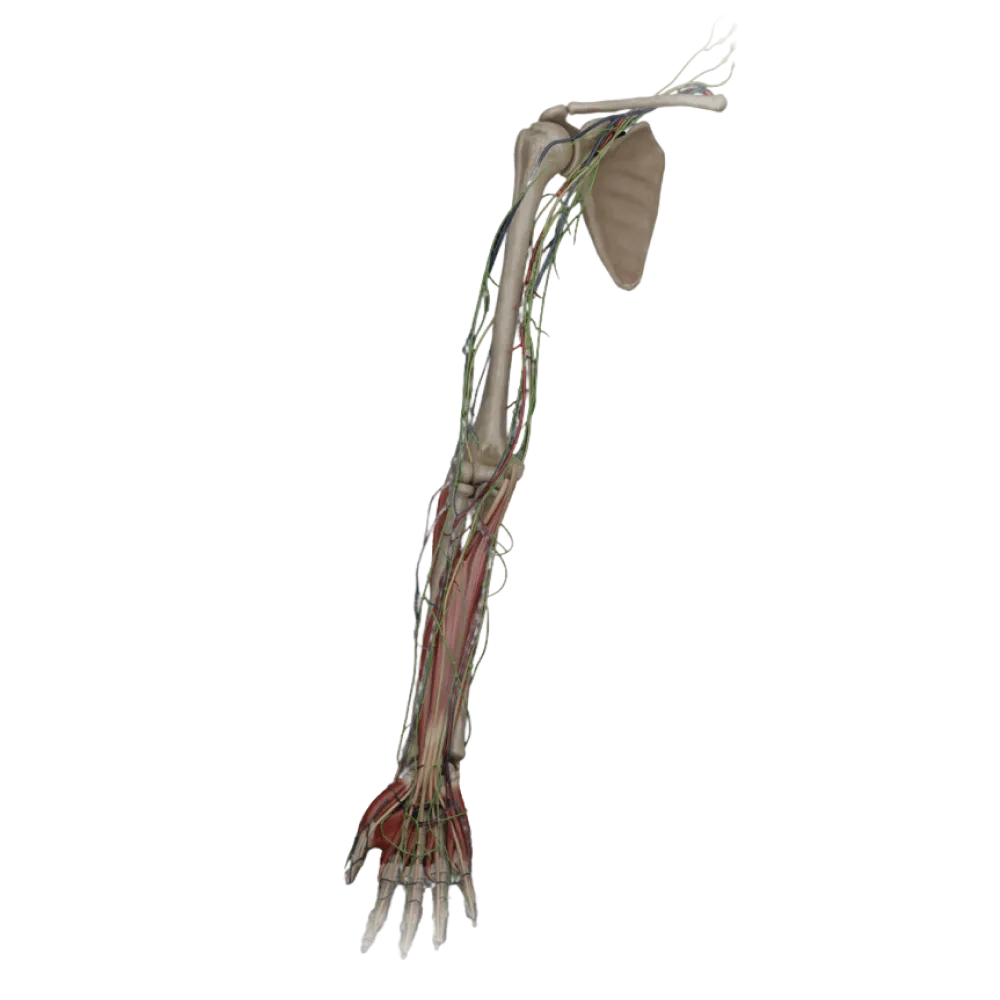

Acromioclavicular joint anatomy test
Evaluate knowledge of the acromioclavicular joint anatomy. The test evaluates the structure, ligamentous apparatus, muscles, blood supply, and innervation.
1/20
bold
text
1. To which type of joints by the shape of articular surfaces does the acromioclavicular joint belong?
-
Flat
The acromioclavicular joint is a planar joint (articulatio plana) permitting small amplitude gliding movements.
-
Ball-and-socket
The acromioclavicular joint is a planar joint (articulatio plana) permitting small amplitude gliding movements.
-
Ellipsoidal
The acromioclavicular joint is a planar joint (articulatio plana) permitting small amplitude gliding movements.
-
Saddle-shaped
The acromioclavicular joint is a planar joint (articulatio plana) permitting small amplitude gliding movements.
-
I find it difficult to answer
The acromioclavicular joint is a planar joint (articulatio plana) permitting small amplitude gliding movements.
2. Which ligament is the primary stabilizer of the acromioclavicular joint, limiting the upward movement of the clavicle?
-
Coracoacromial ligament
The coracoclavicular ligament (lig. coracoclaviculare) is a powerful ligament that firmly holds the acromial end of the clavicle to the scapula.
-
Acromioclavicular ligament
The coracoclavicular ligament (lig. coracoclaviculare) is a powerful ligament that firmly holds the acromial end of the clavicle to the scapula.
-
Transverse scapular ligament
The coracoclavicular ligament (lig. coracoclaviculare) is a powerful ligament that firmly holds the acromial end of the clavicle to the scapula.
-
Coracoclavicular ligament
The coracoclavicular ligament (lig. coracoclaviculare) is a powerful ligament that firmly holds the acromial end of the clavicle to the scapula.
-
I find it difficult to answer
The coracoclavicular ligament (lig. coracoclaviculare) is a powerful ligament that firmly holds the acromial end of the clavicle to the scapula.
3. What are the two anatomical parts of the coracoclavicular ligament?
-
The trapezoid and conoid ligaments
Ligamentum coracoclaviculare functionally and anatomically consists of lig. trapezoideum and lig. conoideum.
-
Deltoid and trapezoid ligaments
Ligamentum coracoclaviculare functionally and anatomically consists of lig. trapezoideum and lig. conoideum.
-
Superior and inferior acromioclavicular ligaments
Ligamentum coracoclaviculare functionally and anatomically consists of lig. trapezoideum and lig. conoideum.
-
Coracoacromial and coracohumeral ligaments
Ligamentum coracoclaviculare functionally and anatomically consists of lig. trapezoideum and lig. conoideum.
-
I find it difficult to answer
Ligamentum coracoclaviculare functionally and anatomically consists of lig. trapezoideum and lig. conoideum.
4. Which of the following ligaments attaches to the conoid tubercle of the clavicle?
-
Conoid ligament
The conoid ligament (lig. conoideum) attaches to the homonymous conoid tubercle (tuberculum conoideum) on the inferior surface of the clavicle.
-
Trapezoid ligament
The conoid ligament (lig. conoideum) attaches to the homonymous conoid tubercle (tuberculum conoideum) on the inferior surface of the clavicle.
-
Coracoacromial ligament
The conoid ligament (lig. conoideum) attaches to the homonymous conoid tubercle (tuberculum conoideum) on the inferior surface of the clavicle.
-
Acromioclavicular ligament
The conoid ligament (lig. conoideum) attaches to the homonymous conoid tubercle (tuberculum conoideum) on the inferior surface of the clavicle.
-
I find it difficult to answer
The conoid ligament (lig. conoideum) attaches to the homonymous conoid tubercle (tuberculum conoideum) on the inferior surface of the clavicle.
5. What type of cartilage usually covers the articular surfaces of the acromioclavicular joint?
-
Hyaline cartilage
The articular surfaces of this joint, like those of the sternoclavicular joint, are covered with durable fibrous cartilage, not the typical hyaline type.
-
Elastic cartilage
The articular surfaces of this joint, like those of the sternoclavicular joint, are covered with durable fibrous cartilage, not the typical hyaline type.
-
Fibrocartilage
The articular surfaces of this joint, like those of the sternoclavicular joint, are covered with durable fibrous cartilage, not the typical hyaline type.
-
Bone tissue without cartilage covering
The articular surfaces of this joint, like those of the sternoclavicular joint, are covered with durable fibrous cartilage, not the typical hyaline type.
-
I find it difficult to answer
The articular surfaces of this joint, like those of the sternoclavicular joint, are covered with durable fibrous cartilage, not the typical hyaline type.
6. What intra-articular structure is often found in the acromioclavicular joint, partially or completely dividing its cavity?
-
Intra-articular ligament.
In about 30-50% of cases, the joint cavity contains an articular disc (discus articularis), which may be incomplete.
-
Synovial fold
In about 30-50% of cases, the joint cavity contains an articular disc (discus articularis), which may be incomplete.
-
Fat pad
In about 30-50% of cases, the joint cavity contains an articular disc (discus articularis), which may be incomplete.
-
Articular disc
In about 30-50% of cases, the joint cavity contains an articular disc (discus articularis), which may be incomplete.
-
I find it difficult to answer
In about 30-50% of cases, the joint cavity contains an articular disc (discus articularis), which may be incomplete.
7. Branches of which artery are directly involved in the blood supply to the acromioclavicular joint?
-
Lateral thoracic artery
The acromial branch (ramus acromialis) of the thoracoacromial artery (a. thoracoacromialis) forms the acromial network nourishing the joint.
-
Thoracoacromial artery
The acromial branch (ramus acromialis) of the thoracoacromial artery (a. thoracoacromialis) forms the acromial network nourishing the joint.
-
Subscapular artery
The acromial branch (ramus acromialis) of the thoracoacromial artery (a. thoracoacromialis) forms the acromial network nourishing the joint.
-
Deep brachial artery
The acromial branch (ramus acromialis) of the thoracoacromial artery (a. thoracoacromialis) forms the acromial network nourishing the joint.
-
I find it difficult to answer
The acromial branch (ramus acromialis) of the thoracoacromial artery (a. thoracoacromialis) forms the acromial network nourishing the joint.
8. Which artery, alongside the thoracoacromial one, contributes to the formation of the acromial network for the blood supply of this joint?
-
Anterior circumflex humeral artery
The acromial network (rete acromiale) is formed by anastomoses between the acromial branch of the thoracoacromial artery and branches of the suprascapular artery.
-
Suprascapular artery
The acromial network (rete acromiale) is formed by anastomoses between the acromial branch of the thoracoacromial artery and branches of the suprascapular artery.
-
Superior thoracic artery
The acromial network (rete acromiale) is formed by anastomoses between the acromial branch of the thoracoacromial artery and branches of the suprascapular artery.
-
Circumflex scapular artery
The acromial network (rete acromiale) is formed by anastomoses between the acromial branch of the thoracoacromial artery and branches of the suprascapular artery.
-
I find it difficult to answer
The acromial network (rete acromiale) is formed by anastomoses between the acromial branch of the thoracoacromial artery and branches of the suprascapular artery.
9. Which nerve is one of the main sources of sensory innervation of the acromioclavicular joint capsule?
-
Axillary nerve
The suprascapular nerve (n. suprascapularis) contributes sensory articular branches to the acromioclavicular and shoulder joints.
-
Musculocutaneous nerve
The suprascapular nerve (n. suprascapularis) contributes sensory articular branches to the acromioclavicular and shoulder joints.
-
Radial nerve
The suprascapular nerve (n. suprascapularis) contributes sensory articular branches to the acromioclavicular and shoulder joints.
-
Suprascapular nerve
The suprascapular nerve (n. suprascapularis) contributes sensory articular branches to the acromioclavicular and shoulder joints.
-
I find it difficult to answer
The suprascapular nerve (n. suprascapularis) contributes sensory articular branches to the acromioclavicular and shoulder joints.
10. Which additional nerve (from the short branches of the brachial plexus) can also innervate the acromioclavicular joint?
-
Lateral pectoral nerve
The lateral pectoral nerve (n. pectoralis lateralis) often provides branches to the capsule of the acromioclavicular joint.
-
Medial pectoral nerve
The lateral pectoral nerve (n. pectoralis lateralis) often provides branches to the capsule of the acromioclavicular joint.
-
Long thoracic nerve
The lateral pectoral nerve (n. pectoralis lateralis) often provides branches to the capsule of the acromioclavicular joint.
-
Axillary nerve
The lateral pectoral nerve (n. pectoralis lateralis) often provides branches to the capsule of the acromioclavicular joint.
-
I find it difficult to answer
The lateral pectoral nerve (n. pectoralis lateralis) often provides branches to the capsule of the acromioclavicular joint.
11. Which muscle attaches to the lateral third of the clavicle and the acromion, beginning from them and acting on the shoulder joint?
-
Pectoralis major muscle
The deltoid muscle (m. deltoideus) originates from the lateral third of the clavicle, acromion, and spine of the scapula, surrounding the joint.
-
Supraspinatus muscle
The deltoid muscle (m. deltoideus) originates from the lateral third of the clavicle, acromion, and spine of the scapula, surrounding the joint.
-
Biceps brachii
The deltoid muscle (m. deltoideus) originates from the lateral third of the clavicle, acromion, and spine of the scapula, surrounding the joint.
-
Deltoid muscle
The deltoid muscle (m. deltoideus) originates from the lateral third of the clavicle, acromion, and spine of the scapula, surrounding the joint.
-
I find it difficult to answer
The deltoid muscle (m. deltoideus) originates from the lateral third of the clavicle, acromion, and spine of the scapula, surrounding the joint.
12. Which muscle attaches to the acromial end of the clavicle and the acromion above, providing movement to the scapula and indirectly to the clavicle?
-
Rhomboid muscle
The trapezius muscle (m. trapezius) attaches to the acromial end of the clavicle, acromion, and spine of the scapula.
-
Trapezius muscle
The trapezius muscle (m. trapezius) attaches to the acromial end of the clavicle, acromion, and spine of the scapula.
-
Levator scapulae.
The trapezius muscle (m. trapezius) attaches to the acromial end of the clavicle, acromion, and spine of the scapula.
-
Serratus anterior muscle
The trapezius muscle (m. trapezius) attaches to the acromial end of the clavicle, acromion, and spine of the scapula.
-
I find it difficult to answer
The trapezius muscle (m. trapezius) attaches to the acromial end of the clavicle, acromion, and spine of the scapula.
13. How is the trapezoid ligament topographically positioned in relation to the conoid ligament?
-
Precisely above
The trapezoid ligament (lig. trapezoideum) lies more laterally and anteriorly compared to the conoid ligament.
-
Precisely below
The trapezoid ligament (lig. trapezoideum) lies more laterally and anteriorly compared to the conoid ligament.
-
Laterally and anteriorly
The trapezoid ligament (lig. trapezoideum) lies more laterally and anteriorly compared to the conoid ligament.
-
Medially and posteriorly
The trapezoid ligament (lig. trapezoideum) lies more laterally and anteriorly compared to the conoid ligament.
-
I find it difficult to answer
The trapezoid ligament (lig. trapezoideum) lies more laterally and anteriorly compared to the conoid ligament.
14. Where is the attachment site of the trapezoid ligament on the clavicle?
-
Conoid tubercle
The trapezoid ligament attaches to the trapezoid line (linea trapezoidea) on the inferior surface of the acromial end of the clavicle.
-
Trapezoid line
The trapezoid ligament attaches to the trapezoid line (linea trapezoidea) on the inferior surface of the acromial end of the clavicle.
-
Impression for costoclavicular ligament
The trapezoid ligament attaches to the trapezoid line (linea trapezoidea) on the inferior surface of the acromial end of the clavicle.
-
Groove for subclavian muscle
The trapezoid ligament attaches to the trapezoid line (linea trapezoidea) on the inferior surface of the acromial end of the clavicle.
-
I find it difficult to answer
The trapezoid ligament attaches to the trapezoid line (linea trapezoidea) on the inferior surface of the acromial end of the clavicle.
15. What movements are normally possible in the acromioclavicular joint?
-
Extensive circular movements
The joint is flat, multi-axial, but with very limited range of motion (amphiarthrosis), allowing slight gliding and scapular rotation.
-
High amplitude flexion and extension
The joint is flat, multi-axial, but with very limited range of motion (amphiarthrosis), allowing slight gliding and scapular rotation.
-
Slight gliding movements and scapular rotation
The joint is flat, multi-axial, but with very limited range of motion (amphiarthrosis), allowing slight gliding and scapular rotation.
-
Only rigid fixation, no movements
The joint is flat, multi-axial, but with very limited range of motion (amphiarthrosis), allowing slight gliding and scapular rotation.
-
I find it difficult to answer
The joint is flat, multi-axial, but with very limited range of motion (amphiarthrosis), allowing slight gliding and scapular rotation.
16. Which ligament strengthens the capsule of the acromioclavicular joint directly from above, interweaving with it?
-
Coracoacromial ligament
The acromioclavicular ligament (lig. acromioclaviculare) traverses between the acromion and the clavicle above the joint capsule, reinforcing its upper part.
-
Transverse scapular ligament
The acromioclavicular ligament (lig. acromioclaviculare) traverses between the acromion and the clavicle above the joint capsule, reinforcing its upper part.
-
Acromioclavicular ligament
The acromioclavicular ligament (lig. acromioclaviculare) traverses between the acromion and the clavicle above the joint capsule, reinforcing its upper part.
-
Conoid ligament
The acromioclavicular ligament (lig. acromioclaviculare) traverses between the acromion and the clavicle above the joint capsule, reinforcing its upper part.
-
I find it difficult to answer
The acromioclavicular ligament (lig. acromioclaviculare) traverses between the acromion and the clavicle above the joint capsule, reinforcing its upper part.
17. With which joint does the acromioclavicular joint biomechanically pair during shoulder girdle movements?
-
Glenohumeral joint
Movements in the acromioclavicular joint always occur simultaneously with those in the sternoclavicular joint, functionally they are combined.
-
Sternoclavicular joint
Movements in the acromioclavicular joint always occur simultaneously with those in the sternoclavicular joint, functionally they are combined.
-
Elbow joint
Movements in the acromioclavicular joint always occur simultaneously with those in the sternoclavicular joint, functionally they are combined.
-
Costotransverse joint
Movements in the acromioclavicular joint always occur simultaneously with those in the sternoclavicular joint, functionally they are combined.
-
I find it difficult to answer
Movements in the acromioclavicular joint always occur simultaneously with those in the sternoclavicular joint, functionally they are combined.
18. Which muscle, attaching to the coracoid process of the scapula, is located in close topographical proximity to the coracoclavicular ligament?
-
Pectoralis major muscle
The pectoralis minor muscle (m. pectoralis minor) attaches to the coracoid process, located near the coracoclavicular ligament.
-
Subscapular muscle
The pectoralis minor muscle (m. pectoralis minor) attaches to the coracoid process, located near the coracoclavicular ligament.
-
Supraspinatus muscle
The pectoralis minor muscle (m. pectoralis minor) attaches to the coracoid process, located near the coracoclavicular ligament.
-
Pectoralis minor muscle
The pectoralis minor muscle (m. pectoralis minor) attaches to the coracoid process, located near the coracoclavicular ligament.
-
I find it difficult to answer
The pectoralis minor muscle (m. pectoralis minor) attaches to the coracoid process, located near the coracoclavicular ligament.
19. Venous drainage from the acromioclavicular joint is predominantly through the system of:
-
Axillary and subclavian veins
Veins accompanying the homonymous arteries (v. thoracoacromialis, v. suprascapularis), drain into the axillary (v. axillaris) and subclavian (v. subclavia) veins.
-
Internal jugular vein
Veins accompanying the homonymous arteries (v. thoracoacromialis, v. suprascapularis), drain into the axillary (v. axillaris) and subclavian (v. subclavia) veins.
-
Azygos vein
Veins accompanying the homonymous arteries (v. thoracoacromialis, v. suprascapularis), drain into the axillary (v. axillaris) and subclavian (v. subclavia) veins.
-
Brachiocephalic vein directly
Veins accompanying the homonymous arteries (v. thoracoacromialis, v. suprascapularis), drain into the axillary (v. axillaris) and subclavian (v. subclavia) veins.
-
I find it difficult to answer
Veins accompanying the homonymous arteries (v. thoracoacromialis, v. suprascapularis), drain into the axillary (v. axillaris) and subclavian (v. subclavia) veins.
20. What shoulder arch structure overhangs the shoulder joint, originating from the process participating in the formation of the acromioclavicular joint?
-
Coracohumeral ligament
The coracoacromial ligament (lig. coracoacromiale) is stretched between the coracoid process and the acromion, forming the shoulder arch with them.
-
Transverse ligament of the shoulder
The coracoacromial ligament (lig. coracoacromiale) is stretched between the coracoid process and the acromion, forming the shoulder arch with them.
-
Coracoacromial ligament
The coracoacromial ligament (lig. coracoacromiale) is stretched between the coracoid process and the acromion, forming the shoulder arch with them.
-
Tendon of the long head of biceps
The coracoacromial ligament (lig. coracoacromiale) is stretched between the coracoid process and the acromion, forming the shoulder arch with them.
-
I find it difficult to answer
The coracoacromial ligament (lig. coracoacromiale) is stretched between the coracoid process and the acromion, forming the shoulder arch with them.
Retake this quiz?
Your current progress will be reset.