1/20
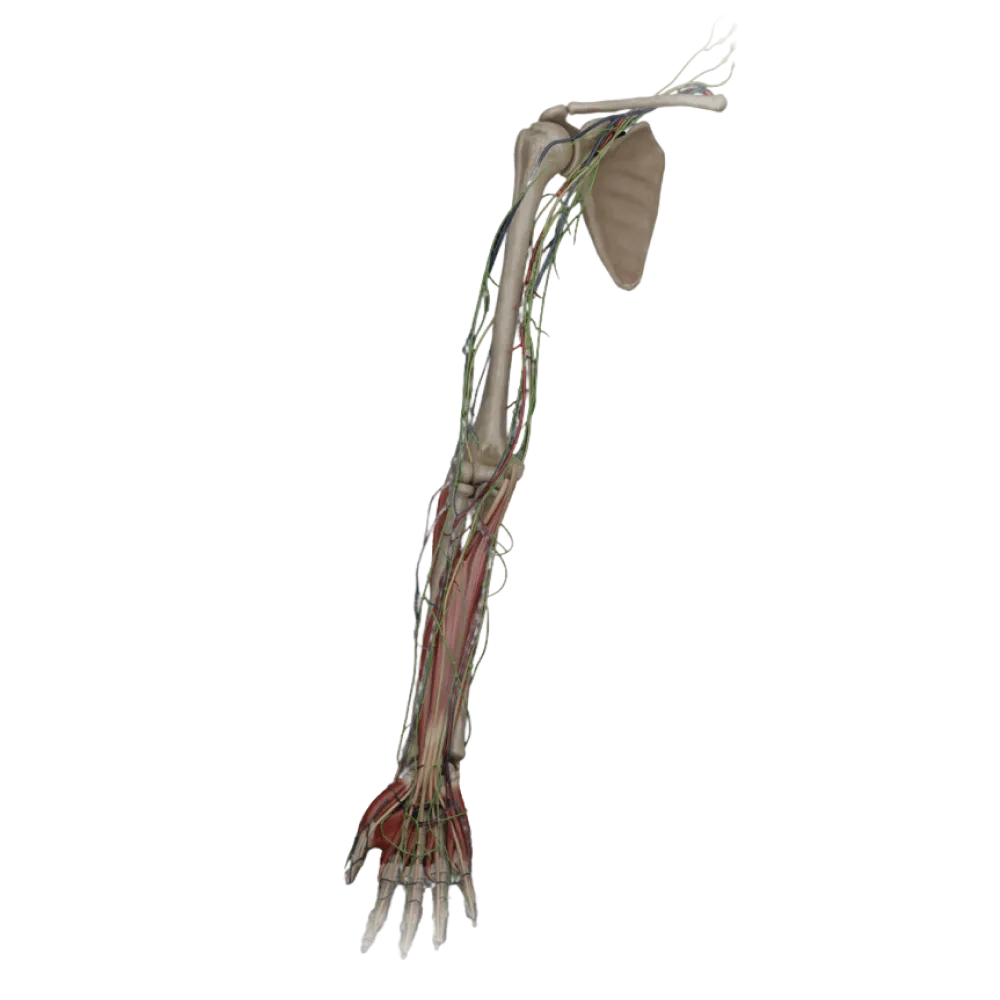

Upper limb joints anatomy test
Evaluate knowledge of upper limb joints anatomy. The test examines the structure, classification, ligamentous apparatus, and biomechanics of the joints.
1. Which joint is saddle-shaped in terms of articular surfaces but functionally approaches a ball-and-socket joint?
-
Acromioclavicular
The sternoclavicular joint has saddle-shaped articular surfaces, but the presence of an articular disc permits movements around three axes.
-
Sternoclavicular
The sternoclavicular joint has saddle-shaped articular surfaces, but the presence of an articular disc permits movements around three axes.
-
Shoulder
The sternoclavicular joint has saddle-shaped articular surfaces, but the presence of an articular disc permits movements around three axes.
-
Humeroulnar
The sternoclavicular joint has saddle-shaped articular surfaces, but the presence of an articular disc permits movements around three axes.
-
I find it difficult to answer
The sternoclavicular joint has saddle-shaped articular surfaces, but the presence of an articular disc permits movements around three axes.
2. Which ligament is not associated with the sternoclavicular joint?
-
Anterior sternoclavicular ligament
The coracoclavicular ligament strengthens the acromioclavicular joint by connecting the coracoid process of the scapula to the clavicle.
-
Interclavicular ligament
The coracoclavicular ligament strengthens the acromioclavicular joint by connecting the coracoid process of the scapula to the clavicle.
-
Costoclavicular ligament
The coracoclavicular ligament strengthens the acromioclavicular joint by connecting the coracoid process of the scapula to the clavicle.
-
Coracoclavicular ligament
The coracoclavicular ligament strengthens the acromioclavicular joint by connecting the coracoid process of the scapula to the clavicle.
-
I find it difficult to answer
The coracoclavicular ligament strengthens the acromioclavicular joint by connecting the coracoid process of the scapula to the clavicle.
3. Which ligament belongs to the intrinsic ligaments of the scapula and forms the glenoid arch?
-
Coracoacromial ligament
The coracoacromial ligament is stretched between the coracoid process and the acromion, forming the glenoid arch.
-
Acromioclavicular ligament
The coracoacromial ligament is stretched between the coracoid process and the acromion, forming the glenoid arch.
-
Superior transverse scapular ligament
The coracoacromial ligament is stretched between the coracoid process and the acromion, forming the glenoid arch.
-
Coracohumeral ligament
The coracoacromial ligament is stretched between the coracoid process and the acromion, forming the glenoid arch.
-
I find it difficult to answer
The coracoacromial ligament is stretched between the coracoid process and the acromion, forming the glenoid arch.
4. What anatomical structure passes within the glenohumeral joint cavity?
-
Tendon of the short head of biceps brachii muscle
The tendon of the long head of the biceps brachii muscle originates from the supraglenoid tubercle of the scapula and passes through the joint cavity.
-
Tendon of the long head of biceps brachii muscle
The tendon of the long head of the biceps brachii muscle originates from the supraglenoid tubercle of the scapula and passes through the joint cavity.
-
Tendon of the long head of triceps brachii muscle
The tendon of the long head of the biceps brachii muscle originates from the supraglenoid tubercle of the scapula and passes through the joint cavity.
-
Coracohumeral ligament
The tendon of the long head of the biceps brachii muscle originates from the supraglenoid tubercle of the scapula and passes through the joint cavity.
-
I find it difficult to answer
The tendon of the long head of the biceps brachii muscle originates from the supraglenoid tubercle of the scapula and passes through the joint cavity.
5. What type of joint in terms of shape does the glenohumeral joint belong to?
-
Hinge
The glenohumeral joint is formed by the head of the humerus and the glenoid cavity of the scapula, being a typical multi-axial ball-and-socket joint.
-
Ellipsoidal
The glenohumeral joint is formed by the head of the humerus and the glenoid cavity of the scapula, being a typical multi-axial ball-and-socket joint.
-
Ball-and-socket
The glenohumeral joint is formed by the head of the humerus and the glenoid cavity of the scapula, being a typical multi-axial ball-and-socket joint.
-
Saddle-shaped
The glenohumeral joint is formed by the head of the humerus and the glenoid cavity of the scapula, being a typical multi-axial ball-and-socket joint.
-
I find it difficult to answer
The glenohumeral joint is formed by the head of the humerus and the glenoid cavity of the scapula, being a typical multi-axial ball-and-socket joint.
6. How many simple joints are enclosed in a common capsule of the elbow joint?
-
Two
The elbow joint comprises three joints: the humeroulnar, humeroradial, and proximal radioulnar joints.
-
Three
The elbow joint comprises three joints: the humeroulnar, humeroradial, and proximal radioulnar joints.
-
Four
The elbow joint comprises three joints: the humeroulnar, humeroradial, and proximal radioulnar joints.
-
Five
The elbow joint comprises three joints: the humeroulnar, humeroradial, and proximal radioulnar joints.
-
I find it difficult to answer
The elbow joint comprises three joints: the humeroulnar, humeroradial, and proximal radioulnar joints.
7. Which of the joints, part of the elbow, is a typical cylindrical joint?
-
Humeroulnar joint
The proximal radioulnar joint is formed by the articular circumference of the radius and the ulnar notch of the ulna, allowing rotation.
-
Radiocapitellar joint
The proximal radioulnar joint is formed by the articular circumference of the radius and the ulnar notch of the ulna, allowing rotation.
-
Proximal radioulnar joint
The proximal radioulnar joint is formed by the articular circumference of the radius and the ulnar notch of the ulna, allowing rotation.
-
Distal radioulnar joint
The proximal radioulnar joint is formed by the articular circumference of the radius and the ulnar notch of the ulna, allowing rotation.
-
I find it difficult to answer
The proximal radioulnar joint is formed by the articular circumference of the radius and the ulnar notch of the ulna, allowing rotation.
8. Which ligament encircles the neck of the radius and holds it against the ulna?
-
Annular ligament of the radius
The annular ligament of the radius attaches to the edges of the radial notch of the ulna, encircling the articular circumference of the radius.
-
Ulnar collateral ligament
The annular ligament of the radius attaches to the edges of the radial notch of the ulna, encircling the articular circumference of the radius.
-
Radial collateral ligament
The annular ligament of the radius attaches to the edges of the radial notch of the ulna, encircling the articular circumference of the radius.
-
Quadrate ligament
The annular ligament of the radius attaches to the edges of the radial notch of the ulna, encircling the articular circumference of the radius.
-
I find it difficult to answer
The annular ligament of the radius attaches to the edges of the radial notch of the ulna, encircling the articular circumference of the radius.
9. Which bone does not take direct part in the formation of the radiocarpal joint?
-
Radius
The ulna is separated from the radiocarpal joint by an articular disc and does not directly articulate with the carpal bones.
-
Ulna
The ulna is separated from the radiocarpal joint by an articular disc and does not directly articulate with the carpal bones.
-
Navicular bone
The ulna is separated from the radiocarpal joint by an articular disc and does not directly articulate with the carpal bones.
-
Lunate bone
The ulna is separated from the radiocarpal joint by an articular disc and does not directly articulate with the carpal bones.
-
I find it difficult to answer
The ulna is separated from the radiocarpal joint by an articular disc and does not directly articulate with the carpal bones.
10. What type of joint in terms of shape does the radiocarpal joint belong to?
-
Cylinder-shaped
The radiocarpal joint is a complex, biaxial ellipsoidal joint, allowing flexion-extension and abduction-adduction.
-
Hinge
The radiocarpal joint is a complex, biaxial ellipsoidal joint, allowing flexion-extension and abduction-adduction.
-
Saddle-shaped
The radiocarpal joint is a complex, biaxial ellipsoidal joint, allowing flexion-extension and abduction-adduction.
-
Ellipsoidal
The radiocarpal joint is a complex, biaxial ellipsoidal joint, allowing flexion-extension and abduction-adduction.
-
I find it difficult to answer
The radiocarpal joint is a complex, biaxial ellipsoidal joint, allowing flexion-extension and abduction-adduction.
11. Where is the midcarpal joint located?
-
Between the bones of the proximal and distal rows of the carpus
The midcarpal joint is located between the first (excluding the pisiform bone) and second rows of carpal bones.
-
Between the forearm bones and the proximal row of the carpus
The midcarpal joint is located between the first (excluding the pisiform bone) and second rows of carpal bones.
-
Between the distal row of carpal bones and the metacarpal bones
The midcarpal joint is located between the first (excluding the pisiform bone) and second rows of carpal bones.
-
Between individual bones of the proximal carpal row
The midcarpal joint is located between the first (excluding the pisiform bone) and second rows of carpal bones.
-
I find it difficult to answer
The midcarpal joint is located between the first (excluding the pisiform bone) and second rows of carpal bones.
12. Which joint in the hand is the classic example of a saddle joint?
-
Radiocarpal joint
The carpometacarpal joint of the first digit is formed by the trapezium and the base of the first metacarpal bone, providing high mobility.
-
Carpometacarpal joint of the thumb
The carpometacarpal joint of the first digit is formed by the trapezium and the base of the first metacarpal bone, providing high mobility.
-
Metacarpophalangeal joint of the thumb
The carpometacarpal joint of the first digit is formed by the trapezium and the base of the first metacarpal bone, providing high mobility.
-
Interphalangeal joint
The carpometacarpal joint of the first digit is formed by the trapezium and the base of the first metacarpal bone, providing high mobility.
-
I find it difficult to answer
The carpometacarpal joint of the first digit is formed by the trapezium and the base of the first metacarpal bone, providing high mobility.
13. Which movement is not possible in the metacarpophalangeal joints of digits II-V?
-
Flexion and extension
The metacarpophalangeal joints are ellipsoidal (biaxial), so active rotation (circumduction) is not possible.
-
Abduction and adduction
The metacarpophalangeal joints are ellipsoidal (biaxial), so active rotation (circumduction) is not possible.
-
Circumduction
The metacarpophalangeal joints are ellipsoidal (biaxial), so active rotation (circumduction) is not possible.
-
Active rotation about the longitudinal axis
The metacarpophalangeal joints are ellipsoidal (biaxial), so active rotation (circumduction) is not possible.
-
I find it difficult to answer
The metacarpophalangeal joints are ellipsoidal (biaxial), so active rotation (circumduction) is not possible.
14. What type of joints do the interphalangeal joints of the hand belong to?
-
Hinge
The interphalangeal joints are typical uniaxial hinge joints, allowing only flexion and extension.
-
Ball-and-socket
The interphalangeal joints are typical uniaxial hinge joints, allowing only flexion and extension.
-
Plane
The interphalangeal joints are typical uniaxial hinge joints, allowing only flexion and extension.
-
Cylindrical
The interphalangeal joints are typical uniaxial hinge joints, allowing only flexion and extension.
-
I find it difficult to answer
The interphalangeal joints are typical uniaxial hinge joints, allowing only flexion and extension.
15. What is related to continuous connections (syndesmoses) of forearm bones?
-
Annular ligament of the radius
The interosseous membrane of the forearm is a fibrous membrane connecting the interosseous borders of the radius and ulna.
-
Interosseous membrane of the forearm
The interosseous membrane of the forearm is a fibrous membrane connecting the interosseous borders of the radius and ulna.
-
Radial collateral ligament
The interosseous membrane of the forearm is a fibrous membrane connecting the interosseous borders of the radius and ulna.
-
Articular disc of the radiocarpal joint
The interosseous membrane of the forearm is a fibrous membrane connecting the interosseous borders of the radius and ulna.
-
I find it difficult to answer
The interosseous membrane of the forearm is a fibrous membrane connecting the interosseous borders of the radius and ulna.
16. With which structure does the head of the humerus articulate?
-
With the acromion of the scapula
The head of the humerus articulates with the glenoid cavity of the scapula (cavitas glenoidalis), forming the glenohumeral joint.
-
With the coracoid process of the scapula
The head of the humerus articulates with the glenoid cavity of the scapula (cavitas glenoidalis), forming the glenohumeral joint.
-
With the glenoid cavity of the scapula
The head of the humerus articulates with the glenoid cavity of the scapula (cavitas glenoidalis), forming the glenohumeral joint.
-
With the articular disc
The head of the humerus articulates with the glenoid cavity of the scapula (cavitas glenoidalis), forming the glenohumeral joint.
-
I find it difficult to answer
The head of the humerus articulates with the glenoid cavity of the scapula (cavitas glenoidalis), forming the glenohumeral joint.
17. What increases the congruence of the articular surfaces in the glenohumeral joint?
-
Articular disc
The glenoid labrum (labrum glenoidale) attaches to the edge of the glenoid cavity of the scapula, deepening it and increasing the surface area.
-
Articular meniscus
The glenoid labrum (labrum glenoidale) attaches to the edge of the glenoid cavity of the scapula, deepening it and increasing the surface area.
-
Glenoid labrum
The glenoid labrum (labrum glenoidale) attaches to the edge of the glenoid cavity of the scapula, deepening it and increasing the surface area.
-
Synovial bursa
The glenoid labrum (labrum glenoidale) attaches to the edge of the glenoid cavity of the scapula, deepening it and increasing the surface area.
-
I find it difficult to answer
The glenoid labrum (labrum glenoidale) attaches to the edge of the glenoid cavity of the scapula, deepening it and increasing the surface area.
18. Which ligament strengthens the capsule of the glenohumeral joint anteriorly?
-
Coracohumeral ligament
The coracohumeral ligament weaves into the capsule of the glenohumeral joint anteriorly, limiting extension and lateral rotation of the arm.
-
Coracoacromial ligament
The coracohumeral ligament weaves into the capsule of the glenohumeral joint anteriorly, limiting extension and lateral rotation of the arm.
-
Superior transverse scapular ligament
The coracohumeral ligament weaves into the capsule of the glenohumeral joint anteriorly, limiting extension and lateral rotation of the arm.
-
Acromioclavicular ligament
The coracohumeral ligament weaves into the capsule of the glenohumeral joint anteriorly, limiting extension and lateral rotation of the arm.
-
I find it difficult to answer
The coracohumeral ligament weaves into the capsule of the glenohumeral joint anteriorly, limiting extension and lateral rotation of the arm.
19. In which joint does pronation and supination of the forearm occur?
-
Only in the distal radioulnar
The proximal and distal radioulnar joints form a combined cylindrical joint facilitating rotation of the radius.
-
In the humeroulnar and humeroradial joints
The proximal and distal radioulnar joints form a combined cylindrical joint facilitating rotation of the radius.
-
In the proximal and distal radioulnar joints
The proximal and distal radioulnar joints form a combined cylindrical joint facilitating rotation of the radius.
-
In the radiocarpal joint
The proximal and distal radioulnar joints form a combined cylindrical joint facilitating rotation of the radius.
-
I find it difficult to answer
The proximal and distal radioulnar joints form a combined cylindrical joint facilitating rotation of the radius.
20. Which joint is classified as a plane multiaxial but slightly movable joint (amphiarthrosis)?
-
Sternoclavicular joint
The carpometacarpal joints of fingers II-V are plane, rigid joints firmly connected by ligaments (the firm base of the hand).
-
Radiocapitellar joint
The carpometacarpal joints of fingers II-V are plane, rigid joints firmly connected by ligaments (the firm base of the hand).
-
Carpometacarpal joint of the thumb
The carpometacarpal joints of fingers II-V are plane, rigid joints firmly connected by ligaments (the firm base of the hand).
-
Carpometacarpal joints of fingers II-V
The carpometacarpal joints of fingers II-V are plane, rigid joints firmly connected by ligaments (the firm base of the hand).
-
I find it difficult to answer
The carpometacarpal joints of fingers II-V are plane, rigid joints firmly connected by ligaments (the firm base of the hand).
Retake this quiz?
Your current progress will be reset.