
Hand bones anatomy quiz
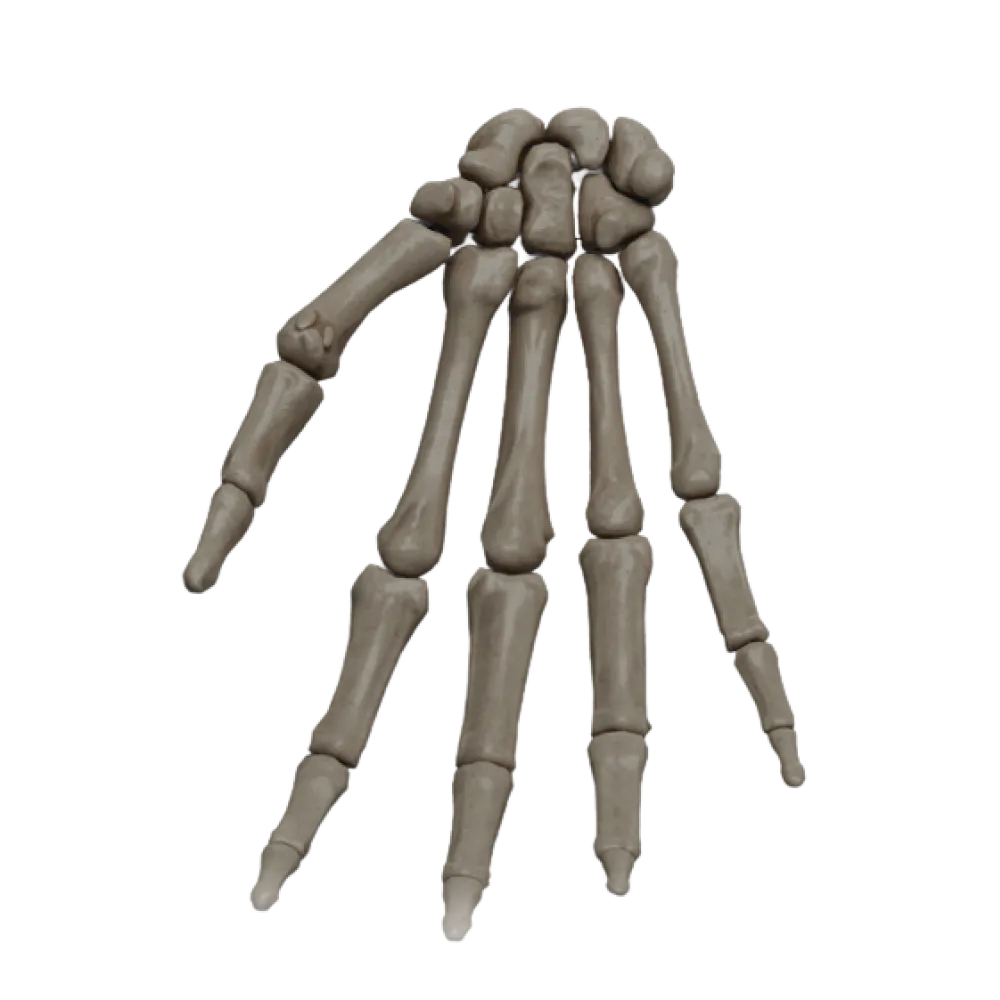
Assess the knowledge of hand osteology. The test examines the anatomy of the carpal, metacarpal, and phalangeal bones, their topography, articular surfaces, and processes.
1/20
bold
text
1. Which bone of the proximal carpal row is most laterally located?
-
Navicular bone.
The scaphoid bone (os scaphoideum) occupies the most lateral position in the proximal carpal row.
-
Lunate bone
The scaphoid bone (os scaphoideum) occupies the most lateral position in the proximal carpal row.
-
Trihedral bone
The scaphoid bone (os scaphoideum) occupies the most lateral position in the proximal carpal row.
-
Pisiform bone
The scaphoid bone (os scaphoideum) occupies the most lateral position in the proximal carpal row.
-
I find it difficult to answer
The scaphoid bone (os scaphoideum) occupies the most lateral position in the proximal carpal row.
2. Which carpal bone is characterized by having a hook-shaped process (hamulus)?
-
Capitate bone
The hamate bone (os hamatum) is easily recognized by its hooked process, which protrudes on the palmar surface.
-
Trapezium
The hamate bone (os hamatum) is easily recognized by its hooked process, which protrudes on the palmar surface.
-
Trapezoid
The hamate bone (os hamatum) is easily recognized by its hooked process, which protrudes on the palmar surface.
-
Uncinate bone
The hamate bone (os hamatum) is easily recognized by its hooked process, which protrudes on the palmar surface.
-
I find it difficult to answer
The hamate bone (os hamatum) is easily recognized by its hooked process, which protrudes on the palmar surface.
3. Which carpal bone is the largest and occupies a central position in the distal row?
-
Navicular bone.
The capitate bone (os capitatum) is the largest component of the carpus, located at the center of the distal row.
-
Uncinate bone
The capitate bone (os capitatum) is the largest component of the carpus, located at the center of the distal row.
-
Capitate bone
The capitate bone (os capitatum) is the largest component of the carpus, located at the center of the distal row.
-
Trapezoid
The capitate bone (os capitatum) is the largest component of the carpus, located at the center of the distal row.
-
I find it difficult to answer
The capitate bone (os capitatum) is the largest component of the carpus, located at the center of the distal row.
4. The base of the first metacarpal bone articulates with which carpal bone?
-
Trapezium
The saddle joint of the thumb is formed by the articulation of the base of the first metacarpal bone and the trapezium bone (os trapezium).
-
Trapezoid
The saddle joint of the thumb is formed by the articulation of the base of the first metacarpal bone and the trapezium bone (os trapezium).
-
Capitate bone
The saddle joint of the thumb is formed by the articulation of the base of the first metacarpal bone and the trapezium bone (os trapezium).
-
Navicular bone.
The saddle joint of the thumb is formed by the articulation of the base of the first metacarpal bone and the trapezium bone (os trapezium).
-
I find it difficult to answer
The saddle joint of the thumb is formed by the articulation of the base of the first metacarpal bone and the trapezium bone (os trapezium).
5. To which group do the pisiform bones (os pisiforme) belong according to the classification?
-
Tubular bones
The pisiform bone is a sesamoid bone located within the tendon of the flexor carpi ulnaris.
-
Sesamoid bones
The pisiform bone is a sesamoid bone located within the tendon of the flexor carpi ulnaris.
-
Flat bones
The pisiform bone is a sesamoid bone located within the tendon of the flexor carpi ulnaris.
-
Air-filled bones
The pisiform bone is a sesamoid bone located within the tendon of the flexor carpi ulnaris.
-
I find it difficult to answer
The pisiform bone is a sesamoid bone located within the tendon of the flexor carpi ulnaris.
6. Which carpal bone predominantly articulates with the lateral articular surface of the radius?
-
Navicular bone
The scaphoid bone articulates with the lateral part of the radial articular surface, participating in the radiocarpal joint.
-
Lunate bone
The scaphoid bone articulates with the lateral part of the radial articular surface, participating in the radiocarpal joint.
-
Triquetral bone
The scaphoid bone articulates with the lateral part of the radial articular surface, participating in the radiocarpal joint.
-
Capitate bone
The scaphoid bone articulates with the lateral part of the radial articular surface, participating in the radiocarpal joint.
-
I find it difficult to answer
The scaphoid bone articulates with the lateral part of the radial articular surface, participating in the radiocarpal joint.
7. Which bone of the distal carpal row is positioned most medially?
-
Capitate bone
The hamate bone (os hamatum) is located on the very edge of the medial (ulnar) side of the distal row.
-
Uncinate bone
The hamate bone (os hamatum) is located on the very edge of the medial (ulnar) side of the distal row.
-
Trapezoid
The hamate bone (os hamatum) is located on the very edge of the medial (ulnar) side of the distal row.
-
Trapezium
The hamate bone (os hamatum) is located on the very edge of the medial (ulnar) side of the distal row.
-
I find it difficult to answer
The hamate bone (os hamatum) is located on the very edge of the medial (ulnar) side of the distal row.
8. With which bone does the pisiform bone articulate its only articular surface?
-
Radius
The pisiform bone articulates exclusively with the anterior (palmar) surface of the triquetral bone.
-
Hamate bone
The pisiform bone articulates exclusively with the anterior (palmar) surface of the triquetral bone.
-
Lunate bone
The pisiform bone articulates exclusively with the anterior (palmar) surface of the triquetral bone.
-
Triquetral bone
The pisiform bone articulates exclusively with the anterior (palmar) surface of the triquetral bone.
-
I find it difficult to answer
The pisiform bone articulates exclusively with the anterior (palmar) surface of the triquetral bone.
9. On the base of which metacarpal bone on the dorsal side is there a styloid process (processus styloideus)?
-
On the first metacarpal bone
A characteristic styloid process (processus styloideus) is located on the dorsolateral part of the base of the third metacarpal bone.
-
On the second metacarpal bone
A characteristic styloid process (processus styloideus) is located on the dorsolateral part of the base of the third metacarpal bone.
-
On the third metacarpal bone
A characteristic styloid process (processus styloideus) is located on the dorsolateral part of the base of the third metacarpal bone.
-
On the fifth metacarpal bone
A characteristic styloid process (processus styloideus) is located on the dorsolateral part of the base of the third metacarpal bone.
-
I find it difficult to answer
A characteristic styloid process (processus styloideus) is located on the dorsolateral part of the base of the third metacarpal bone.
10. Which bones form the lateral eminence of the wrist (eminentia carpi radialis)?
-
Scaphoid and lunate bones
The radial wrist eminence is formed by the tubercles of the scaphoid and trapezium bones.
-
The scaphoid bone and the trapezium
The radial wrist eminence is formed by the tubercles of the scaphoid and trapezium bones.
-
Trapezoid and capitate bones
The radial wrist eminence is formed by the tubercles of the scaphoid and trapezium bones.
-
Capitate and hamate bones
The radial wrist eminence is formed by the tubercles of the scaphoid and trapezium bones.
-
I find it difficult to answer
The radial wrist eminence is formed by the tubercles of the scaphoid and trapezium bones.
11. Which carpal bone has a half-moon shape and is located between the scaphoid and triquetral bones?
-
Pisiform bone
The lunate bone (os lunatum) is located at the center of the proximal row, having a characteristic concave surface.
-
Capitate bone
The lunate bone (os lunatum) is located at the center of the proximal row, having a characteristic concave surface.
-
Trapezoid
The lunate bone (os lunatum) is located at the center of the proximal row, having a characteristic concave surface.
-
Lunate bone
The lunate bone (os lunatum) is located at the center of the proximal row, having a characteristic concave surface.
-
I find it difficult to answer
The lunate bone (os lunatum) is located at the center of the proximal row, having a characteristic concave surface.
12. What is the name of the part of a metacarpal bone that has a spherical articular surface for articulation with the proximal phalanx?
-
Head
The head (caput) of a metacarpal bone represents the distal epiphysis, articulating with the corresponding phalanx.
-
Body
The head (caput) of a metacarpal bone represents the distal epiphysis, articulating with the corresponding phalanx.
-
Base
The head (caput) of a metacarpal bone represents the distal epiphysis, articulating with the corresponding phalanx.
-
Neck
The head (caput) of a metacarpal bone represents the distal epiphysis, articulating with the corresponding phalanx.
-
I find it difficult to answer
The head (caput) of a metacarpal bone represents the distal epiphysis, articulating with the corresponding phalanx.
13. How many phalanges does the thumb (pollex) normally contain?
-
One phalanx
The first finger (pollex) morphologically differs from the other fingers by having only two phalanges: proximal and distal.
-
Three phalanges
The first finger (pollex) morphologically differs from the other fingers by having only two phalanges: proximal and distal.
-
Two phalanges
The first finger (pollex) morphologically differs from the other fingers by having only two phalanges: proximal and distal.
-
Four phalanges
The first finger (pollex) morphologically differs from the other fingers by having only two phalanges: proximal and distal.
-
I find it difficult to answer
The first finger (pollex) morphologically differs from the other fingers by having only two phalanges: proximal and distal.
14. Where is the tuberosity of the distal phalanx (tuberositas phalangis distalis) located on the phalanges of the fingers?
-
On the proximal base
The tuberosity (tuberositas) of the distal phalanx is located at the distal end of its palmar surface and serves as a site of tissue attachment.
-
On the distal end of the palmar surface
The tuberosity (tuberositas) of the distal phalanx is located at the distal end of its palmar surface and serves as a site of tissue attachment.
-
At the midshaft of the phalanx
The tuberosity (tuberositas) of the distal phalanx is located at the distal end of its palmar surface and serves as a site of tissue attachment.
-
On the dorsal surface
The tuberosity (tuberositas) of the distal phalanx is located at the distal end of its palmar surface and serves as a site of tissue attachment.
-
I find it difficult to answer
The tuberosity (tuberositas) of the distal phalanx is located at the distal end of its palmar surface and serves as a site of tissue attachment.
15. Which structures form the medial (ulnar) eminence of the wrist (eminentia carpi ulnaris)?
-
Pisiform bone and the hook of the hamate bone
The ulnar wrist eminence (eminentia carpi ulnaris) is formed by the pisiform bone and the hook of the hamate bone.
-
Triquetral and lunate bones
The ulnar wrist eminence (eminentia carpi ulnaris) is formed by the pisiform bone and the hook of the hamate bone.
-
Capitate bone and fifth metacarpal bone
The ulnar wrist eminence (eminentia carpi ulnaris) is formed by the pisiform bone and the hook of the hamate bone.
-
Trapezium bone and scaphoid bone
The ulnar wrist eminence (eminentia carpi ulnaris) is formed by the pisiform bone and the hook of the hamate bone.
-
I find it difficult to answer
The ulnar wrist eminence (eminentia carpi ulnaris) is formed by the pisiform bone and the hook of the hamate bone.
16. What shape does the articular surface of the capitate head, facing the proximal row, have?
-
Flat.
The head of the capitate bone has a rounded shape, entering a deep notch formed by the bones of the proximal row.
-
Saddle-shaped.
The head of the capitate bone has a rounded shape, entering a deep notch formed by the bones of the proximal row.
-
Ellipsoidal.
The head of the capitate bone has a rounded shape, entering a deep notch formed by the bones of the proximal row.
-
Ball-shaped.
The head of the capitate bone has a rounded shape, entering a deep notch formed by the bones of the proximal row.
-
I find it difficult to answer
The head of the capitate bone has a rounded shape, entering a deep notch formed by the bones of the proximal row.
17. Which bone of the distal carpal row is located between the trapezium and capitate bones?
-
Navicular bone.
The trapezoid bone (os trapezoideum) is anatomically wedged in the distal row between the trapezium and capitate bones.
-
Trapezoid
The trapezoid bone (os trapezoideum) is anatomically wedged in the distal row between the trapezium and capitate bones.
-
Trihedral bone
The trapezoid bone (os trapezoideum) is anatomically wedged in the distal row between the trapezium and capitate bones.
-
Uncinate bone
The trapezoid bone (os trapezoideum) is anatomically wedged in the distal row between the trapezium and capitate bones.
-
I find it difficult to answer
The trapezoid bone (os trapezoideum) is anatomically wedged in the distal row between the trapezium and capitate bones.
18. How many bones in total form the wrist (carpus)?
-
Six bones
The adult wrist consists of 8 bones, arranged in two rows of 4 bones each.
-
Ten bones
The adult wrist consists of 8 bones, arranged in two rows of 4 bones each.
-
Eight bones
The adult wrist consists of 8 bones, arranged in two rows of 4 bones each.
-
Five bones
The adult wrist consists of 8 bones, arranged in two rows of 4 bones each.
-
I find it difficult to answer
The adult wrist consists of 8 bones, arranged in two rows of 4 bones each.
19. What was the historical name for the trapezoid bone (os trapezoideum)?
-
Lesser multangular bone
Historically, the os trapezoideum was called os multangulum minus (lesser multangular bone) as opposed to the trapezium bone.
-
Greater multangular bone
Historically, the os trapezoideum was called os multangulum minus (lesser multangular bone) as opposed to the trapezium bone.
-
Uncinate bone
Historically, the os trapezoideum was called os multangulum minus (lesser multangular bone) as opposed to the trapezium bone.
-
Navicular bone.
Historically, the os trapezoideum was called os multangulum minus (lesser multangular bone) as opposed to the trapezium bone.
-
I find it difficult to answer
Historically, the os trapezoideum was called os multangulum minus (lesser multangular bone) as opposed to the trapezium bone.
20. What structure forms the concavity (bed) of the wrist groove (sulcus carpi)?
-
Flexor retinaculum
The carpal groove is formed by the concavity of the palmar surface of the carpal bones; it is topped by the flexor retinaculum.
-
Thenar muscles
The carpal groove is formed by the concavity of the palmar surface of the carpal bones; it is topped by the flexor retinaculum.
-
Flexor tendons
The carpal groove is formed by the concavity of the palmar surface of the carpal bones; it is topped by the flexor retinaculum.
-
Palmar surface of the carpal bones
The carpal groove is formed by the concavity of the palmar surface of the carpal bones; it is topped by the flexor retinaculum.
-
I find it difficult to answer
The carpal groove is formed by the concavity of the palmar surface of the carpal bones; it is topped by the flexor retinaculum.
Retake this quiz?
Your current progress will be reset.