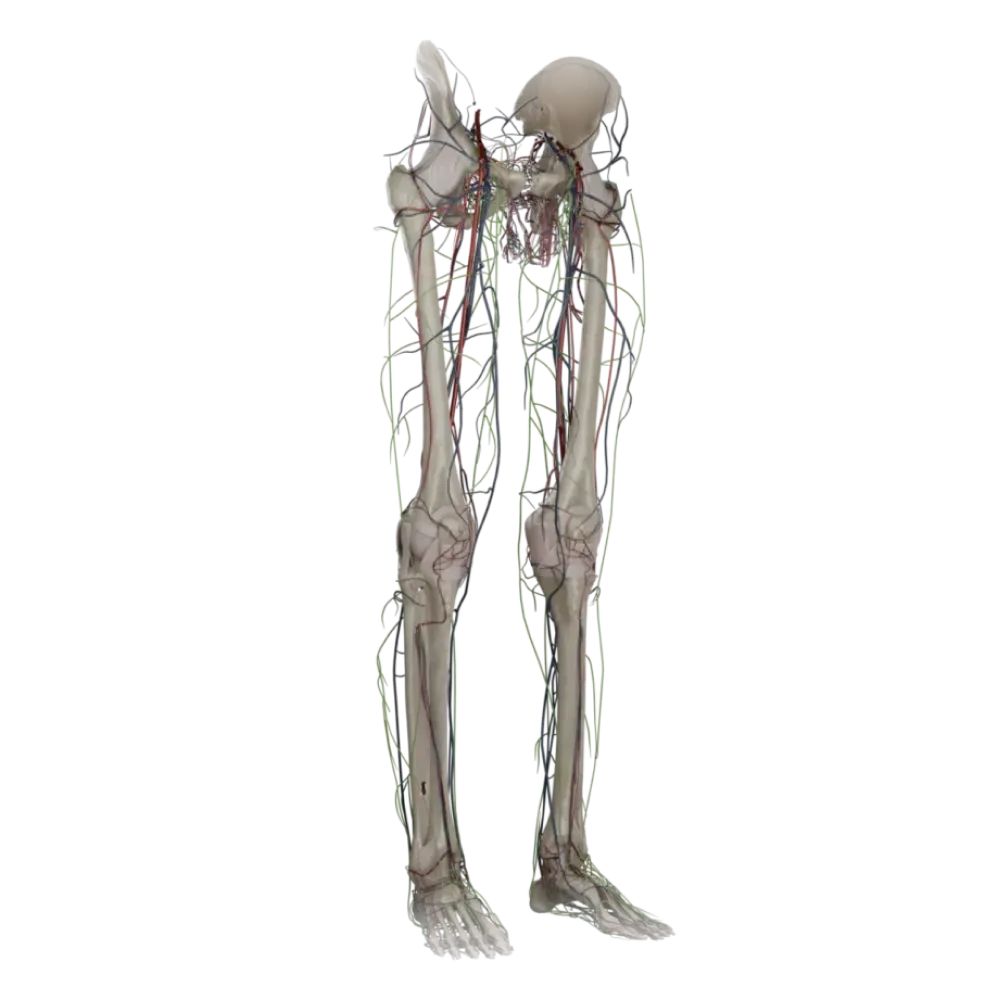


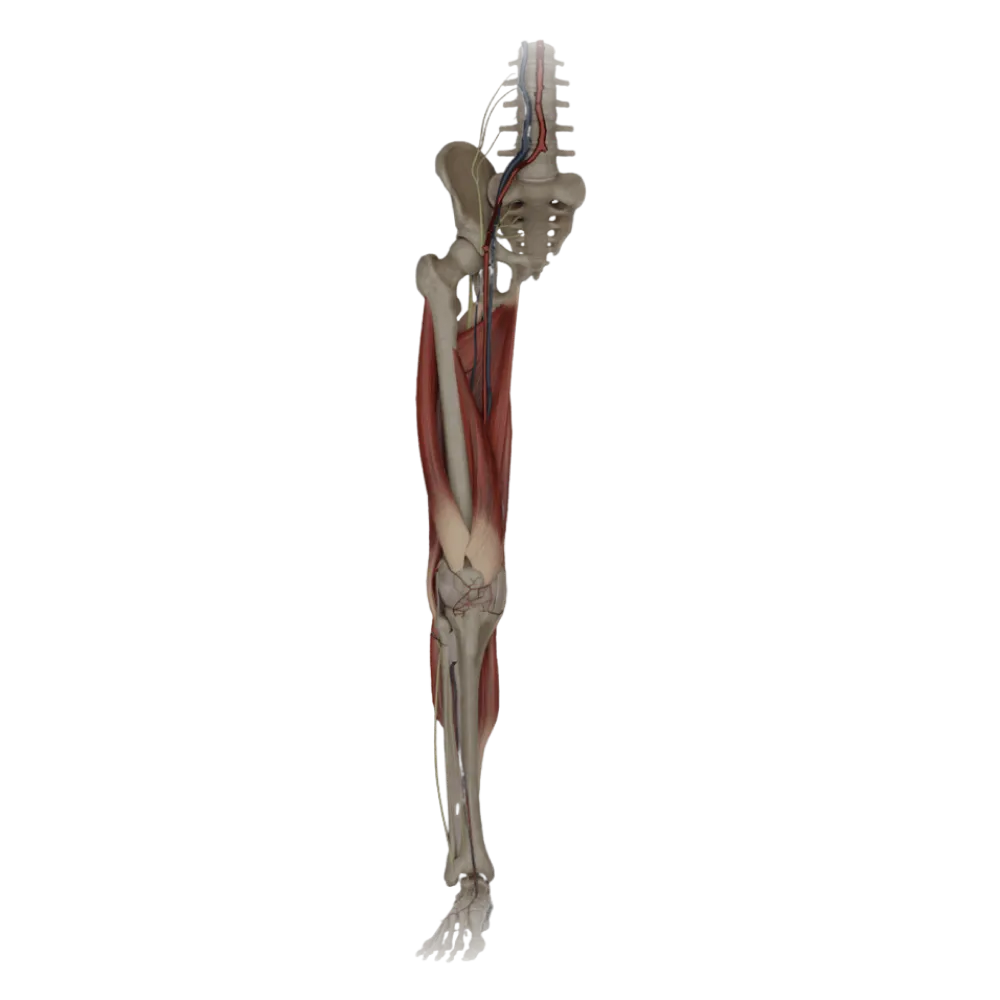
Femoral artery anatomy test.
Evaluate femoral artery anatomy knowledge. The test strictly examines its topography, branches, anastomoses, and blood supply zones on the thigh.
1/20
bold
text
1. Which artery continues as the femoral artery?
-
The obturator artery
The femoral artery is a direct continuation of the external iliac artery after passing through the vascular lacuna beneath the inguinal ligament.
-
Common iliac artery
The femoral artery is a direct continuation of the external iliac artery after passing through the vascular lacuna beneath the inguinal ligament.
-
External iliac artery
The femoral artery is a direct continuation of the external iliac artery after passing through the vascular lacuna beneath the inguinal ligament.
-
Internal iliac artery
The femoral artery is a direct continuation of the external iliac artery after passing through the vascular lacuna beneath the inguinal ligament.
-
I find it difficult to answer
The femoral artery is a direct continuation of the external iliac artery after passing through the vascular lacuna beneath the inguinal ligament.
2. Through which anatomical structure does the femoral artery emerge onto the thigh?
-
Vascular lacuna
The artery emerges onto the anterior surface of the thigh through the vascular lacuna (lacuna vasorum), positioned laterally to the femoral vein.
-
Muscular lacuna
The artery emerges onto the anterior surface of the thigh through the vascular lacuna (lacuna vasorum), positioned laterally to the femoral vein.
-
Infrapiriform foramen
The artery emerges onto the anterior surface of the thigh through the vascular lacuna (lacuna vasorum), positioned laterally to the femoral vein.
-
Suprapiriform foramen
The artery emerges onto the anterior surface of the thigh through the vascular lacuna (lacuna vasorum), positioned laterally to the femoral vein.
-
I find it difficult to answer
The artery emerges onto the anterior surface of the thigh through the vascular lacuna (lacuna vasorum), positioned laterally to the femoral vein.
3. What anatomical structure is located medially to the femoral artery in the vascular lacuna?
-
Femoral nerve.
In the vascular lacuna, the femoral vein is located strictly medially in relation to the femoral artery.
-
Femoral vein
In the vascular lacuna, the femoral vein is located strictly medially in relation to the femoral artery.
-
Iliopectineal arch
In the vascular lacuna, the femoral vein is located strictly medially in relation to the femoral artery.
-
Iliopsoas muscle
In the vascular lacuna, the femoral vein is located strictly medially in relation to the femoral artery.
-
I find it difficult to answer
In the vascular lacuna, the femoral vein is located strictly medially in relation to the femoral artery.
4. At what distance from the inguinal ligament does the deep femoral artery (a. profunda femoris) typically arise?
-
In the lower third of the thigh
The deep femoral artery is the largest branch of the femoral artery, arising from its posterolateral wall 3-4 cm below the inguinal ligament.
-
Just below the inguinal ligament
The deep femoral artery is the largest branch of the femoral artery, arising from its posterolateral wall 3-4 cm below the inguinal ligament.
-
In the adductor canal
The deep femoral artery is the largest branch of the femoral artery, arising from its posterolateral wall 3-4 cm below the inguinal ligament.
-
3-4 cm below the inguinal ligament
The deep femoral artery is the largest branch of the femoral artery, arising from its posterolateral wall 3-4 cm below the inguinal ligament.
-
I find it difficult to answer
The deep femoral artery is the largest branch of the femoral artery, arising from its posterolateral wall 3-4 cm below the inguinal ligament.
5. What are the major branches of the deep femoral artery?
-
Medial and lateral circumflex femoral arteries and perforating arteries
The deep femoral artery gives rise to a. circumflexa femoris medialis, a. circumflexa femoris lateralis and aa. perforantes.
-
Descending genicular artery and muscular branches
The deep femoral artery gives rise to a. circumflexa femoris medialis, a. circumflexa femoris lateralis and aa. perforantes.
-
Superficial epigastric artery and external pudendal arteries
The deep femoral artery gives rise to a. circumflexa femoris medialis, a. circumflexa femoris lateralis and aa. perforantes.
-
Popliteal artery and recurrent tibial arteries
The deep femoral artery gives rise to a. circumflexa femoris medialis, a. circumflexa femoris lateralis and aa. perforantes.
-
I find it difficult to answer
The deep femoral artery gives rise to a. circumflexa femoris medialis, a. circumflexa femoris lateralis and aa. perforantes.
6. Which branch of the femoral artery supplies the skin and subcutaneous tissue of the anterior abdominal wall up to the level of the umbilicus?
-
Superficial circumflex iliac artery
The superficial epigastric artery (a. epigastrica superficialis) ascends on the anterior abdominal wall, supplying its coverings up to the umbilicus.
-
Deep circumflex iliac artery
The superficial epigastric artery (a. epigastrica superficialis) ascends on the anterior abdominal wall, supplying its coverings up to the umbilicus.
-
Superficial epigastric artery
The superficial epigastric artery (a. epigastrica superficialis) ascends on the anterior abdominal wall, supplying its coverings up to the umbilicus.
-
Inferior epigastric artery
The superficial epigastric artery (a. epigastrica superficialis) ascends on the anterior abdominal wall, supplying its coverings up to the umbilicus.
-
I find it difficult to answer
The superficial epigastric artery (a. epigastrica superficialis) ascends on the anterior abdominal wall, supplying its coverings up to the umbilicus.
7. In which anatomical structure is the femoral artery located in the lower third of the thigh?
-
In the femoral canal
In the lower third of the thigh, the femoral artery passes through the adductor canal (Hunter's), moving towards the popliteal fossa.
-
In the obturator canal
In the lower third of the thigh, the femoral artery passes through the adductor canal (Hunter's), moving towards the popliteal fossa.
-
In the crural canal
In the lower third of the thigh, the femoral artery passes through the adductor canal (Hunter's), moving towards the popliteal fossa.
-
In the adductor canal
In the lower third of the thigh, the femoral artery passes through the adductor canal (Hunter's), moving towards the popliteal fossa.
-
I find it difficult to answer
In the lower third of the thigh, the femoral artery passes through the adductor canal (Hunter's), moving towards the popliteal fossa.
8. What forms the anterior wall of the adductor (Hunter's) canal, covering the artery?
-
Fibrous plate (lamina vastoadductoria).
The anterior wall of the canal is formed by a fibrous lamina (lamina vastoadductoria), stretched between m. vastus medialis and m. adductor magnus.
-
Adductor magnus muscle.
The anterior wall of the canal is formed by a fibrous lamina (lamina vastoadductoria), stretched between m. vastus medialis and m. adductor magnus.
-
Adductor longus muscle.
The anterior wall of the canal is formed by a fibrous lamina (lamina vastoadductoria), stretched between m. vastus medialis and m. adductor magnus.
-
Fascia lata of the thigh
The anterior wall of the canal is formed by a fibrous lamina (lamina vastoadductoria), stretched between m. vastus medialis and m. adductor magnus.
-
I find it difficult to answer
The anterior wall of the canal is formed by a fibrous lamina (lamina vastoadductoria), stretched between m. vastus medialis and m. adductor magnus.
9. Which artery originates directly from the femoral artery within the adductor canal?
-
Lateral circumflex femoral artery
The descending genicular artery (a. descendens genus) begins from the femoral artery in the adductor canal and exits through its anterior wall.
-
Descending genicular artery
The descending genicular artery (a. descendens genus) begins from the femoral artery in the adductor canal and exits through its anterior wall.
-
First perforating artery
The descending genicular artery (a. descendens genus) begins from the femoral artery in the adductor canal and exits through its anterior wall.
-
Superior medial genicular artery
The descending genicular artery (a. descendens genus) begins from the femoral artery in the adductor canal and exits through its anterior wall.
-
I find it difficult to answer
The descending genicular artery (a. descendens genus) begins from the femoral artery in the adductor canal and exits through its anterior wall.
10. Which nerve does the descending genicular artery pierce the anterior wall of the adductor canal with?
-
Femoral nerve
The A. descendens genus perforates the lamina vastoadductoria together with the saphenous nerve (n. saphenous), heading towards the knee joint.
-
Sciatic nerve
The A. descendens genus perforates the lamina vastoadductoria together with the saphenous nerve (n. saphenous), heading towards the knee joint.
-
Saphenous nerve (n. saphenous)
The A. descendens genus perforates the lamina vastoadductoria together with the saphenous nerve (n. saphenous), heading towards the knee joint.
-
Obturator nerve
The A. descendens genus perforates the lamina vastoadductoria together with the saphenous nerve (n. saphenous), heading towards the knee joint.
-
I find it difficult to answer
The A. descendens genus perforates the lamina vastoadductoria together with the saphenous nerve (n. saphenous), heading towards the knee joint.
11. Which branch of the lateral artery, encircling the femur, participates in forming the arterial network of the knee joint?
-
Ascending branch
The descending branch (r. descendens) descends along the lateral side of the thigh and anastomoses with branches of the popliteal artery at the knee.
-
Descending branch
The descending branch (r. descendens) descends along the lateral side of the thigh and anastomoses with branches of the popliteal artery at the knee.
-
Transverse branch
The descending branch (r. descendens) descends along the lateral side of the thigh and anastomoses with branches of the popliteal artery at the knee.
-
Acetabular branch
The descending branch (r. descendens) descends along the lateral side of the thigh and anastomoses with branches of the popliteal artery at the knee.
-
I find it difficult to answer
The descending branch (r. descendens) descends along the lateral side of the thigh and anastomoses with branches of the popliteal artery at the knee.
12. Between which muscles does the medial artery, encircling the femur, pass, bypassing its neck?
-
Between the sartorius and rectus femoris muscles
The medial artery, encircling the femur, moves medially and posteriorly, passing between m. iliopsoas and m. pectineus.
-
Between the semitendinosus and semimembranosus muscles
The medial artery, encircling the femur, moves medially and posteriorly, passing between m. iliopsoas and m. pectineus.
-
Between the adductor magnus and longus muscles
The medial artery, encircling the femur, moves medially and posteriorly, passing between m. iliopsoas and m. pectineus.
-
Between the iliopsoas and pectineus muscles
The medial artery, encircling the femur, moves medially and posteriorly, passing between m. iliopsoas and m. pectineus.
-
I find it difficult to answer
The medial artery, encircling the femur, moves medially and posteriorly, passing between m. iliopsoas and m. pectineus.
13. Which of the listed arteries participates in forming the cruciate anastomosis in the posterior thigh region?
-
First perforating artery
The cruciate anastomosis is formed by branches of the inferior gluteal, medial and lateral arteries encircling the femur, and the first perforating artery.
-
Superficial epigastric artery
The cruciate anastomosis is formed by branches of the inferior gluteal, medial and lateral arteries encircling the femur, and the first perforating artery.
-
The external pudendal artery
The cruciate anastomosis is formed by branches of the inferior gluteal, medial and lateral arteries encircling the femur, and the first perforating artery.
-
Descending genicular artery
The cruciate anastomosis is formed by branches of the inferior gluteal, medial and lateral arteries encircling the femur, and the first perforating artery.
-
I find it difficult to answer
The cruciate anastomosis is formed by branches of the inferior gluteal, medial and lateral arteries encircling the femur, and the first perforating artery.
14. Through which opening does the femoral artery leave the adductor canal, becoming the popliteal artery?
-
Suprapiriform foramen
Passing through the tendinous hiatus of the adductor magnus muscle (hiatus tendineus), the femoral artery enters the popliteal fossa and is renamed popliteal artery.
-
Superficial ring of the femoral canal
Passing through the tendinous hiatus of the adductor magnus muscle (hiatus tendineus), the femoral artery enters the popliteal fossa and is renamed popliteal artery.
-
Tendinous hiatus (hiatus tendineus)
Passing through the tendinous hiatus of the adductor magnus muscle (hiatus tendineus), the femoral artery enters the popliteal fossa and is renamed popliteal artery.
-
Obturator foramen
Passing through the tendinous hiatus of the adductor magnus muscle (hiatus tendineus), the femoral artery enters the popliteal fossa and is renamed popliteal artery.
-
I find it difficult to answer
Passing through the tendinous hiatus of the adductor magnus muscle (hiatus tendineus), the femoral artery enters the popliteal fossa and is renamed popliteal artery.
15. Which muscle do the perforating arteries (aa. perforantes) pierce to reach the posterior surface of the thigh?
-
Biceps femoris muscle
Perforating arteries penetrate through the tendon of the adductor magnus muscle (m. adductor magnus), heading towards the flexor muscles of the thigh.
-
Semimembranosus muscle
Perforating arteries penetrate through the tendon of the adductor magnus muscle (m. adductor magnus), heading towards the flexor muscles of the thigh.
-
Gracilis muscle
Perforating arteries penetrate through the tendon of the adductor magnus muscle (m. adductor magnus), heading towards the flexor muscles of the thigh.
-
Adductor magnus muscle
Perforating arteries penetrate through the tendon of the adductor magnus muscle (m. adductor magnus), heading towards the flexor muscles of the thigh.
-
I find it difficult to answer
Perforating arteries penetrate through the tendon of the adductor magnus muscle (m. adductor magnus), heading towards the flexor muscles of the thigh.
16. What covers the femoral artery anteriorly within the femoral (Scarpa's) triangle?
-
Sartorius muscle.
In the femoral triangle, the artery is located superficially, being covered anteriorly only by the superficial sheet of the fascia lata of the thigh.
-
Fascia lata (lamina superficialis)
In the femoral triangle, the artery is located superficially, being covered anteriorly only by the superficial sheet of the fascia lata of the thigh.
-
Rectus femoris.
In the femoral triangle, the artery is located superficially, being covered anteriorly only by the superficial sheet of the fascia lata of the thigh.
-
Pectineus muscle.
In the femoral triangle, the artery is located superficially, being covered anteriorly only by the superficial sheet of the fascia lata of the thigh.
-
I find it difficult to answer
In the femoral triangle, the artery is located superficially, being covered anteriorly only by the superficial sheet of the fascia lata of the thigh.
17. Which artery gives off an acetabular branch (r. acetabularis) passing under the transverse ligament of the acetabulum to the head of the femur?
-
Medial circumflex femoral artery
The acetabular branch, nourishing the femoral head, branches off from a. circumflexa femoris medialis (and there is also a similar branch from the obturator artery).
-
Lateral circumflex femoral artery
The acetabular branch, nourishing the femoral head, branches off from a. circumflexa femoris medialis (and there is also a similar branch from the obturator artery).
-
First perforating artery
The acetabular branch, nourishing the femoral head, branches off from a. circumflexa femoris medialis (and there is also a similar branch from the obturator artery).
-
Superficial circumflex iliac artery
The acetabular branch, nourishing the femoral head, branches off from a. circumflexa femoris medialis (and there is also a similar branch from the obturator artery).
-
I find it difficult to answer
The acetabular branch, nourishing the femoral head, branches off from a. circumflexa femoris medialis (and there is also a similar branch from the obturator artery).
18. Which anatomical structures do the external pudendal arteries (aa. pudendae externae) supply?
-
Vastus medialis muscle of the thigh
The external pudendal arteries exit through the saphenous opening (hiatus saphenus) and proceed medially towards the scrotum (in men) or the labia majora (in women).
-
Anterior abdominal wall
The external pudendal arteries exit through the saphenous opening (hiatus saphenus) and proceed medially towards the scrotum (in men) or the labia majora (in women).
-
Scrotum or labia majora
The external pudendal arteries exit through the saphenous opening (hiatus saphenus) and proceed medially towards the scrotum (in men) or the labia majora (in women).
-
Anterior superior iliac spine
The external pudendal arteries exit through the saphenous opening (hiatus saphenus) and proceed medially towards the scrotum (in men) or the labia majora (in women).
-
I find it difficult to answer
The external pudendal arteries exit through the saphenous opening (hiatus saphenus) and proceed medially towards the scrotum (in men) or the labia majora (in women).
19. Which muscle forms the lateral border of the femoral (Scarpa's) triangle where the femoral artery passes?
-
Adductor longus
The lateral border of the femoral triangle is formed by the medial edge of the sartorius muscle (m. sartorius).
-
Sartorius muscle.
The lateral border of the femoral triangle is formed by the medial edge of the sartorius muscle (m. sartorius).
-
Pectineus muscle.
The lateral border of the femoral triangle is formed by the medial edge of the sartorius muscle (m. sartorius).
-
Iliopsoas muscle
The lateral border of the femoral triangle is formed by the medial edge of the sartorius muscle (m. sartorius).
-
I find it difficult to answer
The lateral border of the femoral triangle is formed by the medial edge of the sartorius muscle (m. sartorius).
20. To which anatomical structure does the superficial circumflex iliac artery (a. circumflexa ilium superficialis) direct?
-
To the pubic symphysis
This artery runs from the femoral artery laterally, parallel to the inguinal ligament, to the spina iliaca anterior superior.
-
To the umbilical ring
This artery runs from the femoral artery laterally, parallel to the inguinal ligament, to the spina iliaca anterior superior.
-
To the ischial tuberosity
This artery runs from the femoral artery laterally, parallel to the inguinal ligament, to the spina iliaca anterior superior.
-
To the anterior superior iliac spine
This artery runs from the femoral artery laterally, parallel to the inguinal ligament, to the spina iliaca anterior superior.
-
I find it difficult to answer
This artery runs from the femoral artery laterally, parallel to the inguinal ligament, to the spina iliaca anterior superior.
Retake this quiz?
Your current progress will be reset.