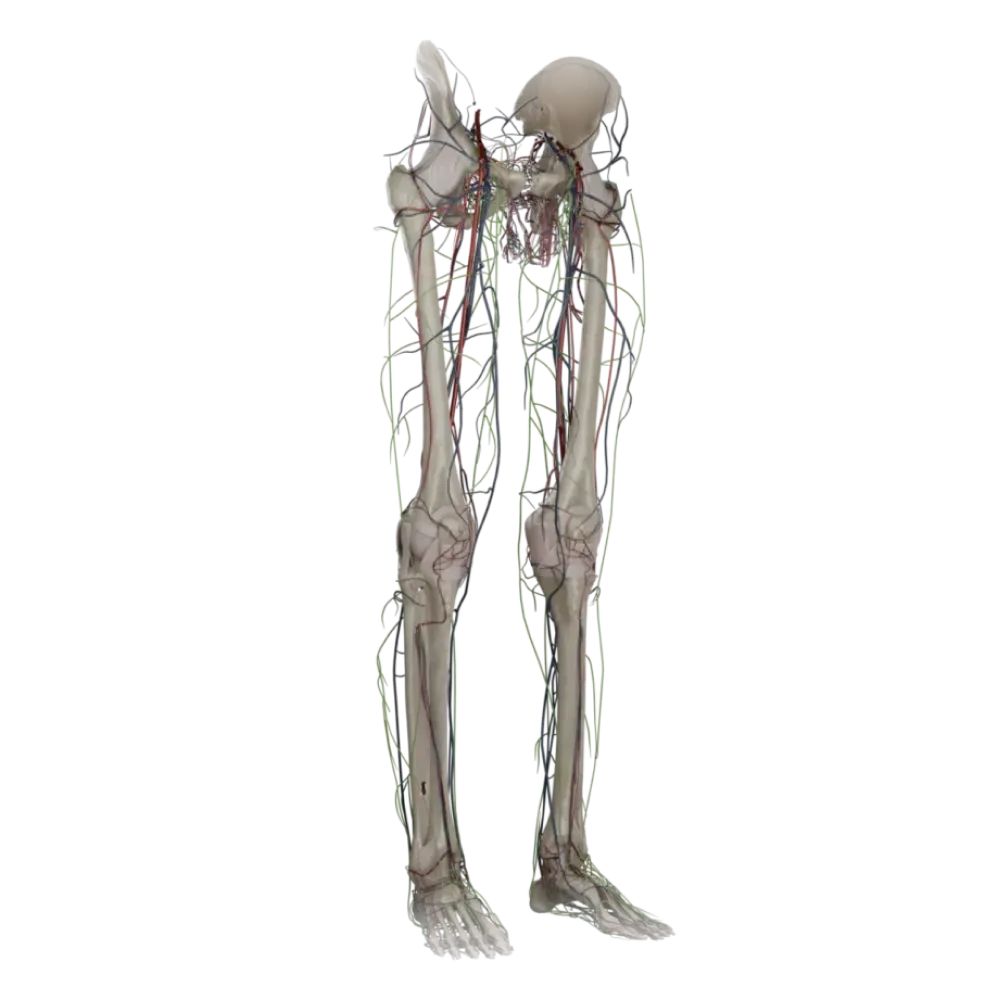


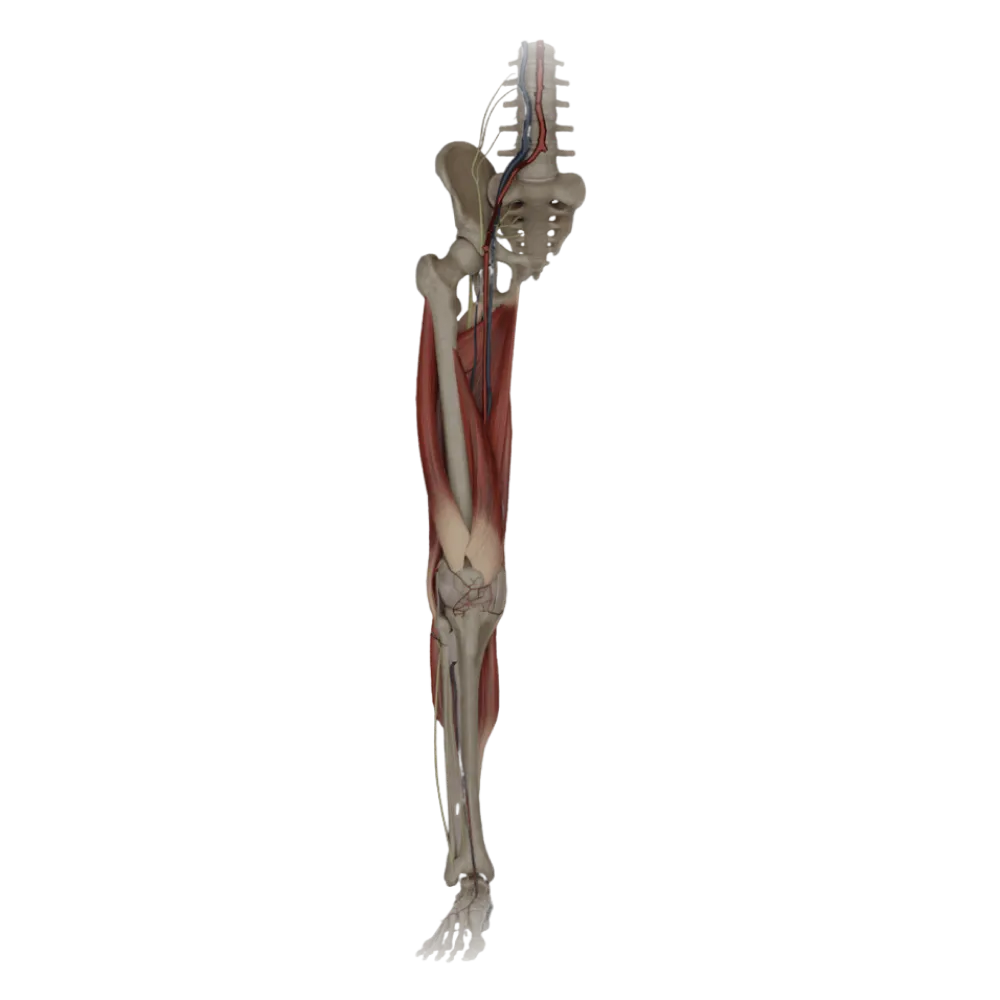
Anatomy test on the arteries of the lower leg and foot
Evaluate knowledge of the anatomy of the lower leg and foot arteries. The test assesses their topography, branching, supply areas, and key anastomoses.
1/20
bold
text
1. Where does the anterior tibial artery pass in the lower leg?
-
In the superior muscular-peroneal canal
The anterior tibial artery runs in the anterior fascial compartment of the lower leg, positioned on the anterior surface of the interosseous membrane.
-
In the crural canal
The anterior tibial artery runs in the anterior fascial compartment of the lower leg, positioned on the anterior surface of the interosseous membrane.
-
On the anterior surface of the interosseous membrane
The anterior tibial artery runs in the anterior fascial compartment of the lower leg, positioned on the anterior surface of the interosseous membrane.
-
In the inferior muscular-peroneal canal
The anterior tibial artery runs in the anterior fascial compartment of the lower leg, positioned on the anterior surface of the interosseous membrane.
-
I find it difficult to answer
The anterior tibial artery runs in the anterior fascial compartment of the lower leg, positioned on the anterior surface of the interosseous membrane.
2. What artery is the largest branch of the posterior tibial artery?
-
Fibular artery
The fibular artery is the largest branch of the posterior tibial artery, branching from it in the upper third of the lower leg.
-
Lateral tarsal artery
The fibular artery is the largest branch of the posterior tibial artery, branching from it in the upper third of the lower leg.
-
Medial plantar artery
The fibular artery is the largest branch of the posterior tibial artery, branching from it in the upper third of the lower leg.
-
Anterior tibial recurrent artery
The fibular artery is the largest branch of the posterior tibial artery, branching from it in the upper third of the lower leg.
-
I find it difficult to answer
The fibular artery is the largest branch of the posterior tibial artery, branching from it in the upper third of the lower leg.
3. What artery forms the deep plantar arch in conjunction with the deep plantar branch of the dorsalis pedis artery?
-
Arcuate artery
The deep plantar arch is formed by an anastomosis between the lateral plantar artery and the deep plantar branch of the dorsalis pedis artery.
-
Lateral plantar artery
The deep plantar arch is formed by an anastomosis between the lateral plantar artery and the deep plantar branch of the dorsalis pedis artery.
-
Medial plantar artery
The deep plantar arch is formed by an anastomosis between the lateral plantar artery and the deep plantar branch of the dorsalis pedis artery.
-
First dorsal metatarsal artery
The deep plantar arch is formed by an anastomosis between the lateral plantar artery and the deep plantar branch of the dorsalis pedis artery.
-
I find it difficult to answer
The deep plantar arch is formed by an anastomosis between the lateral plantar artery and the deep plantar branch of the dorsalis pedis artery.
4. In which anatomical canal does the posterior tibial artery pass?
-
Femoral-popliteal canal
The posterior tibial artery passes in the crural canal of the lower leg (Gruber's canal), lying between the deep and superficial muscles of the posterior compartment.
-
Superior muscular-peroneal canal.
The posterior tibial artery passes in the crural canal of the lower leg (Gruber's canal), lying between the deep and superficial muscles of the posterior compartment.
-
Inferior muscular-peroneal canal.
The posterior tibial artery passes in the crural canal of the lower leg (Gruber's canal), lying between the deep and superficial muscles of the posterior compartment.
-
Cruripoplietal canal (canalis cruropopliteus).
The posterior tibial artery passes in the crural canal of the lower leg (Gruber's canal), lying between the deep and superficial muscles of the posterior compartment.
-
I find it difficult to answer
The posterior tibial artery passes in the crural canal of the lower leg (Gruber's canal), lying between the deep and superficial muscles of the posterior compartment.
5. What blood vessel is the direct continuation of the anterior tibial artery in the foot?
-
Medial plantar artery
The dorsalis pedis artery is the direct continuation of the anterior tibial artery after it passes under the inferior extensor retinaculum.
-
Dorsalis pedis artery (a. dorsalis pedis)
The dorsalis pedis artery is the direct continuation of the anterior tibial artery after it passes under the inferior extensor retinaculum.
-
Arcuate artery
The dorsalis pedis artery is the direct continuation of the anterior tibial artery after it passes under the inferior extensor retinaculum.
-
Lateral plantar artery
The dorsalis pedis artery is the direct continuation of the anterior tibial artery after it passes under the inferior extensor retinaculum.
-
I find it difficult to answer
The dorsalis pedis artery is the direct continuation of the anterior tibial artery after it passes under the inferior extensor retinaculum.
6. What branch arises from the dorsalis pedis artery and anastomoses with the lateral tarsal artery?
-
Medial tarsal artery
The arcuate artery originates from the dorsalis pedis artery at the level of the bases of the metatarsal bones and runs laterally, anastomosing with the lateral tarsal artery.
-
Deep plantar branch
The arcuate artery originates from the dorsalis pedis artery at the level of the bases of the metatarsal bones and runs laterally, anastomosing with the lateral tarsal artery.
-
First dorsal metatarsal artery
The arcuate artery originates from the dorsalis pedis artery at the level of the bases of the metatarsal bones and runs laterally, anastomosing with the lateral tarsal artery.
-
Arcuate artery
The arcuate artery originates from the dorsalis pedis artery at the level of the bases of the metatarsal bones and runs laterally, anastomosing with the lateral tarsal artery.
-
I find it difficult to answer
The arcuate artery originates from the dorsalis pedis artery at the level of the bases of the metatarsal bones and runs laterally, anastomosing with the lateral tarsal artery.
7. Behind which bony structure can the pulsation of the posterior tibial artery be normally palpated?
-
Medial malleolus
The pulsation of the posterior tibial artery is detected posterior to the medial malleolus, where it passes through the flexor retinaculum.
-
Lateral malleolus.
The pulsation of the posterior tibial artery is detected posterior to the medial malleolus, where it passes through the flexor retinaculum.
-
Head of the fibula.
The pulsation of the posterior tibial artery is detected posterior to the medial malleolus, where it passes through the flexor retinaculum.
-
Tibial tuberosity.
The pulsation of the posterior tibial artery is detected posterior to the medial malleolus, where it passes through the flexor retinaculum.
-
I find it difficult to answer
The pulsation of the posterior tibial artery is detected posterior to the medial malleolus, where it passes through the flexor retinaculum.
8. Which artery primarily supplies the muscles of the lateral compartment of the lower leg (long and short fibular muscles)?
-
Fibular artery (a. fibularis)
The fibular artery runs in the inferior muscular-peroneal canal, giving muscle branches to the lateral muscle group of the lower leg.
-
Anterior tibial artery.
The fibular artery runs in the inferior muscular-peroneal canal, giving muscle branches to the lateral muscle group of the lower leg.
-
Medial inferior genicular artery
The fibular artery runs in the inferior muscular-peroneal canal, giving muscle branches to the lateral muscle group of the lower leg.
-
Posterior tibial artery.
The fibular artery runs in the inferior muscular-peroneal canal, giving muscle branches to the lateral muscle group of the lower leg.
-
I find it difficult to answer
The fibular artery runs in the inferior muscular-peroneal canal, giving muscle branches to the lateral muscle group of the lower leg.
9. Where does the fibular artery lie in the lower third of the lower leg before giving off calcaneal branches?
-
In the inferior muscular-peroneal canal
The fibular artery descends and is located posterior to the lateral malleolus, participating in the formation of the lateral malleolar network.
-
Posterior to the medial malleolus
The fibular artery descends and is located posterior to the lateral malleolus, participating in the formation of the lateral malleolar network.
-
Behind the lateral malleolus
The fibular artery descends and is located posterior to the lateral malleolus, participating in the formation of the lateral malleolar network.
-
On the anterior surface of the interosseous membrane
The fibular artery descends and is located posterior to the lateral malleolus, participating in the formation of the lateral malleolar network.
-
I find it difficult to answer
The fibular artery descends and is located posterior to the lateral malleolus, participating in the formation of the lateral malleolar network.
10. Which of the listed arteries participates in the formation of the medial malleolar network (rete malleolare mediale)?
-
Arcuate artery
The formation of the medial malleolar network involves the anterior medial malleolar artery (from the anterior tibial) and the medial malleolar branches (from the posterior tibial).
-
Anterior medial malleolar artery
The formation of the medial malleolar network involves the anterior medial malleolar artery (from the anterior tibial) and the medial malleolar branches (from the posterior tibial).
-
Anterior lateral malleolar artery
The formation of the medial malleolar network involves the anterior medial malleolar artery (from the anterior tibial) and the medial malleolar branches (from the posterior tibial).
-
Perforating branch of the fibular artery
The formation of the medial malleolar network involves the anterior medial malleolar artery (from the anterior tibial) and the medial malleolar branches (from the posterior tibial).
-
I find it difficult to answer
The formation of the medial malleolar network involves the anterior medial malleolar artery (from the anterior tibial) and the medial malleolar branches (from the posterior tibial).
11. At what level does the anterior tibial artery pass through the interosseous membrane of the lower leg into the anterior fascial compartment?
-
In the middle third of the interosseous membrane
The anterior tibial artery transitions into the anterior compartment of the lower leg from the popliteal fossa through the upper opening of the interosseous membrane.
-
In the lower third through the lower opening
The anterior tibial artery transitions into the anterior compartment of the lower leg from the popliteal fossa through the upper opening of the interosseous membrane.
-
At the level of the ankle joint
The anterior tibial artery transitions into the anterior compartment of the lower leg from the popliteal fossa through the upper opening of the interosseous membrane.
-
In its upper part through the upper opening
The anterior tibial artery transitions into the anterior compartment of the lower leg from the popliteal fossa through the upper opening of the interosseous membrane.
-
I find it difficult to answer
The anterior tibial artery transitions into the anterior compartment of the lower leg from the popliteal fossa through the upper opening of the interosseous membrane.
12. What arteries arise distally from the arcuate artery of the foot?
-
Dorsal metatarsal arteries (II-IV)
Distally, the second, third, and fourth dorsal metatarsal arteries (aa. metatarsales dorsales II-IV) branch from the arcuate artery.
-
Plantar metatarsal arteries
Distally, the second, third, and fourth dorsal metatarsal arteries (aa. metatarsales dorsales II-IV) branch from the arcuate artery.
-
Common plantar digital arteries
Distally, the second, third, and fourth dorsal metatarsal arteries (aa. metatarsales dorsales II-IV) branch from the arcuate artery.
-
Lateral tarsal arteries
Distally, the second, third, and fourth dorsal metatarsal arteries (aa. metatarsales dorsales II-IV) branch from the arcuate artery.
-
I find it difficult to answer
Distally, the second, third, and fourth dorsal metatarsal arteries (aa. metatarsales dorsales II-IV) branch from the arcuate artery.
13. Which lower leg muscle serves as the main landmark for the anterior tibial artery in the upper half of the lower leg (medi ally accompanying it)?
-
Extensor digitorum longus.
In the upper half of the lower leg, the anterior tibial artery lies between the anterior tibial muscle medially and the extensor digitorum longus laterally.
-
Fibularis tertius muscle.
In the upper half of the lower leg, the anterior tibial artery lies between the anterior tibial muscle medially and the extensor digitorum longus laterally.
-
Tibialis anterior muscle.
In the upper half of the lower leg, the anterior tibial artery lies between the anterior tibial muscle medially and the extensor digitorum longus laterally.
-
Extensor hallucis longus
In the upper half of the lower leg, the anterior tibial artery lies between the anterior tibial muscle medially and the extensor digitorum longus laterally.
-
I find it difficult to answer
In the upper half of the lower leg, the anterior tibial artery lies between the anterior tibial muscle medially and the extensor digitorum longus laterally.
14. Into what two terminal branches does the posterior tibial artery divide upon entering the plantar surface?
-
Superficial and deep plantar arteries
The posterior tibial artery, after passing behind the medial malleolus, divides into the medial and lateral plantar arteries on the foot.
-
Medial and lateral plantar arteries
The posterior tibial artery, after passing behind the medial malleolus, divides into the medial and lateral plantar arteries on the foot.
-
Common and proper plantar digital arteries
The posterior tibial artery, after passing behind the medial malleolus, divides into the medial and lateral plantar arteries on the foot.
-
Dorsalis pedis artery and perforating artery
The posterior tibial artery, after passing behind the medial malleolus, divides into the medial and lateral plantar arteries on the foot.
-
I find it difficult to answer
The posterior tibial artery, after passing behind the medial malleolus, divides into the medial and lateral plantar arteries on the foot.
15. Which artery (or branches) supplies predominantly the calcaneus and its surrounding soft tissues, participating in the formation of the calcaneal network (rete calcaneum)?
-
Lateral tarsal artery
The calcaneal arterial network is formed by calcaneal branches stemming from the fibular and posterior tibial arteries.
-
Anterior medial malleolar artery
The calcaneal arterial network is formed by calcaneal branches stemming from the fibular and posterior tibial arteries.
-
Medial plantar artery
The calcaneal arterial network is formed by calcaneal branches stemming from the fibular and posterior tibial arteries.
-
Calcaneal branches of the posterior tibial and fibular arteries
The calcaneal arterial network is formed by calcaneal branches stemming from the fibular and posterior tibial arteries.
-
I find it difficult to answer
The calcaneal arterial network is formed by calcaneal branches stemming from the fibular and posterior tibial arteries.
16. Which area is primarily supplied by the medial plantar artery?
-
Muscles of the hypothenar of the foot
The medial plantar artery, being the smaller of the two terminal branches, predominantly supplies the muscles of the medial group of the sole (the thenar).
-
The dorsum of the foot
The medial plantar artery, being the smaller of the two terminal branches, predominantly supplies the muscles of the medial group of the sole (the thenar).
-
Muscles of the thenar of the foot
The medial plantar artery, being the smaller of the two terminal branches, predominantly supplies the muscles of the medial group of the sole (the thenar).
-
Interosseous muscles of all the spaces of the foot
The medial plantar artery, being the smaller of the two terminal branches, predominantly supplies the muscles of the medial group of the sole (the thenar).
-
I find it difficult to answer
The medial plantar artery, being the smaller of the two terminal branches, predominantly supplies the muscles of the medial group of the sole (the thenar).
17. Which of the listed arteries is NOT normally a branch of the anterior tibial artery?
-
Posterior tibial recurrent artery
The branch, circumflexing the fibula (r. circumflexus fibulae), stems from the posterior tibial artery at its onset.
-
Circumflex fibular branch (r. circumflexus fibulae)
The branch, circumflexing the fibula (r. circumflexus fibulae), stems from the posterior tibial artery at its onset.
-
Anterior tibial recurrent artery
The branch, circumflexing the fibula (r. circumflexus fibulae), stems from the posterior tibial artery at its onset.
-
Anterior lateral malleolar artery
The branch, circumflexing the fibula (r. circumflexus fibulae), stems from the posterior tibial artery at its onset.
-
I find it difficult to answer
The branch, circumflexing the fibula (r. circumflexus fibulae), stems from the posterior tibial artery at its onset.
18. From where does the first dorsal metatarsal artery (a. metatarsalis dorsalis I) originate?
-
Directly from the dorsalis pedis artery
The first dorsal metatarsal artery branches directly from the dorsalis pedis artery before it gives off the deep plantar branch.
-
From the arcuate artery
The first dorsal metatarsal artery branches directly from the dorsalis pedis artery before it gives off the deep plantar branch.
-
From the deep plantar arch
The first dorsal metatarsal artery branches directly from the dorsalis pedis artery before it gives off the deep plantar branch.
-
From the lateral tarsal artery
The first dorsal metatarsal artery branches directly from the dorsalis pedis artery before it gives off the deep plantar branch.
-
I find it difficult to answer
The first dorsal metatarsal artery branches directly from the dorsalis pedis artery before it gives off the deep plantar branch.
19. Of which artery is the perforating branch (r. perforans), participating in the formation of the lateral malleolar network?
-
The anterior tibial artery
The perforating branch arises from the fibular artery, perforates the interosseous membrane, and appears on the anterior surface of the lower leg, anastomosing with the lateral malleolar artery.
-
Dorsalis pedis artery
The perforating branch arises from the fibular artery, perforates the interosseous membrane, and appears on the anterior surface of the lower leg, anastomosing with the lateral malleolar artery.
-
The fibular artery
The perforating branch arises from the fibular artery, perforates the interosseous membrane, and appears on the anterior surface of the lower leg, anastomosing with the lateral malleolar artery.
-
Lateral plantar artery
The perforating branch arises from the fibular artery, perforates the interosseous membrane, and appears on the anterior surface of the lower leg, anastomosing with the lateral malleolar artery.
-
I find it difficult to answer
The perforating branch arises from the fibular artery, perforates the interosseous membrane, and appears on the anterior surface of the lower leg, anastomosing with the lateral malleolar artery.
20. In which topographical zone can the pulsation of the dorsalis pedis artery (a. dorsalis pedis) be clinically determined?
-
Between the medial malleolus and the Achilles tendon
The pulsation of the dorsalis pedis artery is palpated on the dorsum of the foot in the first intermetatarsal space, laterally to the tendon of the extensor hallucis longus muscle.
-
On the plantar surface, in the heel region
The pulsation of the dorsalis pedis artery is palpated on the dorsum of the foot in the first intermetatarsal space, laterally to the tendon of the extensor hallucis longus muscle.
-
Behind the lateral malleolus
The pulsation of the dorsalis pedis artery is palpated on the dorsum of the foot in the first intermetatarsal space, laterally to the tendon of the extensor hallucis longus muscle.
-
On the dorsum of the foot, laterally to the tendon of the extensor hallucis longus muscle
The pulsation of the dorsalis pedis artery is palpated on the dorsum of the foot in the first intermetatarsal space, laterally to the tendon of the extensor hallucis longus muscle.
-
I find it difficult to answer
The pulsation of the dorsalis pedis artery is palpated on the dorsum of the foot in the first intermetatarsal space, laterally to the tendon of the extensor hallucis longus muscle.
Retake this quiz?
Your current progress will be reset.