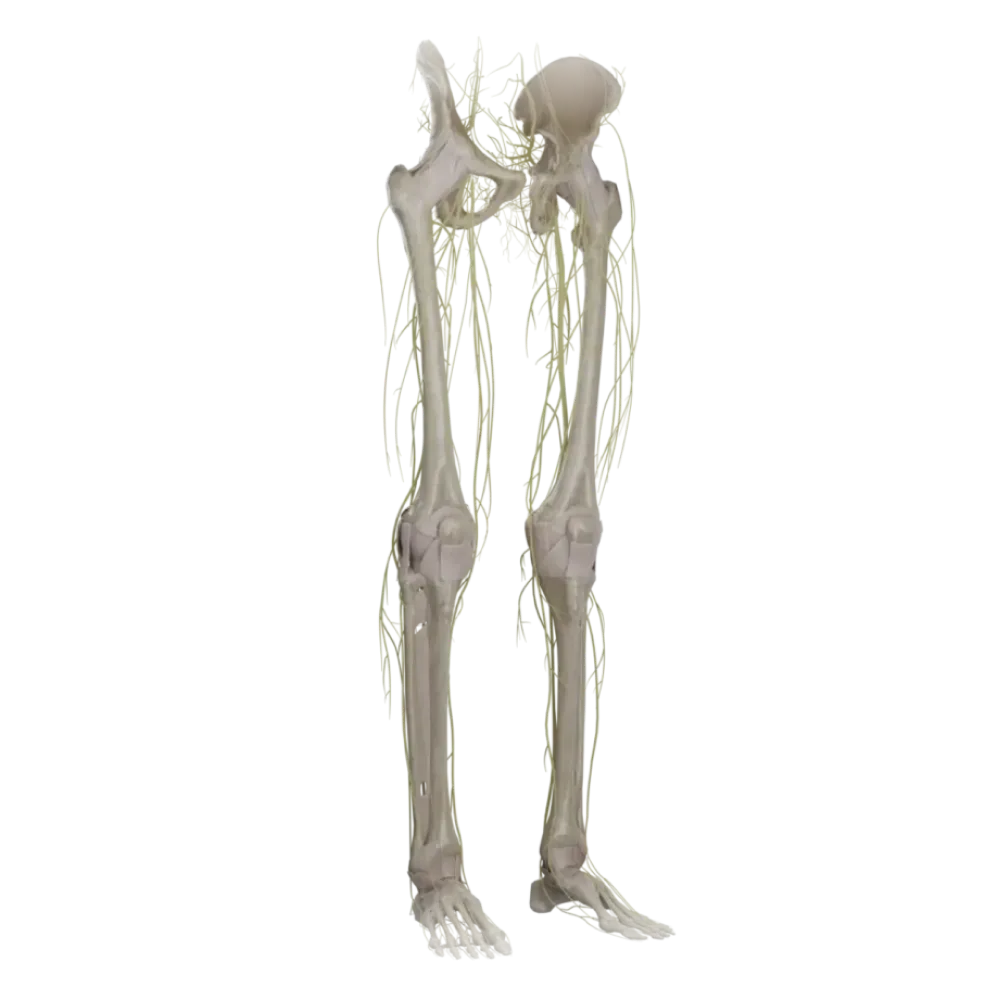
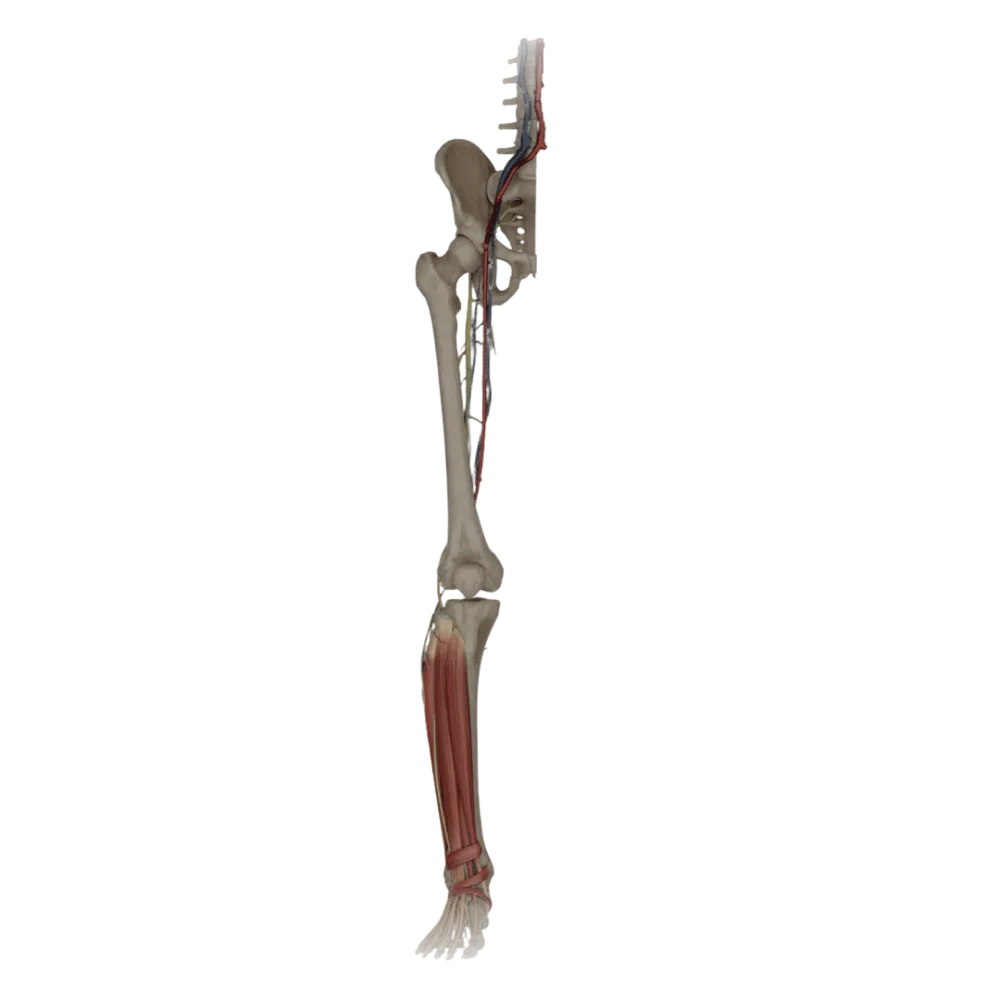
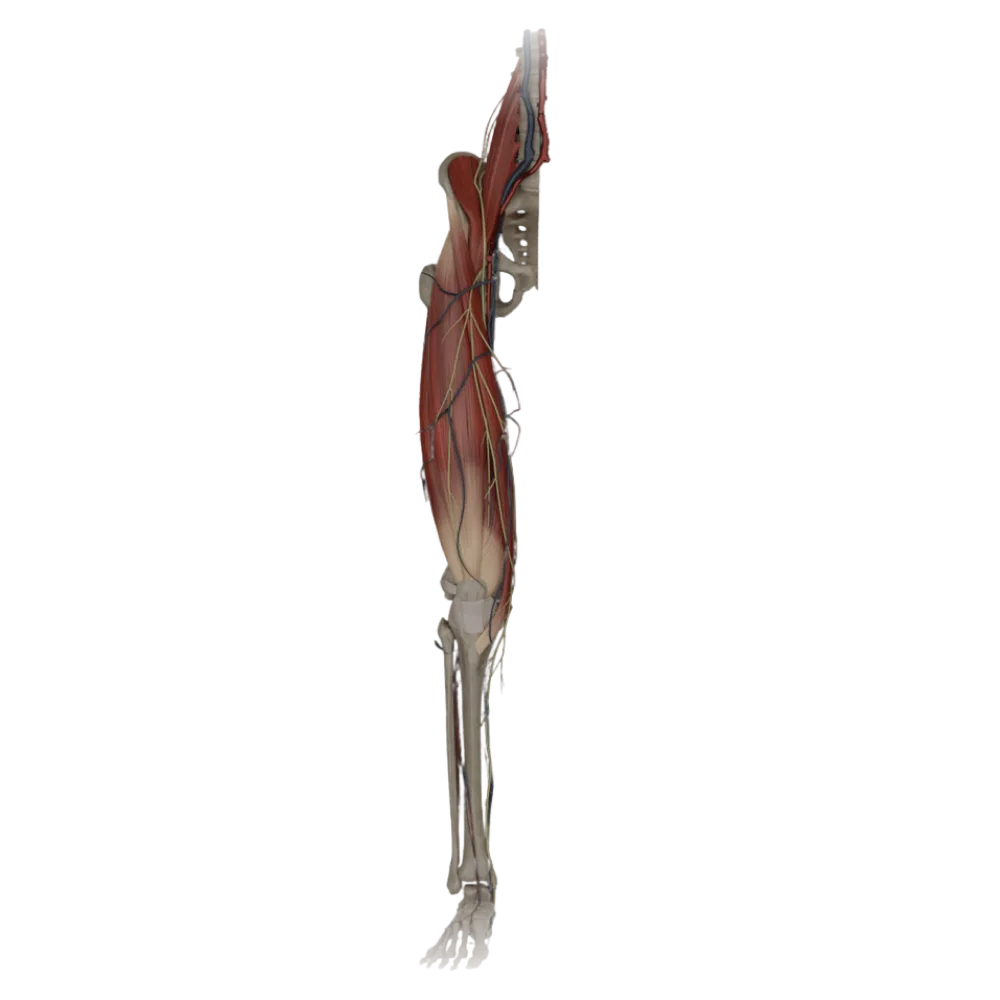
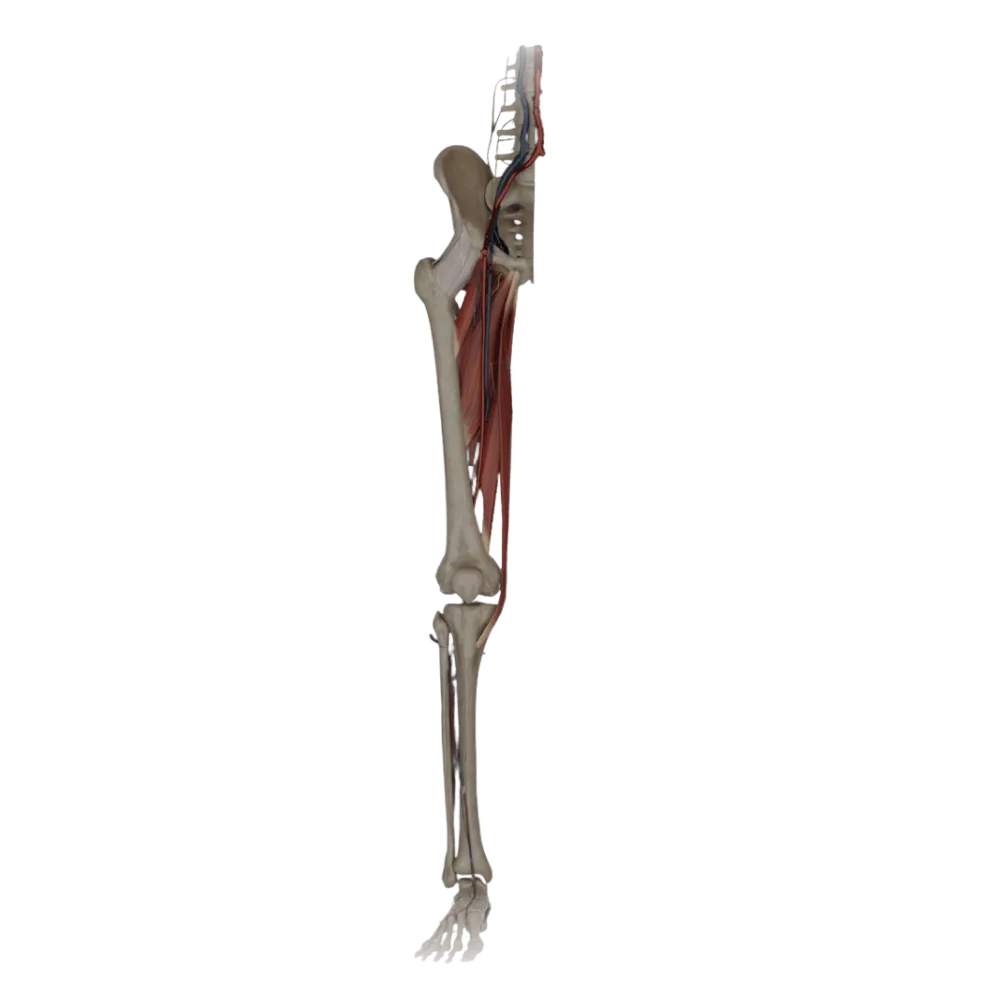
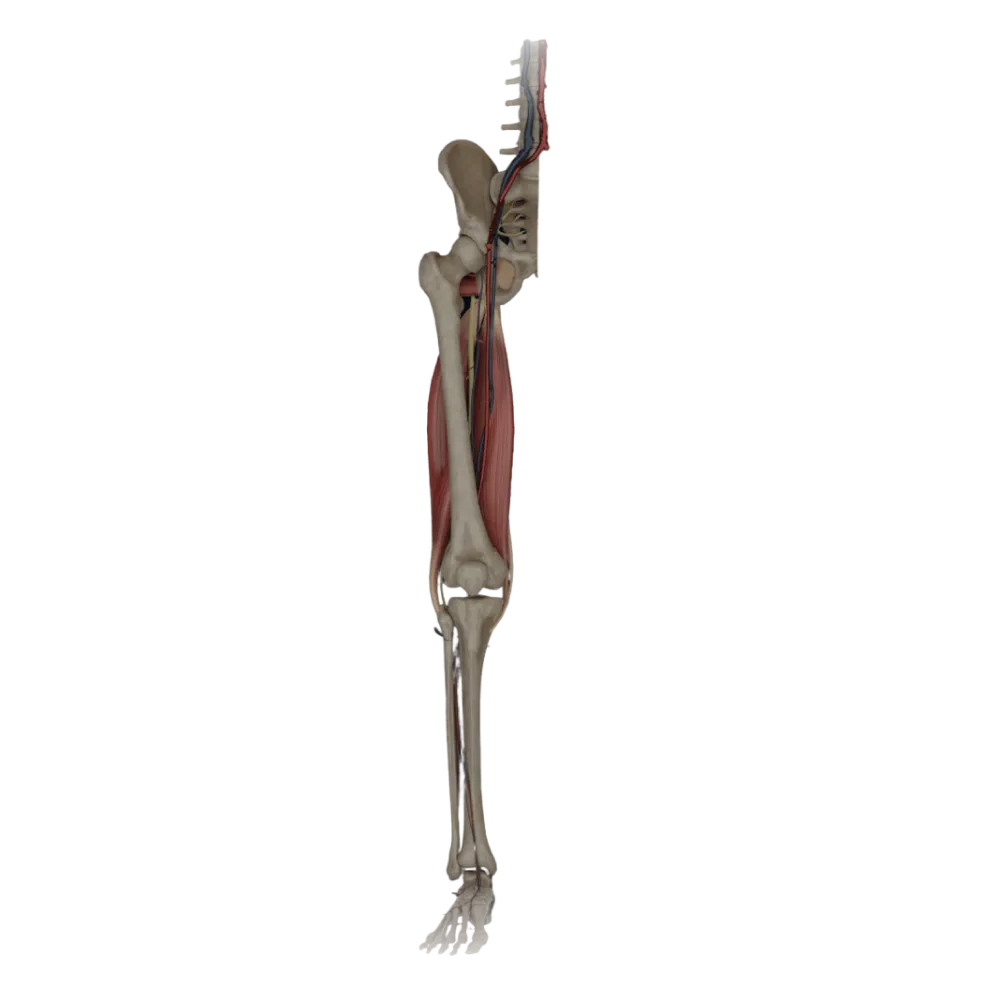
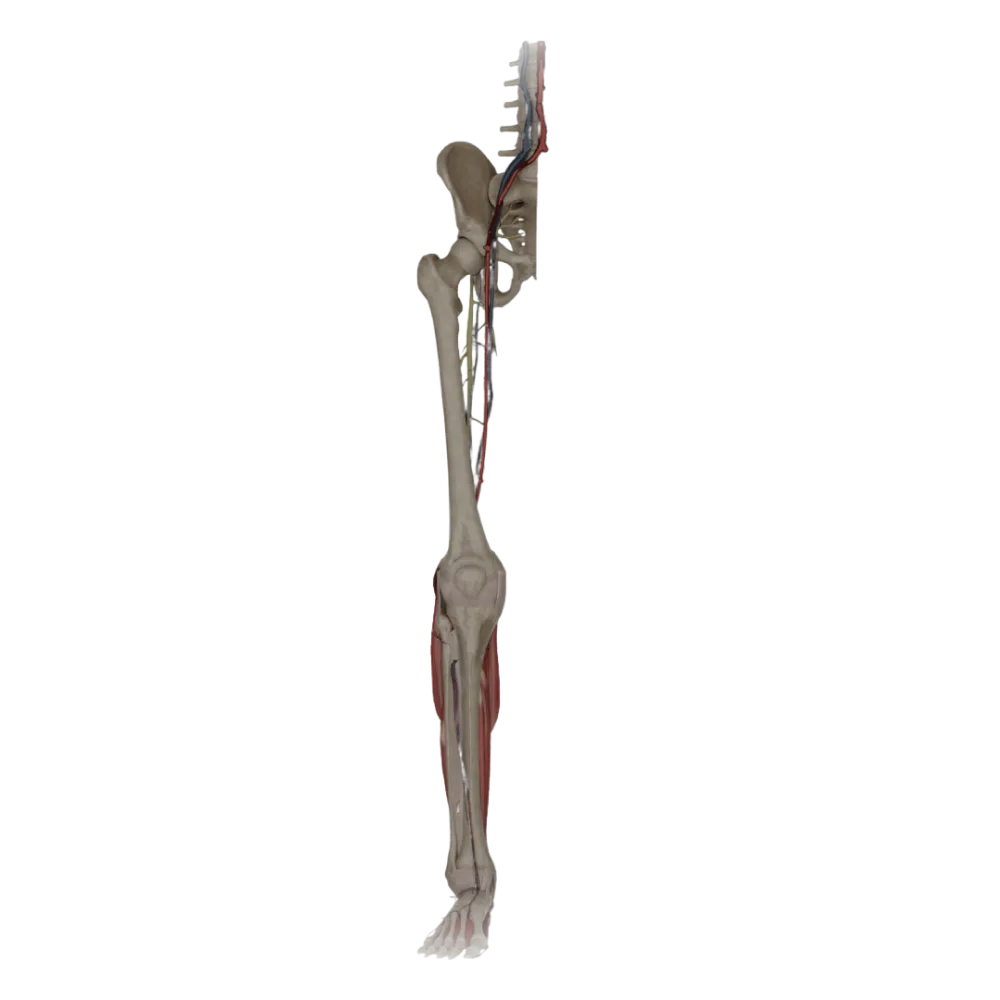
Common fibular nerve anatomy quiz.
Evaluate knowledge of common fibular nerve anatomy. The test assesses its topography, branching, and areas of innervation on the leg and foot.
1/20
bold
text
1. Which plexus gives rise to the fibers forming the common fibular nerve?
-
Cervical
The common fibular nerve is a branch of the sciatic nerve, formed from the sacral plexus (L4-S2).
-
Brachial
The common fibular nerve is a branch of the sciatic nerve, formed from the sacral plexus (L4-S2).
-
Lumbar
The common fibular nerve is a branch of the sciatic nerve, formed from the sacral plexus (L4-S2).
-
Sacral
The common fibular nerve is a branch of the sciatic nerve, formed from the sacral plexus (L4-S2).
-
I find it difficult to answer
The common fibular nerve is a branch of the sciatic nerve, formed from the sacral plexus (L4-S2).
2. Along the medial border of which muscle does the common fibular nerve pass in the popliteal fossa?
-
Semitendinosus muscle
In the popliteal fossa, the nerve is located laterally, descending along the medial border of the tendon of the biceps femoris muscle.
-
Biceps femoris muscle
In the popliteal fossa, the nerve is located laterally, descending along the medial border of the tendon of the biceps femoris muscle.
-
Semimembranosus muscle
In the popliteal fossa, the nerve is located laterally, descending along the medial border of the tendon of the biceps femoris muscle.
-
Medial head of the gastrocnemius
In the popliteal fossa, the nerve is located laterally, descending along the medial border of the tendon of the biceps femoris muscle.
-
I find it difficult to answer
In the popliteal fossa, the nerve is located laterally, descending along the medial border of the tendon of the biceps femoris muscle.
3. Which bony structure does the common fibular nerve encircle before dividing?
-
Lateral malleolus
The nerve winds around the head and neck of the fibula posteriorly to anteriorly, where it is most susceptible to external compression.
-
Tibial tuberosity.
The nerve winds around the head and neck of the fibula posteriorly to anteriorly, where it is most susceptible to external compression.
-
Neck of the fibula.
The nerve winds around the head and neck of the fibula posteriorly to anteriorly, where it is most susceptible to external compression.
-
Medial condyle.
The nerve winds around the head and neck of the fibula posteriorly to anteriorly, where it is most susceptible to external compression.
-
I find it difficult to answer
The nerve winds around the head and neck of the fibula posteriorly to anteriorly, where it is most susceptible to external compression.
4. Into what two main branches does the common fibular nerve divide?
-
Superficial and deep fibular nerves.
After passing the superior muscular-fibular canal, the nerve divides into superficial and deep branches.
-
Tibial and saphenous
After passing the superior muscular-fibular canal, the nerve divides into superficial and deep branches.
-
Lateral and medial plantar
After passing the superior muscular-fibular canal, the nerve divides into superficial and deep branches.
-
Gastrocnemius and femoral
After passing the superior muscular-fibular canal, the nerve divides into superficial and deep branches.
-
I find it difficult to answer
After passing the superior muscular-fibular canal, the nerve divides into superficial and deep branches.
5. In which anatomical canal does the superficial fibular nerve course in the upper third of the leg?
-
Cruropopliteal canal
The superficial fibular nerve descends between portions of the fibularis longus muscle within the superior muscular-peroneal canal.
-
Inferior muscular-peroneal canal.
The superficial fibular nerve descends between portions of the fibularis longus muscle within the superior muscular-peroneal canal.
-
Adductor canal
The superficial fibular nerve descends between portions of the fibularis longus muscle within the superior muscular-peroneal canal.
-
Superior muscular-peroneal canal.
The superficial fibular nerve descends between portions of the fibularis longus muscle within the superior muscular-peroneal canal.
-
I find it difficult to answer
The superficial fibular nerve descends between portions of the fibularis longus muscle within the superior muscular-peroneal canal.
6. Which muscle is innervated by the superficial fibular nerve?
-
Fibularis longus muscle
The superficial fibular nerve provides motor innervation to the lateral group of leg muscles, including the fibularis longus.
-
Anterior tibial muscle
The superficial fibular nerve provides motor innervation to the lateral group of leg muscles, including the fibularis longus.
-
Tibialis posterior muscle
The superficial fibular nerve provides motor innervation to the lateral group of leg muscles, including the fibularis longus.
-
Triceps surae muscle
The superficial fibular nerve provides motor innervation to the lateral group of leg muscles, including the fibularis longus.
-
I find it difficult to answer
The superficial fibular nerve provides motor innervation to the lateral group of leg muscles, including the fibularis longus.
7. Which area of skin is innervated by the superficial fibular nerve?
-
Skin of the sole
The superficial branch innervates most of the dorsum of the foot, except for the lateral border and the first interdigital space.
-
Skin of the dorsum of the foot (except for the first interdigital space)
The superficial branch innervates most of the dorsum of the foot, except for the lateral border and the first interdigital space.
-
Skin of the medial border of the foot
The superficial branch innervates most of the dorsum of the foot, except for the lateral border and the first interdigital space.
-
Skin of the lateral border of the foot
The superficial branch innervates most of the dorsum of the foot, except for the lateral border and the first interdigital space.
-
I find it difficult to answer
The superficial branch innervates most of the dorsum of the foot, except for the lateral border and the first interdigital space.
8. Which artery accompanies the deep fibular nerve in the leg?
-
Popliteal artery.
In the leg, the deep fibular nerve accompanies the anterior tibial artery, forming the anterior neurovascular bundle.
-
Posterior tibial artery.
In the leg, the deep fibular nerve accompanies the anterior tibial artery, forming the anterior neurovascular bundle.
-
Anterior tibial artery.
In the leg, the deep fibular nerve accompanies the anterior tibial artery, forming the anterior neurovascular bundle.
-
Fibular artery
In the leg, the deep fibular nerve accompanies the anterior tibial artery, forming the anterior neurovascular bundle.
-
I find it difficult to answer
In the leg, the deep fibular nerve accompanies the anterior tibial artery, forming the anterior neurovascular bundle.
9. Which muscle is innervated by the deep fibular nerve?
-
Fibularis brevis muscle
The deep fibular nerve innervates the anterior group of leg muscles, including the anterior tibial muscle.
-
Anterior tibial muscle
The deep fibular nerve innervates the anterior group of leg muscles, including the anterior tibial muscle.
-
Gastrocnemius muscle.
The deep fibular nerve innervates the anterior group of leg muscles, including the anterior tibial muscle.
-
Soleus muscle
The deep fibular nerve innervates the anterior group of leg muscles, including the anterior tibial muscle.
-
I find it difficult to answer
The deep fibular nerve innervates the anterior group of leg muscles, including the anterior tibial muscle.
10. Which skin area is innervated by the deep fibular nerve?
-
Lateral surface of the leg
The terminal cutaneous branch of the deep fibular nerve provides sensation only to the area of the first interdigital space.
-
Skin of the heel
The terminal cutaneous branch of the deep fibular nerve provides sensation only to the area of the first interdigital space.
-
Skin of the fifth toe
The terminal cutaneous branch of the deep fibular nerve provides sensation only to the area of the first interdigital space.
-
Skin of the first interdigital space of the foot
The terminal cutaneous branch of the deep fibular nerve provides sensation only to the area of the first interdigital space.
-
I find it difficult to answer
The terminal cutaneous branch of the deep fibular nerve provides sensation only to the area of the first interdigital space.
11. What branch arises from the common fibular nerve in the popliteal fossa?
-
Lateral sural cutaneous nerve
In the popliteal fossa, the common fibular nerve gives off the lateral sural cutaneous nerve for innervation of the lateral leg surface.
-
Medial sural cutaneous nerve.
In the popliteal fossa, the common fibular nerve gives off the lateral sural cutaneous nerve for innervation of the lateral leg surface.
-
Saphenous nerve.
In the popliteal fossa, the common fibular nerve gives off the lateral sural cutaneous nerve for innervation of the lateral leg surface.
-
Obturator nerve.
In the popliteal fossa, the common fibular nerve gives off the lateral sural cutaneous nerve for innervation of the lateral leg surface.
-
I find it difficult to answer
In the popliteal fossa, the common fibular nerve gives off the lateral sural cutaneous nerve for innervation of the lateral leg surface.
12. Which branch of the tibial nerve does the fibular communicating branch join to form the sural nerve?
-
Lateral sural cutaneous nerve
The fibular communicating branch merges with the medial sural cutaneous nerve (from the tibial nerve) forming the sural nerve.
-
Saphenous nerve
The fibular communicating branch merges with the medial sural cutaneous nerve (from the tibial nerve) forming the sural nerve.
-
Medial sural cutaneous nerve
The fibular communicating branch merges with the medial sural cutaneous nerve (from the tibial nerve) forming the sural nerve.
-
Posterior femoral cutaneous nerve
The fibular communicating branch merges with the medial sural cutaneous nerve (from the tibial nerve) forming the sural nerve.
-
I find it difficult to answer
The fibular communicating branch merges with the medial sural cutaneous nerve (from the tibial nerve) forming the sural nerve.
13. Which muscle on the dorsum of the foot is innervated by the deep fibular nerve?
-
Flexor digitorum brevis muscle.
The deep fibular nerve gives off motor branches to the extensor digitorum and hallucis brevis muscles on the foot.
-
Abductor hallucis muscle.
The deep fibular nerve gives off motor branches to the extensor digitorum and hallucis brevis muscles on the foot.
-
Quadratus plantae muscle.
The deep fibular nerve gives off motor branches to the extensor digitorum and hallucis brevis muscles on the foot.
-
Extensor digitorum brevis
The deep fibular nerve gives off motor branches to the extensor digitorum and hallucis brevis muscles on the foot.
-
I find it difficult to answer
The deep fibular nerve gives off motor branches to the extensor digitorum and hallucis brevis muscles on the foot.
14. Into which branches does the superficial fibular nerve divide on the dorsum of the foot?
-
Lateral and medial plantar nerves
In the lower third of the leg, the superficial nerve divides into the medial and intermediate dorsal cutaneous nerves of the foot.
-
Anterior and posterior tibial nerves
In the lower third of the leg, the superficial nerve divides into the medial and intermediate dorsal cutaneous nerves of the foot.
-
Medial and intermediate dorsal cutaneous nerves
In the lower third of the leg, the superficial nerve divides into the medial and intermediate dorsal cutaneous nerves of the foot.
-
Deep and superficial nerves of the foot
In the lower third of the leg, the superficial nerve divides into the medial and intermediate dorsal cutaneous nerves of the foot.
-
I find it difficult to answer
In the lower third of the leg, the superficial nerve divides into the medial and intermediate dorsal cutaneous nerves of the foot.
15. In which third of the leg does the superficial fibular nerve typically perforate the leg fascia and emerge subcutaneously?
-
Upper third
The emergence of the superficial fibular nerve subcutaneously through the leg fascia occurs in the lower third of the leg.
-
Lower third
The emergence of the superficial fibular nerve subcutaneously through the leg fascia occurs in the lower third of the leg.
-
Middle third
The emergence of the superficial fibular nerve subcutaneously through the leg fascia occurs in the lower third of the leg.
-
At the level of the knee joint
The emergence of the superficial fibular nerve subcutaneously through the leg fascia occurs in the lower third of the leg.
-
I find it difficult to answer
The emergence of the superficial fibular nerve subcutaneously through the leg fascia occurs in the lower third of the leg.
16. Which group of muscles in the leg is innervated by the deep fibular nerve?
-
Anterior.
The deep branch is responsible for innervating the muscles of the anterior fascial compartment of the leg (extensors).
-
Posterior (superficial layer)
The deep branch is responsible for innervating the muscles of the anterior fascial compartment of the leg (extensors).
-
Lateral.
The deep branch is responsible for innervating the muscles of the anterior fascial compartment of the leg (extensors).
-
Posterior (deep layer)
The deep branch is responsible for innervating the muscles of the anterior fascial compartment of the leg (extensors).
-
I find it difficult to answer
The deep branch is responsible for innervating the muscles of the anterior fascial compartment of the leg (extensors).
17. How is the deep fibular nerve positioned relative to the anterior tibial artery in the upper third of the leg?
-
Medially
In the upper third of the leg, the nerve is positioned lateral to the artery, then crosses it anteriorly and lies medially.
-
Anteriorly
In the upper third of the leg, the nerve is positioned lateral to the artery, then crosses it anteriorly and lies medially.
-
Posteriorly
In the upper third of the leg, the nerve is positioned lateral to the artery, then crosses it anteriorly and lies medially.
-
Laterally
In the upper third of the leg, the nerve is positioned lateral to the artery, then crosses it anteriorly and lies medially.
-
I find it difficult to answer
In the upper third of the leg, the nerve is positioned lateral to the artery, then crosses it anteriorly and lies medially.
18. Which of the listed muscles does NOT receive innervation from branches of the common fibular nerve?
-
Flexor digitorum longus
The flexor digitorum longus belongs to the posterior group of leg muscles and is innervated by the tibial nerve.
-
Fibularis tertius muscle.
The flexor digitorum longus belongs to the posterior group of leg muscles and is innervated by the tibial nerve.
-
Extensor digitorum longus.
The flexor digitorum longus belongs to the posterior group of leg muscles and is innervated by the tibial nerve.
-
Extensor hallucis brevis
The flexor digitorum longus belongs to the posterior group of leg muscles and is innervated by the tibial nerve.
-
I find it difficult to answer
The flexor digitorum longus belongs to the posterior group of leg muscles and is innervated by the tibial nerve.
19. The fibers of which spinal cord segments predominantly form the common fibular nerve?
-
L1-L3
Fibers from the sacral plexus segments L4-S2 form the sciatic nerve and consequently its fibular portion.
-
L4-S2
Fibers from the sacral plexus segments L4-S2 form the sciatic nerve and consequently its fibular portion.
-
L2 - L4
Fibers from the sacral plexus segments L4-S2 form the sciatic nerve and consequently its fibular portion.
-
S2-S4
Fibers from the sacral plexus segments L4-S2 form the sciatic nerve and consequently its fibular portion.
-
I find it difficult to answer
Fibers from the sacral plexus segments L4-S2 form the sciatic nerve and consequently its fibular portion.
20. Through which muscle does the initial part of the deep fibular nerve pass, piercing its anterior intermuscular septum?
-
Fibularis longus muscle
After dividing, the deep fibular nerve passes through the thickness of the initial part of the extensor longus digitorum into the anterior compartment.
-
Anterior tibial muscle
After dividing, the deep fibular nerve passes through the thickness of the initial part of the extensor longus digitorum into the anterior compartment.
-
Extensor digitorum longus.
After dividing, the deep fibular nerve passes through the thickness of the initial part of the extensor longus digitorum into the anterior compartment.
-
Soleus muscle
After dividing, the deep fibular nerve passes through the thickness of the initial part of the extensor longus digitorum into the anterior compartment.
-
I find it difficult to answer
After dividing, the deep fibular nerve passes through the thickness of the initial part of the extensor longus digitorum into the anterior compartment.
Retake this quiz?
Your current progress will be reset.