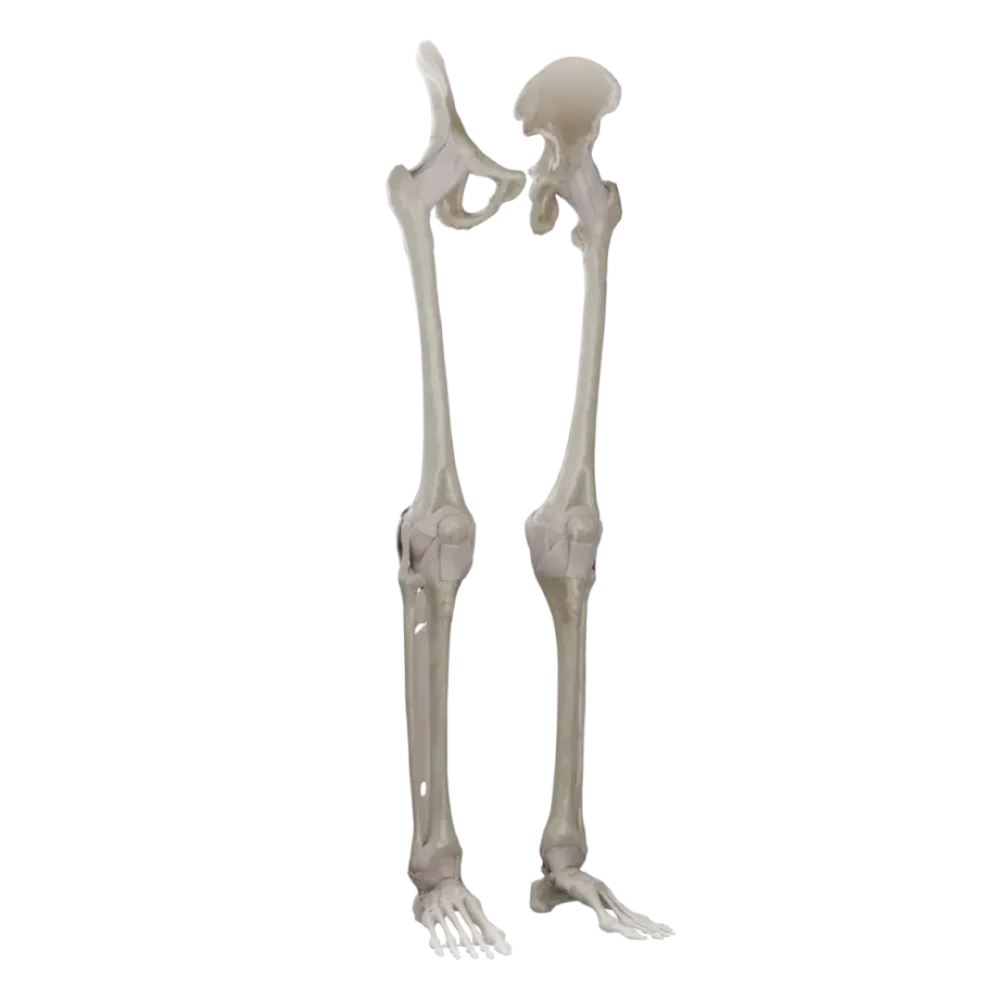

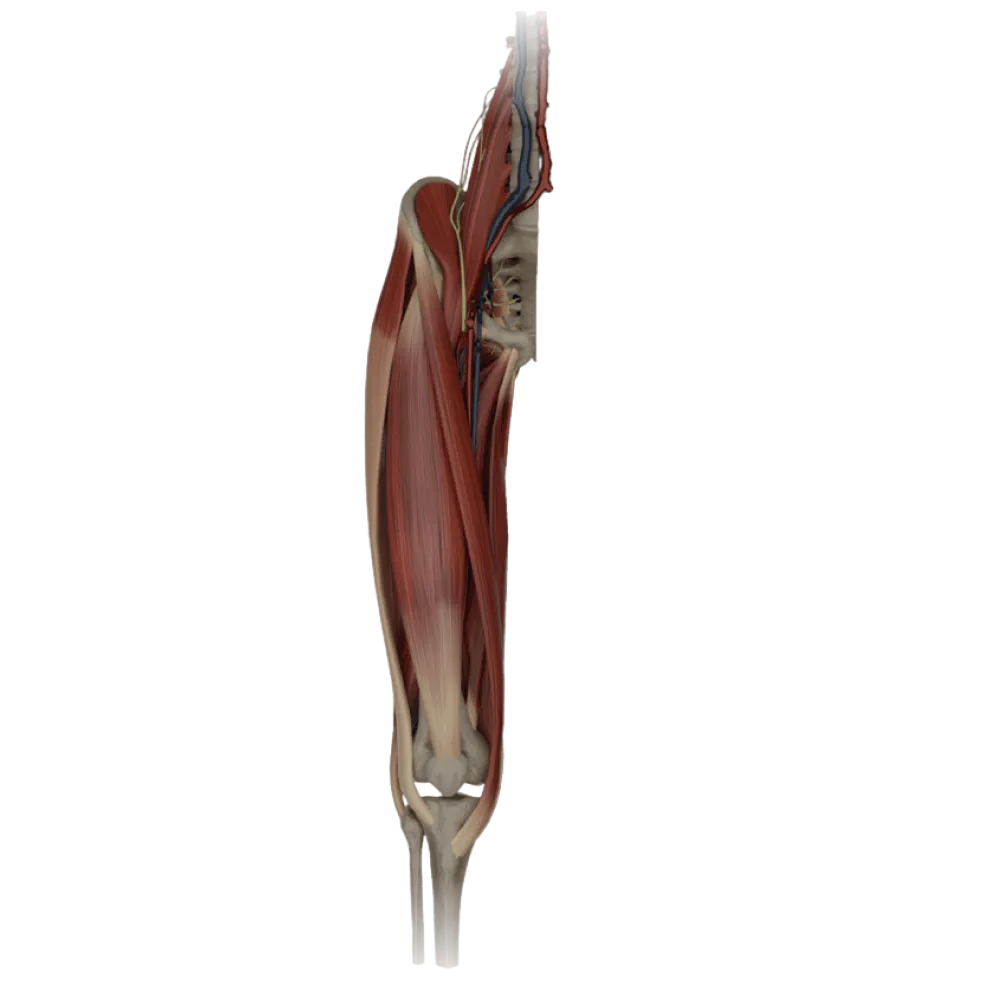
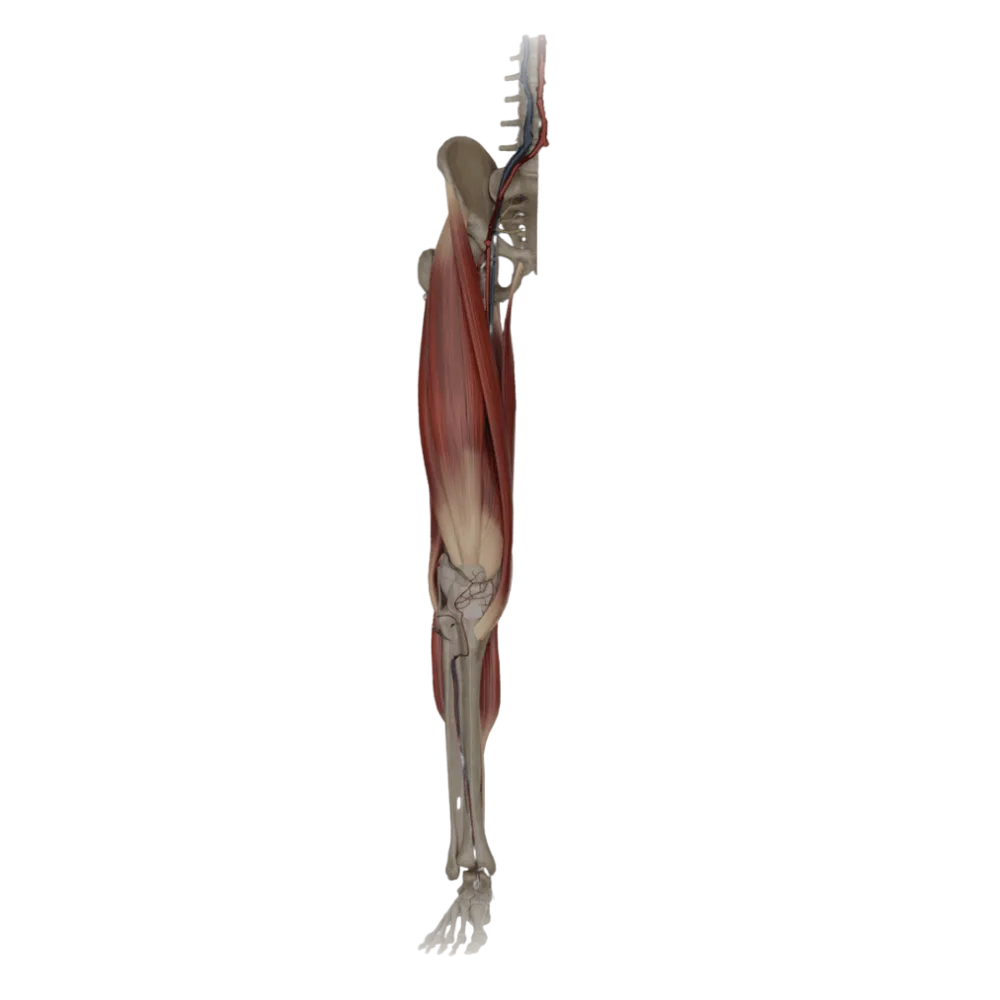
Knee joint anatomy test.
Test your knowledge of the knee joint anatomy. The test covers the topography, muscles, innervation, and blood supply of the knee structures.
1/20
bold
text
1. Which muscle flexes the leg at the knee joint and medially rotates it when the knee is flexed?
-
Semimembranosus muscle.
The semimembranosus muscle flexes the leg and medially rotates it when the knee joint is flexed.
-
Biceps femoris muscle.
The semimembranosus muscle flexes the leg and medially rotates it when the knee joint is flexed.
-
Rectus femoris.
The semimembranosus muscle flexes the leg and medially rotates it when the knee joint is flexed.
-
Vastus medialis
The semimembranosus muscle flexes the leg and medially rotates it when the knee joint is flexed.
-
I find it difficult to answer
The semimembranosus muscle flexes the leg and medially rotates it when the knee joint is flexed.
2. Which artery directly gives rise to the superior medial genicular artery (a. superior medialis genus)?
-
Femoral artery.
The superior medial genicular artery is a direct branch of the popliteal artery.
-
Anterior tibial artery.
The superior medial genicular artery is a direct branch of the popliteal artery.
-
Deep femoral artery.
The superior medial genicular artery is a direct branch of the popliteal artery.
-
Popliteal artery.
The superior medial genicular artery is a direct branch of the popliteal artery.
-
I find it difficult to answer
The superior medial genicular artery is a direct branch of the popliteal artery.
3. Which nerve’s branches predominantly innervate the posterior aspect of the knee joint capsule?
-
Common fibular nerve.
The tibial nerve gives articular branches to the posterior aspect of the knee joint capsule.
-
Tibial nerve.
The tibial nerve gives articular branches to the posterior aspect of the knee joint capsule.
-
Femoral nerve.
The tibial nerve gives articular branches to the posterior aspect of the knee joint capsule.
-
Obturator nerve.
The tibial nerve gives articular branches to the posterior aspect of the knee joint capsule.
-
I find it difficult to answer
The tibial nerve gives articular branches to the posterior aspect of the knee joint capsule.
4. Which muscle initiates flexion ('unlocks') of the fully extended knee joint by laterally rotating the femur on the fixed tibia?
-
Plantar muscle
The popliteal muscle initiates knee joint flexion by laterally rotating the femur relative to the tibia.
-
Gastrocnemius muscle.
The popliteal muscle initiates knee joint flexion by laterally rotating the femur relative to the tibia.
-
Soleus muscle.
The popliteal muscle initiates knee joint flexion by laterally rotating the femur relative to the tibia.
-
Popliteal muscle.
The popliteal muscle initiates knee joint flexion by laterally rotating the femur relative to the tibia.
-
I find it difficult to answer
The popliteal muscle initiates knee joint flexion by laterally rotating the femur relative to the tibia.
5. Which artery predominantly contributes to the blood supply of the cruciate ligaments of the knee joint?
-
Middle genicular artery
The middle genicular artery penetrates the joint capsule and supplies the cruciate ligaments and synovial folds.
-
Inferior lateral genicular artery
The middle genicular artery penetrates the joint capsule and supplies the cruciate ligaments and synovial folds.
-
Descending genicular artery
The middle genicular artery penetrates the joint capsule and supplies the cruciate ligaments and synovial folds.
-
Anterior recurrent tibial artery.
The middle genicular artery penetrates the joint capsule and supplies the cruciate ligaments and synovial folds.
-
I find it difficult to answer
The middle genicular artery penetrates the joint capsule and supplies the cruciate ligaments and synovial folds.
6. Which muscle is the chief and most powerful extensor of the knee joint?
-
Biceps femoris muscle.
The quadriceps femoris muscle is the primary extensor of the knee joint.
-
Quadriceps femoris muscle.
The quadriceps femoris muscle is the primary extensor of the knee joint.
-
Sartorius muscle.
The quadriceps femoris muscle is the primary extensor of the knee joint.
-
Gracilis muscle.
The quadriceps femoris muscle is the primary extensor of the knee joint.
-
I find it difficult to answer
The quadriceps femoris muscle is the primary extensor of the knee joint.
7. Which nerve provides sensory innervation to the skin of the medial and anteromedial knee joint regions?
-
Lateral femoral cutaneous nerve.
The infrapatellar branch of the saphenous nerve innervates the skin of the medial knee region.
-
Medial sural cutaneous nerve.
The infrapatellar branch of the saphenous nerve innervates the skin of the medial knee region.
-
Saphenous nerve (infrapatellar branch).
The infrapatellar branch of the saphenous nerve innervates the skin of the medial knee region.
-
Superficial fibular nerve.
The infrapatellar branch of the saphenous nerve innervates the skin of the medial knee region.
-
I find it difficult to answer
The infrapatellar branch of the saphenous nerve innervates the skin of the medial knee region.
8. Which artery is a branch of the femoral artery and contributes to the formation of the knee joint network (rete articulare genus)?
-
Descending genicular artery
The descending genicular artery branches from the femoral artery in the adductor canal.
-
Superior lateral genicular artery
The descending genicular artery branches from the femoral artery in the adductor canal.
-
Posterior recurrent tibial artery.
The descending genicular artery branches from the femoral artery in the adductor canal.
-
Circumflex fibular artery.
The descending genicular artery branches from the femoral artery in the adductor canal.
-
I find it difficult to answer
The descending genicular artery branches from the femoral artery in the adductor canal.
9. Which muscle flexes the leg and rotates it laterally when the knee joint is flexed?
-
Semitendinosus muscle.
The biceps femoris muscle flexes the leg and laterally rotates the bent leg.
-
Sartorius muscle.
The biceps femoris muscle flexes the leg and laterally rotates the bent leg.
-
Gracilis muscle.
The biceps femoris muscle flexes the leg and laterally rotates the bent leg.
-
Biceps femoris muscle.
The biceps femoris muscle flexes the leg and laterally rotates the bent leg.
-
I find it difficult to answer
The biceps femoris muscle flexes the leg and laterally rotates the bent leg.
10. Which structures form the floor of the popliteal fossa, adjacent to the knee joint capsule?
-
Popliteal muscle.
The floor of the popliteal fossa is formed by the popliteal surface of the femur and the posterior part of the joint capsule.
-
Gastrocnemius muscle.
The floor of the popliteal fossa is formed by the popliteal surface of the femur and the posterior part of the joint capsule.
-
Popliteal surface of femur and joint capsule.
The floor of the popliteal fossa is formed by the popliteal surface of the femur and the posterior part of the joint capsule.
-
Tendon of the biceps femoris muscle.
The floor of the popliteal fossa is formed by the popliteal surface of the femur and the posterior part of the joint capsule.
-
I find it difficult to answer
The floor of the popliteal fossa is formed by the popliteal surface of the femur and the posterior part of the joint capsule.
11. Which artery predominantly anastomoses with the anterior recurrent tibial artery (a. recurrens tibialis anterior) in the joint network?
-
Inferior lateral genicular artery
The anterior recurrent tibial artery ascends and anastomoses with inferior knee arteries.
-
Descending genicular artery
The anterior recurrent tibial artery ascends and anastomoses with inferior knee arteries.
-
Superior medial genicular artery
The anterior recurrent tibial artery ascends and anastomoses with inferior knee arteries.
-
Deep circumflex iliac artery
The anterior recurrent tibial artery ascends and anastomoses with inferior knee arteries.
-
I find it difficult to answer
The anterior recurrent tibial artery ascends and anastomoses with inferior knee arteries.
12. Which muscle’s tendon contributes to the formation of the superficial 'pes anserinus' together with the sartorius and gracilis muscles?
-
Semimembranosus muscle.
The superficial 'pes anserinus' is formed by the tendons of the sartorius, gracilis, and semitendinosus muscles.
-
Semitendinosus muscle.
The superficial 'pes anserinus' is formed by the tendons of the sartorius, gracilis, and semitendinosus muscles.
-
Pectineus muscle.
The superficial 'pes anserinus' is formed by the tendons of the sartorius, gracilis, and semitendinosus muscles.
-
Adductor magnus muscle.
The superficial 'pes anserinus' is formed by the tendons of the sartorius, gracilis, and semitendinosus muscles.
-
I find it difficult to answer
The superficial 'pes anserinus' is formed by the tendons of the sartorius, gracilis, and semitendinosus muscles.
13. Which nerve innervates the short head of the biceps femoris muscle?
-
Tibial nerve.
The short head of the biceps femoris muscle is innervated by the common fibular nerve.
-
Sciatic nerve (tibial portion).
The short head of the biceps femoris muscle is innervated by the common fibular nerve.
-
Inferior gluteal nerve.
The short head of the biceps femoris muscle is innervated by the common fibular nerve.
-
Common fibular nerve.
The short head of the biceps femoris muscle is innervated by the common fibular nerve.
-
I find it difficult to answer
The short head of the biceps femoris muscle is innervated by the common fibular nerve.
14. From which structure does the popliteal muscle (m. popliteus) originate?
-
Medial condyle of femur.
The popliteal muscle originates from the lateral condyle of the femur and the knee joint capsule.
-
Lateral condyle of femur.
The popliteal muscle originates from the lateral condyle of the femur and the knee joint capsule.
-
Head of the fibula.
The popliteal muscle originates from the lateral condyle of the femur and the knee joint capsule.
-
Tibial tuberosity.
The popliteal muscle originates from the lateral condyle of the femur and the knee joint capsule.
-
I find it difficult to answer
The popliteal muscle originates from the lateral condyle of the femur and the knee joint capsule.
15. Which branch of the sacral plexus gives articular branches to the knee joint capsule laterally?
-
Common fibular nerve.
The common fibular nerve innervates the knee joint capsule laterally.
-
Femoral nerve.
The common fibular nerve innervates the knee joint capsule laterally.
-
Obturator nerve.
The common fibular nerve innervates the knee joint capsule laterally.
-
Posterior femoral cutaneous nerve.
The common fibular nerve innervates the knee joint capsule laterally.
-
I find it difficult to answer
The common fibular nerve innervates the knee joint capsule laterally.
16. Which artery, passing through the adductor hiatus, continues as the popliteal artery?
-
Obturator artery.
The femoral artery passes through the adductor canal and continues into the popliteal fossa.
-
External iliac artery
The femoral artery passes through the adductor canal and continues into the popliteal fossa.
-
Femoral artery.
The femoral artery passes through the adductor canal and continues into the popliteal fossa.
-
Deep femoral artery.
The femoral artery passes through the adductor canal and continues into the popliteal fossa.
-
I find it difficult to answer
The femoral artery passes through the adductor canal and continues into the popliteal fossa.
17. The patellar ligament (lig. patellae) is the continuation of the tendon of which muscle?
-
Sartorius muscle.
The patellar ligament is a continuation of the quadriceps femoris tendon.
-
Biceps femoris muscle.
The patellar ligament is a continuation of the quadriceps femoris tendon.
-
Quadriceps femoris muscle.
The patellar ligament is a continuation of the quadriceps femoris tendon.
-
Tensor fasciae latae
The patellar ligament is a continuation of the quadriceps femoris tendon.
-
I find it difficult to answer
The patellar ligament is a continuation of the quadriceps femoris tendon.
18. Which articular branch typically arises from the anterior tibial artery before it passes through the interosseous membrane?
-
Anterior recurrent tibial artery.
The posterior recurrent tibial artery originates from the anterior tibial artery on the posterior surface of the leg.
-
Anterior lateral malleolar artery
The posterior recurrent tibial artery originates from the anterior tibial artery on the posterior surface of the leg.
-
Lateral tarsal artery
The posterior recurrent tibial artery originates from the anterior tibial artery on the posterior surface of the leg.
-
Posterior recurrent tibial artery.
The posterior recurrent tibial artery originates from the anterior tibial artery on the posterior surface of the leg.
-
I find it difficult to answer
The posterior recurrent tibial artery originates from the anterior tibial artery on the posterior surface of the leg.
19. Which muscle provides crucial dynamic stabilization of the medial compartment of the knee joint and the patella?
-
Vastus lateralis muscle
The vastus medialis muscle stabilizes the patella, preventing its lateral displacement.
-
Vastus medialis
The vastus medialis muscle stabilizes the patella, preventing its lateral displacement.
-
Biceps femoris muscle.
The vastus medialis muscle stabilizes the patella, preventing its lateral displacement.
-
Plantar muscle
The vastus medialis muscle stabilizes the patella, preventing its lateral displacement.
-
I find it difficult to answer
The vastus medialis muscle stabilizes the patella, preventing its lateral displacement.
20. To what type of joints by the shape of the articular surfaces does the knee joint anatomically belong?
-
Spheroidal (articulatio spheroidea)
By the shape of its articular surfaces, the knee joint is a typical bicondylar joint.
-
Trochoid (articulatio trochoidea)
By the shape of its articular surfaces, the knee joint is a typical bicondylar joint.
-
Bicondylar (articulatio bicondylaris)
By the shape of its articular surfaces, the knee joint is a typical bicondylar joint.
-
Planar (articulatio plana)
By the shape of its articular surfaces, the knee joint is a typical bicondylar joint.
-
I find it difficult to answer
By the shape of its articular surfaces, the knee joint is a typical bicondylar joint.
Retake this quiz?
Your current progress will be reset.