


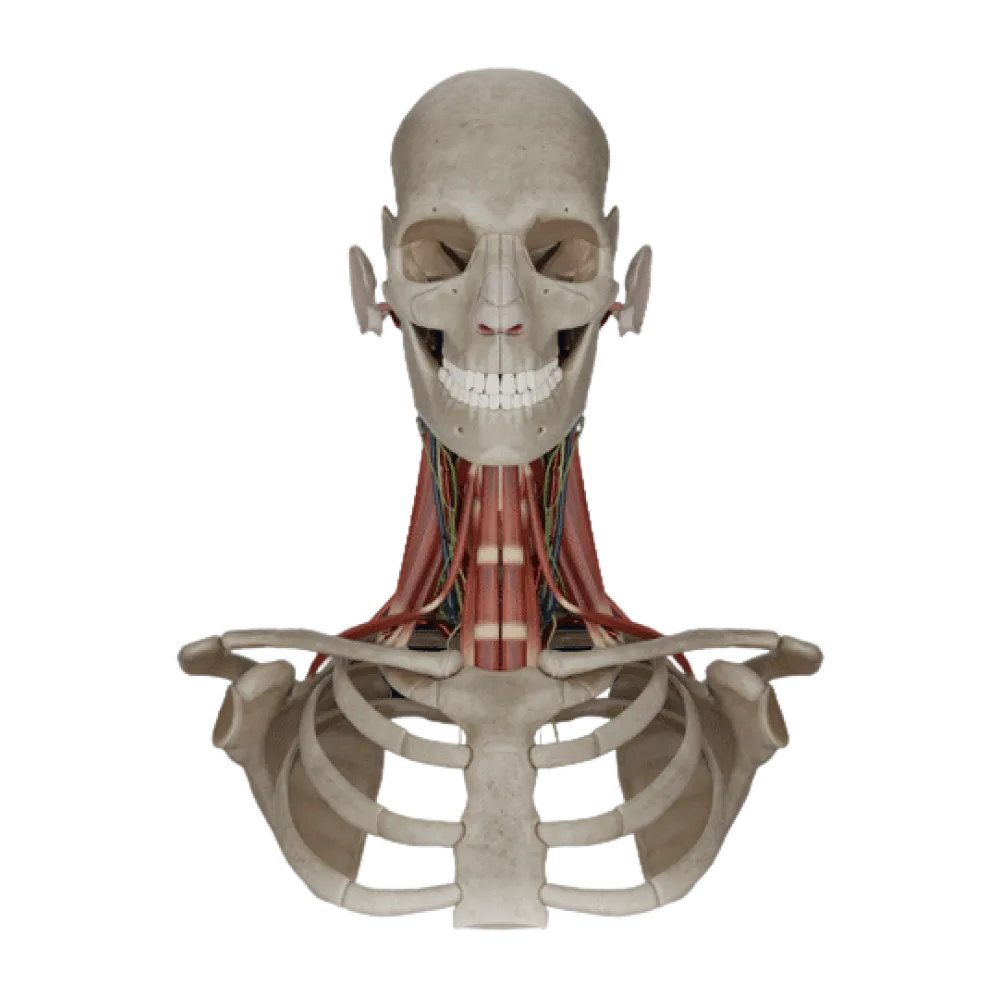
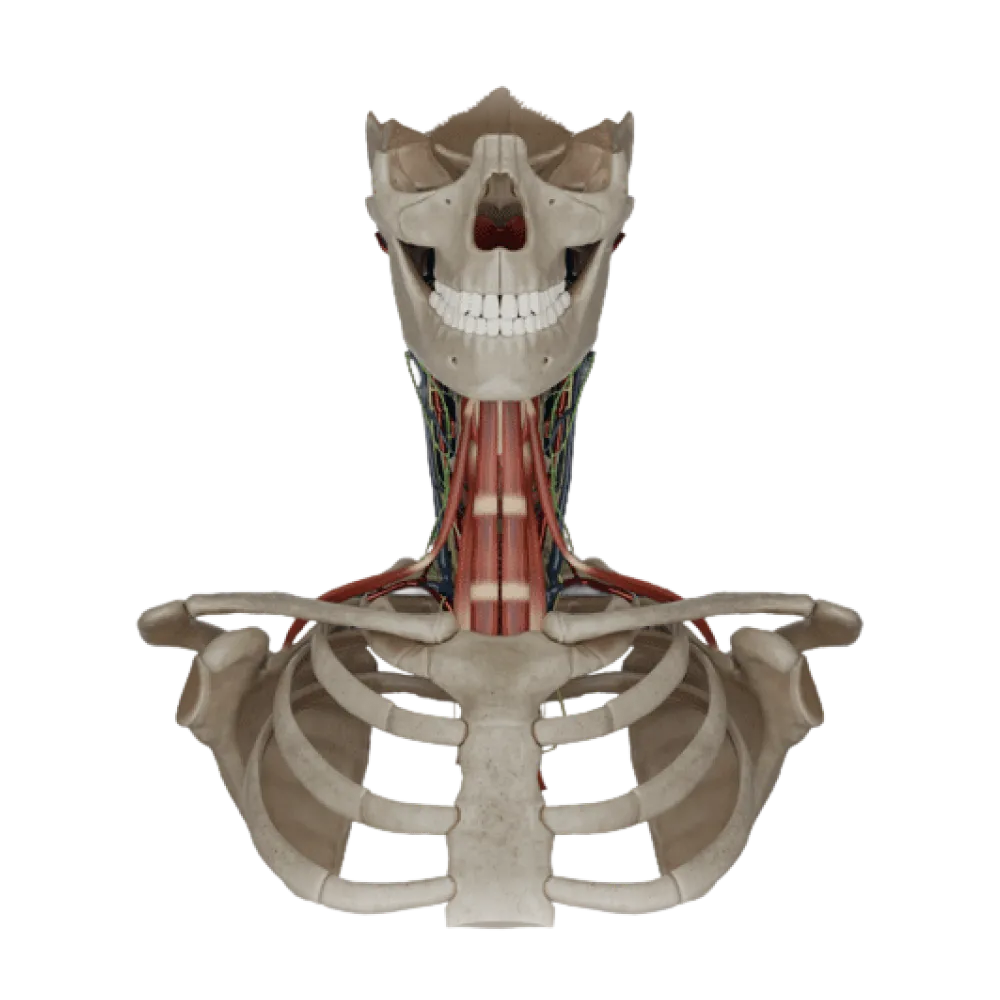
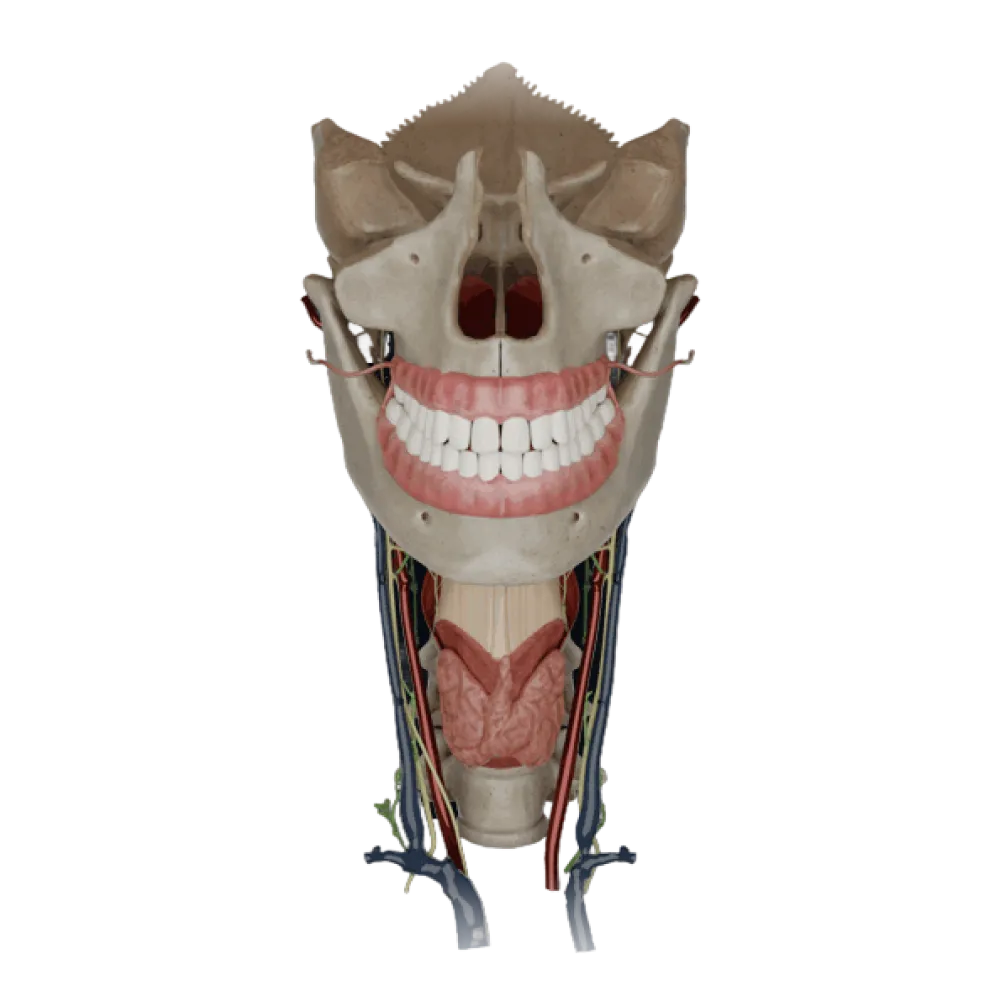
Anatomy test of the larynx
Evaluate your knowledge of laryngeal anatomy. The test assesses skeletal topology, syntopy, blood supply, lymphatic drainage, somatic and autonomic innervation.
1/20
bold
text
1. In adults, the larynx is normally positioned relative to the vertebral column at the level of:
-
C2-C4
In adults, the larynx is located in the anterior region of the neck at the level of the IV to VI cervical vertebrae.
-
C4-C6
In adults, the larynx is located in the anterior region of the neck at the level of the IV to VI cervical vertebrae.
-
C6-T1
In adults, the larynx is located in the anterior region of the neck at the level of the IV to VI cervical vertebrae.
-
T1-T3
In adults, the larynx is located in the anterior region of the neck at the level of the IV to VI cervical vertebrae.
-
I find it difficult to answer
In adults, the larynx is located in the anterior region of the neck at the level of the IV to VI cervical vertebrae.
2. Which anatomical structure directly adjoins the posterior wall of the larynx?
-
Pharynx
The laryngeal part of the pharynx is located behind the larynx. The esophagus begins lower, at the level of the cricoid cartilage.
-
Thyroid gland
The laryngeal part of the pharynx is located behind the larynx. The esophagus begins lower, at the level of the cricoid cartilage.
-
Trachea
The laryngeal part of the pharynx is located behind the larynx. The esophagus begins lower, at the level of the cricoid cartilage.
-
Esophagus
The laryngeal part of the pharynx is located behind the larynx. The esophagus begins lower, at the level of the cricoid cartilage.
-
I find it difficult to answer
The laryngeal part of the pharynx is located behind the larynx. The esophagus begins lower, at the level of the cricoid cartilage.
3. The superior laryngeal artery (a. laryngea superior) is a branch of which artery?
-
Lingual artery
The superior laryngeal artery branches from the superior thyroid artery, which is the first branch of the external carotid artery.
-
Facial artery
The superior laryngeal artery branches from the superior thyroid artery, which is the first branch of the external carotid artery.
-
Superior thyroid artery.
The superior laryngeal artery branches from the superior thyroid artery, which is the first branch of the external carotid artery.
-
Ascending pharyngeal artery
The superior laryngeal artery branches from the superior thyroid artery, which is the first branch of the external carotid artery.
-
I find it difficult to answer
The superior laryngeal artery branches from the superior thyroid artery, which is the first branch of the external carotid artery.
4. The inferior laryngeal artery (a. laryngea inferior) originates from which artery?
-
Thyrocervical trunk
The inferior laryngeal artery is a branch of the inferior thyroid artery, which arises from the thyrocervical trunk.
-
Internal thoracic artery
The inferior laryngeal artery is a branch of the inferior thyroid artery, which arises from the thyrocervical trunk.
-
Subclavian artery
The inferior laryngeal artery is a branch of the inferior thyroid artery, which arises from the thyrocervical trunk.
-
Inferior thyroid artery.
The inferior laryngeal artery is a branch of the inferior thyroid artery, which arises from the thyrocervical trunk.
-
I find it difficult to answer
The inferior laryngeal artery is a branch of the inferior thyroid artery, which arises from the thyrocervical trunk.
5. Which of the mentioned laryngeal muscles is innervated by the external branch of the superior laryngeal nerve?
-
Cricothyroid muscle
The external branch of the superior laryngeal nerve is motor and innervates only one laryngeal muscle - the cricothyroid.
-
Posterior cricoarytenoid muscle.
The external branch of the superior laryngeal nerve is motor and innervates only one laryngeal muscle - the cricothyroid.
-
Transverse arytenoid muscle
The external branch of the superior laryngeal nerve is motor and innervates only one laryngeal muscle - the cricothyroid.
-
Vocalis muscle
The external branch of the superior laryngeal nerve is motor and innervates only one laryngeal muscle - the cricothyroid.
-
I find it difficult to answer
The external branch of the superior laryngeal nerve is motor and innervates only one laryngeal muscle - the cricothyroid.
6. Which nerve provides sensory innervation to the mucous membrane of the larynx ABOVE the vocal cords?
-
Recurrent laryngeal nerve.
The internal branch of the superior laryngeal nerve perforates the thyrohyoid membrane, providing sensitivity to the mucosa above the vocal folds.
-
Internal branch of the superior laryngeal nerve
The internal branch of the superior laryngeal nerve perforates the thyrohyoid membrane, providing sensitivity to the mucosa above the vocal folds.
-
External branch of the superior laryngeal nerve
The internal branch of the superior laryngeal nerve perforates the thyrohyoid membrane, providing sensitivity to the mucosa above the vocal folds.
-
Glossopharyngeal nerve
The internal branch of the superior laryngeal nerve perforates the thyrohyoid membrane, providing sensitivity to the mucosa above the vocal folds.
-
I find it difficult to answer
The internal branch of the superior laryngeal nerve perforates the thyrohyoid membrane, providing sensitivity to the mucosa above the vocal folds.
7. Which nerve provides sensory innervation to the mucous membrane of the larynx BELOW the vocal cords?
-
Internal branch of the superior laryngeal nerve
The inferior laryngeal nerve (terminal branch of the recurrent laryngeal nerve) innervates the mucosa of the larynx below the vocal folds.
-
External branch of the superior laryngeal nerve
The inferior laryngeal nerve (terminal branch of the recurrent laryngeal nerve) innervates the mucosa of the larynx below the vocal folds.
-
Sympathetic trunk
The inferior laryngeal nerve (terminal branch of the recurrent laryngeal nerve) innervates the mucosa of the larynx below the vocal folds.
-
Inferior laryngeal nerve
The inferior laryngeal nerve (terminal branch of the recurrent laryngeal nerve) innervates the mucosa of the larynx below the vocal folds.
-
I find it difficult to answer
The inferior laryngeal nerve (terminal branch of the recurrent laryngeal nerve) innervates the mucosa of the larynx below the vocal folds.
8. Which muscle is the sole dilator of the glottis (abducts the vocal folds)?
-
Lateral cricoarytenoid muscle.
The posterior cricoarytenoid muscle (m. cricoarytenoideus posterior) rotates the arytenoid cartilage outwards, being the only dilator of the glottis.
-
Thyroarytenoid muscle.
The posterior cricoarytenoid muscle (m. cricoarytenoideus posterior) rotates the arytenoid cartilage outwards, being the only dilator of the glottis.
-
Posterior cricoarytenoid muscle.
The posterior cricoarytenoid muscle (m. cricoarytenoideus posterior) rotates the arytenoid cartilage outwards, being the only dilator of the glottis.
-
Transverse arytenoid muscle
The posterior cricoarytenoid muscle (m. cricoarytenoideus posterior) rotates the arytenoid cartilage outwards, being the only dilator of the glottis.
-
I find it difficult to answer
The posterior cricoarytenoid muscle (m. cricoarytenoideus posterior) rotates the arytenoid cartilage outwards, being the only dilator of the glottis.
9. Which venous vessel does the blood from the superior laryngeal vein ultimately drain into?
-
Into the internal jugular vein.
The superior laryngeal vein drains into the superior thyroid vein, which carries blood to the internal jugular vein.
-
Into the brachiocephalic vein
The superior laryngeal vein drains into the superior thyroid vein, which carries blood to the internal jugular vein.
-
Into the external jugular vein.
The superior laryngeal vein drains into the superior thyroid vein, which carries blood to the internal jugular vein.
-
Into the anterior jugular vein
The superior laryngeal vein drains into the superior thyroid vein, which carries blood to the internal jugular vein.
-
I find it difficult to answer
The superior laryngeal vein drains into the superior thyroid vein, which carries blood to the internal jugular vein.
10. Where does the lymph from the superior part of the larynx (the vestibule) mainly drain to?
-
To the submandibular lymph nodes
Lymph from the superior part of the larynx drains mainly to the deep lateral cervical (jugular) lymph nodes.
-
To the deep lateral cervical lymph nodes
Lymph from the superior part of the larynx drains mainly to the deep lateral cervical (jugular) lymph nodes.
-
To the retropharyngeal lymph nodes
Lymph from the superior part of the larynx drains mainly to the deep lateral cervical (jugular) lymph nodes.
-
To the submental lymph nodes
Lymph from the superior part of the larynx drains mainly to the deep lateral cervical (jugular) lymph nodes.
-
I find it difficult to answer
Lymph from the superior part of the larynx drains mainly to the deep lateral cervical (jugular) lymph nodes.
11. Which of the listed laryngeal cartilages is paired?
-
Thyroid cartilage
The arytenoid, corniculate, and cuneiform cartilages are paired cartilages of the larynx.
-
Cricoid cartilage
The arytenoid, corniculate, and cuneiform cartilages are paired cartilages of the larynx.
-
Epiglottis
The arytenoid, corniculate, and cuneiform cartilages are paired cartilages of the larynx.
-
Arytenoid cartilage
The arytenoid, corniculate, and cuneiform cartilages are paired cartilages of the larynx.
-
I find it difficult to answer
The arytenoid, corniculate, and cuneiform cartilages are paired cartilages of the larynx.
12. By which structure is the thyroid cartilage of the larynx connected to the hyoid bone?
-
Cricothyroid ligament
The larynx is suspended from the hyoid bone by a broad fibrous sheet - the thyrohyoid membrane (membrana thyrohyoidea).
-
Cricotracheal ligament
The larynx is suspended from the hyoid bone by a broad fibrous sheet - the thyrohyoid membrane (membrana thyrohyoidea).
-
Thyrohyoid membrane
The larynx is suspended from the hyoid bone by a broad fibrous sheet - the thyrohyoid membrane (membrana thyrohyoidea).
-
Hyoepiglottic ligament
The larynx is suspended from the hyoid bone by a broad fibrous sheet - the thyrohyoid membrane (membrana thyrohyoidea).
-
I find it difficult to answer
The larynx is suspended from the hyoid bone by a broad fibrous sheet - the thyrohyoid membrane (membrana thyrohyoidea).
13. Which anatomical structure is located on the lateral wall of the larynx between the vestibular and vocal folds?
-
Laryngeal ventricle
The laryngeal ventricle (ventriculus laryngis, Morgagni's ventricle) is a recess located between the false (vestibular) and true vocal folds.
-
Laryngeal vestibule
The laryngeal ventricle (ventriculus laryngis, Morgagni's ventricle) is a recess located between the false (vestibular) and true vocal folds.
-
Infraglottic cavity
The laryngeal ventricle (ventriculus laryngis, Morgagni's ventricle) is a recess located between the false (vestibular) and true vocal folds.
-
Piriform recess
The laryngeal ventricle (ventriculus laryngis, Morgagni's ventricle) is a recess located between the false (vestibular) and true vocal folds.
-
I find it difficult to answer
The laryngeal ventricle (ventriculus laryngis, Morgagni's ventricle) is a recess located between the false (vestibular) and true vocal folds.
14. Which anatomical structures adjoin the larynx laterally (syntopy)?
-
The pharynx and cervical esophagus
Laterally, the right and left lobes of the thyroid gland, as well as the main neurovascular bundle of the neck (carotid artery, internal jugular vein, vagus nerve), are adjacent to the larynx.
-
Lobes of the thyroid gland and the cervical neurovascular bundles
Laterally, the right and left lobes of the thyroid gland, as well as the main neurovascular bundle of the neck (carotid artery, internal jugular vein, vagus nerve), are adjacent to the larynx.
-
Trachea and thymus gland
Laterally, the right and left lobes of the thyroid gland, as well as the main neurovascular bundle of the neck (carotid artery, internal jugular vein, vagus nerve), are adjacent to the larynx.
-
Long muscles of the neck and head
Laterally, the right and left lobes of the thyroid gland, as well as the main neurovascular bundle of the neck (carotid artery, internal jugular vein, vagus nerve), are adjacent to the larynx.
-
I find it difficult to answer
Laterally, the right and left lobes of the thyroid gland, as well as the main neurovascular bundle of the neck (carotid artery, internal jugular vein, vagus nerve), are adjacent to the larynx.
15. Through which structure do the internal branch of the superior laryngeal nerve and the superior laryngeal artery penetrate into the laryngeal cavity?
-
Cricothyroid membrane
The neurovascular bundle (a. laryngea superior, v. laryngea superior, r. internus n. laryngei superioris) perforates the thyrohyoid membrane at its lateral part.
-
Cricotracheal ligament
The neurovascular bundle (a. laryngea superior, v. laryngea superior, r. internus n. laryngei superioris) perforates the thyrohyoid membrane at its lateral part.
-
Quadrate membrane
The neurovascular bundle (a. laryngea superior, v. laryngea superior, r. internus n. laryngei superioris) perforates the thyrohyoid membrane at its lateral part.
-
Thyrohyoid membrane
The neurovascular bundle (a. laryngea superior, v. laryngea superior, r. internus n. laryngei superioris) perforates the thyrohyoid membrane at its lateral part.
-
I find it difficult to answer
The neurovascular bundle (a. laryngea superior, v. laryngea superior, r. internus n. laryngei superioris) perforates the thyrohyoid membrane at its lateral part.
16. What movement occurs in the paired cricothyroid joint (articulatio cricothyroidea)?
-
Rotation of the arytenoid cartilage around the vertical axis
In the cricothyroid joint, movement around the frontal axis is possible: the thyroid cartilage tilts forward or backward, changing the tension of the vocal cords.
-
Sliding of the arytenoid cartilage over the cricoid
In the cricothyroid joint, movement around the frontal axis is possible: the thyroid cartilage tilts forward or backward, changing the tension of the vocal cords.
-
Forward and backward tilting of the thyroid cartilage
In the cricothyroid joint, movement around the frontal axis is possible: the thyroid cartilage tilts forward or backward, changing the tension of the vocal cords.
-
Abduction and adduction of the vocal folds
In the cricothyroid joint, movement around the frontal axis is possible: the thyroid cartilage tilts forward or backward, changing the tension of the vocal cords.
-
I find it difficult to answer
In the cricothyroid joint, movement around the frontal axis is possible: the thyroid cartilage tilts forward or backward, changing the tension of the vocal cords.
17. Within the wall thickness of the larynx, the superior laryngeal artery forms an anastomosis predominantly with:
-
Inferior laryngeal artery
Branches of the superior and inferior laryngeal arteries widely anastomose within the mucosa and muscles of the larynx.
-
Lingual artery
Branches of the superior and inferior laryngeal arteries widely anastomose within the mucosa and muscles of the larynx.
-
Ascending pharyngeal artery
Branches of the superior and inferior laryngeal arteries widely anastomose within the mucosa and muscles of the larynx.
-
Facial artery
Branches of the superior and inferior laryngeal arteries widely anastomose within the mucosa and muscles of the larynx.
-
I find it difficult to answer
Branches of the superior and inferior laryngeal arteries widely anastomose within the mucosa and muscles of the larynx.
18. Where does the lymph from the infraglottic cavity (lower part of the larynx) primarily drain?
-
To the submental lymph nodes
Lymph from the lower part of the larynx collects in lymph nodes located anteriorly and laterally to the trachea and larynx.
-
To the prelaryngeal, pretracheal, and paratracheal nodes
Lymph from the lower part of the larynx collects in lymph nodes located anteriorly and laterally to the trachea and larynx.
-
To the retropharyngeal lymph nodes
Lymph from the lower part of the larynx collects in lymph nodes located anteriorly and laterally to the trachea and larynx.
-
To the parotid lymph nodes
Lymph from the lower part of the larynx collects in lymph nodes located anteriorly and laterally to the trachea and larynx.
-
I find it difficult to answer
Lymph from the lower part of the larynx collects in lymph nodes located anteriorly and laterally to the trachea and larynx.
19. From which source does the larynx receive postganglionic sympathetic fibers?
-
From the vagus nerve
Sympathetic innervation of the larynx is provided by branches originating from the superior (and sometimes middle and inferior) cervical ganglia of the sympathetic trunk, running along the course of the arteries.
-
From the glossopharyngeal nerve
Sympathetic innervation of the larynx is provided by branches originating from the superior (and sometimes middle and inferior) cervical ganglia of the sympathetic trunk, running along the course of the arteries.
-
From the cervical plexus
Sympathetic innervation of the larynx is provided by branches originating from the superior (and sometimes middle and inferior) cervical ganglia of the sympathetic trunk, running along the course of the arteries.
-
From the cervical ganglia of the sympathetic trunk
Sympathetic innervation of the larynx is provided by branches originating from the superior (and sometimes middle and inferior) cervical ganglia of the sympathetic trunk, running along the course of the arteries.
-
I find it difficult to answer
Sympathetic innervation of the larynx is provided by branches originating from the superior (and sometimes middle and inferior) cervical ganglia of the sympathetic trunk, running along the course of the arteries.
20. The free upper margin of the elastic cone of the larynx (conus elasticus) forms:
-
Vestibular ligament
The elastic cone tapers upward, and its thickened free upper margins, stretched between the thyroid and arytenoid cartilages, form the vocal ligaments (ligamenta vocalia).
-
Aryepiglottic fold
The elastic cone tapers upward, and its thickened free upper margins, stretched between the thyroid and arytenoid cartilages, form the vocal ligaments (ligamenta vocalia).
-
Vocal ligament
The elastic cone tapers upward, and its thickened free upper margins, stretched between the thyroid and arytenoid cartilages, form the vocal ligaments (ligamenta vocalia).
-
Thyrohyoid membrane
The elastic cone tapers upward, and its thickened free upper margins, stretched between the thyroid and arytenoid cartilages, form the vocal ligaments (ligamenta vocalia).
-
I find it difficult to answer
The elastic cone tapers upward, and its thickened free upper margins, stretched between the thyroid and arytenoid cartilages, form the vocal ligaments (ligamenta vocalia).
Retake this quiz?
Your current progress will be reset.