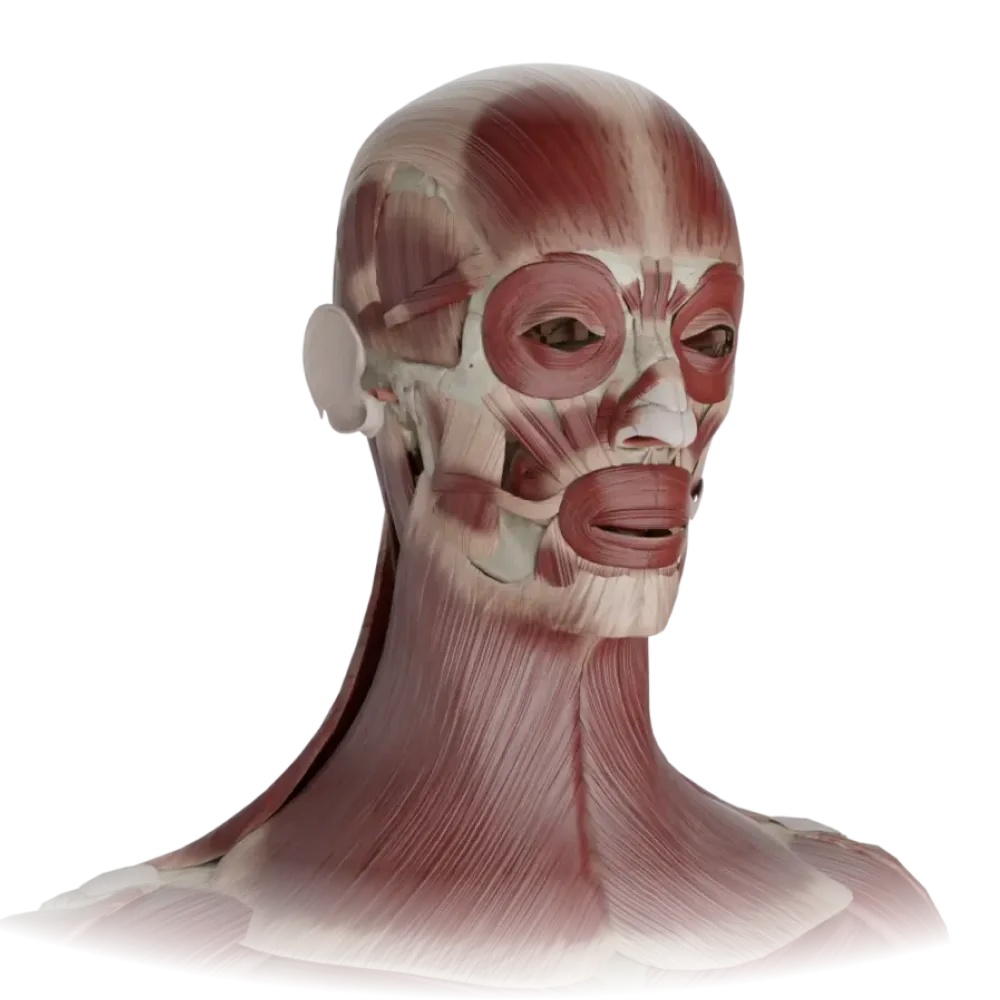
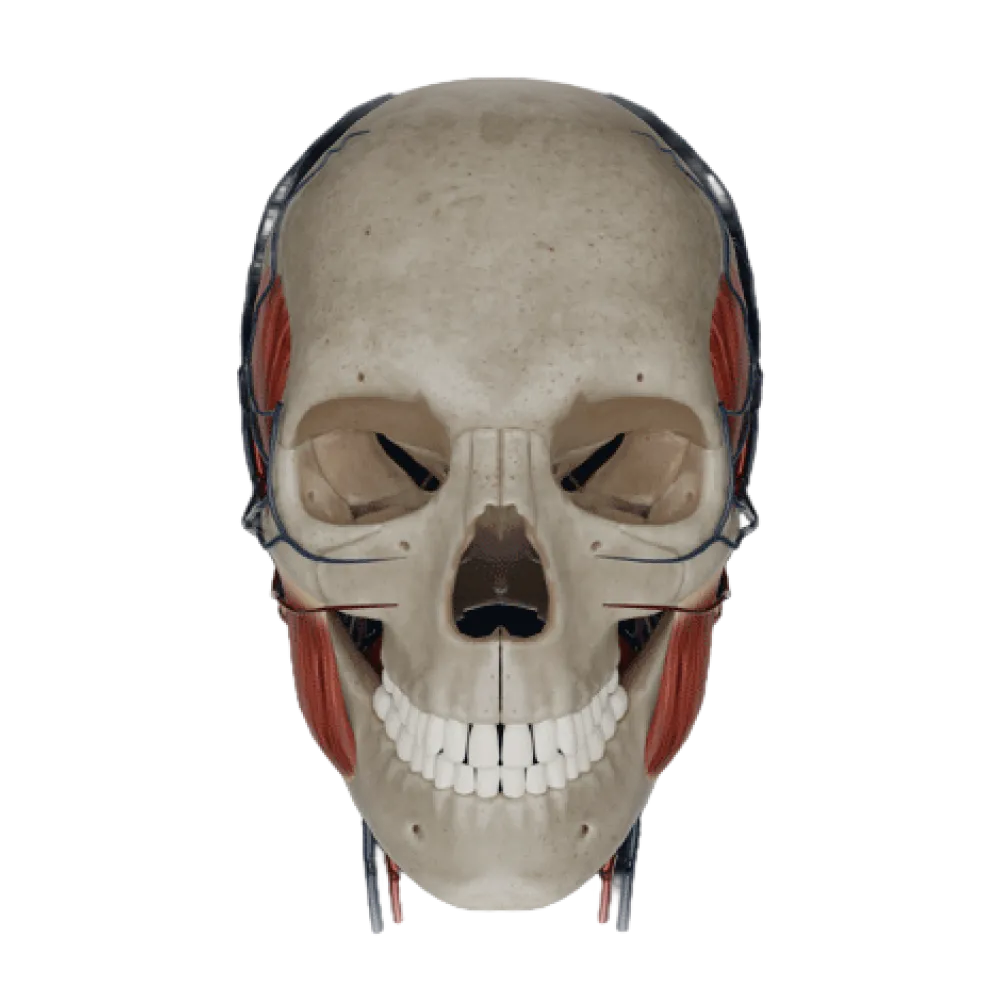
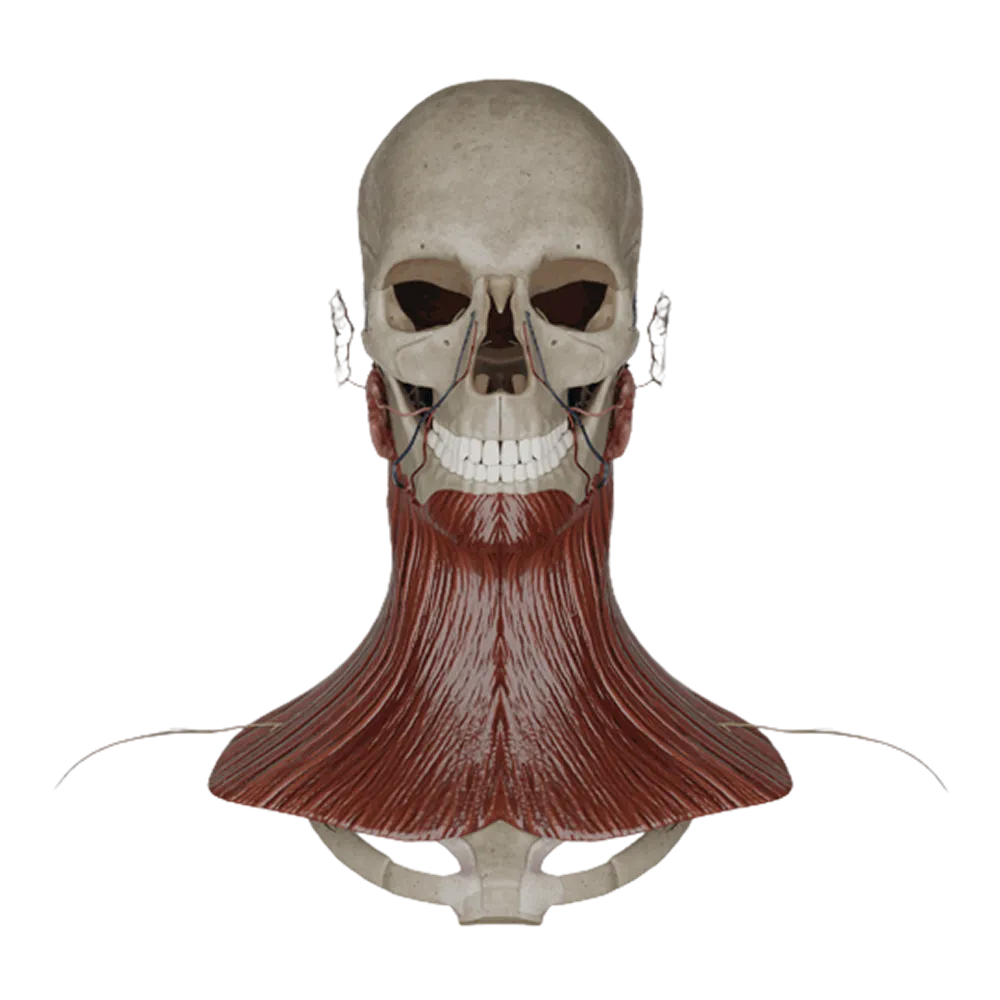
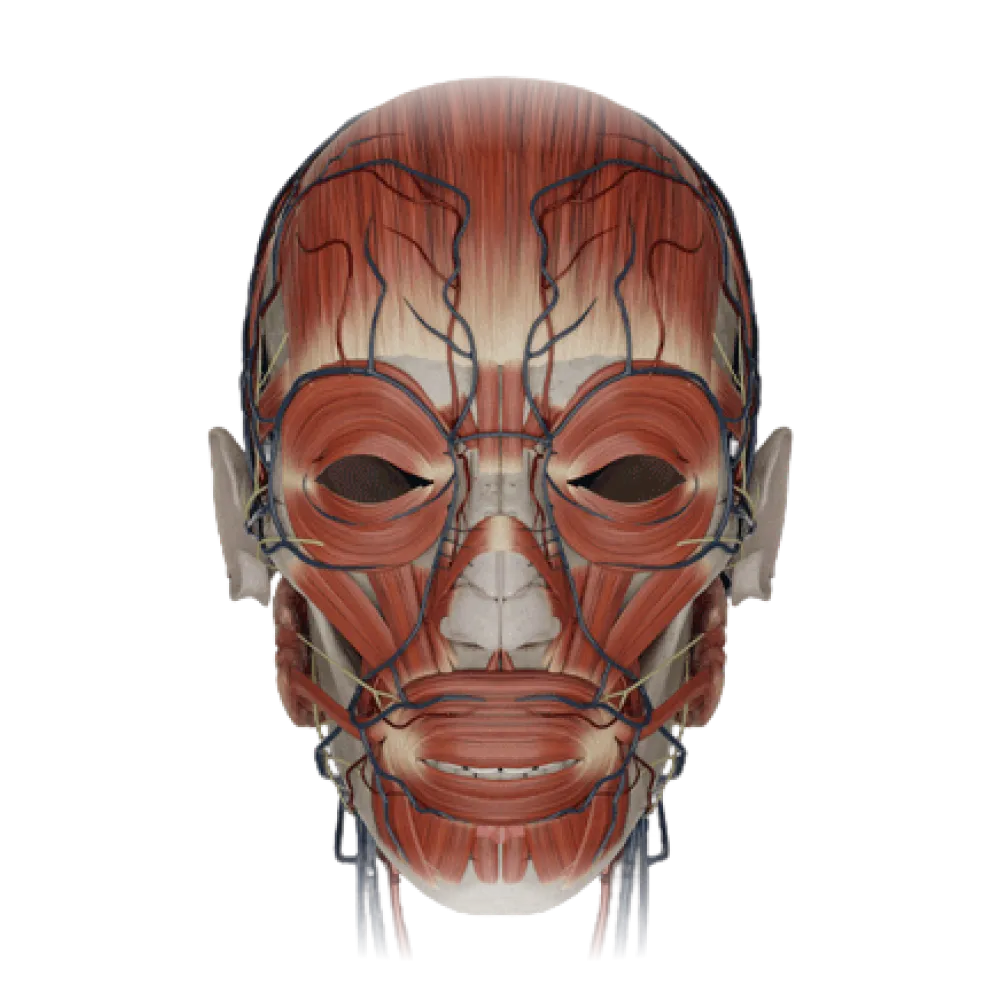
Anatomy test on superficial muscles of the head
Test your knowledge of the superficial muscles of the head. The test covers the facial muscles, as well as their blood supply and innervation.
1/20
bold
text
1. Which branch of the facial nerve innervates the frontal belly of the occipitofrontalis muscle?
-
Temporal branches
The frontal belly of the occipitofrontalis muscle is innervated by the temporal branches of the facial nerve, which ascend from the parotid plexus.
-
Zygomatic branches
The frontal belly of the occipitofrontalis muscle is innervated by the temporal branches of the facial nerve, which ascend from the parotid plexus.
-
Buccal branches
The frontal belly of the occipitofrontalis muscle is innervated by the temporal branches of the facial nerve, which ascend from the parotid plexus.
-
Posterior auricular nerve
The frontal belly of the occipitofrontalis muscle is innervated by the temporal branches of the facial nerve, which ascend from the parotid plexus.
-
I find it difficult to answer
The frontal belly of the occipitofrontalis muscle is innervated by the temporal branches of the facial nerve, which ascend from the parotid plexus.
2. Which artery mainly participates in the blood supply to the buccinator muscle (m. buccinator)?
-
Facial artery
The primary source of blood supply to the buccinator muscle is the buccal artery, branching from the maxillary artery, although the facial artery also contributes.
-
Buccal artery (branch of the maxillary)
The primary source of blood supply to the buccinator muscle is the buccal artery, branching from the maxillary artery, although the facial artery also contributes.
-
Transverse facial artery
The primary source of blood supply to the buccinator muscle is the buccal artery, branching from the maxillary artery, although the facial artery also contributes.
-
Submental artery
The primary source of blood supply to the buccinator muscle is the buccal artery, branching from the maxillary artery, although the facial artery also contributes.
-
I find it difficult to answer
The primary source of blood supply to the buccinator muscle is the buccal artery, branching from the maxillary artery, although the facial artery also contributes.
3. Which branches of the facial nerve innervate the orbicularis oris muscle?
-
Temporal and zygomatic branches
The orbicularis oris muscle receives motor innervation from the buccal branches and the marginal mandibular branch of the facial nerve.
-
Cervical branch
The orbicularis oris muscle receives motor innervation from the buccal branches and the marginal mandibular branch of the facial nerve.
-
Buccal and marginal mandibular branch
The orbicularis oris muscle receives motor innervation from the buccal branches and the marginal mandibular branch of the facial nerve.
-
Posterior auricular nerve
The orbicularis oris muscle receives motor innervation from the buccal branches and the marginal mandibular branch of the facial nerve.
-
I find it difficult to answer
The orbicularis oris muscle receives motor innervation from the buccal branches and the marginal mandibular branch of the facial nerve.
4. What source primarily supplies the blood to the occipital belly of the occipitofrontalis muscle?
-
Superficial temporal artery
The occipital belly receives its blood supply from the occipital and posterior auricular arteries, branches of the external carotid artery.
-
Posterior auricular and occipital arteries
The occipital belly receives its blood supply from the occipital and posterior auricular arteries, branches of the external carotid artery.
-
Facial artery
The occipital belly receives its blood supply from the occipital and posterior auricular arteries, branches of the external carotid artery.
-
Maxillary artery
The occipital belly receives its blood supply from the occipital and posterior auricular arteries, branches of the external carotid artery.
-
I find it difficult to answer
The occipital belly receives its blood supply from the occipital and posterior auricular arteries, branches of the external carotid artery.
5. Which nerve provides motor innervation to the buccinator muscle?
-
Buccal nerve (branch of the trigeminal nerve)
Motor innervation of the buccinator muscle is via the buccal branches of the facial nerve. The buccal nerve of the trigeminal system only provides sensory innervation to the mucosa.
-
Inferior alveolar nerve
Motor innervation of the buccinator muscle is via the buccal branches of the facial nerve. The buccal nerve of the trigeminal system only provides sensory innervation to the mucosa.
-
Masseteric nerve
Motor innervation of the buccinator muscle is via the buccal branches of the facial nerve. The buccal nerve of the trigeminal system only provides sensory innervation to the mucosa.
-
Buccal branches of the facial nerve
Motor innervation of the buccinator muscle is via the buccal branches of the facial nerve. The buccal nerve of the trigeminal system only provides sensory innervation to the mucosa.
-
I find it difficult to answer
Motor innervation of the buccinator muscle is via the buccal branches of the facial nerve. The buccal nerve of the trigeminal system only provides sensory innervation to the mucosa.
6. Which artery supplies the procerus muscle (m. procerus)?
-
Angular artery and supratrochlear artery
The procerus muscle is supplied by the angular artery (terminal branch of the facial) and the supratrochlear artery (from the internal carotid system).
-
Transverse facial artery
The procerus muscle is supplied by the angular artery (terminal branch of the facial) and the supratrochlear artery (from the internal carotid system).
-
Superior labial artery
The procerus muscle is supplied by the angular artery (terminal branch of the facial) and the supratrochlear artery (from the internal carotid system).
-
Infraorbital artery
The procerus muscle is supplied by the angular artery (terminal branch of the facial) and the supratrochlear artery (from the internal carotid system).
-
I find it difficult to answer
The procerus muscle is supplied by the angular artery (terminal branch of the facial) and the supratrochlear artery (from the internal carotid system).
7. Which branch of the facial nerve innervates the posterior auricular muscle?
-
Temporal branches
The posterior auricular muscle, as well as the occipital belly of the occipitofrontalis muscle, is innervated by the posterior auricular nerve, branching from the facial nerve before it enters the parotid gland.
-
Posterior auricular nerve
The posterior auricular muscle, as well as the occipital belly of the occipitofrontalis muscle, is innervated by the posterior auricular nerve, branching from the facial nerve before it enters the parotid gland.
-
Cervical branch
The posterior auricular muscle, as well as the occipital belly of the occipitofrontalis muscle, is innervated by the posterior auricular nerve, branching from the facial nerve before it enters the parotid gland.
-
Zygomatic branches
The posterior auricular muscle, as well as the occipital belly of the occipitofrontalis muscle, is innervated by the posterior auricular nerve, branching from the facial nerve before it enters the parotid gland.
-
I find it difficult to answer
The posterior auricular muscle, as well as the occipital belly of the occipitofrontalis muscle, is innervated by the posterior auricular nerve, branching from the facial nerve before it enters the parotid gland.
8. Which artery does the angular artery that supplies the nasalis muscle branch from?
-
Maxillary artery
The angular artery is the terminal branch of the facial artery and anastomoses with the dorsal nasal artery.
-
Superficial temporal artery
The angular artery is the terminal branch of the facial artery and anastomoses with the dorsal nasal artery.
-
Facial artery
The angular artery is the terminal branch of the facial artery and anastomoses with the dorsal nasal artery.
-
Ophthalmic artery
The angular artery is the terminal branch of the facial artery and anastomoses with the dorsal nasal artery.
-
I find it difficult to answer
The angular artery is the terminal branch of the facial artery and anastomoses with the dorsal nasal artery.
9. Which branches of the facial nerve innervate the larger and smaller zygomatic muscles?
-
Cervical branch
The major and minor zygomatic muscles receive motor innervation from the zygomatic branches of the facial nerve.
-
Temporal branches
The major and minor zygomatic muscles receive motor innervation from the zygomatic branches of the facial nerve.
-
Marginal branch of the mandible
The major and minor zygomatic muscles receive motor innervation from the zygomatic branches of the facial nerve.
-
Zygomatic branches
The major and minor zygomatic muscles receive motor innervation from the zygomatic branches of the facial nerve.
-
I find it difficult to answer
The major and minor zygomatic muscles receive motor innervation from the zygomatic branches of the facial nerve.
10. Which artery supplies blood to the lateral portion of the orbicularis oculi muscle?
-
Superficial temporal artery
The lateral portion of the orbicularis oculi muscle is supplied by branches of the superficial temporal artery and the transverse facial artery.
-
Facial artery
The lateral portion of the orbicularis oculi muscle is supplied by branches of the superficial temporal artery and the transverse facial artery.
-
Angular artery
The lateral portion of the orbicularis oculi muscle is supplied by branches of the superficial temporal artery and the transverse facial artery.
-
Supraorbital artery
The lateral portion of the orbicularis oculi muscle is supplied by branches of the superficial temporal artery and the transverse facial artery.
-
I find it difficult to answer
The lateral portion of the orbicularis oculi muscle is supplied by branches of the superficial temporal artery and the transverse facial artery.
11. Which branch of the facial nerve innervates the mentalis muscle?
-
Buccal branches
The mentalis muscle (m. mentalis) is innervated by the marginal mandibular branch (r. marginalis mandibulae) of the facial nerve.
-
Marginal branch of the mandible
The mentalis muscle (m. mentalis) is innervated by the marginal mandibular branch (r. marginalis mandibulae) of the facial nerve.
-
Cervical branch
The mentalis muscle (m. mentalis) is innervated by the marginal mandibular branch (r. marginalis mandibulae) of the facial nerve.
-
Zygomatic branches
The mentalis muscle (m. mentalis) is innervated by the marginal mandibular branch (r. marginalis mandibulae) of the facial nerve.
-
I find it difficult to answer
The mentalis muscle (m. mentalis) is innervated by the marginal mandibular branch (r. marginalis mandibulae) of the facial nerve.
12. Which arteries supply the depressor anguli oris muscle (m. depressor anguli oris)?
-
Inferior labial and mental arteries
The blood supply to this muscle is provided by the inferior labial artery (branch of the facial) and the mental artery (branch of the inferior alveolar).
-
Superior labial and angular arteries
The blood supply to this muscle is provided by the inferior labial artery (branch of the facial) and the mental artery (branch of the inferior alveolar).
-
Transverse facial artery
The blood supply to this muscle is provided by the inferior labial artery (branch of the facial) and the mental artery (branch of the inferior alveolar).
-
Infraorbital artery
The blood supply to this muscle is provided by the inferior labial artery (branch of the facial) and the mental artery (branch of the inferior alveolar).
-
I find it difficult to answer
The blood supply to this muscle is provided by the inferior labial artery (branch of the facial) and the mental artery (branch of the inferior alveolar).
13. From which vascular basin does the corrugator supercilii muscle (m. corrugator supercilii) receive its blood?
-
Only from the basin of the external carotid artery
Supplied by the supraorbital, supratrochlear (from the ophthalmic artery - internal carotid), and the frontal branch of the superficial temporal artery (external carotid).
-
Only from the basin of the internal carotid artery
Supplied by the supraorbital, supratrochlear (from the ophthalmic artery - internal carotid), and the frontal branch of the superficial temporal artery (external carotid).
-
From the basins of the external and internal carotid arteries
Supplied by the supraorbital, supratrochlear (from the ophthalmic artery - internal carotid), and the frontal branch of the superficial temporal artery (external carotid).
-
From the basin of the vertebral artery
Supplied by the supraorbital, supratrochlear (from the ophthalmic artery - internal carotid), and the frontal branch of the superficial temporal artery (external carotid).
-
I find it difficult to answer
Supplied by the supraorbital, supratrochlear (from the ophthalmic artery - internal carotid), and the frontal branch of the superficial temporal artery (external carotid).
14. Which branch of the facial nerve innervates the anterior auricular muscle?
-
Zygomatic branches
The anterior and superior auricular muscles are innervated by the temporal branches of the facial nerve.
-
Buccal branches
The anterior and superior auricular muscles are innervated by the temporal branches of the facial nerve.
-
Posterior auricular nerve
The anterior and superior auricular muscles are innervated by the temporal branches of the facial nerve.
-
Temporal branches
The anterior and superior auricular muscles are innervated by the temporal branches of the facial nerve.
-
I find it difficult to answer
The anterior and superior auricular muscles are innervated by the temporal branches of the facial nerve.
15. Which artery, as a branch of the maxillary, participates in the blood supply to the levator labii superioris muscle?
-
Infraorbital artery
The infraorbital artery passes through the infraorbital foramen and supplies the muscles and skin of the infraorbital region, including m. Levator labii superioris (m. levator labii superioris).
-
Descending palatine artery
The infraorbital artery passes through the infraorbital foramen and supplies the muscles and skin of the infraorbital region, including m. Levator labii superioris (m. levator labii superioris).
-
Sphenopalatine artery
The infraorbital artery passes through the infraorbital foramen and supplies the muscles and skin of the infraorbital region, including m. Levator labii superioris (m. levator labii superioris).
-
Middle meningeal artery
The infraorbital artery passes through the infraorbital foramen and supplies the muscles and skin of the infraorbital region, including m. Levator labii superioris (m. levator labii superioris).
-
I find it difficult to answer
The infraorbital artery passes through the infraorbital foramen and supplies the muscles and skin of the infraorbital region, including m. Levator labii superioris (m. levator labii superioris).
16. Which branch of the facial nerve innervates the risorius muscle (m. risorius)?
-
Temporal branches
The risorius muscle is located in the buccal region and is innervated by the buccal branches of the facial nerve.
-
Buccal branches
The risorius muscle is located in the buccal region and is innervated by the buccal branches of the facial nerve.
-
Posterior auricular nerve
The risorius muscle is located in the buccal region and is innervated by the buccal branches of the facial nerve.
-
Cervical branch
The risorius muscle is located in the buccal region and is innervated by the buccal branches of the facial nerve.
-
I find it difficult to answer
The risorius muscle is located in the buccal region and is innervated by the buccal branches of the facial nerve.
17. The blood supply to the levator anguli oris muscle (m. levator anguli oris) is mainly provided by:
-
Mental artery
The levator anguli oris muscle receives blood from the facial artery and the infraorbital artery (branch of the maxillary).
-
Superficial temporal artery
The levator anguli oris muscle receives blood from the facial artery and the infraorbital artery (branch of the maxillary).
-
Infraorbital and facial arteries
The levator anguli oris muscle receives blood from the facial artery and the infraorbital artery (branch of the maxillary).
-
Occipital artery.
The levator anguli oris muscle receives blood from the facial artery and the infraorbital artery (branch of the maxillary).
-
I find it difficult to answer
The levator anguli oris muscle receives blood from the facial artery and the infraorbital artery (branch of the maxillary).
18. The innervation of the depressor labii inferioris muscle (m. depressor labii inferioris) is provided by:
-
Temporal branches of the facial nerve
All facial expression muscles in the lower part of the face below the mouth angle are innervated by the marginal mandibular branch. The mental nerve is sensory.
-
Buccal branches of the facial nerve
All facial expression muscles in the lower part of the face below the mouth angle are innervated by the marginal mandibular branch. The mental nerve is sensory.
-
Mental nerve
All facial expression muscles in the lower part of the face below the mouth angle are innervated by the marginal mandibular branch. The mental nerve is sensory.
-
Marginal mandibular branch of the facial nerve
All facial expression muscles in the lower part of the face below the mouth angle are innervated by the marginal mandibular branch. The mental nerve is sensory.
-
I find it difficult to answer
All facial expression muscles in the lower part of the face below the mouth angle are innervated by the marginal mandibular branch. The mental nerve is sensory.
19. Which artery gives rise to the transverse facial artery that supplies the facial muscles in the buccal and zygomatic regions?
-
Superficial temporal artery
The transverse facial artery (a. transversa faciei) branches from the superficial temporal artery within the parotid gland.
-
Facial artery
The transverse facial artery (a. transversa faciei) branches from the superficial temporal artery within the parotid gland.
-
Maxillary artery
The transverse facial artery (a. transversa faciei) branches from the superficial temporal artery within the parotid gland.
-
External carotid artery (directly)
The transverse facial artery (a. transversa faciei) branches from the superficial temporal artery within the parotid gland.
-
I find it difficult to answer
The transverse facial artery (a. transversa faciei) branches from the superficial temporal artery within the parotid gland.
20. Through which structure do the branches of the facial nerve, forming the pes anserinus, pass before innervating the facial muscles?
-
Submandibular salivary gland
The facial nerve pierces the parotid salivary gland, where it forms an intraglandular plexus, from whence branches fan out to the facial muscles.
-
Parotid salivary gland
The facial nerve pierces the parotid salivary gland, where it forms an intraglandular plexus, from whence branches fan out to the facial muscles.
-
Buccal fat pad of Bichat
The facial nerve pierces the parotid salivary gland, where it forms an intraglandular plexus, from whence branches fan out to the facial muscles.
-
Masseter muscle
The facial nerve pierces the parotid salivary gland, where it forms an intraglandular plexus, from whence branches fan out to the facial muscles.
-
I find it difficult to answer
The facial nerve pierces the parotid salivary gland, where it forms an intraglandular plexus, from whence branches fan out to the facial muscles.
Retake this quiz?
Your current progress will be reset.