Test on the anatomy of neck muscles
Check your knowledge of the blood supply and innervation of the neck muscles. The test covers superficial, supra-and infrahyoid, as well as deep muscle groups.
1/20
bold
text
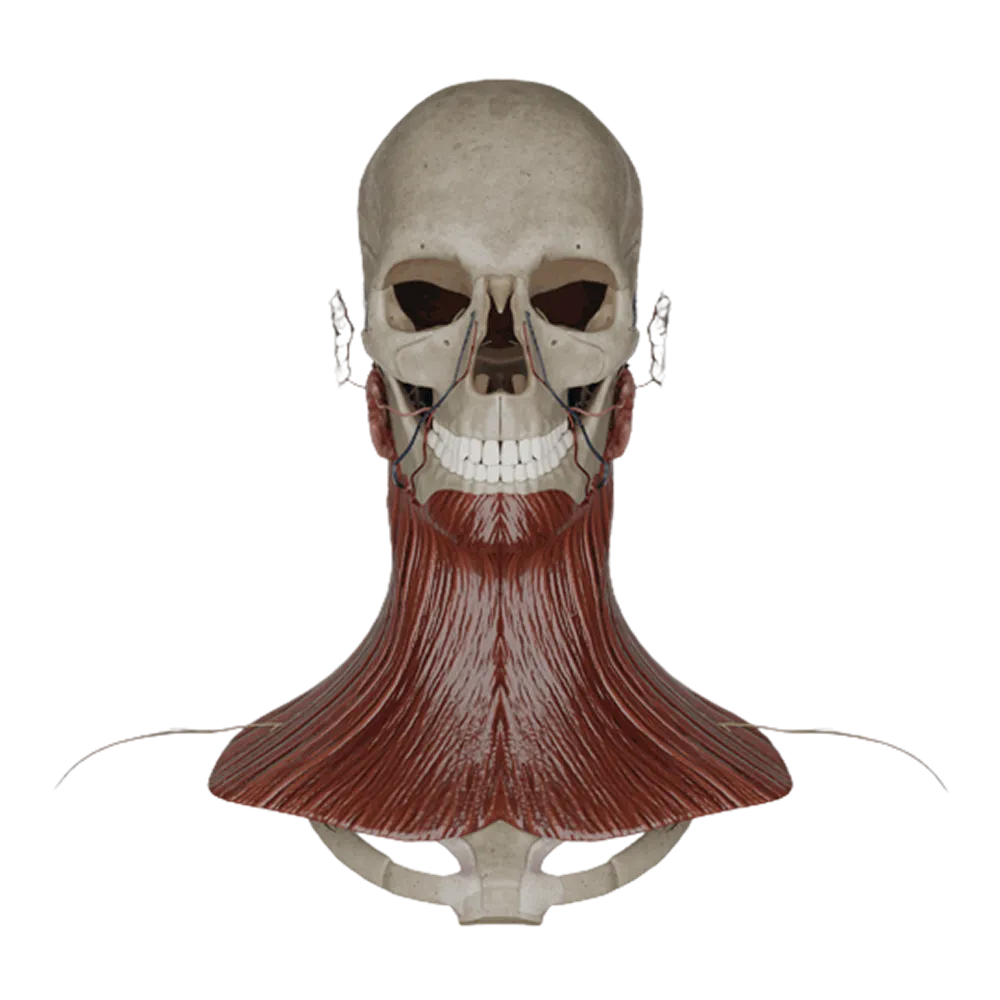
1. Which nerve innervates the platysma (m. platysma)?
-
Marginal branch of the mandible
The platysma muscle develops from the second branchial arch and is therefore innervated by the cervical branch of the facial nerve (r. colli n. facialis).
-
Transverse cervical nerve
The platysma muscle develops from the second branchial arch and is therefore innervated by the cervical branch of the facial nerve (r. colli n. facialis).
-
Cervical branch of the facial nerve
The platysma muscle develops from the second branchial arch and is therefore innervated by the cervical branch of the facial nerve (r. colli n. facialis).
-
Motor portion of the trigeminal nerve
The platysma muscle develops from the second branchial arch and is therefore innervated by the cervical branch of the facial nerve (r. colli n. facialis).
-
I find it difficult to answer
The platysma muscle develops from the second branchial arch and is therefore innervated by the cervical branch of the facial nerve (r. colli n. facialis).
2. Indicate the primary source of blood supply to the sternocleidomastoid muscle from the external carotid artery system:
-
A. thyroidea superior et a. occipitalis
Blood supply to the m. sternocleidomastoideus is provided by the sternocleidomastoid branches from the superior thyroid and occipital arteries.
-
A. facialis et a. lingualis
Blood supply to the m. sternocleidomastoideus is provided by the sternocleidomastoid branches from the superior thyroid and occipital arteries.
-
A. cervicalis profunda
Blood supply to the m. sternocleidomastoideus is provided by the sternocleidomastoid branches from the superior thyroid and occipital arteries.
-
A. vertebralis
Blood supply to the m. sternocleidomastoideus is provided by the sternocleidomastoid branches from the superior thyroid and occipital arteries.
-
I find it difficult to answer
Blood supply to the m. sternocleidomastoideus is provided by the sternocleidomastoid branches from the superior thyroid and occipital arteries.
3. Which structure provides motor innervation to the posterior belly of the digastric muscle?
-
N. mylohyoideus
Posterior belly of the m. The digastricus muscle is a derivative of the 2nd visceral arch and is innervated by the digastric branch of the facial nerve.
-
Ansa cervicalis
Posterior belly of the m. The digastricus muscle is a derivative of the 2nd visceral arch and is innervated by the digastric branch of the facial nerve.
-
N. glossopharyngeus
Posterior belly of the m. The digastricus muscle is a derivative of the 2nd visceral arch and is innervated by the digastric branch of the facial nerve.
-
R. digastricus n. facialis
Posterior belly of the m. The digastricus muscle is a derivative of the 2nd visceral arch and is innervated by the digastric branch of the facial nerve.
-
I find it difficult to answer
Posterior belly of the m. The digastricus muscle is a derivative of the 2nd visceral arch and is innervated by the digastric branch of the facial nerve.
4. Which nerve innervates the anterior belly of the digastric muscle?
-
N. facialis
The anterior belly develops from the 1st branchial arch and is innervated by the mylohyoid nerve, a branch of the inferior alveolar nerve (from V3).
-
N. mylohyoideus (from n. mandibularis)
The anterior belly develops from the 1st branchial arch and is innervated by the mylohyoid nerve, a branch of the inferior alveolar nerve (from V3).
-
N. hypoglossus
The anterior belly develops from the 1st branchial arch and is innervated by the mylohyoid nerve, a branch of the inferior alveolar nerve (from V3).
-
N. vagus
The anterior belly develops from the 1st branchial arch and is innervated by the mylohyoid nerve, a branch of the inferior alveolar nerve (from V3).
-
I find it difficult to answer
The anterior belly develops from the 1st branchial arch and is innervated by the mylohyoid nerve, a branch of the inferior alveolar nerve (from V3).
5. From what source are the scalene muscles of the neck predominantly vascularized?
-
A. thyroidea superior
The scalene muscles receive nourishment from the a. cervicalis ascendens (from tr. thyrocervicalis) and a. transversa colli.
-
A. carotis interna
The scalene muscles receive nourishment from the a. cervicalis ascendens (from tr. thyrocervicalis) and a. transversa colli.
-
A. cervicalis ascendens et a. transversa colli
The scalene muscles receive nourishment from the a. cervicalis ascendens (from tr. thyrocervicalis) and a. transversa colli.
-
A. laryngea superior
The scalene muscles receive nourishment from the a. cervicalis ascendens (from tr. thyrocervicalis) and a. transversa colli.
-
I find it difficult to answer
The scalene muscles receive nourishment from the a. cervicalis ascendens (from tr. thyrocervicalis) and a. transversa colli.
6. Which muscle from the infrahyoid group is not innervated by ansa cervicalis but by direct fibers of C1 running within the hypoglossal nerve?
-
M. sternohyoideus
The thyrohyoid muscle is innervated by r. thyrohyoideus, containing fibers from the first cervical spinal nerve (C1), running with n. hypoglossus.
-
M. omohyoideus
The thyrohyoid muscle is innervated by r. thyrohyoideus, containing fibers from the first cervical spinal nerve (C1), running with n. hypoglossus.
-
M. sternothyroideus
The thyrohyoid muscle is innervated by r. thyrohyoideus, containing fibers from the first cervical spinal nerve (C1), running with n. hypoglossus.
-
M. thyrohyoideus
The thyrohyoid muscle is innervated by r. thyrohyoideus, containing fibers from the first cervical spinal nerve (C1), running with n. hypoglossus.
-
I find it difficult to answer
The thyrohyoid muscle is innervated by r. thyrohyoideus, containing fibers from the first cervical spinal nerve (C1), running with n. hypoglossus.
7. Select the muscle whose blood supply is provided by a. submentalis (branch of a. facialis):
-
M. mylohyoideus
The submental artery (a. submentalis) supplies the mylohyoid muscle and the anterior belly of the digastric muscle.
-
M. longus colli
The submental artery (a. submentalis) supplies the mylohyoid muscle and the anterior belly of the digastric muscle.
-
M. scalenus anterior
The submental artery (a. submentalis) supplies the mylohyoid muscle and the anterior belly of the digastric muscle.
-
M. sternocleidomastoideus
The submental artery (a. submentalis) supplies the mylohyoid muscle and the anterior belly of the digastric muscle.
-
I find it difficult to answer
The submental artery (a. submentalis) supplies the mylohyoid muscle and the anterior belly of the digastric muscle.
8. Which artery does not participate in the blood supply to the longus colli muscle (m. longus colli)?
-
A. vertebralis
The internal thoracic artery supplies the anterior chest wall, pericardium, and diaphragm, but does not contribute to the nourishment of the deep neck muscles.
-
A. thoracica interna
The internal thoracic artery supplies the anterior chest wall, pericardium, and diaphragm, but does not contribute to the nourishment of the deep neck muscles.
-
A. cervicalis ascendens
The internal thoracic artery supplies the anterior chest wall, pericardium, and diaphragm, but does not contribute to the nourishment of the deep neck muscles.
-
A. cervicalis profunda
The internal thoracic artery supplies the anterior chest wall, pericardium, and diaphragm, but does not contribute to the nourishment of the deep neck muscles.
-
I find it difficult to answer
The internal thoracic artery supplies the anterior chest wall, pericardium, and diaphragm, but does not contribute to the nourishment of the deep neck muscles.
9. Which spinal nerves are involved in forming the ansa cervicalis, which innervates most of the infrahyoid muscles?
-
C3-C5
The ansa cervicalis is formed by the upper (C1-C2, running with the hypoglossal nerve) and lower (C2-C3) branches of the cervical plexus.
-
C5-C7
The ansa cervicalis is formed by the upper (C1-C2, running with the hypoglossal nerve) and lower (C2-C3) branches of the cervical plexus.
-
C1-C3
The ansa cervicalis is formed by the upper (C1-C2, running with the hypoglossal nerve) and lower (C2-C3) branches of the cervical plexus.
-
C8-T1
The ansa cervicalis is formed by the upper (C1-C2, running with the hypoglossal nerve) and lower (C2-C3) branches of the cervical plexus.
-
I find it difficult to answer
The ansa cervicalis is formed by the upper (C1-C2, running with the hypoglossal nerve) and lower (C2-C3) branches of the cervical plexus.
10. Which of the following nerves can pierce the middle scalene muscle while heading to the back muscles?
-
N. thoracicus longus
The dorsal scapular nerve often pierces the m. scalenus medius while heading to the rhomboid muscles and the levator scapulae muscle.
-
N. phrenicus
The dorsal scapular nerve often pierces the m. scalenus medius while heading to the rhomboid muscles and the levator scapulae muscle.
-
N. suprascapularis
The dorsal scapular nerve often pierces the m. scalenus medius while heading to the rhomboid muscles and the levator scapulae muscle.
-
N. dorsalis scapulae
The dorsal scapular nerve often pierces the m. scalenus medius while heading to the rhomboid muscles and the levator scapulae muscle.
-
I find it difficult to answer
The dorsal scapular nerve often pierces the m. scalenus medius while heading to the rhomboid muscles and the levator scapulae muscle.
11. The innervation of the stylohyoid muscle (m. stylohyoideus) is provided by:
-
R. stylohyoideus n. facialis
Like the posterior belly of the digastric muscle, the stylohyoid muscle is innervated by a branch of the facial nerve (r. stylohyoideus).
-
N. glossopharyngeus
Like the posterior belly of the digastric muscle, the stylohyoid muscle is innervated by a branch of the facial nerve (r. stylohyoideus).
-
N. accessorius
Like the posterior belly of the digastric muscle, the stylohyoid muscle is innervated by a branch of the facial nerve (r. stylohyoideus).
-
N. laryngeus superior
Like the posterior belly of the digastric muscle, the stylohyoid muscle is innervated by a branch of the facial nerve (r. stylohyoideus).
-
I find it difficult to answer
Like the posterior belly of the digastric muscle, the stylohyoid muscle is innervated by a branch of the facial nerve (r. stylohyoideus).
12. Indicate the nerve that innervates the geniohyoid muscle (m. geniohyoideus):
-
N. lingualis
The m. geniohyoideus is innervated by direct branches from the first cervical nerve (C1), which accompany the hypoglossal nerve.
-
Fibers of C1 within n. hypoglossus
The m. geniohyoideus is innervated by direct branches from the first cervical nerve (C1), which accompany the hypoglossal nerve.
-
N. mylohyoideus
The m. geniohyoideus is innervated by direct branches from the first cervical nerve (C1), which accompany the hypoglossal nerve.
-
Ansa cervicalis
The m. geniohyoideus is innervated by direct branches from the first cervical nerve (C1), which accompany the hypoglossal nerve.
-
I find it difficult to answer
The m. geniohyoideus is innervated by direct branches from the first cervical nerve (C1), which accompany the hypoglossal nerve.
13. Which arterial trunk gives rise to the superior thyroid artery, supplying the infrahyoid muscles?
-
Truncus thyrocervicalis
The superior thyroid artery is the first anterior branch of the external carotid artery and gives branches to the infrahyoid muscles.
-
A. carotis interna
The superior thyroid artery is the first anterior branch of the external carotid artery and gives branches to the infrahyoid muscles.
-
A. subclavia
The superior thyroid artery is the first anterior branch of the external carotid artery and gives branches to the infrahyoid muscles.
-
external carotid artery
The superior thyroid artery is the first anterior branch of the external carotid artery and gives branches to the infrahyoid muscles.
-
I find it difficult to answer
The superior thyroid artery is the first anterior branch of the external carotid artery and gives branches to the infrahyoid muscles.
14. Which muscle receives dual innervation: from the accessory nerve and muscular branches of the cervical plexus (C2-C4)?
-
M. scalenus anterior
The sternocleidomastoid muscle (like the trapezius) is innervated by n. accessorius (XI pair) and proprioceptive branches of the cervical plexus.
-
M. platysma
The sternocleidomastoid muscle (like the trapezius) is innervated by n. accessorius (XI pair) and proprioceptive branches of the cervical plexus.
-
M. sternocleidomastoideus
The sternocleidomastoid muscle (like the trapezius) is innervated by n. accessorius (XI pair) and proprioceptive branches of the cervical plexus.
-
M. digastricus
The sternocleidomastoid muscle (like the trapezius) is innervated by n. accessorius (XI pair) and proprioceptive branches of the cervical plexus.
-
I find it difficult to answer
The sternocleidomastoid muscle (like the trapezius) is innervated by n. accessorius (XI pair) and proprioceptive branches of the cervical plexus.
15. Blood supply to the posterior group of deep neck muscles (suboccipital muscles) is mainly provided by:
-
A. vertebralis
The suboccipital muscles receive arterial blood from the muscular branches of the vertebral artery (a. vertebralis) and a. cervicalis profunda.
-
A. facialis (facial artery)
The suboccipital muscles receive arterial blood from the muscular branches of the vertebral artery (a. vertebralis) and a. cervicalis profunda.
-
A. lingualis
The suboccipital muscles receive arterial blood from the muscular branches of the vertebral artery (a. vertebralis) and a. cervicalis profunda.
-
A. suprascapularis
The suboccipital muscles receive arterial blood from the muscular branches of the vertebral artery (a. vertebralis) and a. cervicalis profunda.
-
I find it difficult to answer
The suboccipital muscles receive arterial blood from the muscular branches of the vertebral artery (a. vertebralis) and a. cervicalis profunda.
16. Motor fibers for the muscle that elevates the scapula (m. levator scapulae) in the neck region originate from:
-
N. accessorius
The m. levator scapulae is innervated by motor branches of the cervical plexus (C3-C4) and the dorsal scapular nerve (C5).
-
Nn. cervicales (C3-C4) and n. dorsalis scapulae
The m. levator scapulae is innervated by motor branches of the cervical plexus (C3-C4) and the dorsal scapular nerve (C5).
-
Ansa cervicalis
The m. levator scapulae is innervated by motor branches of the cervical plexus (C3-C4) and the dorsal scapular nerve (C5).
-
N. thoracodorsalis
The m. levator scapulae is innervated by motor branches of the cervical plexus (C3-C4) and the dorsal scapular nerve (C5).
-
I find it difficult to answer
The m. levator scapulae is innervated by motor branches of the cervical plexus (C3-C4) and the dorsal scapular nerve (C5).
17. Which neck muscle is primarily supplied by the a. cervicalis profunda, arising from the costocervical trunk?
-
M. platysma
The deep cervical artery supplies the deep muscles of the posterior neck region, including the semispinalis cervicis muscle.
-
M. sternohyoideus
The deep cervical artery supplies the deep muscles of the posterior neck region, including the semispinalis cervicis muscle.
-
M. semispinalis cervicis
The deep cervical artery supplies the deep muscles of the posterior neck region, including the semispinalis cervicis muscle.
-
M. mylohyoideus
The deep cervical artery supplies the deep muscles of the posterior neck region, including the semispinalis cervicis muscle.
-
I find it difficult to answer
The deep cervical artery supplies the deep muscles of the posterior neck region, including the semispinalis cervicis muscle.
18. The inferior belly of the omohyoid muscle (m. omohyoideus) crosses the neck and is supplied by:
-
A. facialis (facial artery)
The omohyoid muscle receives its blood supply in the inferior region of the neck from the transverse cervical artery and the suprascapular artery.
-
A. occipitalis (occipital artery)
The omohyoid muscle receives its blood supply in the inferior region of the neck from the transverse cervical artery and the suprascapular artery.
-
A. temporalis superficialis (superficial temporal artery)
The omohyoid muscle receives its blood supply in the inferior region of the neck from the transverse cervical artery and the suprascapular artery.
-
A. transversa colli and a. suprascapularis
The omohyoid muscle receives its blood supply in the inferior region of the neck from the transverse cervical artery and the suprascapular artery.
-
I find it difficult to answer
The omohyoid muscle receives its blood supply in the inferior region of the neck from the transverse cervical artery and the suprascapular artery.
19. Innervation of the longus capitis muscle (m. longus capitis) is provided by:
-
Branches of the cervical plexus (C1-C3)
The longus capitis muscle belongs to the prevertebral group of deep neck muscles and is innervated by short muscular branches from C1 to C3.
-
N. hypoglossus
The longus capitis muscle belongs to the prevertebral group of deep neck muscles and is innervated by short muscular branches from C1 to C3.
-
N. glossopharyngeus
The longus capitis muscle belongs to the prevertebral group of deep neck muscles and is innervated by short muscular branches from C1 to C3.
-
N. vagus
The longus capitis muscle belongs to the prevertebral group of deep neck muscles and is innervated by short muscular branches from C1 to C3.
-
I find it difficult to answer
The longus capitis muscle belongs to the prevertebral group of deep neck muscles and is innervated by short muscular branches from C1 to C3.
20. Which nerve, emerging from under the posterior edge of the m. sternocleidomastoideus, pierces the m. platysma, but does not provide motor innervation to it, instead supplying the sensation of the skin of the anterior neck region?
-
N. auricularis magnus
The transverse cervical nerve (n. transversus colli) is a sensory branch of the cervical plexus and innervates the skin of the anterior neck region.
-
N. transversus colli
The transverse cervical nerve (n. transversus colli) is a sensory branch of the cervical plexus and innervates the skin of the anterior neck region.
-
N. occipitalis minor
The transverse cervical nerve (n. transversus colli) is a sensory branch of the cervical plexus and innervates the skin of the anterior neck region.
-
Nn. supraclaviculares
The transverse cervical nerve (n. transversus colli) is a sensory branch of the cervical plexus and innervates the skin of the anterior neck region.
-
I find it difficult to answer
The transverse cervical nerve (n. transversus colli) is a sensory branch of the cervical plexus and innervates the skin of the anterior neck region.
Retake this quiz?
Your current progress will be reset.