1/20
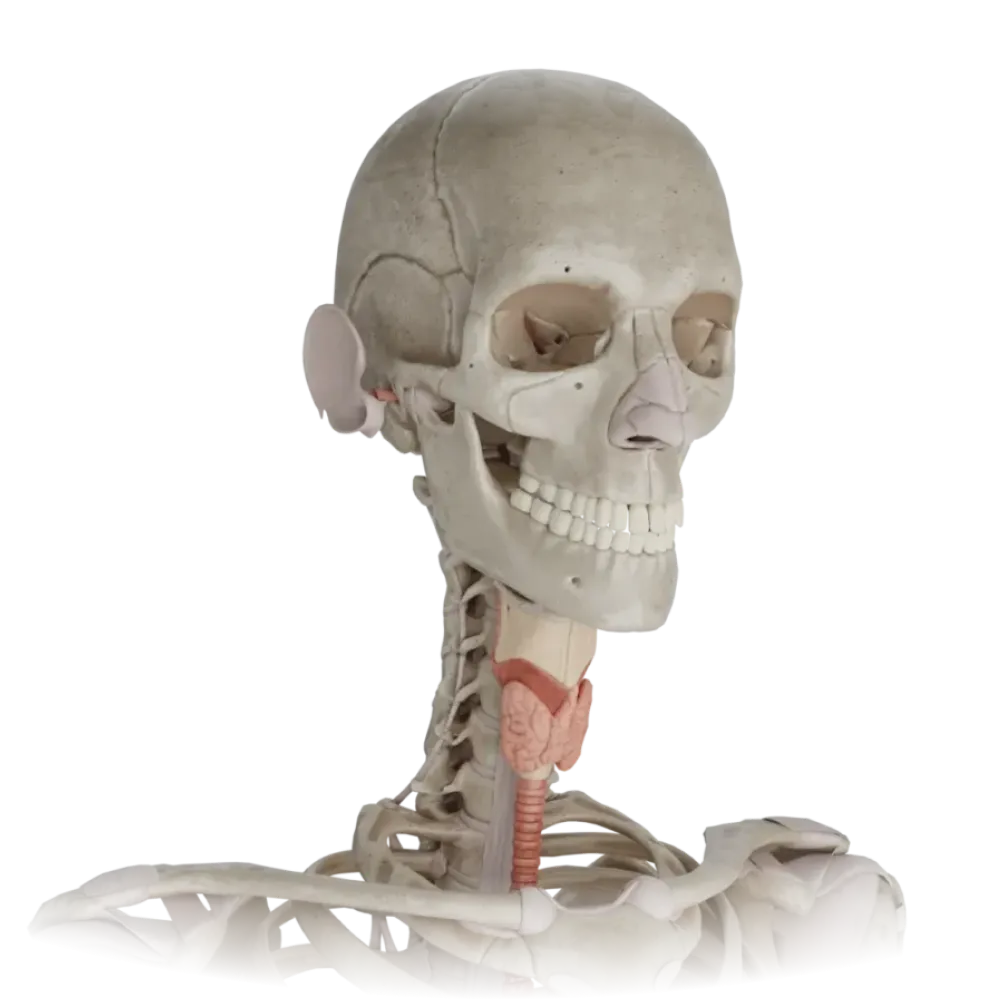
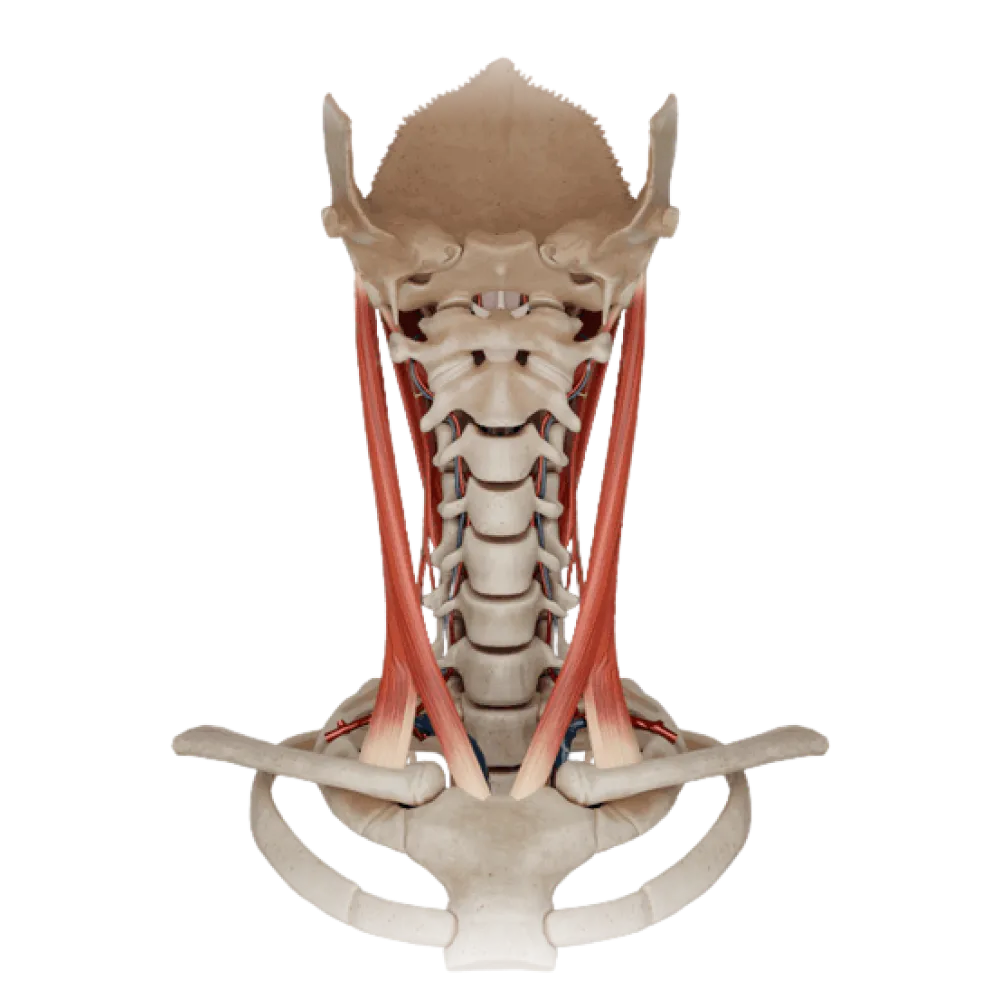

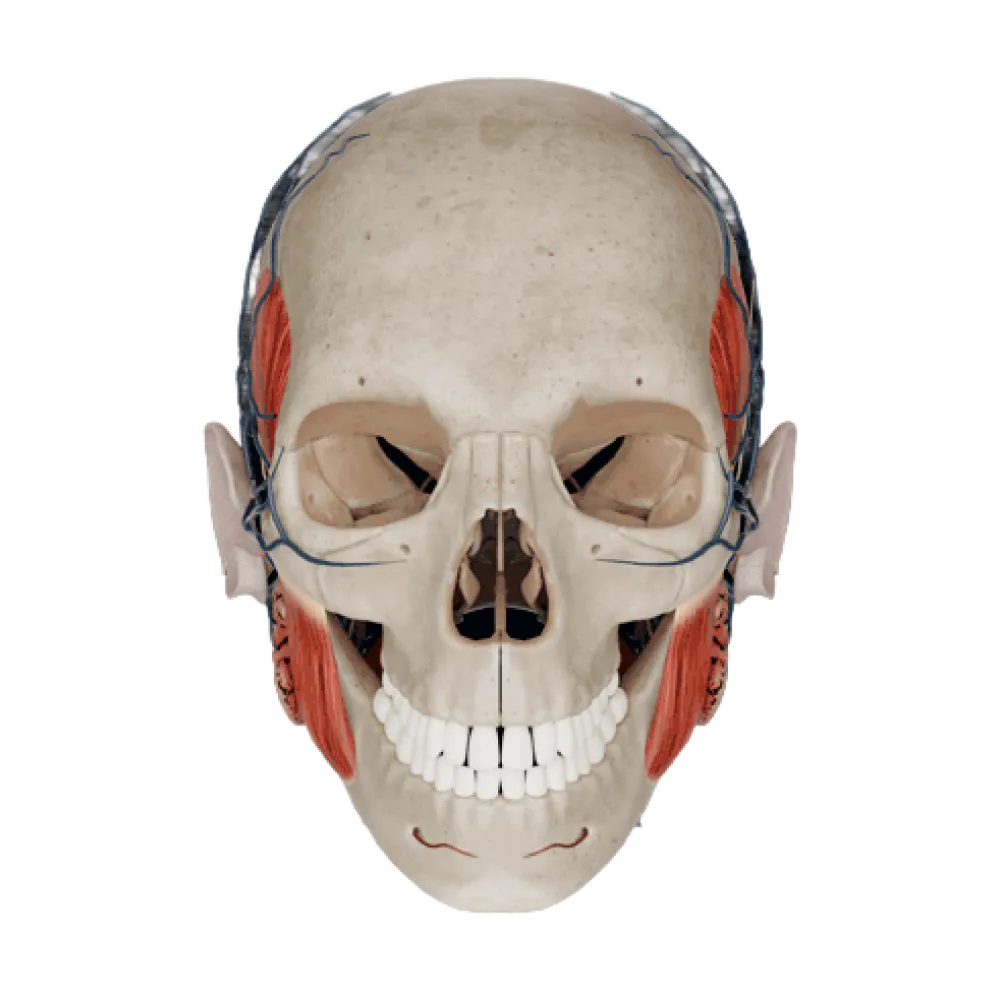
Quiz on the anatomy of head and neck joints
Evaluate the anatomical knowledge of head and neck joints. The test assesses the structure of the TMJ and craniovertebral joints, their muscles, vessels, and nerves.
1. To which type of joints by articular surfaces' shape does the temporomandibular joint belong?
-
Ball-and-socket
The temporomandibular joint is a paired, complex, combined, and condylar (ellipsoidal) joint by shape.
-
Condylar (ellipsoid).
The temporomandibular joint is a paired, complex, combined, and condylar (ellipsoidal) joint by shape.
-
Hinge
The temporomandibular joint is a paired, complex, combined, and condylar (ellipsoidal) joint by shape.
-
Cylinder-shaped
The temporomandibular joint is a paired, complex, combined, and condylar (ellipsoidal) joint by shape.
-
I find it difficult to answer
The temporomandibular joint is a paired, complex, combined, and condylar (ellipsoidal) joint by shape.
2. What structure divides the TMJ cavity into two isolated compartments?
-
Intra-articular ligament.
The articular disc (discus articularis) completely divides the TMJ cavity into upper and lower compartments.
-
Articular meniscus
The articular disc (discus articularis) completely divides the TMJ cavity into upper and lower compartments.
-
Fat pad.
The articular disc (discus articularis) completely divides the TMJ cavity into upper and lower compartments.
-
Articular disc
The articular disc (discus articularis) completely divides the TMJ cavity into upper and lower compartments.
-
I find it difficult to answer
The articular disc (discus articularis) completely divides the TMJ cavity into upper and lower compartments.
3. What ligament of the temporomandibular joint inserts into the capsule and prevents excessive posterior movement of the mandible?
-
Lateral ligament
The lateral ligament (lig. laterale) thickens the TMJ capsule externally and limits posterior movement of the mandible.
-
Sphenomandibular ligament
The lateral ligament (lig. laterale) thickens the TMJ capsule externally and limits posterior movement of the mandible.
-
Stylomandibular ligament
The lateral ligament (lig. laterale) thickens the TMJ capsule externally and limits posterior movement of the mandible.
-
Sphenomandibular ligament.
The lateral ligament (lig. laterale) thickens the TMJ capsule externally and limits posterior movement of the mandible.
-
I find it difficult to answer
The lateral ligament (lig. laterale) thickens the TMJ capsule externally and limits posterior movement of the mandible.
4. What form do the articular surfaces of the atlanto-occipital joint have?
-
Ball-shaped.
The atlanto-occipital joint is formed by the occipital condyles and the superior articular facets of the atlas, belonging to ellipsoid joints.
-
Saddle-shaped.
The atlanto-occipital joint is formed by the occipital condyles and the superior articular facets of the atlas, belonging to ellipsoid joints.
-
Ellipsoidal.
The atlanto-occipital joint is formed by the occipital condyles and the superior articular facets of the atlas, belonging to ellipsoid joints.
-
Flat.
The atlanto-occipital joint is formed by the occipital condyles and the superior articular facets of the atlas, belonging to ellipsoid joints.
-
I find it difficult to answer
The atlanto-occipital joint is formed by the occipital condyles and the superior articular facets of the atlas, belonging to ellipsoid joints.
5. What ligament holds the odontoid process of the axis in the fossa of the anterior arch of the atlas?
-
Alar ligaments.
The transverse ligament of the atlas (lig. transversum atlantis) securely holds the odontoid process of the axis, forming the median atlantoaxial joint.
-
Transverse ligament of the atlas.
The transverse ligament of the atlas (lig. transversum atlantis) securely holds the odontoid process of the axis, forming the median atlantoaxial joint.
-
Apical ligament of the odontoid process.
The transverse ligament of the atlas (lig. transversum atlantis) securely holds the odontoid process of the axis, forming the median atlantoaxial joint.
-
Cruciform ligament of the atlas.
The transverse ligament of the atlas (lig. transversum atlantis) securely holds the odontoid process of the axis, forming the median atlantoaxial joint.
-
I find it difficult to answer
The transverse ligament of the atlas (lig. transversum atlantis) securely holds the odontoid process of the axis, forming the median atlantoaxial joint.
6. To which type of joints by form do the lateral atlantoaxial joints belong?
-
Ball-and-socket
The lateral atlantoaxial joints (artt. atlantoaxiales laterales) are flat low-mobile joints that allow sliding during rotation.
-
Ellipsoid.
The lateral atlantoaxial joints (artt. atlantoaxiales laterales) are flat low-mobile joints that allow sliding during rotation.
-
Cylindrical
The lateral atlantoaxial joints (artt. atlantoaxiales laterales) are flat low-mobile joints that allow sliding during rotation.
-
Plane
The lateral atlantoaxial joints (artt. atlantoaxiales laterales) are flat low-mobile joints that allow sliding during rotation.
-
I find it difficult to answer
The lateral atlantoaxial joints (artt. atlantoaxiales laterales) are flat low-mobile joints that allow sliding during rotation.
7. Which nerve branches provide sensory innervation to the capsule of the temporomandibular joint?
-
Auriculotemporal and masseteric nerves.
The capsule of the TMJ is innervated primarily by branches of the auriculotemporal (n. auriculotemporalis) and masseteric (n. massetericus) nerves from the trigeminal nerve system.
-
Vagus nerve
The capsule of the TMJ is innervated primarily by branches of the auriculotemporal (n. auriculotemporalis) and masseteric (n. massetericus) nerves from the trigeminal nerve system.
-
Facial nerve
The capsule of the TMJ is innervated primarily by branches of the auriculotemporal (n. auriculotemporalis) and masseteric (n. massetericus) nerves from the trigeminal nerve system.
-
Glossopharyngeal nerve
The capsule of the TMJ is innervated primarily by branches of the auriculotemporal (n. auriculotemporalis) and masseteric (n. massetericus) nerves from the trigeminal nerve system.
-
I find it difficult to answer
The capsule of the TMJ is innervated primarily by branches of the auriculotemporal (n. auriculotemporalis) and masseteric (n. massetericus) nerves from the trigeminal nerve system.
8. Which artery's pool mainly supplies blood to the temporomandibular joint?
-
Facial artery
Blood supply to the TMJ is mainly provided by branches of the superficial temporal and maxillary arteries (external carotid artery pool).
-
Internal carotid artery
Blood supply to the TMJ is mainly provided by branches of the superficial temporal and maxillary arteries (external carotid artery pool).
-
Superficial temporal and maxillary arteries.
Blood supply to the TMJ is mainly provided by branches of the superficial temporal and maxillary arteries (external carotid artery pool).
-
Occipital artery
Blood supply to the TMJ is mainly provided by branches of the superficial temporal and maxillary arteries (external carotid artery pool).
-
I find it difficult to answer
Blood supply to the TMJ is mainly provided by branches of the superficial temporal and maxillary arteries (external carotid artery pool).
9. Contraction of which muscle during bilateral action pulls the articular disc and head of the mandible forward, opening the mouth?
-
Medial pterygoid muscle
The lateral pterygoid muscle (m. pterygoideus lateralis) shifts the mandible forward during bilateral contraction, aiding in mouth opening.
-
Lateral pterygoid muscle
The lateral pterygoid muscle (m. pterygoideus lateralis) shifts the mandible forward during bilateral contraction, aiding in mouth opening.
-
Temporalis muscle
The lateral pterygoid muscle (m. pterygoideus lateralis) shifts the mandible forward during bilateral contraction, aiding in mouth opening.
-
Masseter muscle
The lateral pterygoid muscle (m. pterygoideus lateralis) shifts the mandible forward during bilateral contraction, aiding in mouth opening.
-
I find it difficult to answer
The lateral pterygoid muscle (m. pterygoideus lateralis) shifts the mandible forward during bilateral contraction, aiding in mouth opening.
10. Which muscle acting on the temporomandibular joint has the most pronounced fan-like structure and raises the mandible, while its posterior fibers draw it back?
-
Lateral pterygoid muscle
The temporalis muscle (m. temporalis) elevates the mandible, and its posterior horizontal fibers shift the protruded mandible backward.
-
Masseter muscle
The temporalis muscle (m. temporalis) elevates the mandible, and its posterior horizontal fibers shift the protruded mandible backward.
-
Medial pterygoid muscle
The temporalis muscle (m. temporalis) elevates the mandible, and its posterior horizontal fibers shift the protruded mandible backward.
-
Temporalis muscle
The temporalis muscle (m. temporalis) elevates the mandible, and its posterior horizontal fibers shift the protruded mandible backward.
-
I find it difficult to answer
The temporalis muscle (m. temporalis) elevates the mandible, and its posterior horizontal fibers shift the protruded mandible backward.
11. Which muscle during bilateral contraction bends the head backward, acting on the atlanto-occipital joint, and is located in the suboccipital area?
-
Longissimus capitis muscle
The rectus capitis posterior major muscle (m. rectus capitis posterior major) extends the neck and tilts the head back during bilateral contraction.
-
Sternocleidomastoid muscle
The rectus capitis posterior major muscle (m. rectus capitis posterior major) extends the neck and tilts the head back during bilateral contraction.
-
Rectus posterior major capitis muscle
The rectus capitis posterior major muscle (m. rectus capitis posterior major) extends the neck and tilts the head back during bilateral contraction.
-
Anterior scalene muscle
The rectus capitis posterior major muscle (m. rectus capitis posterior major) extends the neck and tilts the head back during bilateral contraction.
-
I find it difficult to answer
The rectus capitis posterior major muscle (m. rectus capitis posterior major) extends the neck and tilts the head back during bilateral contraction.
12. Which ligament is a continuation of the posterior longitudinal ligament of the spine and covers the cruciform ligament of the atlas from behind?
-
Tectorial membrane
The tectorial membrane (membrana tectoria) is the expanded upper end of the posterior longitudinal ligament and covers the odontoid process and its ligaments from the spinal canal side.
-
Nuchal ligament
The tectorial membrane (membrana tectoria) is the expanded upper end of the posterior longitudinal ligament and covers the odontoid process and its ligaments from the spinal canal side.
-
Ligamenta flava
The tectorial membrane (membrana tectoria) is the expanded upper end of the posterior longitudinal ligament and covers the odontoid process and its ligaments from the spinal canal side.
-
Posterior atlantooccipital membrane
The tectorial membrane (membrana tectoria) is the expanded upper end of the posterior longitudinal ligament and covers the odontoid process and its ligaments from the spinal canal side.
-
I find it difficult to answer
The tectorial membrane (membrana tectoria) is the expanded upper end of the posterior longitudinal ligament and covers the odontoid process and its ligaments from the spinal canal side.
13. What structure stretches between the anterior arch of the atlas and the basilar part of the occipital bone?
-
Anterior longitudinal ligament
The anterior atlanto-occipital membrane (membrana atlantooccipitalis anterior) connects the anterior arch of the atlas with the anterior edge of the foramen magnum.
-
Tectorial membrane
The anterior atlanto-occipital membrane (membrana atlantooccipitalis anterior) connects the anterior arch of the atlas with the anterior edge of the foramen magnum.
-
Apex ligament of the odontoid process.
The anterior atlanto-occipital membrane (membrana atlantooccipitalis anterior) connects the anterior arch of the atlas with the anterior edge of the foramen magnum.
-
Anterior atlanto-occipital membrane.
The anterior atlanto-occipital membrane (membrana atlantooccipitalis anterior) connects the anterior arch of the atlas with the anterior edge of the foramen magnum.
-
I find it difficult to answer
The anterior atlanto-occipital membrane (membrana atlantooccipitalis anterior) connects the anterior arch of the atlas with the anterior edge of the foramen magnum.
14. What nerve predominantly innervates the capsule of the atlanto-occipital joint?
-
Greater occipital nerve.
The capsule of the atlanto-occipital joint receives sensory innervation predominantly from the suboccipital nerve (n. suboccipitalis), the posterior branch of the first cervical nerve.
-
Suboccipital nerve (posterior branch C1).
The capsule of the atlanto-occipital joint receives sensory innervation predominantly from the suboccipital nerve (n. suboccipitalis), the posterior branch of the first cervical nerve.
-
Accessory nerve.
The capsule of the atlanto-occipital joint receives sensory innervation predominantly from the suboccipital nerve (n. suboccipitalis), the posterior branch of the first cervical nerve.
-
Facial nerve.
The capsule of the atlanto-occipital joint receives sensory innervation predominantly from the suboccipital nerve (n. suboccipitalis), the posterior branch of the first cervical nerve.
-
I find it difficult to answer
The capsule of the atlanto-occipital joint receives sensory innervation predominantly from the suboccipital nerve (n. suboccipitalis), the posterior branch of the first cervical nerve.
15. Which artery runs along the superior surface of the posterior arch of the atlas, supplying adjacent joints and muscles?
-
Vertebral artery
The vertebral artery (a. vertebralis) lies in the groove of the vertebral artery on the atlas, giving off branches to the muscles and joints of the craniocervical transition.
-
Internal carotid artery
The vertebral artery (a. vertebralis) lies in the groove of the vertebral artery on the atlas, giving off branches to the muscles and joints of the craniocervical transition.
-
Ascending pharyngeal artery
The vertebral artery (a. vertebralis) lies in the groove of the vertebral artery on the atlas, giving off branches to the muscles and joints of the craniocervical transition.
-
Deep cervical artery
The vertebral artery (a. vertebralis) lies in the groove of the vertebral artery on the atlas, giving off branches to the muscles and joints of the craniocervical transition.
-
I find it difficult to answer
The vertebral artery (a. vertebralis) lies in the groove of the vertebral artery on the atlas, giving off branches to the muscles and joints of the craniocervical transition.
16. From which bundles is the cruciform ligament of the atlas composed?
-
Alar and apical ligaments.
The cruciform ligament of the atlas is formed by the transverse ligament of the atlas and vertically oriented upper and lower longitudinal fascicles (fasciculi longitudinales).
-
Tectorial membrane and nuchal ligament.
The cruciform ligament of the atlas is formed by the transverse ligament of the atlas and vertically oriented upper and lower longitudinal fascicles (fasciculi longitudinales).
-
Transverse ligament of the atlas and longitudinal fascicles (upper and lower).
The cruciform ligament of the atlas is formed by the transverse ligament of the atlas and vertically oriented upper and lower longitudinal fascicles (fasciculi longitudinales).
-
Anterior and posterior atlanto-occipital membranes.
The cruciform ligament of the atlas is formed by the transverse ligament of the atlas and vertically oriented upper and lower longitudinal fascicles (fasciculi longitudinales).
-
I find it difficult to answer
The cruciform ligament of the atlas is formed by the transverse ligament of the atlas and vertically oriented upper and lower longitudinal fascicles (fasciculi longitudinales).
17. To which biomechanical group does the median atlantoaxial joint belong by the form of its articular surfaces?
-
Ball-and-socket
The median atlantoaxial joint (art. atlantoaxialis mediana) is a cylindrical (rotational) joint, allowing the head to turn around the vertical axis.
-
Cylinder-shaped
The median atlantoaxial joint (art. atlantoaxialis mediana) is a cylindrical (rotational) joint, allowing the head to turn around the vertical axis.
-
Ellipsoidal
The median atlantoaxial joint (art. atlantoaxialis mediana) is a cylindrical (rotational) joint, allowing the head to turn around the vertical axis.
-
Saddle-shaped
The median atlantoaxial joint (art. atlantoaxialis mediana) is a cylindrical (rotational) joint, allowing the head to turn around the vertical axis.
-
I find it difficult to answer
The median atlantoaxial joint (art. atlantoaxialis mediana) is a cylindrical (rotational) joint, allowing the head to turn around the vertical axis.
18. Which muscle during unilateral contraction turns the head to the opposite side, acting on the atlantoaxial joints?
-
Splenius capitis muscle
The sternocleidomastoid muscle (m. sternocleidomastoideus) inclines the head towards itself and turns the face to the opposite side during unilateral contraction.
-
Longissimus capitis muscle
The sternocleidomastoid muscle (m. sternocleidomastoideus) inclines the head towards itself and turns the face to the opposite side during unilateral contraction.
-
Obliquus superior capitis muscle
The sternocleidomastoid muscle (m. sternocleidomastoideus) inclines the head towards itself and turns the face to the opposite side during unilateral contraction.
-
Sternocleidomastoid muscle
The sternocleidomastoid muscle (m. sternocleidomastoideus) inclines the head towards itself and turns the face to the opposite side during unilateral contraction.
-
I find it difficult to answer
The sternocleidomastoid muscle (m. sternocleidomastoideus) inclines the head towards itself and turns the face to the opposite side during unilateral contraction.
19. Where is the venous outflow from the temporomandibular joint primarily directed?
-
Into the retromandibular vein and pterygoid venous plexus.
The venous outflow from the TMJ primarily occurs into the retromandibular vein (v. retromandibularis) and the surrounding pterygoid venous plexus (plexus venosus pterygoideus).
-
Into the internal jugular vein.
The venous outflow from the TMJ primarily occurs into the retromandibular vein (v. retromandibularis) and the surrounding pterygoid venous plexus (plexus venosus pterygoideus).
-
Into the facial vein.
The venous outflow from the TMJ primarily occurs into the retromandibular vein (v. retromandibularis) and the surrounding pterygoid venous plexus (plexus venosus pterygoideus).
-
Into the cavernous sinus.
The venous outflow from the TMJ primarily occurs into the retromandibular vein (v. retromandibularis) and the surrounding pterygoid venous plexus (plexus venosus pterygoideus).
-
I find it difficult to answer
The venous outflow from the TMJ primarily occurs into the retromandibular vein (v. retromandibularis) and the surrounding pterygoid venous plexus (plexus venosus pterygoideus).
20. From where do the alar ligaments originate and to where are they attached?
-
From the anterior arch of the atlas to the apex of the odontoid process.
The alar ligaments run from the lateral surfaces of the odontoid process of the axis (C2) to the internal surfaces of the occipital condyles, limiting excessive rotation of the head.
-
From the spinous process of the axis to the posterior arch of the atlas.
The alar ligaments run from the lateral surfaces of the odontoid process of the axis (C2) to the internal surfaces of the occipital condyles, limiting excessive rotation of the head.
-
From the lateral surfaces of the odontoid process of the axis to the internal edges of the occipital condyles.
The alar ligaments run from the lateral surfaces of the odontoid process of the axis (C2) to the internal surfaces of the occipital condyles, limiting excessive rotation of the head.
-
From the transverse processes of the atlas to the jugular processes of the occipital bone.
The alar ligaments run from the lateral surfaces of the odontoid process of the axis (C2) to the internal surfaces of the occipital condyles, limiting excessive rotation of the head.
-
I find it difficult to answer
The alar ligaments run from the lateral surfaces of the odontoid process of the axis (C2) to the internal surfaces of the occipital condyles, limiting excessive rotation of the head.
Retake this quiz?
Your current progress will be reset.
Joints of the head and neck
Temporomandibular joint
0/20