1/20
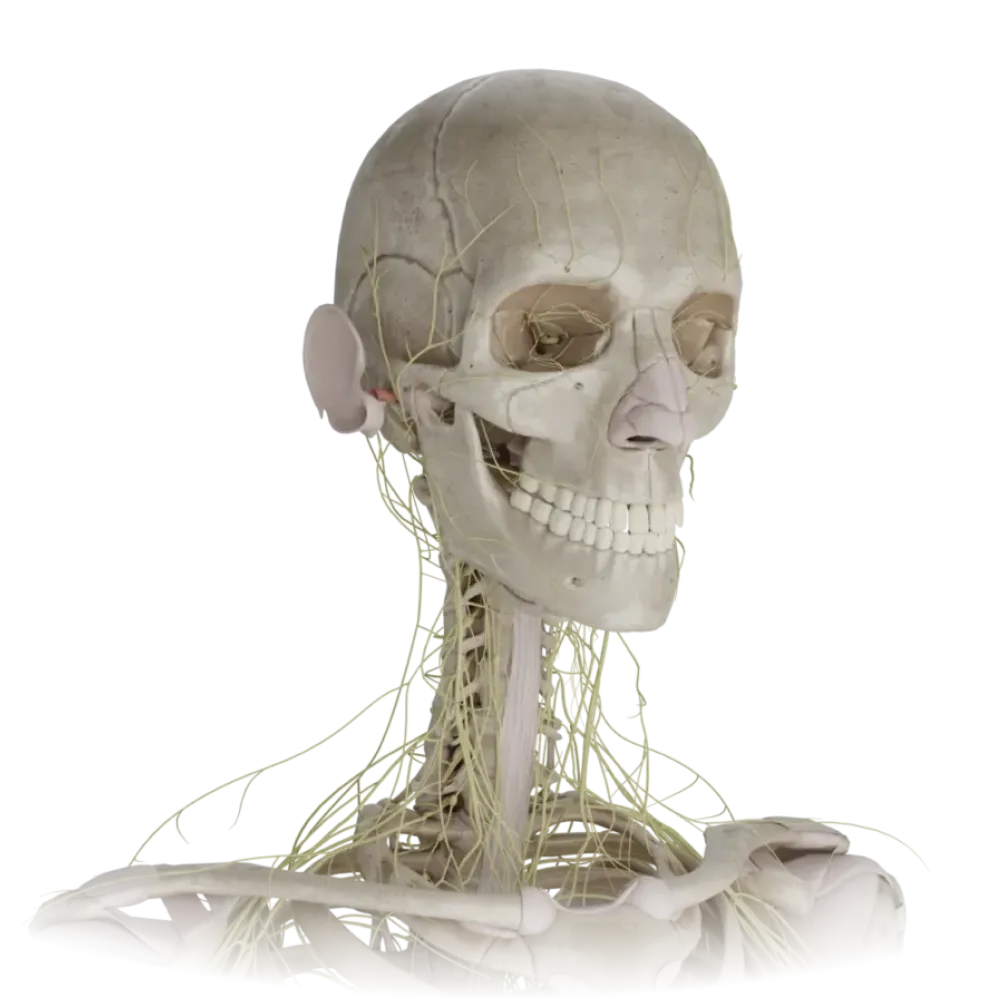
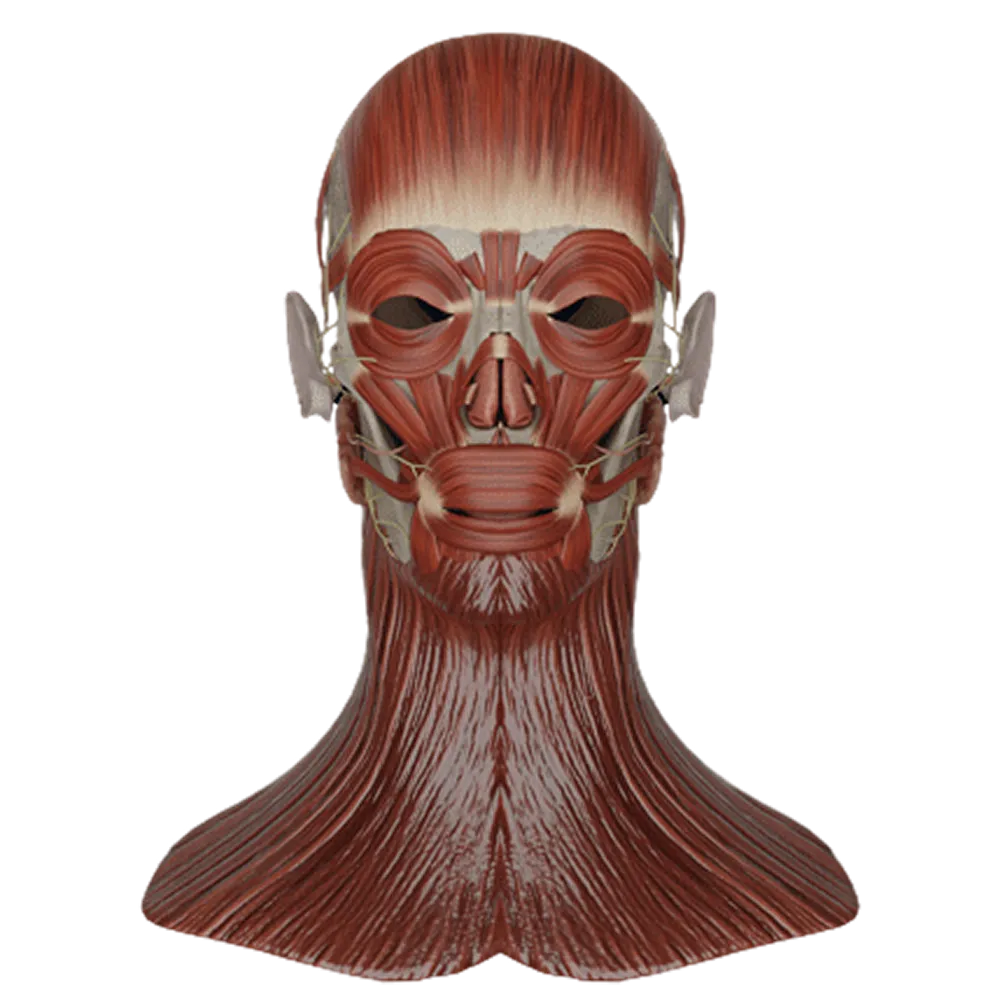
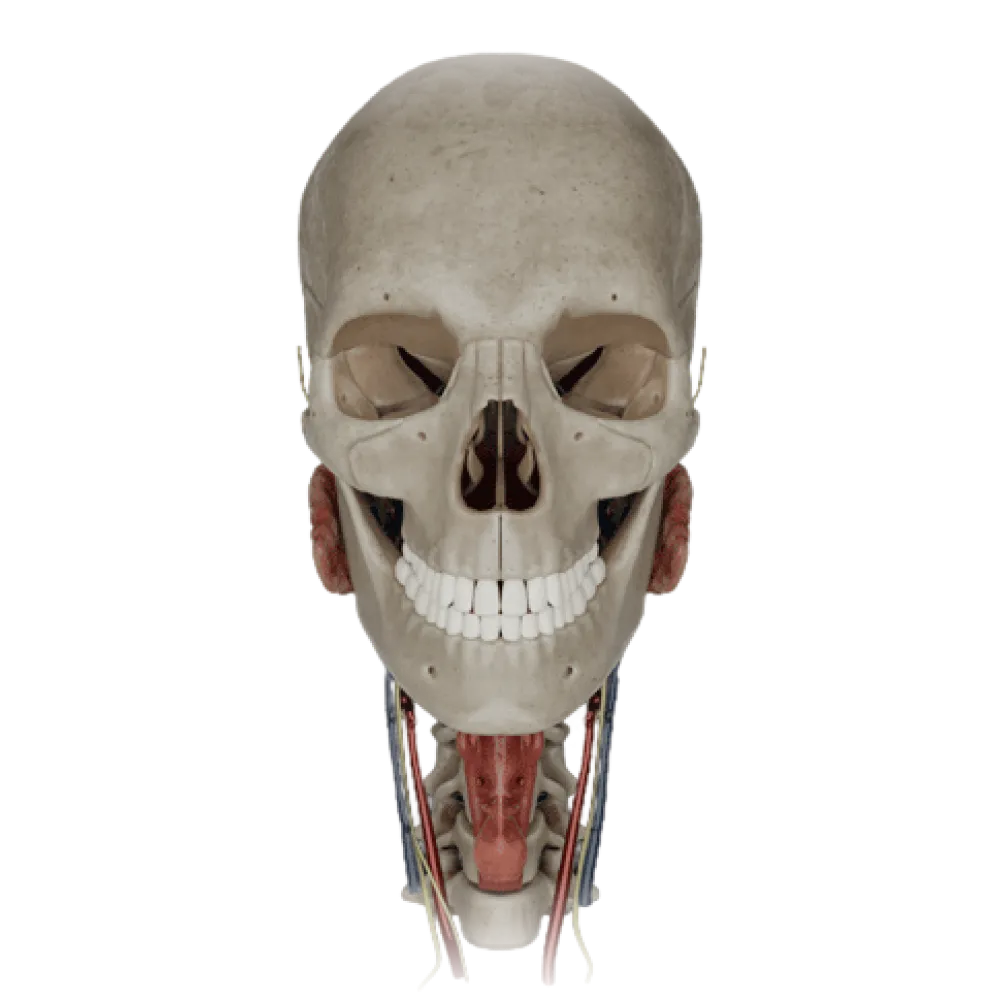
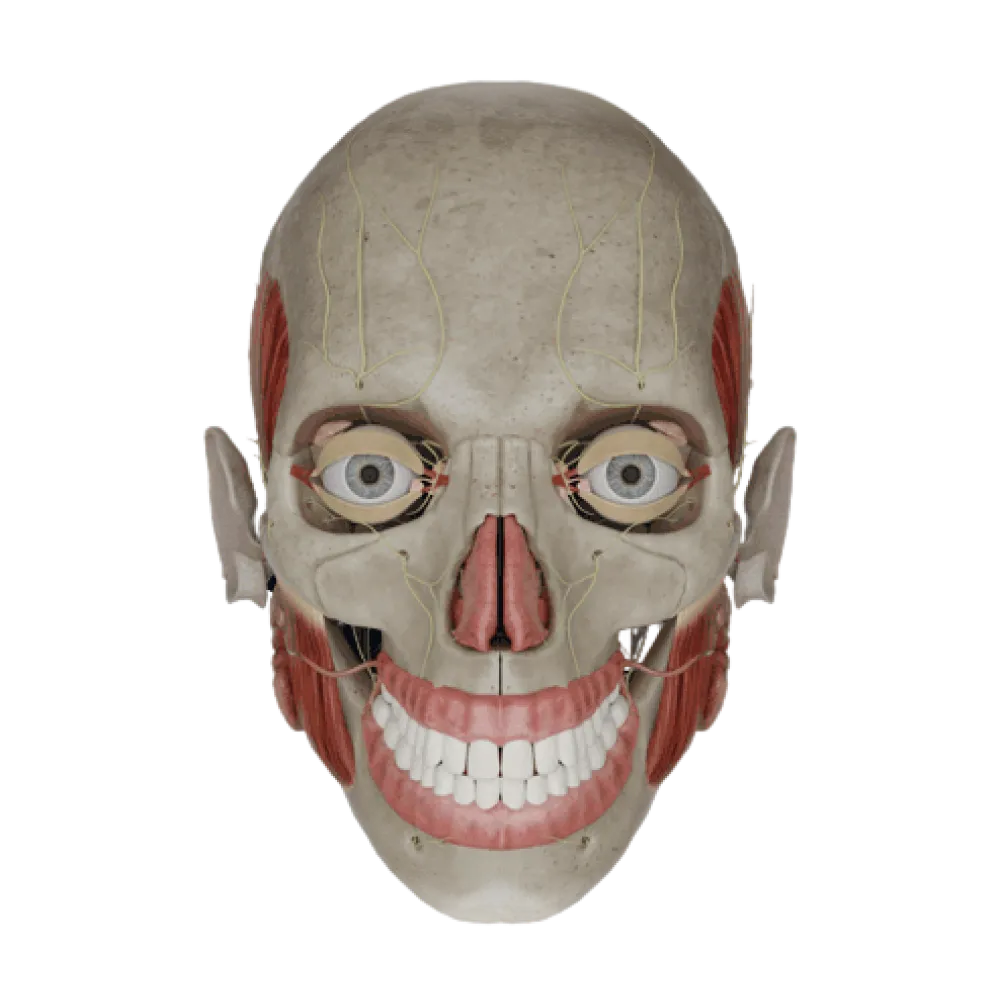
Quiz on head and neck nerve anatomy
Evaluate the knowledge of cranial nerve anatomy. The test assesses the topology, branches, and innervation areas of the trigeminal, facial, and glossopharyngeal nerves.
1. Which branch of the ophthalmic nerve (n. ophthalmicus) innervates the skin of the nose root and the medial corner of the eye?
-
Infratrochlear nerve (n. infratrochlearis)
The infratrochlear nerve branches from the nasociliary nerve and extends to the medial corner of the eye, innervating the skin of the nose root, eyelids, and conjunctiva.
-
Supratrochlear nerve (n. supratrochlearis)
The infratrochlear nerve branches from the nasociliary nerve and extends to the medial corner of the eye, innervating the skin of the nose root, eyelids, and conjunctiva.
-
Lacrimal nerve (n. lacrimalis)
The infratrochlear nerve branches from the nasociliary nerve and extends to the medial corner of the eye, innervating the skin of the nose root, eyelids, and conjunctiva.
-
Frontal nerve (n. frontalis)
The infratrochlear nerve branches from the nasociliary nerve and extends to the medial corner of the eye, innervating the skin of the nose root, eyelids, and conjunctiva.
-
I find it difficult to answer
The infratrochlear nerve branches from the nasociliary nerve and extends to the medial corner of the eye, innervating the skin of the nose root, eyelids, and conjunctiva.
2. Through which anatomical structure does the maxillary nerve (n. maxillaris) leave the cranial cavity?
-
Foramen ovale
The maxillary nerve exits the middle cranial fossa via the foramen rotundum directly into the pterygopalatine fossa.
-
Foramen rotundum
The maxillary nerve exits the middle cranial fossa via the foramen rotundum directly into the pterygopalatine fossa.
-
Foramen spinosum
The maxillary nerve exits the middle cranial fossa via the foramen rotundum directly into the pterygopalatine fossa.
-
Superior orbital fissure
The maxillary nerve exits the middle cranial fossa via the foramen rotundum directly into the pterygopalatine fossa.
-
I find it difficult to answer
The maxillary nerve exits the middle cranial fossa via the foramen rotundum directly into the pterygopalatine fossa.
3. Which of the listed muscles is innervated by the motor fibers of the mandibular nerve (n. mandibularis)?
-
Platysma (platysma)
The motor portion of the mandibular nerve innervates the mylohyoid muscle and the anterior belly of the digastric muscle.
-
Stylohyoid muscle (m. stylohyoideus)
The motor portion of the mandibular nerve innervates the mylohyoid muscle and the anterior belly of the digastric muscle.
-
Posterior belly of the digastric muscle (venter posterior m. digastrici)
The motor portion of the mandibular nerve innervates the mylohyoid muscle and the anterior belly of the digastric muscle.
-
Mylohyoid muscle (m. mylohyoideus)
The motor portion of the mandibular nerve innervates the mylohyoid muscle and the anterior belly of the digastric muscle.
-
I find it difficult to answer
The motor portion of the mandibular nerve innervates the mylohyoid muscle and the anterior belly of the digastric muscle.
4. Which artery does the auriculotemporal nerve (n. auriculotemporalis) encircle with its two roots when branching off from the mandibular nerve?
-
Superficial temporal artery (a. temporalis superficialis)
The auriculotemporal nerve typically begins with two roots that form a loop around the middle meningeal artery.
-
Deep temporal artery (a. temporalis profunda)
The auriculotemporal nerve typically begins with two roots that form a loop around the middle meningeal artery.
-
Middle meningeal artery (a. meningea media)
The auriculotemporal nerve typically begins with two roots that form a loop around the middle meningeal artery.
-
Maxillary artery (a. maxillaris)
The auriculotemporal nerve typically begins with two roots that form a loop around the middle meningeal artery.
-
I find it difficult to answer
The auriculotemporal nerve typically begins with two roots that form a loop around the middle meningeal artery.
5. The chorda tympani, a branch of the facial nerve, joins in the infratemporal fossa to:
-
Lingual nerve (n. lingualis)
The chorda tympani weaves into the lingual nerve at an acute angle, carrying taste and secretory fibers to it.
-
Inferior alveolar nerve (n. alveolaris inferior)
The chorda tympani weaves into the lingual nerve at an acute angle, carrying taste and secretory fibers to it.
-
Buccal nerve (n. buccalis)
The chorda tympani weaves into the lingual nerve at an acute angle, carrying taste and secretory fibers to it.
-
Auriculotemporal nerve (n. auriculotemporalis)
The chorda tympani weaves into the lingual nerve at an acute angle, carrying taste and secretory fibers to it.
-
I find it difficult to answer
The chorda tympani weaves into the lingual nerve at an acute angle, carrying taste and secretory fibers to it.
6. Which branch of the trigeminal nerve, emerging onto the face through its corresponding foramen, forms the minor goosefoot (pes anserinus minor)?
-
Mental nerve (n. mentalis)
The infraorbital nerve, after exiting the infraorbital foramen, spreads into a fan-like bundle of branches, forming the minor goosefoot.
-
Supraorbital nerve (n. supraorbitalis)
The infraorbital nerve, after exiting the infraorbital foramen, spreads into a fan-like bundle of branches, forming the minor goosefoot.
-
Infraorbital nerve (n. infraorbitalis)
The infraorbital nerve, after exiting the infraorbital foramen, spreads into a fan-like bundle of branches, forming the minor goosefoot.
-
Zygomaticofacial nerve (n. zygomaticofacialis)
The infraorbital nerve, after exiting the infraorbital foramen, spreads into a fan-like bundle of branches, forming the minor goosefoot.
-
I find it difficult to answer
The infraorbital nerve, after exiting the infraorbital foramen, spreads into a fan-like bundle of branches, forming the minor goosefoot.
7. With which parasympathetic ganglion of the head is the greater petrosal nerve (n. petrosus major) topographically and functionally connected?
-
Otic ganglion (ganglion oticum)
The greater petrosal nerve carries preganglionic parasympathetic fibers, which are interrupted in the pterygopalatine ganglion.
-
Pterygopalatine ganglion (ganglion pterygopalatinum)
The greater petrosal nerve carries preganglionic parasympathetic fibers, which are interrupted in the pterygopalatine ganglion.
-
Ciliary ganglion (ganglion ciliare)
The greater petrosal nerve carries preganglionic parasympathetic fibers, which are interrupted in the pterygopalatine ganglion.
-
Submandibular ganglion (ganglion submandibulare)
The greater petrosal nerve carries preganglionic parasympathetic fibers, which are interrupted in the pterygopalatine ganglion.
-
I find it difficult to answer
The greater petrosal nerve carries preganglionic parasympathetic fibers, which are interrupted in the pterygopalatine ganglion.
8. Where does the greater petrosal nerve (n. petrosus major) branch off from the facial nerve?
-
At the level of the geniculate ganglion (geniculum n. facialis)
The greater petrosal nerve arises from the facial nerve at the level of its geniculate ganglion, exiting through the hiatus of the greater petrosal nerve canal.
-
At the onset of the internal acoustic meatus (meatus acusticus internus)
The greater petrosal nerve arises from the facial nerve at the level of its geniculate ganglion, exiting through the hiatus of the greater petrosal nerve canal.
-
At the level of the stylomastoid foramen (foramen stylomastoideum)
The greater petrosal nerve arises from the facial nerve at the level of its geniculate ganglion, exiting through the hiatus of the greater petrosal nerve canal.
-
In the tympanic cavity (cavitas tympani)
The greater petrosal nerve arises from the facial nerve at the level of its geniculate ganglion, exiting through the hiatus of the greater petrosal nerve canal.
-
I find it difficult to answer
The greater petrosal nerve arises from the facial nerve at the level of its geniculate ganglion, exiting through the hiatus of the greater petrosal nerve canal.
9. Which branch of the facial nerve departs from the main trunk immediately after its exit from the stylomastoid foramen and directs backward and upward?
-
Digastric branch (ramus digastricus)
The posterior auricular nerve is the first extracranial branch to loop around the mastoid process to innervate the occipital and auricular muscles.
-
Cervical branch (ramus colli)
The posterior auricular nerve is the first extracranial branch to loop around the mastoid process to innervate the occipital and auricular muscles.
-
Marginal mandibular branch (ramus marginalis mandibulae)
The posterior auricular nerve is the first extracranial branch to loop around the mastoid process to innervate the occipital and auricular muscles.
-
Posterior auricular nerve (n. auricularis posterior)
The posterior auricular nerve is the first extracranial branch to loop around the mastoid process to innervate the occipital and auricular muscles.
-
I find it difficult to answer
The posterior auricular nerve is the first extracranial branch to loop around the mastoid process to innervate the occipital and auricular muscles.
10. Which branches of the parotid plexus (plexus parotideus) of the facial nerve provide motor innervation to the orbicularis oculi muscle (m. orbicularis oculi)?
-
Buccal branches (rr. buccales)
The temporal branches innervate the upper part of the orbicularis oculi muscle, while the zygomatic branches innervate the lower part.
-
Temporal and zygomatic branches (rr. temporales et zygomatici)
The temporal branches innervate the upper part of the orbicularis oculi muscle, while the zygomatic branches innervate the lower part.
-
Marginal mandibular branch (r. marginalis mandibulae)
The temporal branches innervate the upper part of the orbicularis oculi muscle, while the zygomatic branches innervate the lower part.
-
Cervical branch (r. colli)
The temporal branches innervate the upper part of the orbicularis oculi muscle, while the zygomatic branches innervate the lower part.
-
I find it difficult to answer
The temporal branches innervate the upper part of the orbicularis oculi muscle, while the zygomatic branches innervate the lower part.
11. Which neck muscle is innervated by the cervical branch (ramus colli) of the facial nerve?
-
Platysma (platysma)
The platysma muscle is derived from the second branchial arch and receives innervation exclusively from the facial nerve.
-
Sternocleidomastoid muscle (m. sternocleidomastoideus)
The platysma muscle is derived from the second branchial arch and receives innervation exclusively from the facial nerve.
-
Mylohyoid muscle (m. mylohyoideus)
The platysma muscle is derived from the second branchial arch and receives innervation exclusively from the facial nerve.
-
Omohyoid muscle (m. omohyoideus)
The platysma muscle is derived from the second branchial arch and receives innervation exclusively from the facial nerve.
-
I find it difficult to answer
The platysma muscle is derived from the second branchial arch and receives innervation exclusively from the facial nerve.
12. Through which opening does the chorda tympani (chorda tympani) exit the skull, leaving the tympanic cavity?
-
Stylomastoid foramen (foramen stylomastoideum)
The chorda tympani traverses the tympanic cavity and exits the skull through the petrotympanic (Gasserian) fissure.
-
Petrosquamous fissure (fissura petrosquamosa)
The chorda tympani traverses the tympanic cavity and exits the skull through the petrotympanic (Gasserian) fissure.
-
Petrotympanic fissure (fissura petrotympanica)
The chorda tympani traverses the tympanic cavity and exits the skull through the petrotympanic (Gasserian) fissure.
-
Tympanomastoid fissure (fissura tympanomastoidea)
The chorda tympani traverses the tympanic cavity and exits the skull through the petrotympanic (Gasserian) fissure.
-
I find it difficult to answer
The chorda tympani traverses the tympanic cavity and exits the skull through the petrotympanic (Gasserian) fissure.
13. From which groove at the base of the brainstem do the roots of the glossopharyngeal nerve (n. glossopharyngeus) exit?
-
Anterolateral sulcus of the medulla oblongata (sulcus anterolateralis)
The glossopharyngeal nerve exits from the posterior lateral sulcus of the medulla oblongata (behind the olive), cranial to the roots of the vagus nerve.
-
Posterolateral sulcus of the medulla oblongata (sulcus posterolateralis)
The glossopharyngeal nerve exits from the posterior lateral sulcus of the medulla oblongata (behind the olive), cranial to the roots of the vagus nerve.
-
Bulbopontine sulcus (sulcus bulbopontinus)
The glossopharyngeal nerve exits from the posterior lateral sulcus of the medulla oblongata (behind the olive), cranial to the roots of the vagus nerve.
-
Pontocerebellar angle (angulus pontocerebellaris)
The glossopharyngeal nerve exits from the posterior lateral sulcus of the medulla oblongata (behind the olive), cranial to the roots of the vagus nerve.
-
I find it difficult to answer
The glossopharyngeal nerve exits from the posterior lateral sulcus of the medulla oblongata (behind the olive), cranial to the roots of the vagus nerve.
14. Which ganglion houses the cell bodies of the first sensory neurons of the glossopharyngeal nerve and is located in the petrous fossa?
-
Geniculate ganglion (ganglion geniculi)
The sensitive inferior ganglion of the glossopharyngeal nerve is larger than the superior and lies within the petrous fossa (fossula petrosa).
-
Superior ganglion of the vagus nerve (ganglion superius n. vagi)
The sensitive inferior ganglion of the glossopharyngeal nerve is larger than the superior and lies within the petrous fossa (fossula petrosa).
-
Otic ganglion (ganglion oticum)
The sensitive inferior ganglion of the glossopharyngeal nerve is larger than the superior and lies within the petrous fossa (fossula petrosa).
-
Inferior ganglion (ganglion inferius)
The sensitive inferior ganglion of the glossopharyngeal nerve is larger than the superior and lies within the petrous fossa (fossula petrosa).
-
I find it difficult to answer
The sensitive inferior ganglion of the glossopharyngeal nerve is larger than the superior and lies within the petrous fossa (fossula petrosa).
15. Which branch of the glossopharyngeal nerve starts from its inferior ganglion and enters the tympanic cavity to form a plexus?
-
Tympanic nerve (n. tympanicus)
The tympanic nerve branches from the inferior ganglion of the glossopharyngeal nerve, enters the tympanic canaliculus, and forms the tympanic plexus.
-
Chorda tympani (chorda tympani)
The tympanic nerve branches from the inferior ganglion of the glossopharyngeal nerve, enters the tympanic canaliculus, and forms the tympanic plexus.
-
Greater petrosal nerve (n. petrosus major)
The tympanic nerve branches from the inferior ganglion of the glossopharyngeal nerve, enters the tympanic canaliculus, and forms the tympanic plexus.
-
Stapedial nerve (n. stapedius)
The tympanic nerve branches from the inferior ganglion of the glossopharyngeal nerve, enters the tympanic canaliculus, and forms the tympanic plexus.
-
I find it difficult to answer
The tympanic nerve branches from the inferior ganglion of the glossopharyngeal nerve, enters the tympanic canaliculus, and forms the tympanic plexus.
16. To which autonomic ganglion do the preganglionic parasympathetic fibers of the lesser petrosal nerve (n. petrosus minor) go?
-
Submandibular ganglion (ganglion submandibulare)
The lesser petrosal nerve carries parasympathetic fibers to the otic ganglion for the innervation of the parotid gland.
-
Pterygopalatine ganglion (ganglion pterygopalatinum)
The lesser petrosal nerve carries parasympathetic fibers to the otic ganglion for the innervation of the parotid gland.
-
Otic ganglion (ganglion oticum)
The lesser petrosal nerve carries parasympathetic fibers to the otic ganglion for the innervation of the parotid gland.
-
Ciliary ganglion (ganglion ciliare)
The lesser petrosal nerve carries parasympathetic fibers to the otic ganglion for the innervation of the parotid gland.
-
I find it difficult to answer
The lesser petrosal nerve carries parasympathetic fibers to the otic ganglion for the innervation of the parotid gland.
17. Which single muscle is innervated by the motor portion of the glossopharyngeal nerve (n. glossopharyngeus)?
-
Salpingopharyngeus muscle (m. salpingopharyngeus)
Unlike the vagus nerve, the glossopharyngeal nerve motorally innervates only one pharyngeal muscle — the stylopharyngeus.
-
Stylopharyngeus muscle (m. stylopharyngeus)
Unlike the vagus nerve, the glossopharyngeal nerve motorally innervates only one pharyngeal muscle — the stylopharyngeus.
-
Palatopharyngeus muscle (m. palatopharyngeus)
Unlike the vagus nerve, the glossopharyngeal nerve motorally innervates only one pharyngeal muscle — the stylopharyngeus.
-
Superior pharyngeal constrictor (m. constrictor pharyngis superior)
Unlike the vagus nerve, the glossopharyngeal nerve motorally innervates only one pharyngeal muscle — the stylopharyngeus.
-
I find it difficult to answer
Unlike the vagus nerve, the glossopharyngeal nerve motorally innervates only one pharyngeal muscle — the stylopharyngeus.
18. What area’s general and gustatory sensitivity is provided by the glossopharyngeal nerve?
-
Posterior third of the tongue
The lingual branches of the glossopharyngeal nerve innervate the mucous membrane of the posterior third of the tongue, providing both general and gustatory sensitivity.
-
Anterior two-thirds of the tongue
The lingual branches of the glossopharyngeal nerve innervate the mucous membrane of the posterior third of the tongue, providing both general and gustatory sensitivity.
-
Root of the tongue in the area of the epiglottis
The lingual branches of the glossopharyngeal nerve innervate the mucous membrane of the posterior third of the tongue, providing both general and gustatory sensitivity.
-
Hard palate
The lingual branches of the glossopharyngeal nerve innervate the mucous membrane of the posterior third of the tongue, providing both general and gustatory sensitivity.
-
I find it difficult to answer
The lingual branches of the glossopharyngeal nerve innervate the mucous membrane of the posterior third of the tongue, providing both general and gustatory sensitivity.
19. Which sensory branch of the glossopharyngeal nerve descends along the course of the internal carotid artery to its bifurcation?
-
Tonsillar branch (ramus tonsillaris)
The carotid sinus branch innervates the carotid sinus and carotid body, transmitting sensory information about pressure and blood composition.
-
Pharyngeal branch (ramus pharyngeus)
The carotid sinus branch innervates the carotid sinus and carotid body, transmitting sensory information about pressure and blood composition.
-
Tympanic nerve (n. tympanicus)
The carotid sinus branch innervates the carotid sinus and carotid body, transmitting sensory information about pressure and blood composition.
-
Carotid sinus branch (ramus sinus carotici)
The carotid sinus branch innervates the carotid sinus and carotid body, transmitting sensory information about pressure and blood composition.
-
I find it difficult to answer
The carotid sinus branch innervates the carotid sinus and carotid body, transmitting sensory information about pressure and blood composition.
20. Which part of the trigeminal nerve (n. trigeminus) contains motor fibers?
-
Ophthalmic nerve (n. ophthalmicus)
The trigeminal nerve is mixed, but the motor fibers run exclusively within its third branch — the mandibular nerve.
-
Maxillary nerve (n. maxillaris)
The trigeminal nerve is mixed, but the motor fibers run exclusively within its third branch — the mandibular nerve.
-
Mandibular nerve (n. mandibularis)
The trigeminal nerve is mixed, but the motor fibers run exclusively within its third branch — the mandibular nerve.
-
Intermediate nerve (n. intermedius)
The trigeminal nerve is mixed, but the motor fibers run exclusively within its third branch — the mandibular nerve.
-
I find it difficult to answer
The trigeminal nerve is mixed, but the motor fibers run exclusively within its third branch — the mandibular nerve.
Retake this quiz?
Your current progress will be reset.
Nerves of head and neck
Trigeminal nerve
0/20