


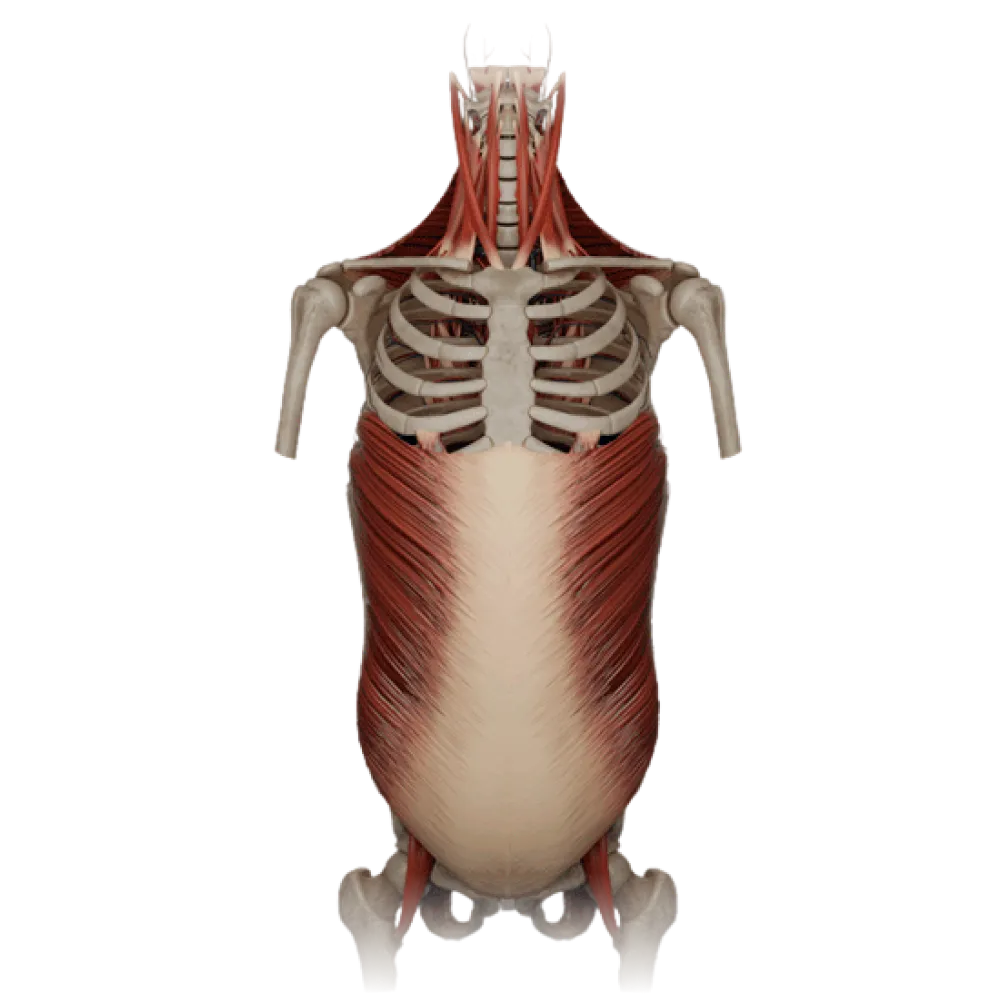
Zygapophyseal joint anatomy test
Assess knowledge of zygapophyseal joint anatomy. The test evaluates their topography, biomechanics, muscles, blood supply, and innervation.
1/20
bold
text
1. By which nerves is the innervation of zygapophyseal joints provided?
-
Ventral branches of spinal nerves.
Zygapophyseal joints are innervated by the medial branches of the dorsal (posterior) branches of the spinal nerves.
-
Sympathetic trunks.
Zygapophyseal joints are innervated by the medial branches of the dorsal (posterior) branches of the spinal nerves.
-
Medial branches of the dorsal branches of the spinal nerves.
Zygapophyseal joints are innervated by the medial branches of the dorsal (posterior) branches of the spinal nerves.
-
Recurrent meningeal nerves (nerves of Luschka).
Zygapophyseal joints are innervated by the medial branches of the dorsal (posterior) branches of the spinal nerves.
-
I find it difficult to answer
Zygapophyseal joints are innervated by the medial branches of the dorsal (posterior) branches of the spinal nerves.
2. To which type of joint based on the shape of the articular surfaces do zygapophyseal joints belong?
-
Plane.
Based on the shape of the articular surfaces, zygapophyseal joints are flat, allowing gliding.
-
Cylindrical.
Based on the shape of the articular surfaces, zygapophyseal joints are flat, allowing gliding.
-
Hinge.
Based on the shape of the articular surfaces, zygapophyseal joints are flat, allowing gliding.
-
Saddle-shaped.
Based on the shape of the articular surfaces, zygapophyseal joints are flat, allowing gliding.
-
I find it difficult to answer
Based on the shape of the articular surfaces, zygapophyseal joints are flat, allowing gliding.
3. How are the articular surfaces of the zygapophyseal joints oriented in the cervical spine?
-
In the sagittal plane.
In the cervical region, the articular surfaces are inclined approximately at a 45-degree angle to the horizontal plane.
-
At a 45-degree angle to the horizontal plane.
In the cervical region, the articular surfaces are inclined approximately at a 45-degree angle to the horizontal plane.
-
In the frontal plane.
In the cervical region, the articular surfaces are inclined approximately at a 45-degree angle to the horizontal plane.
-
Strictly in the horizontal plane.
In the cervical region, the articular surfaces are inclined approximately at a 45-degree angle to the horizontal plane.
-
I find it difficult to answer
In the cervical region, the articular surfaces are inclined approximately at a 45-degree angle to the horizontal plane.
4. In which plane are the articular surfaces of zygapophyseal joints predominantly located in the lumbar region?
-
In the frontal.
In the lumbar region, the articular facets are predominantly located in the sagittal plane.
-
In the horizontal.
In the lumbar region, the articular facets are predominantly located in the sagittal plane.
-
In the oblique (transitional).
In the lumbar region, the articular facets are predominantly located in the sagittal plane.
-
In the sagittal.
In the lumbar region, the articular facets are predominantly located in the sagittal plane.
-
I find it difficult to answer
In the lumbar region, the articular facets are predominantly located in the sagittal plane.
5. Which source predominantly provides blood supply to the zygapophyseal joints of the cervical spine?
-
Branches of the vertebral artery.
In the cervical region, blood supply is provided by the branches of the vertebral artery, as well as the deep cervical artery.
-
Branches of the internal carotid artery.
In the cervical region, blood supply is provided by the branches of the vertebral artery, as well as the deep cervical artery.
-
Branches of the thoracic aorta.
In the cervical region, blood supply is provided by the branches of the vertebral artery, as well as the deep cervical artery.
-
Branches of the facial artery.
In the cervical region, blood supply is provided by the branches of the vertebral artery, as well as the deep cervical artery.
-
I find it difficult to answer
In the cervical region, blood supply is provided by the branches of the vertebral artery, as well as the deep cervical artery.
6. Which arteries supply the blood to the zygapophyseal joints of the thoracic region?
-
Internal thoracic arteries.
In the thoracic region, joint nutrition is due to the dorsal branches of the posterior intercostal arteries.
-
Superior epigastric artery.
In the thoracic region, joint nutrition is due to the dorsal branches of the posterior intercostal arteries.
-
Posterior intercostal arteries.
In the thoracic region, joint nutrition is due to the dorsal branches of the posterior intercostal arteries.
-
Lateral thoracic arteries.
In the thoracic region, joint nutrition is due to the dorsal branches of the posterior intercostal arteries.
-
I find it difficult to answer
In the thoracic region, joint nutrition is due to the dorsal branches of the posterior intercostal arteries.
7. Which arteries' branches supply the zygapophyseal joints of the lumbar region?
-
Inferior phrenic arteries.
In the lumbar region, arterial blood supply is provided by the dorsal branches of the lumbar arteries.
-
Lumbar arteries.
In the lumbar region, arterial blood supply is provided by the dorsal branches of the lumbar arteries.
-
Iliolumbar artery.
In the lumbar region, arterial blood supply is provided by the dorsal branches of the lumbar arteries.
-
Median sacral artery.
In the lumbar region, arterial blood supply is provided by the dorsal branches of the lumbar arteries.
-
I find it difficult to answer
In the lumbar region, arterial blood supply is provided by the dorsal branches of the lumbar arteries.
8. Which muscle, upon bilateral contraction, extends the spine by acting on zygapophyseal joints?
-
Rectus abdominis muscle.
The erector spinae muscle (m. erector spinae) is a powerful extensor.
-
External oblique muscle of the abdomen.
The erector spinae muscle (m. erector spinae) is a powerful extensor.
-
Psoas major.
The erector spinae muscle (m. erector spinae) is a powerful extensor.
-
Erector spinae.
The erector spinae muscle (m. erector spinae) is a powerful extensor.
-
I find it difficult to answer
The erector spinae muscle (m. erector spinae) is a powerful extensor.
9. Which back muscles play a main role in the rotation of the vertebral column around its longitudinal axis?
-
Rotator muscles (mm. rotatores).
Rotator muscles, upon unilateral contraction, rotate the spine.
-
Spinalis muscles.
Rotator muscles, upon unilateral contraction, rotate the spine.
-
Longissimus muscles.
Rotator muscles, upon unilateral contraction, rotate the spine.
-
Iliocostalis muscles.
Rotator muscles, upon unilateral contraction, rotate the spine.
-
I find it difficult to answer
Rotator muscles, upon unilateral contraction, rotate the spine.
10. What is the characteristic of the joint capsule of the zygapophyseal joints in the cervical region?
-
It is thick and tightly stretched.
In the cervical region, the capsule of the zygapophyseal joints is the thinnest and most loose.
-
It is absent.
In the cervical region, the capsule of the zygapophyseal joints is the thinnest and most loose.
-
It is thin, loose, and long.
In the cervical region, the capsule of the zygapophyseal joints is the thinnest and most loose.
-
It fuses with the posterior longitudinal ligament.
In the cervical region, the capsule of the zygapophyseal joints is the thinnest and most loose.
-
I find it difficult to answer
In the cervical region, the capsule of the zygapophyseal joints is the thinnest and most loose.
11. Which of the listed muscles, upon unilateral contraction, tilts the spine to its side?
-
Transversus abdominis muscle.
The iliocostalis muscle, upon unilateral contraction, produces lateral flexion.
-
Iliocostalis muscles.
The iliocostalis muscle, upon unilateral contraction, produces lateral flexion.
-
Pyramidalis muscle.
The iliocostalis muscle, upon unilateral contraction, produces lateral flexion.
-
Longus colli muscle.
The iliocostalis muscle, upon unilateral contraction, produces lateral flexion.
-
I find it difficult to answer
The iliocostalis muscle, upon unilateral contraction, produces lateral flexion.
12. What is the unique aspect of the innervation of each individual zygapophyseal joint?
-
Innervated by branches of at least two adjacent nerves.
Each zygapophyseal joint receives overlapping innervation from two adjacent levels.
-
Innervated by only one spinal nerve.
Each zygapophyseal joint receives overlapping innervation from two adjacent levels.
-
Innervated exclusively by autonomic fibers.
Each zygapophyseal joint receives overlapping innervation from two adjacent levels.
-
Has no afferent innervation.
Each zygapophyseal joint receives overlapping innervation from two adjacent levels.
-
I find it difficult to answer
Each zygapophyseal joint receives overlapping innervation from two adjacent levels.
13. Where is the venous outflow from the zygapophyseal joints primarily directed?
-
Into the portal vein system.
Venous blood from the joints drains into the internal and external vertebral venous plexuses.
-
Into the azygos vein directly.
Venous blood from the joints drains into the internal and external vertebral venous plexuses.
-
Into the superior vena cava, bypassing plexuses.
Venous blood from the joints drains into the internal and external vertebral venous plexuses.
-
Into the vertebral venous plexuses.
Venous blood from the joints drains into the internal and external vertebral venous plexuses.
-
I find it difficult to answer
Venous blood from the joints drains into the internal and external vertebral venous plexuses.
14. Where is the joint capsule of the zygapophyseal joints attached?
-
At the margins of the articular cartilage.
Normally, the capsule is strictly attached at the edge of the articular surfaces.
-
1 cm from the margin of the articular cartilage.
Normally, the capsule is strictly attached at the edge of the articular surfaces.
-
On the spinous processes.
Normally, the capsule is strictly attached at the edge of the articular surfaces.
-
On the transverse processes.
Normally, the capsule is strictly attached at the edge of the articular surfaces.
-
I find it difficult to answer
Normally, the capsule is strictly attached at the edge of the articular surfaces.
15. What movement is most restricted in the zygapophyseal joints of the thoracic spine due to the presence of ribs?
-
Rotation (ротация).
Flexion and extension in the thoracic region are significantly limited due to the rib cage structure.
-
Lateral flexion.
Flexion and extension in the thoracic region are significantly limited due to the rib cage structure.
-
Flexion and extension.
Flexion and extension in the thoracic region are significantly limited due to the rib cage structure.
-
All movements are free.
Flexion and extension in the thoracic region are significantly limited due to the rib cage structure.
-
I find it difficult to answer
Flexion and extension in the thoracic region are significantly limited due to the rib cage structure.
16. Which group of back muscles lies deepest and directly adjacent to the zygapophyseal joints?
-
Superficial back muscles.
The transversospinalis tract lies deepest and directly adjacent to the joints.
-
Transversospinal muscles.
The transversospinalis tract lies deepest and directly adjacent to the joints.
-
Splenius muscles.
The transversospinalis tract lies deepest and directly adjacent to the joints.
-
Erector spinae.
The transversospinalis tract lies deepest and directly adjacent to the joints.
-
I find it difficult to answer
The transversospinalis tract lies deepest and directly adjacent to the joints.
17. Which structures form the zygapophyseal joint?
-
Bodies of adjacent vertebrae.
The joint is formed by the articulation of articular processes (processus articulares) of adjacent vertebrae.
-
Transverse and spinous processes.
The joint is formed by the articulation of articular processes (processus articulares) of adjacent vertebrae.
-
Vertebral arches and pedicles.
The joint is formed by the articulation of articular processes (processus articulares) of adjacent vertebrae.
-
Superior and inferior articular processes of adjacent vertebrae.
The joint is formed by the articulation of articular processes (processus articulares) of adjacent vertebrae.
-
I find it difficult to answer
The joint is formed by the articulation of articular processes (processus articulares) of adjacent vertebrae.
18. What shape do the articular surfaces of the zygapophyseal joints in the lumbar region usually have?
-
Strictly flat.
In the lumbar region, the articular surfaces often have a slightly cylindrical shape.
-
Ball-shaped.
In the lumbar region, the articular surfaces often have a slightly cylindrical shape.
-
Slightly cylindrical.
In the lumbar region, the articular surfaces often have a slightly cylindrical shape.
-
Saddle-shaped.
In the lumbar region, the articular surfaces often have a slightly cylindrical shape.
-
I find it difficult to answer
In the lumbar region, the articular surfaces often have a slightly cylindrical shape.
19. Which muscle acts on the atlanto-occipital and atlanto-axial joints but does NOT act on typical C2-C7 zygapophyseal joints?
-
Rectus posterior major capitis muscle.
Suboccipital muscles act on the craniovertebral junction, not on typical facet joints.
-
Semispinalis capitis muscle.
Suboccipital muscles act on the craniovertebral junction, not on typical facet joints.
-
Splenius colli muscle.
Suboccipital muscles act on the craniovertebral junction, not on typical facet joints.
-
Longissimus capitis muscle.
Suboccipital muscles act on the craniovertebral junction, not on typical facet joints.
-
I find it difficult to answer
Suboccipital muscles act on the craniovertebral junction, not on typical facet joints.
20. What happens to the capsule of the zygapophyseal joints during maximal spinal flexion?
-
It relaxes.
During spinal flexion, the articular processes separate, tensioning the joint capsule.
-
It tensions.
During spinal flexion, the articular processes separate, tensioning the joint capsule.
-
It gets pinched between the articular surfaces.
During spinal flexion, the articular processes separate, tensioning the joint capsule.
-
It does not change its tension.
During spinal flexion, the articular processes separate, tensioning the joint capsule.
-
I find it difficult to answer
During spinal flexion, the articular processes separate, tensioning the joint capsule.
Retake this quiz?
Your current progress will be reset.