


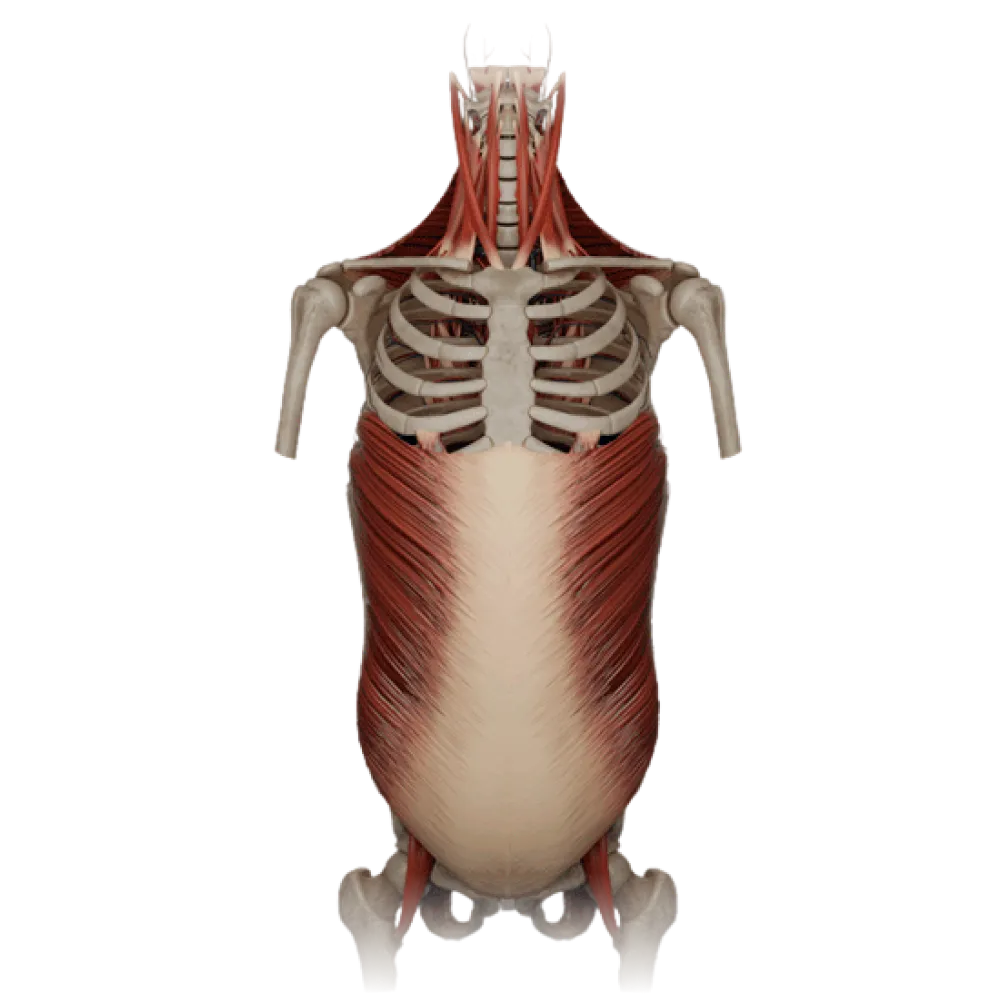
Anatomy test of cartilaginous joints of the spine.
Evaluate the knowledge of the anatomy of the cartilaginous joints of the spine. The test evaluates the topography, structure of the discs, their blood supply, and innervation.
1/20
bold
text
1. To which type of joints does the intervertebral disc belong?
-
Synchondrosis
The intervertebral disc is a false joint or symphysis because a small cleft may be present within the nucleus pulposus.
-
Syndesmosis
The intervertebral disc is a false joint or symphysis because a small cleft may be present within the nucleus pulposus.
-
Symphysis
The intervertebral disc is a false joint or symphysis because a small cleft may be present within the nucleus pulposus.
-
Diarthrosis
The intervertebral disc is a false joint or symphysis because a small cleft may be present within the nucleus pulposus.
-
I find it difficult to answer
The intervertebral disc is a false joint or symphysis because a small cleft may be present within the nucleus pulposus.
2. What is the name of the central part of the intervertebral disc?
-
Anulus fibrosus
The central part of the disc is represented by the nucleus pulposus (nucleus pulposus), which performs a cushioning function.
-
Nucleus pulposus
The central part of the disc is represented by the nucleus pulposus (nucleus pulposus), which performs a cushioning function.
-
Hyaline plate
The central part of the disc is represented by the nucleus pulposus (nucleus pulposus), which performs a cushioning function.
-
Intervertebral cartilage
The central part of the disc is represented by the nucleus pulposus (nucleus pulposus), which performs a cushioning function.
-
I find it difficult to answer
The central part of the disc is represented by the nucleus pulposus (nucleus pulposus), which performs a cushioning function.
3. What tissue is the main structural component of the annulus fibrosus?
-
Fibrocartilage
The annulus fibrosus (anulus fibrosus) consists of concentric layers of fibrocartilage whose collagen fibers are interwoven.
-
Elastic cartilage
The annulus fibrosus (anulus fibrosus) consists of concentric layers of fibrocartilage whose collagen fibers are interwoven.
-
Hyaline cartilage
The annulus fibrosus (anulus fibrosus) consists of concentric layers of fibrocartilage whose collagen fibers are interwoven.
-
Reticular tissue
The annulus fibrosus (anulus fibrosus) consists of concentric layers of fibrocartilage whose collagen fibers are interwoven.
-
I find it difficult to answer
The annulus fibrosus (anulus fibrosus) consists of concentric layers of fibrocartilage whose collagen fibers are interwoven.
4. Between which vertebrae is there no intervertebral disc?
-
Between T12 and L1
There is no intervertebral disc between the atlas (C1) and the axis (C2); the atlantoaxial joints function there.
-
Between C7 and Th1.
There is no intervertebral disc between the atlas (C1) and the axis (C2); the atlantoaxial joints function there.
-
Between L5 and S1
There is no intervertebral disc between the atlas (C1) and the axis (C2); the atlantoaxial joints function there.
-
Between C1 and C2
There is no intervertebral disc between the atlas (C1) and the axis (C2); the atlantoaxial joints function there.
-
I find it difficult to answer
There is no intervertebral disc between the atlas (C1) and the axis (C2); the atlantoaxial joints function there.
5. Which structure covers the upper and lower surfaces of the vertebral bodies, contacting the disc?
-
Periosteum
The cranial and caudal surfaces of the vertebral bodies are covered with thin plates of hyaline cartilage.
-
Synovial membrane
The cranial and caudal surfaces of the vertebral bodies are covered with thin plates of hyaline cartilage.
-
Hyaline cartilaginous plates
The cranial and caudal surfaces of the vertebral bodies are covered with thin plates of hyaline cartilage.
-
Ligamenta flava.
The cranial and caudal surfaces of the vertebral bodies are covered with thin plates of hyaline cartilage.
-
I find it difficult to answer
The cranial and caudal surfaces of the vertebral bodies are covered with thin plates of hyaline cartilage.
6. What is the primary mechanism of nutrition for the intervertebral disc in adults?
-
Direct arterial blood supply
In adults, intervertebral discs are avascular; nutrition is mainly through diffusion across hyaline plates.
-
Diffusion from the capillaries of the vertebral bodies
In adults, intervertebral discs are avascular; nutrition is mainly through diffusion across hyaline plates.
-
Circulation of synovial fluid
In adults, intervertebral discs are avascular; nutrition is mainly through diffusion across hyaline plates.
-
Transport through lymphatic vessels
In adults, intervertebral discs are avascular; nutrition is mainly through diffusion across hyaline plates.
-
I find it difficult to answer
In adults, intervertebral discs are avascular; nutrition is mainly through diffusion across hyaline plates.
7. The nucleus pulposus is a remnant of which embryonic structure?
-
The chordae
The nucleus pulposus (nucleus pulposus) embryologically represents the remnant of the notochord (chord).
-
Nerve tube
The nucleus pulposus (nucleus pulposus) embryologically represents the remnant of the notochord (chord).
-
Sclerotome
The nucleus pulposus (nucleus pulposus) embryologically represents the remnant of the notochord (chord).
-
Dermatome
The nucleus pulposus (nucleus pulposus) embryologically represents the remnant of the notochord (chord).
-
I find it difficult to answer
The nucleus pulposus (nucleus pulposus) embryologically represents the remnant of the notochord (chord).
8. In which part of the vertebral column are the intervertebral discs the thickest?
-
Cervical region
The discs are thickest in the lumbar region due to the high biomechanical load on this area.
-
Thoracic region
The discs are thickest in the lumbar region due to the high biomechanical load on this area.
-
Sacral region
The discs are thickest in the lumbar region due to the high biomechanical load on this area.
-
Lumbar region
The discs are thickest in the lumbar region due to the high biomechanical load on this area.
-
I find it difficult to answer
The discs are thickest in the lumbar region due to the high biomechanical load on this area.
9. With which ligament do the intervertebral discs closely merge on their anterior surface?
-
Posterior longitudinal ligament
The anterior longitudinal ligament is firmly fused with the anterior surface of the intervertebral discs.
-
Anterior longitudinal ligament
The anterior longitudinal ligament is firmly fused with the anterior surface of the intervertebral discs.
-
Ligamenta flava
The anterior longitudinal ligament is firmly fused with the anterior surface of the intervertebral discs.
-
Interspinal ligament
The anterior longitudinal ligament is firmly fused with the anterior surface of the intervertebral discs.
-
I find it difficult to answer
The anterior longitudinal ligament is firmly fused with the anterior surface of the intervertebral discs.
10. How does the posterior longitudinal ligament interact with the intervertebral discs?
-
It is tightly fused with the discs, expanding at their level
The posterior longitudinal ligament expands at the level of the discs and is firmly fused with their posterior surface (annulus fibrosus).
-
It does not contact the discs
The posterior longitudinal ligament expands at the level of the discs and is firmly fused with their posterior surface (annulus fibrosus).
-
It fuses only with the bodies of the vertebrae
The posterior longitudinal ligament expands at the level of the discs and is firmly fused with their posterior surface (annulus fibrosus).
-
It weaves into the annulus fibrosus only in the cervical region
The posterior longitudinal ligament expands at the level of the discs and is firmly fused with their posterior surface (annulus fibrosus).
-
I find it difficult to answer
The posterior longitudinal ligament expands at the level of the discs and is firmly fused with their posterior surface (annulus fibrosus).
11. What motion of the spine is most restricted by the oblique course of the fibers of the annulus fibrosus?
-
Flexion
The intersecting (oblique) direction of the collagen fibers of the annulus fibrosus optimally resists rotational (torsional) loads.
-
Extension
The intersecting (oblique) direction of the collagen fibers of the annulus fibrosus optimally resists rotational (torsional) loads.
-
Rotation (twisting)
The intersecting (oblique) direction of the collagen fibers of the annulus fibrosus optimally resists rotational (torsional) loads.
-
Lateral bending
The intersecting (oblique) direction of the collagen fibers of the annulus fibrosus optimally resists rotational (torsional) loads.
-
I find it difficult to answer
The intersecting (oblique) direction of the collagen fibers of the annulus fibrosus optimally resists rotational (torsional) loads.
12. What part of the total length of the presacral part of the vertebral column do the intervertebral discs comprise?
-
Approximately 5 %
In adults, intervertebral discs account for about one quarter (25%) of the length of the vertebral column (above the sacrum).
-
Approximately 10 %
In adults, intervertebral discs account for about one quarter (25%) of the length of the vertebral column (above the sacrum).
-
Approximately 50 %
In adults, intervertebral discs account for about one quarter (25%) of the length of the vertebral column (above the sacrum).
-
Approximately 25 %
In adults, intervertebral discs account for about one quarter (25%) of the length of the vertebral column (above the sacrum).
-
I find it difficult to answer
In adults, intervertebral discs account for about one quarter (25%) of the length of the vertebral column (above the sacrum).
13. Symphysis (semi-joint) in the area of the sacrum and coccyx is:
-
Sacroiliac joint
The sacrococcygeal joint often has the structure of a symphysis with the presence of a small cavity in the cartilaginous disc.
-
Sacrococcygeal joint
The sacrococcygeal joint often has the structure of a symphysis with the presence of a small cavity in the cartilaginous disc.
-
Lumbosacral joint
The sacrococcygeal joint often has the structure of a symphysis with the presence of a small cavity in the cartilaginous disc.
-
Zygapophyseal joint
The sacrococcygeal joint often has the structure of a symphysis with the presence of a small cavity in the cartilaginous disc.
-
I find it difficult to answer
The sacrococcygeal joint often has the structure of a symphysis with the presence of a small cavity in the cartilaginous disc.
14. Which part of the intervertebral disc is the thinnest (in the lumbar region)?
-
Posterolateral part of the annulus fibrosus
In the lumbar region, the posterolateral parts of the annulus fibrosus are thinner and anatomically weaker than other parts.
-
Anterior part of the annulus fibrosus
In the lumbar region, the posterolateral parts of the annulus fibrosus are thinner and anatomically weaker than other parts.
-
Hyaline endplate
In the lumbar region, the posterolateral parts of the annulus fibrosus are thinner and anatomically weaker than other parts.
-
Central zone of the nucleus pulposus
In the lumbar region, the posterolateral parts of the annulus fibrosus are thinner and anatomically weaker than other parts.
-
I find it difficult to answer
In the lumbar region, the posterolateral parts of the annulus fibrosus are thinner and anatomically weaker than other parts.
15. To what extent does the intervertebral disc have its own innervation?
-
Only the nucleus pulposus is innervated
Nerve fibers penetrate only the outer third of the annulus fibrosus (mainly from the recurrent meningeal nerve).
-
The disc is completely devoid of nerve endings
Nerve fibers penetrate only the outer third of the annulus fibrosus (mainly from the recurrent meningeal nerve).
-
The outer third of the annulus fibrosus is innervated
Nerve fibers penetrate only the outer third of the annulus fibrosus (mainly from the recurrent meningeal nerve).
-
The entire annulus fibrosus is innervated
Nerve fibers penetrate only the outer third of the annulus fibrosus (mainly from the recurrent meningeal nerve).
-
I find it difficult to answer
Nerve fibers penetrate only the outer third of the annulus fibrosus (mainly from the recurrent meningeal nerve).
16. Which nerve provides sensory innervation to the posterior part of the annulus fibrosus?
-
Dorsal branch of the spinal nerve
The recurrent meningeal nerve (sinuvertebral nerve of Luschka) innervates the posterior part of the annulus fibrosus and the posterior longitudinal ligament.
-
Sympathetic trunk
The recurrent meningeal nerve (sinuvertebral nerve of Luschka) innervates the posterior part of the annulus fibrosus and the posterior longitudinal ligament.
-
Ventral branch of the spinal nerve
The recurrent meningeal nerve (sinuvertebral nerve of Luschka) innervates the posterior part of the annulus fibrosus and the posterior longitudinal ligament.
-
Meningeal branch (nerve of Luschka)
The recurrent meningeal nerve (sinuvertebral nerve of Luschka) innervates the posterior part of the annulus fibrosus and the posterior longitudinal ligament.
-
I find it difficult to answer
The recurrent meningeal nerve (sinuvertebral nerve of Luschka) innervates the posterior part of the annulus fibrosus and the posterior longitudinal ligament.
17. Which wall of the intervertebral foramen is formed by the intervertebral disc?
-
Posterior
The anterior wall of the intervertebral foramen is formed by the posterolateral surfaces of the adjacent vertebral bodies and the disc located between them.
-
Anterior.
The anterior wall of the intervertebral foramen is formed by the posterolateral surfaces of the adjacent vertebral bodies and the disc located between them.
-
Superior
The anterior wall of the intervertebral foramen is formed by the posterolateral surfaces of the adjacent vertebral bodies and the disc located between them.
-
Inferior
The anterior wall of the intervertebral foramen is formed by the posterolateral surfaces of the adjacent vertebral bodies and the disc located between them.
-
I find it difficult to answer
The anterior wall of the intervertebral foramen is formed by the posterolateral surfaces of the adjacent vertebral bodies and the disc located between them.
18. What happens to the nucleus pulposus during forward flexion of the vertebral column?
-
It moves forward
During flexion of the spine, the vertebral bodies come closer anteriorly, pushing the nucleus pulposus backward.
-
It does not change its position
During flexion of the spine, the vertebral bodies come closer anteriorly, pushing the nucleus pulposus backward.
-
It moves backward
During flexion of the spine, the vertebral bodies come closer anteriorly, pushing the nucleus pulposus backward.
-
It compresses evenly
During flexion of the spine, the vertebral bodies come closer anteriorly, pushing the nucleus pulposus backward.
-
I find it difficult to answer
During flexion of the spine, the vertebral bodies come closer anteriorly, pushing the nucleus pulposus backward.
19. Which joints of the vertebral column are considered synchondroses that ossify with age?
-
Connections between sacral vertebrae
In children, the sacral vertebrae are connected by hyaline synchondroses, which are replaced by bone tissue (synostosis) by 15-25 years.
-
Zygapophyseal joints
In children, the sacral vertebrae are connected by hyaline synchondroses, which are replaced by bone tissue (synostosis) by 15-25 years.
-
Connections between the vertebral arches
In children, the sacral vertebrae are connected by hyaline synchondroses, which are replaced by bone tissue (synostosis) by 15-25 years.
-
Atlantooccipital joints
In children, the sacral vertebrae are connected by hyaline synchondroses, which are replaced by bone tissue (synostosis) by 15-25 years.
-
I find it difficult to answer
In children, the sacral vertebrae are connected by hyaline synchondroses, which are replaced by bone tissue (synostosis) by 15-25 years.
20. How does the height of the intervertebral discs change by the end of the day (normally)?
-
Increases by absorbing water
Under the influence of axial load during the day, the nucleus pulposus loses some water, leading to a physiological reduction in disc height.
-
Remains unchanged
Under the influence of axial load during the day, the nucleus pulposus loses some water, leading to a physiological reduction in disc height.
-
Increases due to muscle tone
Under the influence of axial load during the day, the nucleus pulposus loses some water, leading to a physiological reduction in disc height.
-
Decreases due to water loss (dehydration)
Under the influence of axial load during the day, the nucleus pulposus loses some water, leading to a physiological reduction in disc height.
-
I find it difficult to answer
Under the influence of axial load during the day, the nucleus pulposus loses some water, leading to a physiological reduction in disc height.
Retake this quiz?
Your current progress will be reset.