1/20


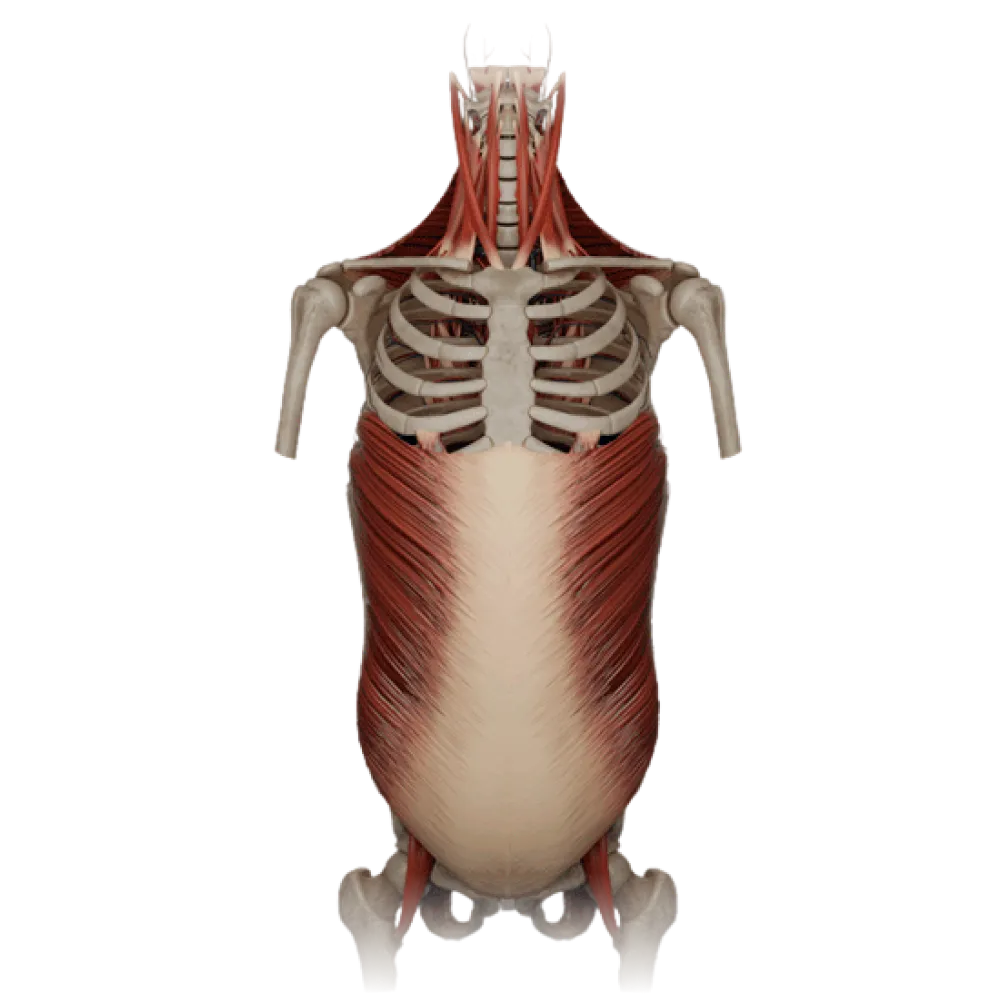
Test on the anatomy of spinal joints
Check your knowledge of spinal joint anatomy. The test covers vertebral joints, syndesmoses, their blood supply, innervation, and muscles.
1. Which ligament prevents excessive extension of the vertebral column?
-
Anterior longitudinal ligament
The anterior longitudinal ligament runs along the anterior surfaces of the vertebral bodies and discs, limiting excessive extension (hyperextension) of the spine.
-
Posterior longitudinal ligament
The anterior longitudinal ligament runs along the anterior surfaces of the vertebral bodies and discs, limiting excessive extension (hyperextension) of the spine.
-
Ligamenta flava
The anterior longitudinal ligament runs along the anterior surfaces of the vertebral bodies and discs, limiting excessive extension (hyperextension) of the spine.
-
Interspinal ligament
The anterior longitudinal ligament runs along the anterior surfaces of the vertebral bodies and discs, limiting excessive extension (hyperextension) of the spine.
-
I find it difficult to answer
The anterior longitudinal ligament runs along the anterior surfaces of the vertebral bodies and discs, limiting excessive extension (hyperextension) of the spine.
2. What type of tissue predominates in the ligamenta flava, which connect the arches of adjacent vertebrae?
-
Collagen fibers
The ligamenta flava primarily consist of elastic connective tissue, accounting for their color and aiding in extension after flexion.
-
Elastic fibers
The ligamenta flava primarily consist of elastic connective tissue, accounting for their color and aiding in extension after flexion.
-
Hyaline cartilage
The ligamenta flava primarily consist of elastic connective tissue, accounting for their color and aiding in extension after flexion.
-
Reticular fibers
The ligamenta flava primarily consist of elastic connective tissue, accounting for their color and aiding in extension after flexion.
-
I find it difficult to answer
The ligamenta flava primarily consist of elastic connective tissue, accounting for their color and aiding in extension after flexion.
3. What structure makes up the peripheral part of the intervertebral disc?
-
Nucleus pulposus
An intervertebral disc consists of a centrally located nucleus pulposus and a surrounding anulus fibrosus, composed of fibrocartilage.
-
Anulus fibrosus
An intervertebral disc consists of a centrally located nucleus pulposus and a surrounding anulus fibrosus, composed of fibrocartilage.
-
Hyaline plate
An intervertebral disc consists of a centrally located nucleus pulposus and a surrounding anulus fibrosus, composed of fibrocartilage.
-
Intervertebral symphysis
An intervertebral disc consists of a centrally located nucleus pulposus and a surrounding anulus fibrosus, composed of fibrocartilage.
-
I find it difficult to answer
An intervertebral disc consists of a centrally located nucleus pulposus and a surrounding anulus fibrosus, composed of fibrocartilage.
4. To which joint type based on the shape of articular surfaces do zygapophyseal (facet) joints belong?
-
Cylindrical
Zygapophyseal joints are planar by the shape of their articular surfaces, allowing for small-amplitude sliding movements.
-
Ball-and-socket
Zygapophyseal joints are planar by the shape of their articular surfaces, allowing for small-amplitude sliding movements.
-
Plane
Zygapophyseal joints are planar by the shape of their articular surfaces, allowing for small-amplitude sliding movements.
-
Hinge
Zygapophyseal joints are planar by the shape of their articular surfaces, allowing for small-amplitude sliding movements.
-
I find it difficult to answer
Zygapophyseal joints are planar by the shape of their articular surfaces, allowing for small-amplitude sliding movements.
5. Which bundles form the cruciate ligament of the atlas?
-
Alar ligaments and apical dental ligament
The cruciate ligament of the atlas is formed by the transverse atlantal ligament (horizontal part) and longitudinal bundles (vertical part), extending to the occipital bone and the axis.
-
Tectorial membrane and nuchal ligament
The cruciate ligament of the atlas is formed by the transverse atlantal ligament (horizontal part) and longitudinal bundles (vertical part), extending to the occipital bone and the axis.
-
Posterior atlantooccipital membrane and longitudinal bundles
The cruciate ligament of the atlas is formed by the transverse atlantal ligament (horizontal part) and longitudinal bundles (vertical part), extending to the occipital bone and the axis.
-
Transverse atlantal ligament and longitudinal bundles
The cruciate ligament of the atlas is formed by the transverse atlantal ligament (horizontal part) and longitudinal bundles (vertical part), extending to the occipital bone and the axis.
-
I find it difficult to answer
The cruciate ligament of the atlas is formed by the transverse atlantal ligament (horizontal part) and longitudinal bundles (vertical part), extending to the occipital bone and the axis.
6. What ligament is analogous to the posterior longitudinal ligament in the sacrococcygeal joint?
-
Ventral sacrococcygeal ligament
The deep dorsal sacrococcygeal ligament is a direct continuation of the posterior longitudinal ligament at the sacrococcygeal junction.
-
Superficial dorsal sacrococcygeal ligament
The deep dorsal sacrococcygeal ligament is a direct continuation of the posterior longitudinal ligament at the sacrococcygeal junction.
-
Deep dorsal sacrococcygeal ligament
The deep dorsal sacrococcygeal ligament is a direct continuation of the posterior longitudinal ligament at the sacrococcygeal junction.
-
Lateral sacrococcygeal ligament
The deep dorsal sacrococcygeal ligament is a direct continuation of the posterior longitudinal ligament at the sacrococcygeal junction.
-
I find it difficult to answer
The deep dorsal sacrococcygeal ligament is a direct continuation of the posterior longitudinal ligament at the sacrococcygeal junction.
7. Which vessel primarily supplies the vertebrae and their joints in the cervical region?
-
Vertebral artery
Blood supply to the cervical vertebrae and their joints is primarily by the branches of vertebral arteries passing through transverse foramina.
-
Thyrocervical trunk
Blood supply to the cervical vertebrae and their joints is primarily by the branches of vertebral arteries passing through transverse foramina.
-
External carotid artery
Blood supply to the cervical vertebrae and their joints is primarily by the branches of vertebral arteries passing through transverse foramina.
-
Internal carotid artery
Blood supply to the cervical vertebrae and their joints is primarily by the branches of vertebral arteries passing through transverse foramina.
-
I find it difficult to answer
Blood supply to the cervical vertebrae and their joints is primarily by the branches of vertebral arteries passing through transverse foramina.
8. Which nerve branches innervate the capsules of zygapophyseal (facet) joints?
-
Ventral branches of spinal nerves
Innervation of the zygapophyseal (facet) joint capsules is provided by the medial branches of the dorsal (posterior) branches of spinal nerves.
-
Meningeal branches of spinal nerves
Innervation of the zygapophyseal (facet) joint capsules is provided by the medial branches of the dorsal (posterior) branches of spinal nerves.
-
Sympathetic trunks
Innervation of the zygapophyseal (facet) joint capsules is provided by the medial branches of the dorsal (posterior) branches of spinal nerves.
-
Dorsal branches of spinal nerves
Innervation of the zygapophyseal (facet) joint capsules is provided by the medial branches of the dorsal (posterior) branches of spinal nerves.
-
I find it difficult to answer
Innervation of the zygapophyseal (facet) joint capsules is provided by the medial branches of the dorsal (posterior) branches of spinal nerves.
9. Which movement is IMPOSSIBLE at the atlantooccipital joint?
-
Head flexion (nodding)
The atlantooccipital joint is an ellipsoid biaxial joint; flexion/extension and lateral tilts are possible, but rotation is impossible.
-
Head rotation around the vertical axis
The atlantooccipital joint is an ellipsoid biaxial joint; flexion/extension and lateral tilts are possible, but rotation is impossible.
-
Head extension
The atlantooccipital joint is an ellipsoid biaxial joint; flexion/extension and lateral tilts are possible, but rotation is impossible.
-
Head lateral tilt
The atlantooccipital joint is an ellipsoid biaxial joint; flexion/extension and lateral tilts are possible, but rotation is impossible.
-
I find it difficult to answer
The atlantooccipital joint is an ellipsoid biaxial joint; flexion/extension and lateral tilts are possible, but rotation is impossible.
10. Which muscle extends the vertebral column and is a powerful stabilizer when contracted bilaterally?
-
Quadratus lumborum muscle
The erector spinae muscle is the most powerful extensor and stabilizer of the vertebral column when contracted bilaterally.
-
Psoas major
The erector spinae muscle is the most powerful extensor and stabilizer of the vertebral column when contracted bilaterally.
-
Erector spinae
The erector spinae muscle is the most powerful extensor and stabilizer of the vertebral column when contracted bilaterally.
-
External oblique muscle of the abdomen
The erector spinae muscle is the most powerful extensor and stabilizer of the vertebral column when contracted bilaterally.
-
I find it difficult to answer
The erector spinae muscle is the most powerful extensor and stabilizer of the vertebral column when contracted bilaterally.
11. Into which structure does the supraspinous ligament transition at the cervical spine?
-
Tectorial membrane
In the cervical region, the supraspinous ligament thickens significantly, detaches sagittally from the spinous processes, and is termed the nuchal ligament.
-
Nuchal ligament
In the cervical region, the supraspinous ligament thickens significantly, detaches sagittally from the spinous processes, and is termed the nuchal ligament.
-
Posterior atlantooccipital membrane
In the cervical region, the supraspinous ligament thickens significantly, detaches sagittally from the spinous processes, and is termed the nuchal ligament.
-
Ligamenta flava
In the cervical region, the supraspinous ligament thickens significantly, detaches sagittally from the spinous processes, and is termed the nuchal ligament.
-
I find it difficult to answer
In the cervical region, the supraspinous ligament thickens significantly, detaches sagittally from the spinous processes, and is termed the nuchal ligament.
12. Between which formations is the median atlantoaxial joint formed?
-
Lateral masses of the atlas and occipital bone condyles
The median atlantoaxial joint is formed by the articular facet of the anterior arch of the atlas, the transverse ligament of the atlas, and the articular surfaces of the dens of the axis.
-
Articular processes of the atlas and axis
The median atlantoaxial joint is formed by the articular facet of the anterior arch of the atlas, the transverse ligament of the atlas, and the articular surfaces of the dens of the axis.
-
Posterior arch of the atlas and the spinous process of the axis
The median atlantoaxial joint is formed by the articular facet of the anterior arch of the atlas, the transverse ligament of the atlas, and the articular surfaces of the dens of the axis.
-
Anterior arch of the atlas, transverse ligament, and dens of the axis
The median atlantoaxial joint is formed by the articular facet of the anterior arch of the atlas, the transverse ligament of the atlas, and the articular surfaces of the dens of the axis.
-
I find it difficult to answer
The median atlantoaxial joint is formed by the articular facet of the anterior arch of the atlas, the transverse ligament of the atlas, and the articular surfaces of the dens of the axis.
13. In which vertebral region can unco-vertebral joints (Luschka's joints) be found?
-
Cervical
Uncinate processes of vertebral bodies and the body of the vertebrae above form unco-vertebral (hook-like) joints in the cervical region.
-
Thoracic
Uncinate processes of vertebral bodies and the body of the vertebrae above form unco-vertebral (hook-like) joints in the cervical region.
-
Lumbar
Uncinate processes of vertebral bodies and the body of the vertebrae above form unco-vertebral (hook-like) joints in the cervical region.
-
Sacral
Uncinate processes of vertebral bodies and the body of the vertebrae above form unco-vertebral (hook-like) joints in the cervical region.
-
I find it difficult to answer
Uncinate processes of vertebral bodies and the body of the vertebrae above form unco-vertebral (hook-like) joints in the cervical region.
14. In which plane are the articular surfaces of zygapophyseal joints predominantly located in the lumbar region?
-
Frontal
In the lumbar region, zygapophyseal joint surfaces are predominantly in the sagittal plane, facilitating flexion and extension.
-
Sagittal
In the lumbar region, zygapophyseal joint surfaces are predominantly in the sagittal plane, facilitating flexion and extension.
-
Horizontal
In the lumbar region, zygapophyseal joint surfaces are predominantly in the sagittal plane, facilitating flexion and extension.
-
Oblique
In the lumbar region, zygapophyseal joint surfaces are predominantly in the sagittal plane, facilitating flexion and extension.
-
I find it difficult to answer
In the lumbar region, zygapophyseal joint surfaces are predominantly in the sagittal plane, facilitating flexion and extension.
15. Which vertebral connection serves as an example of a persistent synchondrosis until a certain age, then transitions to synostosis?
-
Sacrococcygeal joint
Connections between the five sacral vertebrae in children are represented by cartilage (synchondrosis), which ossifies after 18-25 years, forming synostosis (sacrum).
-
Intervertebral symphysis
Connections between the five sacral vertebrae in children are represented by cartilage (synchondrosis), which ossifies after 18-25 years, forming synostosis (sacrum).
-
Connection between sacral vertebrae in children
Connections between the five sacral vertebrae in children are represented by cartilage (synchondrosis), which ossifies after 18-25 years, forming synostosis (sacrum).
-
Zygapophyseal joints
Connections between the five sacral vertebrae in children are represented by cartilage (synchondrosis), which ossifies after 18-25 years, forming synostosis (sacrum).
-
I find it difficult to answer
Connections between the five sacral vertebrae in children are represented by cartilage (synchondrosis), which ossifies after 18-25 years, forming synostosis (sacrum).
16. In which part of the vertebral column are intertransverse ligaments best developed?
-
Lumbar
Intertransverse ligaments are most prominent in the lumbar region, stretched between the robust transverse (costal) processes of the lumbar vertebrae.
-
Cervical
Intertransverse ligaments are most prominent in the lumbar region, stretched between the robust transverse (costal) processes of the lumbar vertebrae.
-
Thoracic
Intertransverse ligaments are most prominent in the lumbar region, stretched between the robust transverse (costal) processes of the lumbar vertebrae.
-
Coccygeal
Intertransverse ligaments are most prominent in the lumbar region, stretched between the robust transverse (costal) processes of the lumbar vertebrae.
-
I find it difficult to answer
Intertransverse ligaments are most prominent in the lumbar region, stretched between the robust transverse (costal) processes of the lumbar vertebrae.
17. Which arteries provide blood supply to the lumbar vertebrae and their joints?
-
Posterior intercostal arteries
Blood supply to the lumbar spine is provided by paired lumbar arteries branching from the abdominal aorta.
-
Psoas artery (iliolumbar artery)
Blood supply to the lumbar spine is provided by paired lumbar arteries branching from the abdominal aorta.
-
Superior epigastric artery
Blood supply to the lumbar spine is provided by paired lumbar arteries branching from the abdominal aorta.
-
Lumbar arteries
Blood supply to the lumbar spine is provided by paired lumbar arteries branching from the abdominal aorta.
-
I find it difficult to answer
Blood supply to the lumbar spine is provided by paired lumbar arteries branching from the abdominal aorta.
18. Which ligament of the vertebral column is continued as the tectorial membrane (membrana tectoria) upward?
-
Anterior longitudinal ligament
The tectorial membrane (membrana tectoria) is a broad fibrous band representing the cranial continuation of the posterior longitudinal ligament.
-
Ligamenta flava
The tectorial membrane (membrana tectoria) is a broad fibrous band representing the cranial continuation of the posterior longitudinal ligament.
-
Posterior longitudinal ligament
The tectorial membrane (membrana tectoria) is a broad fibrous band representing the cranial continuation of the posterior longitudinal ligament.
-
Nuchal ligament
The tectorial membrane (membrana tectoria) is a broad fibrous band representing the cranial continuation of the posterior longitudinal ligament.
-
I find it difficult to answer
The tectorial membrane (membrana tectoria) is a broad fibrous band representing the cranial continuation of the posterior longitudinal ligament.
19. With which structures of the thoracic vertebrae do the heads of ribs (II to X) articulate?
-
With transverse processes
The heads of ribs II-X articulate with the costal facets (demifacets) of two adjacent thoracic vertebrae and the intervertebral disc between them.
-
With upper and lower costal facets of adjacent vertebrae and the disc
The heads of ribs II-X articulate with the costal facets (demifacets) of two adjacent thoracic vertebrae and the intervertebral disc between them.
-
Only with the body of one corresponding vertebra.
The heads of ribs II-X articulate with the costal facets (demifacets) of two adjacent thoracic vertebrae and the intervertebral disc between them.
-
With the spinous processes.
The heads of ribs II-X articulate with the costal facets (demifacets) of two adjacent thoracic vertebrae and the intervertebral disc between them.
-
I find it difficult to answer
The heads of ribs II-X articulate with the costal facets (demifacets) of two adjacent thoracic vertebrae and the intervertebral disc between them.
20. Which of the following muscles belongs to the transversospinal muscles, stabilizing vertebral connections?
-
Multifidus muscles
The multifidus muscle (m. multifidus) spans 2-4 vertebrae and belongs to the deep layer of back muscles (transversospinal group), stabilizing the connections.
-
Iliocostalis muscles
The multifidus muscle (m. multifidus) spans 2-4 vertebrae and belongs to the deep layer of back muscles (transversospinal group), stabilizing the connections.
-
Longissimus muscles
The multifidus muscle (m. multifidus) spans 2-4 vertebrae and belongs to the deep layer of back muscles (transversospinal group), stabilizing the connections.
-
Spinalis muscles
The multifidus muscle (m. multifidus) spans 2-4 vertebrae and belongs to the deep layer of back muscles (transversospinal group), stabilizing the connections.
-
I find it difficult to answer
The multifidus muscle (m. multifidus) spans 2-4 vertebrae and belongs to the deep layer of back muscles (transversospinal group), stabilizing the connections.
Retake this quiz?
Your current progress will be reset.