1/20

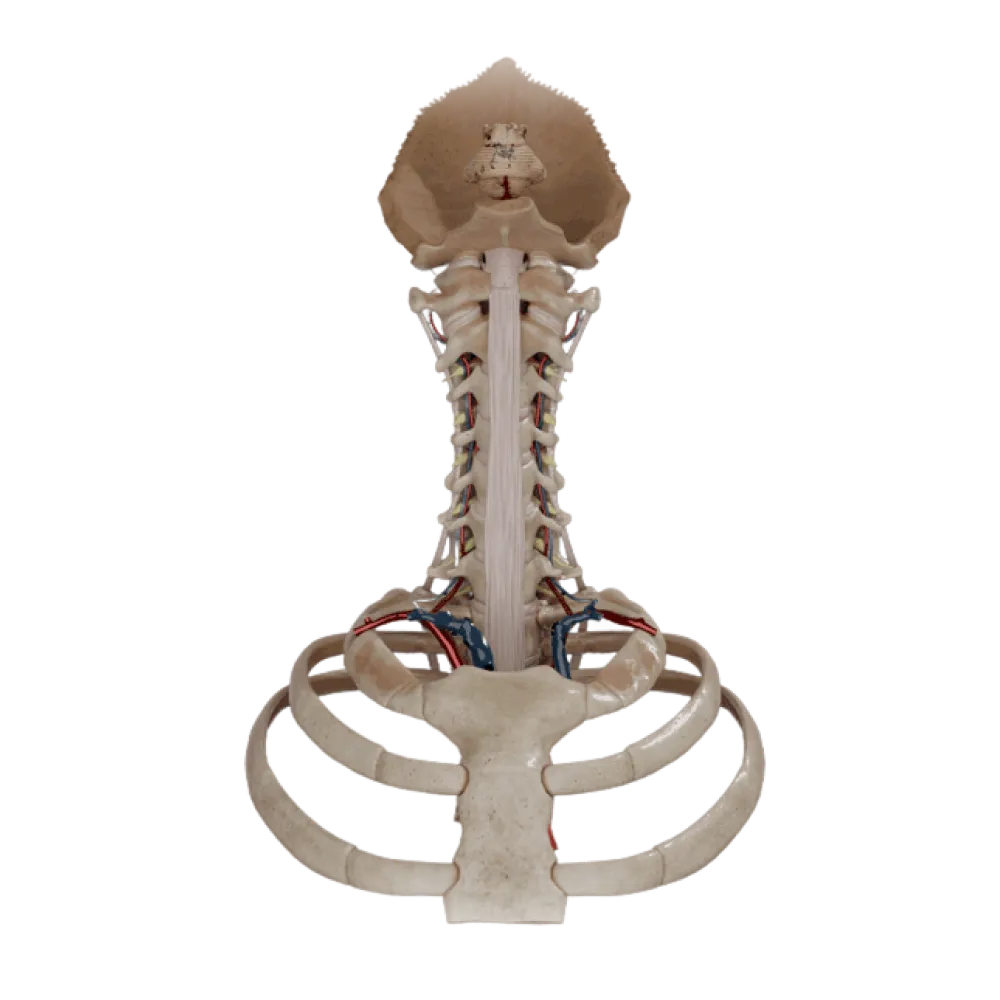
Back vasculature anatomy test
Assess your back vasculature anatomy knowledge. The test evaluates arterial blood supply, venous drainage, and topography of the vessels in this region.
1. Which artery provides the main blood supply to the latissimus dorsi muscle?
-
Thoracodorsal artery
The thoracodorsal artery is a continuation of the subscapular artery and supplies the latissimus dorsi muscle.
-
Dorsal scapular artery
The thoracodorsal artery is a continuation of the subscapular artery and supplies the latissimus dorsi muscle.
-
Posterior circumflex humeral artery
The thoracodorsal artery is a continuation of the subscapular artery and supplies the latissimus dorsi muscle.
-
Suprascapular artery
The thoracodorsal artery is a continuation of the subscapular artery and supplies the latissimus dorsi muscle.
-
I find it difficult to answer
The thoracodorsal artery is a continuation of the subscapular artery and supplies the latissimus dorsi muscle.
2. Which vessels pass through the intervertebral foramina to supply the spinal cord?
-
Posterior intercostal arteries
Spinal branches arise from various arteries and penetrate through intervertebral foramina into the vertebral canal.
-
Lumbar arteries
Spinal branches arise from various arteries and penetrate through intervertebral foramina into the vertebral canal.
-
Spinal branches
Spinal branches arise from various arteries and penetrate through intervertebral foramina into the vertebral canal.
-
Subcostal arteries
Spinal branches arise from various arteries and penetrate through intervertebral foramina into the vertebral canal.
-
I find it difficult to answer
Spinal branches arise from various arteries and penetrate through intervertebral foramina into the vertebral canal.
3. Which venous structure forms a plexus within the vertebral canal?
-
External vertebral venous plexus
Internal vertebral venous plexuses are located in the epidural space of the vertebral canal.
-
Internal vertebral venous plexus
Internal vertebral venous plexuses are located in the epidural space of the vertebral canal.
-
Basilar plexus
Internal vertebral venous plexuses are located in the epidural space of the vertebral canal.
-
Azygos vein
Internal vertebral venous plexuses are located in the epidural space of the vertebral canal.
-
I find it difficult to answer
Internal vertebral venous plexuses are located in the epidural space of the vertebral canal.
4. From which structure do the posterior intercostal arteries, supplying the back muscles, primarily originate?
-
Internal thoracic artery
Posterior intercostal arteries (from the third onward) arise directly from the thoracic segment of the descending aorta.
-
Subclavian artery
Posterior intercostal arteries (from the third onward) arise directly from the thoracic segment of the descending aorta.
-
Thoracic aorta
Posterior intercostal arteries (from the third onward) arise directly from the thoracic segment of the descending aorta.
-
Axillary artery
Posterior intercostal arteries (from the third onward) arise directly from the thoracic segment of the descending aorta.
-
I find it difficult to answer
Posterior intercostal arteries (from the third onward) arise directly from the thoracic segment of the descending aorta.
5. At which level does the great radicular artery (artery of Adamkiewicz) most commonly originate?
-
On the right at the level of the cervical vertebrae
The artery of Adamkiewicz usually originates on the left at the level of T8-L2 and is a major source of blood supply to the lower segments of the spinal cord.
-
On the left at the level of the lower thoracic or upper lumbar vertebrae
The artery of Adamkiewicz usually originates on the left at the level of T8-L2 and is a major source of blood supply to the lower segments of the spinal cord.
-
On the right at the level of the sacrum
The artery of Adamkiewicz usually originates on the left at the level of T8-L2 and is a major source of blood supply to the lower segments of the spinal cord.
-
On the left at the level of the upper thoracic vertebrae
The artery of Adamkiewicz usually originates on the left at the level of T8-L2 and is a major source of blood supply to the lower segments of the spinal cord.
-
I find it difficult to answer
The artery of Adamkiewicz usually originates on the left at the level of T8-L2 and is a major source of blood supply to the lower segments of the spinal cord.
6. Which back muscle is predominantly supplied by the superficial cervical artery (a. cervicalis superficialis)?
-
Latissimus dorsi muscle
The superficial cervical artery supplies the superior part of the trapezius muscle and adjacent structures.
-
Rhomboid muscle
The superficial cervical artery supplies the superior part of the trapezius muscle and adjacent structures.
-
Trapezius muscle
The superficial cervical artery supplies the superior part of the trapezius muscle and adjacent structures.
-
Levator scapulae.
The superficial cervical artery supplies the superior part of the trapezius muscle and adjacent structures.
-
I find it difficult to answer
The superficial cervical artery supplies the superior part of the trapezius muscle and adjacent structures.
7. Where do the dorsal branches of the lumbar arteries pass?
-
In front of the quadratus lumborum muscle
The dorsal branches of the lumbar arteries extend backward between the transverse processes to supply the deep muscles and skin of the back.
-
Between the transverse processes of the lumbar vertebrae
The dorsal branches of the lumbar arteries extend backward between the transverse processes to supply the deep muscles and skin of the back.
-
Through the intervertebral foramina into the vertebral canal
The dorsal branches of the lumbar arteries extend backward between the transverse processes to supply the deep muscles and skin of the back.
-
Along the anterior surfaces of the vertebral bodies
The dorsal branches of the lumbar arteries extend backward between the transverse processes to supply the deep muscles and skin of the back.
-
I find it difficult to answer
The dorsal branches of the lumbar arteries extend backward between the transverse processes to supply the deep muscles and skin of the back.
8. Which vein collects blood from the external vertebral venous plexuses in the cervical region?
-
Occipital vein
The vertebral vein is formed from plexuses around the occipital bone and collects blood from the vertebral plexuses of the neck.
-
Deep cervical vein
The vertebral vein is formed from plexuses around the occipital bone and collects blood from the vertebral plexuses of the neck.
-
Vertebral vein
The vertebral vein is formed from plexuses around the occipital bone and collects blood from the vertebral plexuses of the neck.
-
External jugular vein
The vertebral vein is formed from plexuses around the occipital bone and collects blood from the vertebral plexuses of the neck.
-
I find it difficult to answer
The vertebral vein is formed from plexuses around the occipital bone and collects blood from the vertebral plexuses of the neck.
9. Into which vein do the right posterior intercostal veins primarily drain?
-
Azygos vein
The right posterior intercostal veins (from 4 to 11) drain directly into the azygos vein (v. azygos).
-
Hemiazygos vein
The right posterior intercostal veins (from 4 to 11) drain directly into the azygos vein (v. azygos).
-
Superior vena cava
The right posterior intercostal veins (from 4 to 11) drain directly into the azygos vein (v. azygos).
-
Inferior vena cava
The right posterior intercostal veins (from 4 to 11) drain directly into the azygos vein (v. azygos).
-
I find it difficult to answer
The right posterior intercostal veins (from 4 to 11) drain directly into the azygos vein (v. azygos).
10. Deeper than which muscles does the dorsal scapular artery (a. dorsalis scapulae) typically pass?
-
Rhomboid muscles
The dorsal scapular artery descends along the medial border of the scapula beneath the rhomboid muscles, supplying them.
-
Trapezius muscle
The dorsal scapular artery descends along the medial border of the scapula beneath the rhomboid muscles, supplying them.
-
Latissimus dorsi muscle
The dorsal scapular artery descends along the medial border of the scapula beneath the rhomboid muscles, supplying them.
-
Supraspinatus muscle
The dorsal scapular artery descends along the medial border of the scapula beneath the rhomboid muscles, supplying them.
-
I find it difficult to answer
The dorsal scapular artery descends along the medial border of the scapula beneath the rhomboid muscles, supplying them.
11. Which structure is directly supplied by the anterior and posterior spinal arteries?
-
Brain
The anterior and posterior spinal arteries descend along the spinal cord forming its main longitudinal arterial tract.
-
Spinal cord
The anterior and posterior spinal arteries descend along the spinal cord forming its main longitudinal arterial tract.
-
Spinal ganglia
The anterior and posterior spinal arteries descend along the spinal cord forming its main longitudinal arterial tract.
-
Dura mater
The anterior and posterior spinal arteries descend along the spinal cord forming its main longitudinal arterial tract.
-
I find it difficult to answer
The anterior and posterior spinal arteries descend along the spinal cord forming its main longitudinal arterial tract.
12. Which trunk does the deep cervical artery (a. cervicalis profunda), supplying the deep muscles of the neck and back, branch from?
-
Thyrocervical trunk
The deep cervical artery branches from the costocervical trunk (truncus costocervicalis) of the subclavian artery.
-
Costocervical trunk
The deep cervical artery branches from the costocervical trunk (truncus costocervicalis) of the subclavian artery.
-
Transverse cervical artery
The deep cervical artery branches from the costocervical trunk (truncus costocervicalis) of the subclavian artery.
-
Ascending cervical artery
The deep cervical artery branches from the costocervical trunk (truncus costocervicalis) of the subclavian artery.
-
I find it difficult to answer
The deep cervical artery branches from the costocervical trunk (truncus costocervicalis) of the subclavian artery.
13. How many anterior spinal arteries are normally present in humans?
-
Four.
The anterior spinal artery (a. spinalis anterior) is an unpaired vessel formed from the fusion of branches of vertebral arteries.
-
Three.
The anterior spinal artery (a. spinalis anterior) is an unpaired vessel formed from the fusion of branches of vertebral arteries.
-
Two.
The anterior spinal artery (a. spinalis anterior) is an unpaired vessel formed from the fusion of branches of vertebral arteries.
-
One.
The anterior spinal artery (a. spinalis anterior) is an unpaired vessel formed from the fusion of branches of vertebral arteries.
-
I find it difficult to answer
The anterior spinal artery (a. spinalis anterior) is an unpaired vessel formed from the fusion of branches of vertebral arteries.
14. Into which plexus do the basivertebral veins drain the venous blood from the vertebral bodies?
-
External vertebral plexus
Basivertebral veins exit on the posterior surface of the vertebral bodies and drain into the anterior internal vertebral venous plexus.
-
Anterior internal vertebral venous plexus
Basivertebral veins exit on the posterior surface of the vertebral bodies and drain into the anterior internal vertebral venous plexus.
-
Posterior internal vertebral venous plexus
Basivertebral veins exit on the posterior surface of the vertebral bodies and drain into the anterior internal vertebral venous plexus.
-
Intervertebral veins
Basivertebral veins exit on the posterior surface of the vertebral bodies and drain into the anterior internal vertebral venous plexus.
-
I find it difficult to answer
Basivertebral veins exit on the posterior surface of the vertebral bodies and drain into the anterior internal vertebral venous plexus.
15. What supplies the muscle that straightens the spine in the lumbar region?
-
Ventral branches of lumbar arteries
The dorsal branches (rami dorsales) of the lumbar arteries supply the deep muscles of the back in the lumbar region.
-
Dorsal branches of lumbar arteries
The dorsal branches (rami dorsales) of the lumbar arteries supply the deep muscles of the back in the lumbar region.
-
Psoas artery (iliolumbar artery)
The dorsal branches (rami dorsales) of the lumbar arteries supply the deep muscles of the back in the lumbar region.
-
Median sacral artery
The dorsal branches (rami dorsales) of the lumbar arteries supply the deep muscles of the back in the lumbar region.
-
I find it difficult to answer
The dorsal branches (rami dorsales) of the lumbar arteries supply the deep muscles of the back in the lumbar region.
16. Where does blood from the posterior internal vertebral venous plexus drain at the level of the intervertebral foramina?
-
Basilar plexus
The blood from the internal vertebral plexuses drains through the intervertebral veins (vv. intervertebrales), exiting through the corresponding foramina.
-
Occipital sinus
The blood from the internal vertebral plexuses drains through the intervertebral veins (vv. intervertebrales), exiting through the corresponding foramina.
-
Intervertebral veins
The blood from the internal vertebral plexuses drains through the intervertebral veins (vv. intervertebrales), exiting through the corresponding foramina.
-
Azygos vein
The blood from the internal vertebral plexuses drains through the intervertebral veins (vv. intervertebrales), exiting through the corresponding foramina.
-
I find it difficult to answer
The blood from the internal vertebral plexuses drains through the intervertebral veins (vv. intervertebrales), exiting through the corresponding foramina.
17. The deep branch of the transverse cervical artery (a. transversa cervicis) is also known by the name:
-
Suprascapular artery
The deep branch of the transverse cervical artery functionally and topographically often corresponds to the dorsal scapular artery.
-
Ascending cervical artery
The deep branch of the transverse cervical artery functionally and topographically often corresponds to the dorsal scapular artery.
-
Deep cervical artery
The deep branch of the transverse cervical artery functionally and topographically often corresponds to the dorsal scapular artery.
-
Dorsal scapular artery
The deep branch of the transverse cervical artery functionally and topographically often corresponds to the dorsal scapular artery.
-
I find it difficult to answer
The deep branch of the transverse cervical artery functionally and topographically often corresponds to the dorsal scapular artery.
18. Along the inferior border of which rib does the subcostal artery (a. subcostalis) pass?
-
10th rib
The subcostal artery is analogous to the posterior intercostal arteries and passes under the lower edge of the 12th rib.
-
11th rib
The subcostal artery is analogous to the posterior intercostal arteries and passes under the lower edge of the 12th rib.
-
12th rib
The subcostal artery is analogous to the posterior intercostal arteries and passes under the lower edge of the 12th rib.
-
9th rib
The subcostal artery is analogous to the posterior intercostal arteries and passes under the lower edge of the 12th rib.
-
I find it difficult to answer
The subcostal artery is analogous to the posterior intercostal arteries and passes under the lower edge of the 12th rib.
19. Which arteries give off dorsal branches to the skin and muscles of the back in the sacral area?
-
Lateral and median sacral arteries
The dorsal branches of the sacral arteries exit through the dorsal sacral foramina to supply the soft tissues of the sacral region of the back.
-
Lumbar arteries
The dorsal branches of the sacral arteries exit through the dorsal sacral foramina to supply the soft tissues of the sacral region of the back.
-
Psoas artery (iliolumbar artery)
The dorsal branches of the sacral arteries exit through the dorsal sacral foramina to supply the soft tissues of the sacral region of the back.
-
Inferior gluteal artery
The dorsal branches of the sacral arteries exit through the dorsal sacral foramina to supply the soft tissues of the sacral region of the back.
-
I find it difficult to answer
The dorsal branches of the sacral arteries exit through the dorsal sacral foramina to supply the soft tissues of the sacral region of the back.
20. What is the main source of blood supply to the meninges of the spinal cord?
-
Radicular arteries
The meningeal branches (rami meningei), which originate from the spinal branches, provide vascularization to the dura mater and other meninges of the spinal cord.
-
Meningeal branches of spinal branches
The meningeal branches (rami meningei), which originate from the spinal branches, provide vascularization to the dura mater and other meninges of the spinal cord.
-
Anterior spinal artery
The meningeal branches (rami meningei), which originate from the spinal branches, provide vascularization to the dura mater and other meninges of the spinal cord.
-
Central arteries
The meningeal branches (rami meningei), which originate from the spinal branches, provide vascularization to the dura mater and other meninges of the spinal cord.
-
I find it difficult to answer
The meningeal branches (rami meningei), which originate from the spinal branches, provide vascularization to the dura mater and other meninges of the spinal cord.
Retake this quiz?
Your current progress will be reset.