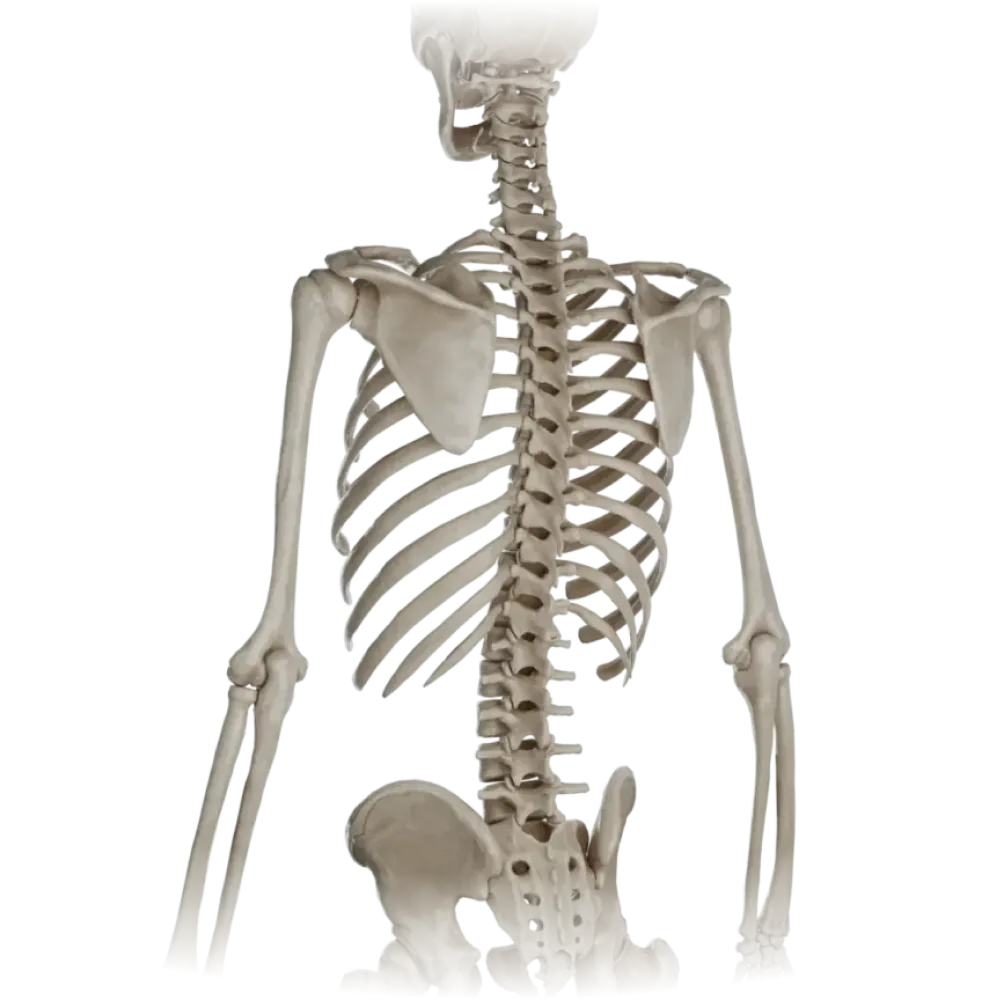
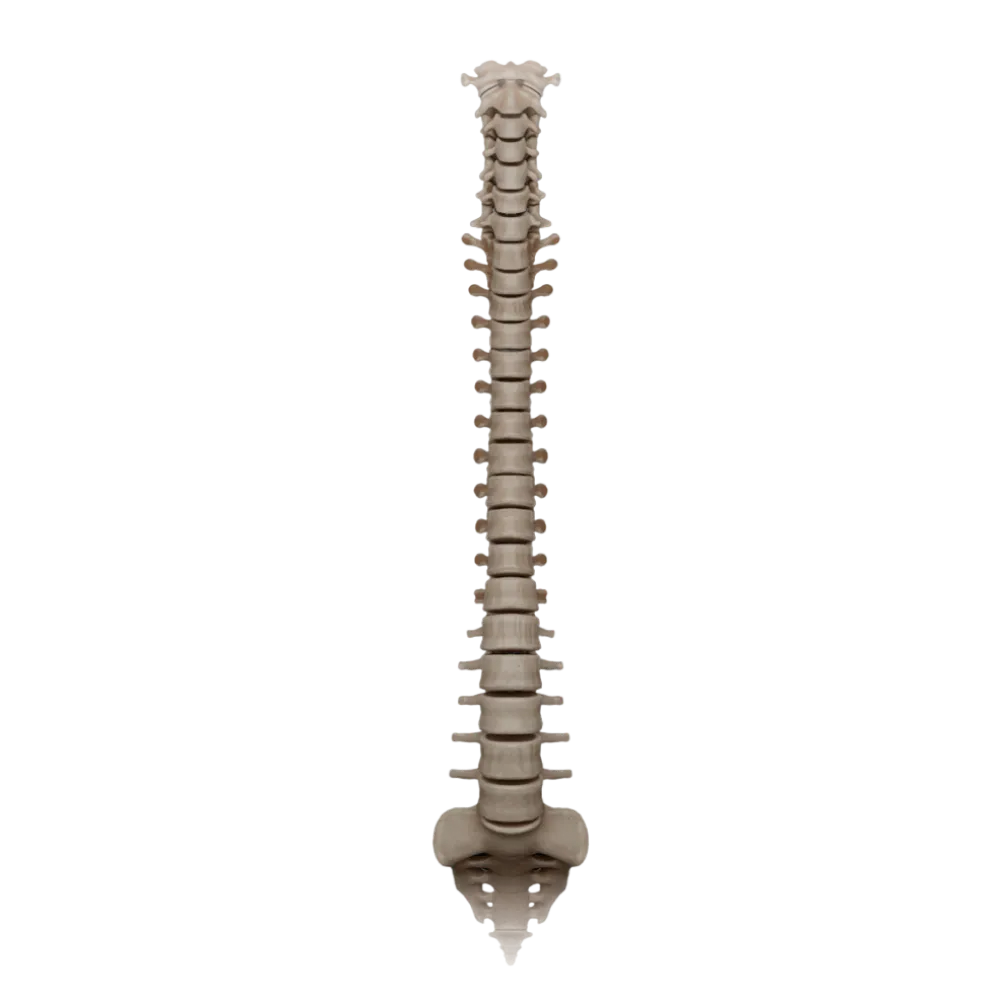
Vertebral column anatomy test.
Check your knowledge of vertebral column anatomy. The test covers the structure of vertebrae, their connections, the ligamentous apparatus, and curvatures.
1/20
bold
text
1. What structure passes through the transverse foramina of the C1-C6 cervical vertebrae?
-
Internal carotid artery
The vertebral artery and its accompanying vein pass through the transverse foramina of the C1-C6 cervical vertebrae.
-
Vertebral artery
The vertebral artery and its accompanying vein pass through the transverse foramina of the C1-C6 cervical vertebrae.
-
External jugular vein
The vertebral artery and its accompanying vein pass through the transverse foramina of the C1-C6 cervical vertebrae.
-
Accessory nerve
The vertebral artery and its accompanying vein pass through the transverse foramina of the C1-C6 cervical vertebrae.
-
I find it difficult to answer
The vertebral artery and its accompanying vein pass through the transverse foramina of the C1-C6 cervical vertebrae.
2. Which cervical vertebra lacks a body and a spinous process?
-
Atlas (C1 cervical vertebra)
The Atlas lacks a body and a spinous process, consisting of anterior and posterior arches connected by lateral masses.
-
Axial (C2 cervical vertebra)
The Atlas lacks a body and a spinous process, consisting of anterior and posterior arches connected by lateral masses.
-
Prominent (C7 cervical vertebra)
The Atlas lacks a body and a spinous process, consisting of anterior and posterior arches connected by lateral masses.
-
Sixth cervical vertebra (C6)
The Atlas lacks a body and a spinous process, consisting of anterior and posterior arches connected by lateral masses.
-
I find it difficult to answer
The Atlas lacks a body and a spinous process, consisting of anterior and posterior arches connected by lateral masses.
3. Which ligament connects the arches of adjacent vertebrae and has high elasticity?
-
Posterior longitudinal ligament
The ligamenta flava (ligamenta flava) connect the vertebral arches and are composed mainly of elastic connective tissue.
-
Interspinal ligament
The ligamenta flava (ligamenta flava) connect the vertebral arches and are composed mainly of elastic connective tissue.
-
Ligamenta flava
The ligamenta flava (ligamenta flava) connect the vertebral arches and are composed mainly of elastic connective tissue.
-
Supraspinal ligament
The ligamenta flava (ligamenta flava) connect the vertebral arches and are composed mainly of elastic connective tissue.
-
I find it difficult to answer
The ligamenta flava (ligamenta flava) connect the vertebral arches and are composed mainly of elastic connective tissue.
4. At what level of the vertebral column is the lower boundary of the spinal cord typically located in adults?
-
At the level of Th12-L1
In adults, the spinal cord typically ends with the conus medullaris at the level of the intervertebral disc between L1 and L2 vertebrae.
-
At the level of L1-L2
In adults, the spinal cord typically ends with the conus medullaris at the level of the intervertebral disc between L1 and L2 vertebrae.
-
At the level of L3-L4
In adults, the spinal cord typically ends with the conus medullaris at the level of the intervertebral disc between L1 and L2 vertebrae.
-
At the level of S1-S2
In adults, the spinal cord typically ends with the conus medullaris at the level of the intervertebral disc between L1 and L2 vertebrae.
-
I find it difficult to answer
In adults, the spinal cord typically ends with the conus medullaris at the level of the intervertebral disc between L1 and L2 vertebrae.
5. Which anatomical landmark is called the sacral promontory (promontorium)?
-
The anteriorly projecting edge of the body of the first sacral vertebra
The sacral promontory is the most anteriorly projecting point on the junction between the fifth lumbar and first sacral vertebrae.
-
Fusion site of the sacral spinous processes
The sacral promontory is the most anteriorly projecting point on the junction between the fifth lumbar and first sacral vertebrae.
-
Superior edge of the sacroiliac joint
The sacral promontory is the most anteriorly projecting point on the junction between the fifth lumbar and first sacral vertebrae.
-
The lowest point of the sacral apex
The sacral promontory is the most anteriorly projecting point on the junction between the fifth lumbar and first sacral vertebrae.
-
I find it difficult to answer
The sacral promontory is the most anteriorly projecting point on the junction between the fifth lumbar and first sacral vertebrae.
6. What structures form the anterior boundaries of the intervertebral foramen (foramen intervertebrale)?
-
By articular processes
The anterior boundary of the intervertebral foramen is formed by the posterior surfaces of adjacent vertebral bodies and the intervertebral disc.
-
By vertebral arches
The anterior boundary of the intervertebral foramen is formed by the posterior surfaces of adjacent vertebral bodies and the intervertebral disc.
-
By the ligamenta flava
The anterior boundary of the intervertebral foramen is formed by the posterior surfaces of adjacent vertebral bodies and the intervertebral disc.
-
By the bodies of adjacent vertebrae and the intervertebral disc
The anterior boundary of the intervertebral foramen is formed by the posterior surfaces of adjacent vertebral bodies and the intervertebral disc.
-
I find it difficult to answer
The anterior boundary of the intervertebral foramen is formed by the posterior surfaces of adjacent vertebral bodies and the intervertebral disc.
7. Which anatomical structure serves as a remnant of the spinal cord in the intervertebral disc?
-
Anulus fibrosus
The nucleus pulposus (nucleus pulposus), located in the center of the intervertebral disc, is a remnant of the embryonic notochord.
-
Nucleus pulposus
The nucleus pulposus (nucleus pulposus), located in the center of the intervertebral disc, is a remnant of the embryonic notochord.
-
Hyaline plate
The nucleus pulposus (nucleus pulposus), located in the center of the intervertebral disc, is a remnant of the embryonic notochord.
-
Posterior longitudinal ligament
The nucleus pulposus (nucleus pulposus), located in the center of the intervertebral disc, is a remnant of the embryonic notochord.
-
I find it difficult to answer
The nucleus pulposus (nucleus pulposus), located in the center of the intervertebral disc, is a remnant of the embryonic notochord.
8. In which plane are the articular surfaces of the superior and inferior articular processes of thoracic vertebrae predominantly located?
-
In the sagittal plane
In thoracic vertebrae, articular surfaces are predominantly located in the frontal plane, limiting flexion and extension.
-
In the horizontal plane
In thoracic vertebrae, articular surfaces are predominantly located in the frontal plane, limiting flexion and extension.
-
Obliquely at a 45-degree angle
In thoracic vertebrae, articular surfaces are predominantly located in the frontal plane, limiting flexion and extension.
-
In the frontal plane
In thoracic vertebrae, articular surfaces are predominantly located in the frontal plane, limiting flexion and extension.
-
I find it difficult to answer
In thoracic vertebrae, articular surfaces are predominantly located in the frontal plane, limiting flexion and extension.
9. Which thoracic vertebra features a full costal facet on the superior side and a demi-facet on the inferior side on the lateral surface of its body?
-
First thoracic vertebra (T1)
The first thoracic vertebra articulates with the first rib via a complete facet and with the second rib through an inferior demi-facet.
-
Tenth thoracic vertebra
The first thoracic vertebra articulates with the first rib via a complete facet and with the second rib through an inferior demi-facet.
-
Eleventh thoracic vertebra
The first thoracic vertebra articulates with the first rib via a complete facet and with the second rib through an inferior demi-facet.
-
Twelfth thoracic vertebra
The first thoracic vertebra articulates with the first rib via a complete facet and with the second rib through an inferior demi-facet.
-
I find it difficult to answer
The first thoracic vertebra articulates with the first rib via a complete facet and with the second rib through an inferior demi-facet.
10. What is the shape type of the median atlantoaxial joint (articulatio atlantoaxialis mediana)?
-
Ball-and-socket
The median atlantoaxial joint is formed by the dens of the C2 vertebra and the fovea of the atlas, and is cylindrical in shape, allowing rotation.
-
Flat
The median atlantoaxial joint is formed by the dens of the C2 vertebra and the fovea of the atlas, and is cylindrical in shape, allowing rotation.
-
Cylinder-shaped
The median atlantoaxial joint is formed by the dens of the C2 vertebra and the fovea of the atlas, and is cylindrical in shape, allowing rotation.
-
Ellipsoidal
The median atlantoaxial joint is formed by the dens of the C2 vertebra and the fovea of the atlas, and is cylindrical in shape, allowing rotation.
-
I find it difficult to answer
The median atlantoaxial joint is formed by the dens of the C2 vertebra and the fovea of the atlas, and is cylindrical in shape, allowing rotation.
11. Which ligament in the cervical region is a strong continuation of the supraspinous ligament and attaches to the external occipital crest?
-
Nuchal ligament
The nuchal ligament (lig. nuchae) is a fibrous-elastic plate extending from the spinous processes to the occipital bone.
-
Alar ligament.
The nuchal ligament (lig. nuchae) is a fibrous-elastic plate extending from the spinous processes to the occipital bone.
-
Cruciform ligament.
The nuchal ligament (lig. nuchae) is a fibrous-elastic plate extending from the spinous processes to the occipital bone.
-
Tectorial membrane
The nuchal ligament (lig. nuchae) is a fibrous-elastic plate extending from the spinous processes to the occipital bone.
-
I find it difficult to answer
The nuchal ligament (lig. nuchae) is a fibrous-elastic plate extending from the spinous processes to the occipital bone.
12. What structure does the costal facet of the transverse process of a thoracic vertebra articulate with (fovea costalis processus transversi)?
-
With the neck of the rib
The costal facet of the transverse process articulates with the articular surface of the rib tubercle (in ribs I-X).
-
With the head of the rib
The costal facet of the transverse process articulates with the articular surface of the rib tubercle (in ribs I-X).
-
With the body of the rib
The costal facet of the transverse process articulates with the articular surface of the rib tubercle (in ribs I-X).
-
With the tubercle of the rib
The costal facet of the transverse process articulates with the articular surface of the rib tubercle (in ribs I-X).
-
I find it difficult to answer
The costal facet of the transverse process articulates with the articular surface of the rib tubercle (in ribs I-X).
13. Which ligament directly holds the dens of the axis against the anterior arch of the atlas?
-
Transverse ligament of atlas.
The transverse ligament of the atlas runs behind the dens of the second vertebra, preventing it from displacing posteriorly into the vertebral canal.
-
Alar ligaments
The transverse ligament of the atlas runs behind the dens of the second vertebra, preventing it from displacing posteriorly into the vertebral canal.
-
Apical ligament of dens = Apical dental ligament
The transverse ligament of the atlas runs behind the dens of the second vertebra, preventing it from displacing posteriorly into the vertebral canal.
-
Tectorial membrane
The transverse ligament of the atlas runs behind the dens of the second vertebra, preventing it from displacing posteriorly into the vertebral canal.
-
I find it difficult to answer
The transverse ligament of the atlas runs behind the dens of the second vertebra, preventing it from displacing posteriorly into the vertebral canal.
14. Through which structures do the anterior branches of the sacral spinal nerves exit the sacral canal?
-
Median sacral crest
The anterior branches of the sacral spinal nerves exit onto the pelvic surface of the sacrum through the pelvic (anterior) sacral foramina.
-
Dorsal sacral foramina
The anterior branches of the sacral spinal nerves exit onto the pelvic surface of the sacrum through the pelvic (anterior) sacral foramina.
-
Pelvic sacral foramina
The anterior branches of the sacral spinal nerves exit onto the pelvic surface of the sacrum through the pelvic (anterior) sacral foramina.
-
Sacral hiatus
The anterior branches of the sacral spinal nerves exit onto the pelvic surface of the sacrum through the pelvic (anterior) sacral foramina.
-
I find it difficult to answer
The anterior branches of the sacral spinal nerves exit onto the pelvic surface of the sacrum through the pelvic (anterior) sacral foramina.
15. What part of a vertebra connects its body to the arch?
-
Spinous process
Pedicles of the vertebral arch (pediculi arcus vertebrae) emanate from the posterolateral surfaces of the body, forming the beginning of the arch.
-
Transverse process
Pedicles of the vertebral arch (pediculi arcus vertebrae) emanate from the posterolateral surfaces of the body, forming the beginning of the arch.
-
Pedicle of the vertebral arch
Pedicles of the vertebral arch (pediculi arcus vertebrae) emanate from the posterolateral surfaces of the body, forming the beginning of the arch.
-
Lamina of the vertebral arch
Pedicles of the vertebral arch (pediculi arcus vertebrae) emanate from the posterolateral surfaces of the body, forming the beginning of the arch.
-
I find it difficult to answer
Pedicles of the vertebral arch (pediculi arcus vertebrae) emanate from the posterolateral surfaces of the body, forming the beginning of the arch.
16. Which physiological curvature of the spine is characterized by posterior convexity?
-
Cervical lordosis
Kyphosis is a curvature of the spine directed posteriorly. Normally, it is present in the thoracic and sacral regions.
-
Thoracic kyphosis
Kyphosis is a curvature of the spine directed posteriorly. Normally, it is present in the thoracic and sacral regions.
-
Lumbar lordosis
Kyphosis is a curvature of the spine directed posteriorly. Normally, it is present in the thoracic and sacral regions.
-
Only the sacral curvature
Kyphosis is a curvature of the spine directed posteriorly. Normally, it is present in the thoracic and sacral regions.
-
I find it difficult to answer
Kyphosis is a curvature of the spine directed posteriorly. Normally, it is present in the thoracic and sacral regions.
17. Which ligament prevents excessive extension (hyperextension) of the vertebral column?
-
Posterior longitudinal ligament
The anterior longitudinal ligament extends along the anterior surface of the vertebral bodies and tightens during spinal extension.
-
Ligamenta flava
The anterior longitudinal ligament extends along the anterior surface of the vertebral bodies and tightens during spinal extension.
-
Interspinal ligament
The anterior longitudinal ligament extends along the anterior surface of the vertebral bodies and tightens during spinal extension.
-
Anterior longitudinal ligament
The anterior longitudinal ligament extends along the anterior surface of the vertebral bodies and tightens during spinal extension.
-
I find it difficult to answer
The anterior longitudinal ligament extends along the anterior surface of the vertebral bodies and tightens during spinal extension.
18. What forms the intermediate sacral crest (crista sacralis intermedia)?
-
By the fusion of spinous processes
The intermediate sacral crest is paired and is formed by the fusion of articular processes of the sacral vertebrae.
-
By the fusion of articular processes
The intermediate sacral crest is paired and is formed by the fusion of articular processes of the sacral vertebrae.
-
By the fusion of transverse processes
The intermediate sacral crest is paired and is formed by the fusion of articular processes of the sacral vertebrae.
-
By the fusion of vertebral bodies
The intermediate sacral crest is paired and is formed by the fusion of articular processes of the sacral vertebrae.
-
I find it difficult to answer
The intermediate sacral crest is paired and is formed by the fusion of articular processes of the sacral vertebrae.
19. What feature is characteristic of the spinous processes of most cervical vertebrae (C2-C6)?
-
They are massive and oriented horizontally
In typical cervical vertebrae (C2 to C6), the spinous processes are relatively short and bifurcated at the end (bifurcated).
-
They are imbricated over each other
In typical cervical vertebrae (C2 to C6), the spinous processes are relatively short and bifurcated at the end (bifurcated).
-
They are bifurcated at the end
In typical cervical vertebrae (C2 to C6), the spinous processes are relatively short and bifurcated at the end (bifurcated).
-
They are absent
In typical cervical vertebrae (C2 to C6), the spinous processes are relatively short and bifurcated at the end (bifurcated).
-
I find it difficult to answer
In typical cervical vertebrae (C2 to C6), the spinous processes are relatively short and bifurcated at the end (bifurcated).
20. With what do the superior articular facets of the lateral masses of the atlas articulate?
-
With the dens of the axis
The superior articular facets of the atlas form the atlanto-occipital joint, articulating with the occipital condyles.
-
With the superior articular processes of the axis
The superior articular facets of the atlas form the atlanto-occipital joint, articulating with the occipital condyles.
-
With the mastoid processes of the temporal bone
The superior articular facets of the atlas form the atlanto-occipital joint, articulating with the occipital condyles.
-
With the occipital condyles
The superior articular facets of the atlas form the atlanto-occipital joint, articulating with the occipital condyles.
-
I find it difficult to answer
The superior articular facets of the atlas form the atlanto-occipital joint, articulating with the occipital condyles.
Retake this quiz?
Your current progress will be reset.