1/20
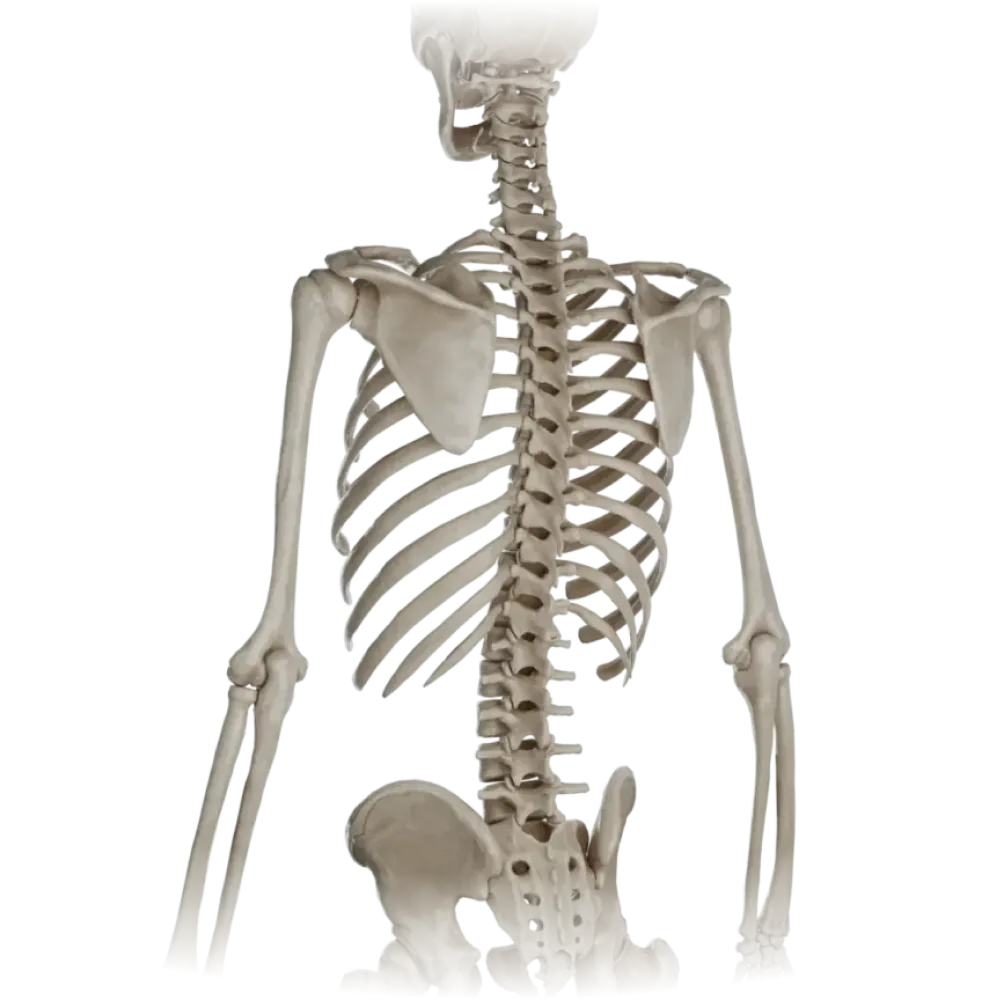
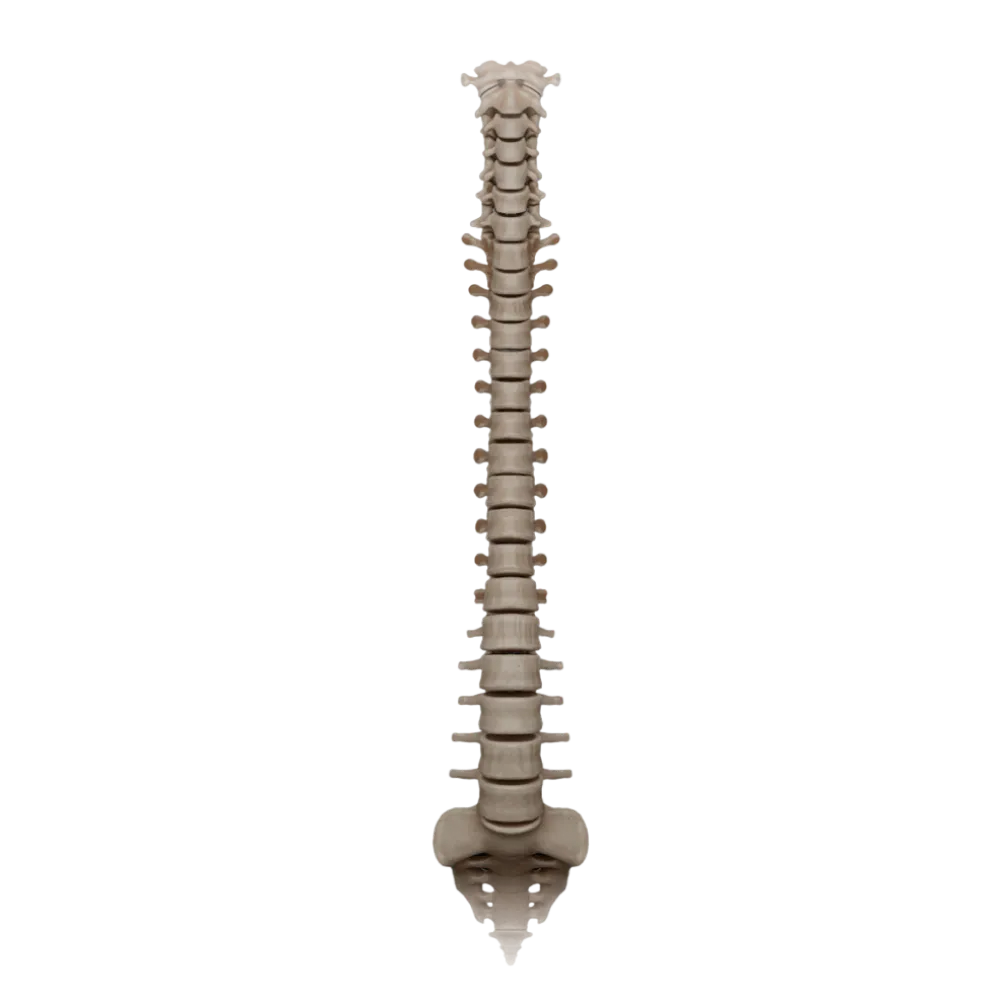
Anatomy test of the back bones
Test your knowledge of osteology of the back. The test covers the structure of all segments of the vertebral column: from atlas to sacrum and coccyx.
1. Which anatomical structure is absent in the first cervical vertebra (atlas)?
-
Anterior arch
The atlas lacks a body, which fuses with the body of the second cervical vertebra during embryogenesis, forming its odontoid process.
-
Lateral masses
The atlas lacks a body, which fuses with the body of the second cervical vertebra during embryogenesis, forming its odontoid process.
-
Posterior arch
The atlas lacks a body, which fuses with the body of the second cervical vertebra during embryogenesis, forming its odontoid process.
-
Body
The atlas lacks a body, which fuses with the body of the second cervical vertebra during embryogenesis, forming its odontoid process.
-
I find it difficult to answer
The atlas lacks a body, which fuses with the body of the second cervical vertebra during embryogenesis, forming its odontoid process.
2. Through which foramen does the vertebral artery pass in the cervical region?
-
Vertebral foramen
The foramen transversarium is a distinctive feature of cervical vertebrae, through which pass the vertebral artery and vein.
-
Intervertebral foramen
The foramen transversarium is a distinctive feature of cervical vertebrae, through which pass the vertebral artery and vein.
-
Foramen of the transverse process
The foramen transversarium is a distinctive feature of cervical vertebrae, through which pass the vertebral artery and vein.
-
Foramen spinosum
The foramen transversarium is a distinctive feature of cervical vertebrae, through which pass the vertebral artery and vein.
-
I find it difficult to answer
The foramen transversarium is a distinctive feature of cervical vertebrae, through which pass the vertebral artery and vein.
3. Which thoracic vertebra typically has a complete superior costal facet and an inferior demifacet on the body?
-
First thoracic (Th I)
The body of Th I has a complete facet for the head of the first rib and a demifacet for the upper half of the head of the second rib.
-
Tenth thoracic (Th X)
The body of Th I has a complete facet for the head of the first rib and a demifacet for the upper half of the head of the second rib.
-
Eleventh thoracic (Th XI)
The body of Th I has a complete facet for the head of the first rib and a demifacet for the upper half of the head of the second rib.
-
Twelfth thoracic (Th XII)
The body of Th I has a complete facet for the head of the first rib and a demifacet for the upper half of the head of the second rib.
-
I find it difficult to answer
The body of Th I has a complete facet for the head of the first rib and a demifacet for the upper half of the head of the second rib.
4. Which structure of a typical lumbar vertebra is a remnant of a rib?
-
Mammillary process
The costal process (processus costalis) of the lumbar vertebra is a homologous structure to a rib, fused with the transverse process.
-
Accessory process
The costal process (processus costalis) of the lumbar vertebra is a homologous structure to a rib, fused with the transverse process.
-
Costal process
The costal process (processus costalis) of the lumbar vertebra is a homologous structure to a rib, fused with the transverse process.
-
Spinous process
The costal process (processus costalis) of the lumbar vertebra is a homologous structure to a rib, fused with the transverse process.
-
I find it difficult to answer
The costal process (processus costalis) of the lumbar vertebra is a homologous structure to a rib, fused with the transverse process.
5. With which structure do the auricular surfaces of the sacrum articulate?
-
Inferior articular processes of the fifth lumbar vertebra
The auricular surfaces of the sacrum form a sacroiliac joint with the corresponding surfaces of the iliac bones.
-
Ischium
The auricular surfaces of the sacrum form a sacroiliac joint with the corresponding surfaces of the iliac bones.
-
Pubis
The auricular surfaces of the sacrum form a sacroiliac joint with the corresponding surfaces of the iliac bones.
-
Ilium
The auricular surfaces of the sacrum form a sacroiliac joint with the corresponding surfaces of the iliac bones.
-
I find it difficult to answer
The auricular surfaces of the sacrum form a sacroiliac joint with the corresponding surfaces of the iliac bones.
6. What is the most anteriorly projecting edge of the sacral base called (at the juncture with the fifth lumbar vertebra)?
-
Sacral horn
The promontory is the forward projecting edge of the body of the fifth lumbar vertebra and the base of the sacrum, an important obstetric landmark.
-
Promontory
The promontory is the forward projecting edge of the body of the fifth lumbar vertebra and the base of the sacrum, an important obstetric landmark.
-
Crest
The promontory is the forward projecting edge of the body of the fifth lumbar vertebra and the base of the sacrum, an important obstetric landmark.
-
Sacral tuberosity
The promontory is the forward projecting edge of the body of the fifth lumbar vertebra and the base of the sacrum, an important obstetric landmark.
-
I find it difficult to answer
The promontory is the forward projecting edge of the body of the fifth lumbar vertebra and the base of the sacrum, an important obstetric landmark.
7. Where is the groove for the vertebral artery (sulcus arteriae vertebralis) located?
-
On the superior surface of the posterior arch of the atlas
The groove for the vertebral artery lies on the superior surface of the posterior arch of the atlas, where the artery lies before entering the foramen magnum.
-
On the superior surface of the anterior arch of the atlas
The groove for the vertebral artery lies on the superior surface of the posterior arch of the atlas, where the artery lies before entering the foramen magnum.
-
On the transverse process of the axis
The groove for the vertebral artery lies on the superior surface of the posterior arch of the atlas, where the artery lies before entering the foramen magnum.
-
Within the vertebral canal
The groove for the vertebral artery lies on the superior surface of the posterior arch of the atlas, where the artery lies before entering the foramen magnum.
-
I find it difficult to answer
The groove for the vertebral artery lies on the superior surface of the posterior arch of the atlas, where the artery lies before entering the foramen magnum.
8. Which cervical vertebra is known as the vertebra prominens due to its long spinous process?
-
Second (C II)
The spinous process of the seventh cervical vertebra is long, not bifurcated, and easily palpable under the skin, hence the vertebra is known as the prominent vertebra.
-
Fifth (C V)
The spinous process of the seventh cervical vertebra is long, not bifurcated, and easily palpable under the skin, hence the vertebra is known as the prominent vertebra.
-
Sixth (C VI)
The spinous process of the seventh cervical vertebra is long, not bifurcated, and easily palpable under the skin, hence the vertebra is known as the prominent vertebra.
-
Seventh (C VII)
The spinous process of the seventh cervical vertebra is long, not bifurcated, and easily palpable under the skin, hence the vertebra is known as the prominent vertebra.
-
I find it difficult to answer
The spinous process of the seventh cervical vertebra is long, not bifurcated, and easily palpable under the skin, hence the vertebra is known as the prominent vertebra.
9. What forms the lateral sacral crest (crista sacralis lateralis)?
-
Fusion of spinous processes
The lateral sacral crest is formed by the fusion of the transverse processes of the sacral vertebrae.
-
Fusion of transverse processes
The lateral sacral crest is formed by the fusion of the transverse processes of the sacral vertebrae.
-
Fusion of articular processes
The lateral sacral crest is formed by the fusion of the transverse processes of the sacral vertebrae.
-
Fusion of sacral vertebral bodies
The lateral sacral crest is formed by the fusion of the transverse processes of the sacral vertebrae.
-
I find it difficult to answer
The lateral sacral crest is formed by the fusion of the transverse processes of the sacral vertebrae.
10. On which part of the thoracic vertebra is the costal facet of the transverse process located?
-
On the anterior surface of the body
The costal facet of the transverse process (fovea costalis processus transversi) is located on the anterior surface of the thickening of the transverse process and articulates with the tubercle of the rib.
-
On the anterior surface of the transverse process
The costal facet of the transverse process (fovea costalis processus transversi) is located on the anterior surface of the thickening of the transverse process and articulates with the tubercle of the rib.
-
On the pedicle of the vertebral arch
The costal facet of the transverse process (fovea costalis processus transversi) is located on the anterior surface of the thickening of the transverse process and articulates with the tubercle of the rib.
-
On the posterior surface of the transverse process
The costal facet of the transverse process (fovea costalis processus transversi) is located on the anterior surface of the thickening of the transverse process and articulates with the tubercle of the rib.
-
I find it difficult to answer
The costal facet of the transverse process (fovea costalis processus transversi) is located on the anterior surface of the thickening of the transverse process and articulates with the tubercle of the rib.
11. On which thoracic vertebrae are the costal facets absent on the transverse processes?
-
On XI and XII
The XI and XII thoracic vertebrae articulate only with the heads of the corresponding ribs, so there are no articular facets on their transverse processes for the tubercles of ribs.
-
On I and II
The XI and XII thoracic vertebrae articulate only with the heads of the corresponding ribs, so there are no articular facets on their transverse processes for the tubercles of ribs.
-
On IX and X
The XI and XII thoracic vertebrae articulate only with the heads of the corresponding ribs, so there are no articular facets on their transverse processes for the tubercles of ribs.
-
On VII and VIII
The XI and XII thoracic vertebrae articulate only with the heads of the corresponding ribs, so there are no articular facets on their transverse processes for the tubercles of ribs.
-
I find it difficult to answer
The XI and XII thoracic vertebrae articulate only with the heads of the corresponding ribs, so there are no articular facets on their transverse processes for the tubercles of ribs.
12. What forms the posterior wall of the vertebral foramen?
-
Vertebral body
The vertebral foramen is bounded anteriorly by the posterior surface of the vertebral body and posteriorly and laterally by the vertebral arch.
-
Pedicles of the vertebral arch
The vertebral foramen is bounded anteriorly by the posterior surface of the vertebral body and posteriorly and laterally by the vertebral arch.
-
Vertebral arch
The vertebral foramen is bounded anteriorly by the posterior surface of the vertebral body and posteriorly and laterally by the vertebral arch.
-
Transverse processes
The vertebral foramen is bounded anteriorly by the posterior surface of the vertebral body and posteriorly and laterally by the vertebral arch.
-
I find it difficult to answer
The vertebral foramen is bounded anteriorly by the posterior surface of the vertebral body and posteriorly and laterally by the vertebral arch.
13. What is the articular surface on the odontoid process of the axis called, which articulates with the anterior arch of the atlas?
-
Posterior articular surface
The anterior articular surface of the odontoid process of the axis (facies articularis anterior) forms a joint with the facet of the tooth on the posterior surface of the anterior arch of the atlas.
-
Anterior articular surface
The anterior articular surface of the odontoid process of the axis (facies articularis anterior) forms a joint with the facet of the tooth on the posterior surface of the anterior arch of the atlas.
-
Superior articular surface
The anterior articular surface of the odontoid process of the axis (facies articularis anterior) forms a joint with the facet of the tooth on the posterior surface of the anterior arch of the atlas.
-
Lateral articular surface
The anterior articular surface of the odontoid process of the axis (facies articularis anterior) forms a joint with the facet of the tooth on the posterior surface of the anterior arch of the atlas.
-
I find it difficult to answer
The anterior articular surface of the odontoid process of the axis (facies articularis anterior) forms a joint with the facet of the tooth on the posterior surface of the anterior arch of the atlas.
14. What bounds the intervertebral foramen (foramen intervertebrale) above and below?
-
Notches of adjacent vertebrae
The intervertebral foramen is formed by the joining of the inferior vertebral notch of the superior vertebra and the superior vertebral notch of the inferior vertebra.
-
Articular processes of adjacent vertebrae
The intervertebral foramen is formed by the joining of the inferior vertebral notch of the superior vertebra and the superior vertebral notch of the inferior vertebra.
-
Bodies of adjacent vertebrae
The intervertebral foramen is formed by the joining of the inferior vertebral notch of the superior vertebra and the superior vertebral notch of the inferior vertebra.
-
Spinous processes of adjacent vertebrae
The intervertebral foramen is formed by the joining of the inferior vertebral notch of the superior vertebra and the superior vertebral notch of the inferior vertebra.
-
I find it difficult to answer
The intervertebral foramen is formed by the joining of the inferior vertebral notch of the superior vertebra and the superior vertebral notch of the inferior vertebra.
15. Which processes of the sacrum form the sacral cornua (cornua sacralia)?
-
Spinous
The sacral cornua are rudiments of the inferior articular processes of the fifth sacral vertebra and limit the sacral hiatus on the sides.
-
Transverse
The sacral cornua are rudiments of the inferior articular processes of the fifth sacral vertebra and limit the sacral hiatus on the sides.
-
Inferior articular
The sacral cornua are rudiments of the inferior articular processes of the fifth sacral vertebra and limit the sacral hiatus on the sides.
-
Superior articular
The sacral cornua are rudiments of the inferior articular processes of the fifth sacral vertebra and limit the sacral hiatus on the sides.
-
I find it difficult to answer
The sacral cornua are rudiments of the inferior articular processes of the fifth sacral vertebra and limit the sacral hiatus on the sides.
16. Where is the carotid tubercle (tuberculum caroticum) located?
-
On the posterior tubercle of the transverse process of the sixth cervical vertebra
The carotid tubercle is a well-developed anterior tubercle of the transverse process of the sixth cervical vertebra, against which the common carotid artery is pressed in cases of bleeding.
-
On the anterior tubercle of the transverse process of the sixth cervical vertebra
The carotid tubercle is a well-developed anterior tubercle of the transverse process of the sixth cervical vertebra, against which the common carotid artery is pressed in cases of bleeding.
-
On the body of the seventh cervical vertebra
The carotid tubercle is a well-developed anterior tubercle of the transverse process of the sixth cervical vertebra, against which the common carotid artery is pressed in cases of bleeding.
-
On the lateral mass of the atlas
The carotid tubercle is a well-developed anterior tubercle of the transverse process of the sixth cervical vertebra, against which the common carotid artery is pressed in cases of bleeding.
-
I find it difficult to answer
The carotid tubercle is a well-developed anterior tubercle of the transverse process of the sixth cervical vertebra, against which the common carotid artery is pressed in cases of bleeding.
17. How many pelvic (anterior) sacral foramina does a normal sacrum have?
-
2 pairs
The sacrum has 4 pairs of pelvic sacral foramina (foramina sacralia anteriora), through which the anterior branches of the sacral spinal nerves exit.
-
3 pairs
The sacrum has 4 pairs of pelvic sacral foramina (foramina sacralia anteriora), through which the anterior branches of the sacral spinal nerves exit.
-
5 pairs
The sacrum has 4 pairs of pelvic sacral foramina (foramina sacralia anteriora), through which the anterior branches of the sacral spinal nerves exit.
-
4 pairs
The sacrum has 4 pairs of pelvic sacral foramina (foramina sacralia anteriora), through which the anterior branches of the sacral spinal nerves exit.
-
I find it difficult to answer
The sacrum has 4 pairs of pelvic sacral foramina (foramina sacralia anteriora), through which the anterior branches of the sacral spinal nerves exit.
18. Which spinal curve forms first in a child after birth?
-
Cervical lordosis
Cervical lordosis forms first (as the child begins to hold their head), followed by thoracic kyphosis (when sitting) and lumbar lordosis (when standing and walking).
-
Thoracic kyphosis
Cervical lordosis forms first (as the child begins to hold their head), followed by thoracic kyphosis (when sitting) and lumbar lordosis (when standing and walking).
-
Lumbar lordosis
Cervical lordosis forms first (as the child begins to hold their head), followed by thoracic kyphosis (when sitting) and lumbar lordosis (when standing and walking).
-
Sacral kyphosis
Cervical lordosis forms first (as the child begins to hold their head), followed by thoracic kyphosis (when sitting) and lumbar lordosis (when standing and walking).
-
I find it difficult to answer
Cervical lordosis forms first (as the child begins to hold their head), followed by thoracic kyphosis (when sitting) and lumbar lordosis (when standing and walking).
19. What are the openings on the dorsal surface of the sacrum called?
-
Intervertebral foramina
On the dorsal surface of the sacrum, there are 4 pairs of posterior sacral foramina (foramina sacralia posteriora) through which the posterior rami of the sacral nerves exit.
-
Pelvic sacral foramina
On the dorsal surface of the sacrum, there are 4 pairs of posterior sacral foramina (foramina sacralia posteriora) through which the posterior rami of the sacral nerves exit.
-
Posterior sacral foramina
On the dorsal surface of the sacrum, there are 4 pairs of posterior sacral foramina (foramina sacralia posteriora) through which the posterior rami of the sacral nerves exit.
-
Sacral canals
On the dorsal surface of the sacrum, there are 4 pairs of posterior sacral foramina (foramina sacralia posteriora) through which the posterior rami of the sacral nerves exit.
-
I find it difficult to answer
On the dorsal surface of the sacrum, there are 4 pairs of posterior sacral foramina (foramina sacralia posteriora) through which the posterior rami of the sacral nerves exit.
20. Which process of a typical lumbar vertebra is directed strictly dorsally (backwards)?
-
Superior articular
The spinous process (processus spinosus) is unpaired and is directed dorsally (backwards) from the arch of the vertebra.
-
Inferior articular
The spinous process (processus spinosus) is unpaired and is directed dorsally (backwards) from the arch of the vertebra.
-
Transverse (costal)
The spinous process (processus spinosus) is unpaired and is directed dorsally (backwards) from the arch of the vertebra.
-
Spinous
The spinous process (processus spinosus) is unpaired and is directed dorsally (backwards) from the arch of the vertebra.
-
I find it difficult to answer
The spinous process (processus spinosus) is unpaired and is directed dorsally (backwards) from the arch of the vertebra.
Retake this quiz?
Your current progress will be reset.