
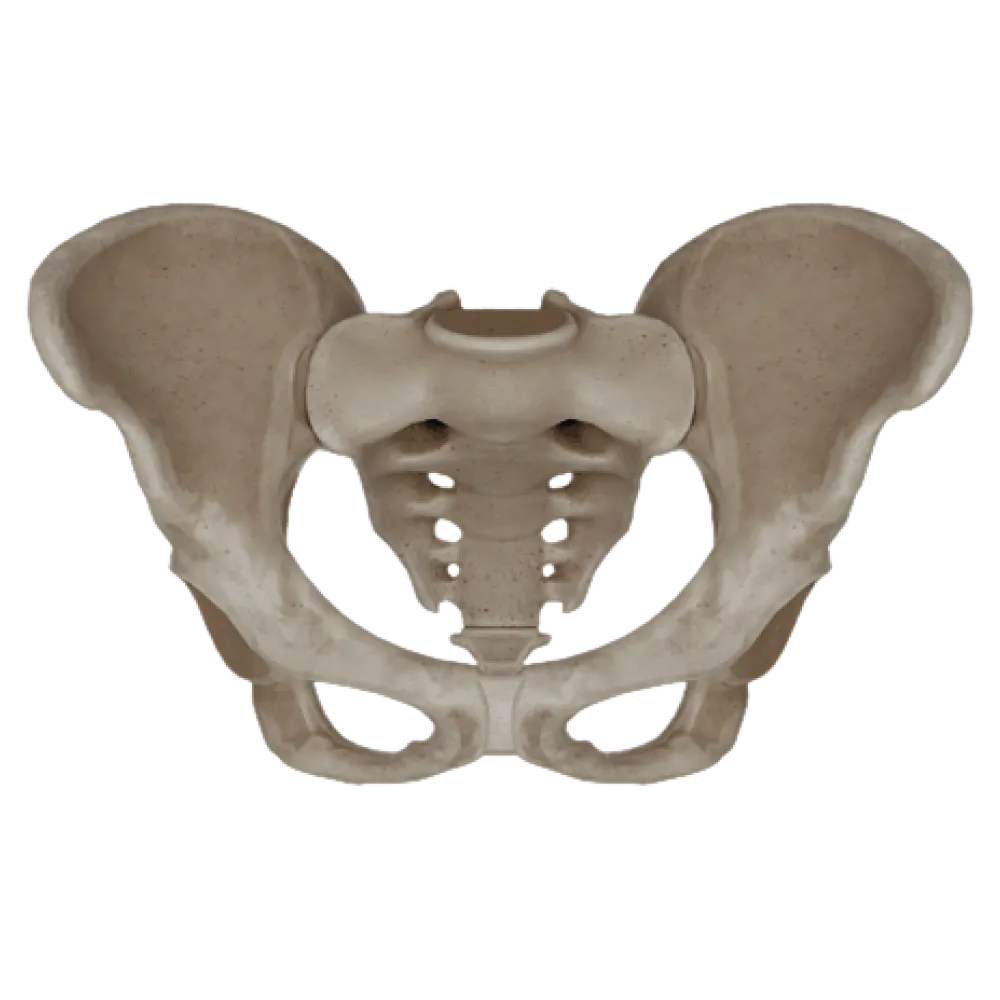
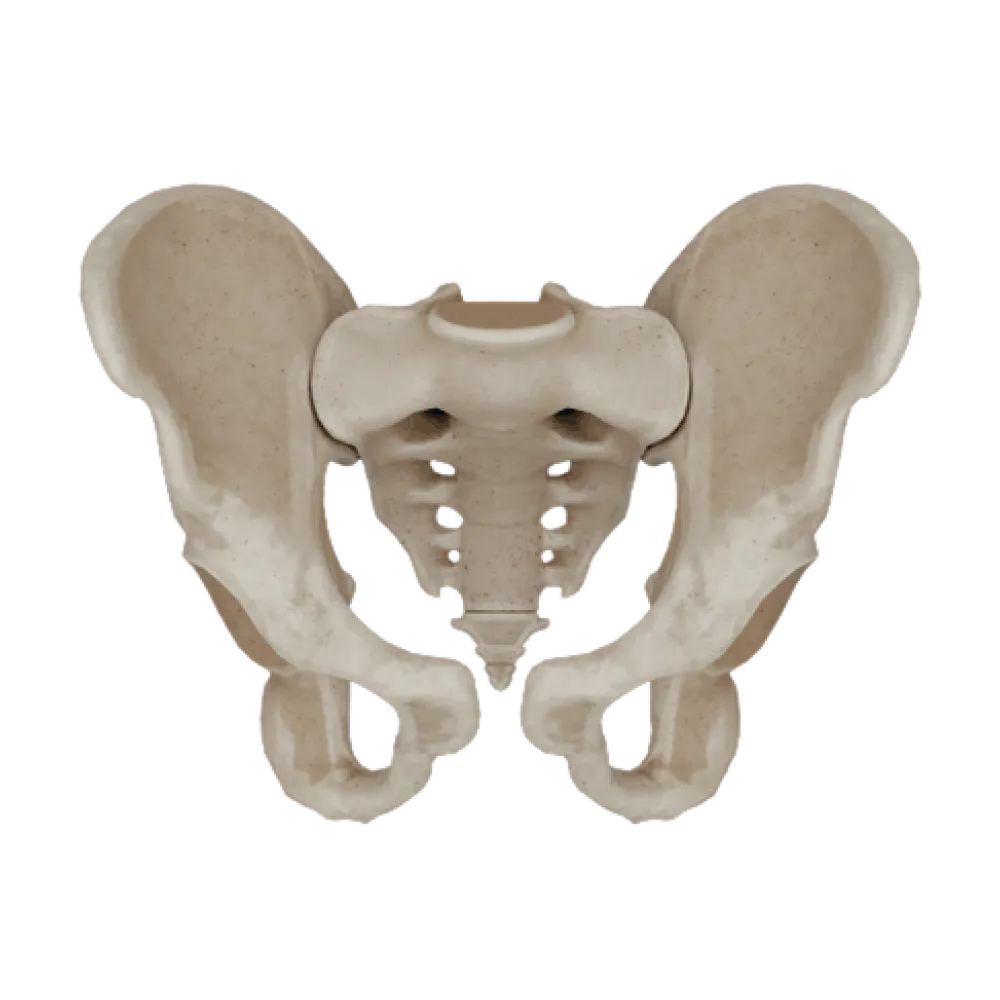
Male pelvic bone anatomy test
Evaluate knowledge of male pelvic bone anatomy. The test strictly assesses osteology, pelvimetry, sexual dimorphism, and the topography of structures.
1/20
bold
text
1. What is the normal shape of the male pelvic inlet (apertura pelvis superior)?
-
Transversely oval
The male pelvic inlet is card-shaped due to the pronounced prominence of the sacral promontory.
-
Round
The male pelvic inlet is card-shaped due to the pronounced prominence of the sacral promontory.
-
Heart-shaped
The male pelvic inlet is card-shaped due to the pronounced prominence of the sacral promontory.
-
Triangular
The male pelvic inlet is card-shaped due to the pronounced prominence of the sacral promontory.
-
I find it difficult to answer
The male pelvic inlet is card-shaped due to the pronounced prominence of the sacral promontory.
2. What is the subpubic angle (angulus subpubicus) in males?
-
70-75 degrees
The subpubic angle in males is acute, measuring 70-75 degrees, unlike the broader angle (pubic arch) in females.
-
90-100 degrees
The subpubic angle in males is acute, measuring 70-75 degrees, unlike the broader angle (pubic arch) in females.
-
110-120 degrees
The subpubic angle in males is acute, measuring 70-75 degrees, unlike the broader angle (pubic arch) in females.
-
130-140 degrees
The subpubic angle in males is acute, measuring 70-75 degrees, unlike the broader angle (pubic arch) in females.
-
I find it difficult to answer
The subpubic angle in males is acute, measuring 70-75 degrees, unlike the broader angle (pubic arch) in females.
3. What are the anatomical characteristics of the male sacrum?
-
Wide and short
The male sacrum is narrower, longer, and has a more pronounced pelvic curvature (concavity) than the female sacrum.
-
Straight and flat
The male sacrum is narrower, longer, and has a more pronounced pelvic curvature (concavity) than the female sacrum.
-
Wide and sharply curved
The male sacrum is narrower, longer, and has a more pronounced pelvic curvature (concavity) than the female sacrum.
-
Narrow, long, and sharply curved
The male sacrum is narrower, longer, and has a more pronounced pelvic curvature (concavity) than the female sacrum.
-
I find it difficult to answer
The male sacrum is narrower, longer, and has a more pronounced pelvic curvature (concavity) than the female sacrum.
4. What shape does the male pelvic cavity (cavitas pelvis) have?
-
Cylindrical
The male pelvic cavity narrows downward, becoming funnel-shaped, while the female pelvis is cylindrical.
-
Funnel-shaped
The male pelvic cavity narrows downward, becoming funnel-shaped, while the female pelvis is cylindrical.
-
Barrel-shaped
The male pelvic cavity narrows downward, becoming funnel-shaped, while the female pelvis is cylindrical.
-
Pear-shaped
The male pelvic cavity narrows downward, becoming funnel-shaped, while the female pelvis is cylindrical.
-
I find it difficult to answer
The male pelvic cavity narrows downward, becoming funnel-shaped, while the female pelvis is cylindrical.
5. What is the characteristic of the greater sciatic notch (incisura ischiadica major) of the male pelvis?
-
Wide and shallow
The greater sciatic notch in males is narrower and deeper, due to the overall vertical structure of their pelvic bones.
-
Normally absent
The greater sciatic notch in males is narrower and deeper, due to the overall vertical structure of their pelvic bones.
-
Wide and deep
The greater sciatic notch in males is narrower and deeper, due to the overall vertical structure of their pelvic bones.
-
Narrow and deep
The greater sciatic notch in males is narrower and deeper, due to the overall vertical structure of their pelvic bones.
-
I find it difficult to answer
The greater sciatic notch in males is narrower and deeper, due to the overall vertical structure of their pelvic bones.
6. What is the height of the pubic symphysis in males compared to females?
-
Significantly shorter
The pubic symphysis in males is significantly higher (longer), contributing to the formation of a narrow and acute subpubic angle.
-
Equal in height to females
The pubic symphysis in males is significantly higher (longer), contributing to the formation of a narrow and acute subpubic angle.
-
Higher (longer) than in females
The pubic symphysis in males is significantly higher (longer), contributing to the formation of a narrow and acute subpubic angle.
-
Depends only on age, not sex
The pubic symphysis in males is significantly higher (longer), contributing to the formation of a narrow and acute subpubic angle.
-
I find it difficult to answer
The pubic symphysis in males is significantly higher (longer), contributing to the formation of a narrow and acute subpubic angle.
7. How are the iliac wings (alae ossis ilii) positioned in the male pelvis?
-
Positioned more vertically
The iliac wings in males stand more vertically, which makes the overall male pelvis narrower and taller.
-
Strongly turned outward
The iliac wings in males stand more vertically, which makes the overall male pelvis narrower and taller.
-
Positioned almost horizontally
The iliac wings in males stand more vertically, which makes the overall male pelvis narrower and taller.
-
Directed medially
The iliac wings in males stand more vertically, which makes the overall male pelvis narrower and taller.
-
I find it difficult to answer
The iliac wings in males stand more vertically, which makes the overall male pelvis narrower and taller.
8. What shape does the obturator foramen (foramen obturatum) have in the male pelvis?
-
Triangular
The obturator foramen in males has an ovoid shape with a longitudinal axis, unlike the triangular foramen in females.
-
Round
The obturator foramen in males has an ovoid shape with a longitudinal axis, unlike the triangular foramen in females.
-
Square
The obturator foramen in males has an ovoid shape with a longitudinal axis, unlike the triangular foramen in females.
-
Ovoid with a longitudinal axis
The obturator foramen in males has an ovoid shape with a longitudinal axis, unlike the triangular foramen in females.
-
I find it difficult to answer
The obturator foramen in males has an ovoid shape with a longitudinal axis, unlike the triangular foramen in females.
9. What osseous structures form the anterolateral boundary of the lower aperture of the male pelvis?
-
Ischial branches and inferior pubic branches
The anterolateral boundary of the pelvis's lower aperture is formed by the inferior pubic branches and ischial branches.
-
Sacrotuberal ligaments and ischial spines
The anterolateral boundary of the pelvis's lower aperture is formed by the inferior pubic branches and ischial branches.
-
Coccyx and sacral apex
The anterolateral boundary of the pelvis's lower aperture is formed by the inferior pubic branches and ischial branches.
-
Iliac crests
The anterolateral boundary of the pelvis's lower aperture is formed by the inferior pubic branches and ischial branches.
-
I find it difficult to answer
The anterolateral boundary of the pelvis's lower aperture is formed by the inferior pubic branches and ischial branches.
10. What is the general characteristic of the thickness and relief of the male pelvic bones?
-
Thin, with a smooth relief
Male pelvic bones are thicker, heavy, and have pronounced points of attachment for strong muscles (tuberosities and roughness).
-
Massive, thick, with marked muscular relief
Male pelvic bones are thicker, heavy, and have pronounced points of attachment for strong muscles (tuberosities and roughness).
-
Porous, light, with thin edges
Male pelvic bones are thicker, heavy, and have pronounced points of attachment for strong muscles (tuberosities and roughness).
-
Smooth tuberosities without roughness
Male pelvic bones are thicker, heavy, and have pronounced points of attachment for strong muscles (tuberosities and roughness).
-
I find it difficult to answer
Male pelvic bones are thicker, heavy, and have pronounced points of attachment for strong muscles (tuberosities and roughness).
11. How does the intertuberous distance (tuber ischiadicum) in males compare to that in females?
-
Significantly more
The intertuberous distance in males is less, making the pelvic lower aperture narrower.
-
Absolutely the same
The intertuberous distance in males is less, making the pelvic lower aperture narrower.
-
Less
The intertuberous distance in males is less, making the pelvic lower aperture narrower.
-
No differences
The intertuberous distance in males is less, making the pelvic lower aperture narrower.
-
I find it difficult to answer
The intertuberous distance in males is less, making the pelvic lower aperture narrower.
12. What is the normal pelvic inclination angle (inclinatio pelvis) in males?
-
50-55 degrees
The pelvic inclination angle in males is 50-55 degrees, which is a few degrees less than in females.
-
65-70 degrees
The pelvic inclination angle in males is 50-55 degrees, which is a few degrees less than in females.
-
30-40 degrees
The pelvic inclination angle in males is 50-55 degrees, which is a few degrees less than in females.
-
75-80 degrees
The pelvic inclination angle in males is 50-55 degrees, which is a few degrees less than in females.
-
I find it difficult to answer
The pelvic inclination angle in males is 50-55 degrees, which is a few degrees less than in females.
13. How is the sacral promontory (promontorium) topographically expressed in the male pelvis?
-
Barely protruding into the pelvic cavity
The male sacral promontory is prominently thrust forward into the pelvic cavity, giving the inlet a card shape.
-
Smooth and almost undetectable
The male sacral promontory is prominently thrust forward into the pelvic cavity, giving the inlet a card shape.
-
Deviated backward from the pelvic cavity
The male sacral promontory is prominently thrust forward into the pelvic cavity, giving the inlet a card shape.
-
Prominently thrust forward
The male sacral promontory is prominently thrust forward into the pelvic cavity, giving the inlet a card shape.
-
I find it difficult to answer
The male sacral promontory is prominently thrust forward into the pelvic cavity, giving the inlet a card shape.
14. Between which anatomical structures does the terminal line (linea terminalis) of the pelvis serve as a boundary?
-
Sacrum and coccyx
The terminal line (linea terminalis) is a distinctive bony boundary between the greater (pelvis major) and lesser pelvis (pelvis minor).
-
Perineum and lesser pelvis
The terminal line (linea terminalis) is a distinctive bony boundary between the greater (pelvis major) and lesser pelvis (pelvis minor).
-
Greater and lesser pelvis
The terminal line (linea terminalis) is a distinctive bony boundary between the greater (pelvis major) and lesser pelvis (pelvis minor).
-
Iliac fossa and wing of the ilium
The terminal line (linea terminalis) is a distinctive bony boundary between the greater (pelvis major) and lesser pelvis (pelvis minor).
-
I find it difficult to answer
The terminal line (linea terminalis) is a distinctive bony boundary between the greater (pelvis major) and lesser pelvis (pelvis minor).
15. What is the anatomical feature of the acetabular fossa (acetabulum) in the male pelvis?
-
Smaller diameter and oriented medially
The acetabular fossae in males are larger (for articulation with the massive femoral head) and are oriented more laterally.
-
Directed more anteverted and spaced wider
The acetabular fossae in males are larger (for articulation with the massive femoral head) and are oriented more laterally.
-
Larger and more laterally oriented
The acetabular fossae in males are larger (for articulation with the massive femoral head) and are oriented more laterally.
-
Strictly oriented posteriorly
The acetabular fossae in males are larger (for articulation with the massive femoral head) and are oriented more laterally.
-
I find it difficult to answer
The acetabular fossae in males are larger (for articulation with the massive femoral head) and are oriented more laterally.
16. Which ligament closes the greater sciatic notch, transforming it into the greater sciatic foramen?
-
Sacrotuberous ligament
The sacrospinous ligament (lig. sacrospinale) encloses the greater sciatic notch, forming the greater sciatic foramen.
-
Sacrospinous ligament
The sacrospinous ligament (lig. sacrospinale) encloses the greater sciatic notch, forming the greater sciatic foramen.
-
Iliolumbar ligament
The sacrospinous ligament (lig. sacrospinale) encloses the greater sciatic notch, forming the greater sciatic foramen.
-
Inguinal ligament
The sacrospinous ligament (lig. sacrospinale) encloses the greater sciatic notch, forming the greater sciatic foramen.
-
I find it difficult to answer
The sacrospinous ligament (lig. sacrospinale) encloses the greater sciatic notch, forming the greater sciatic foramen.
17. How are the inferior branches of the pubic bones connected in males?
-
Form a broad pubic arch
In males, the inferior branches of the pubic bones converge at an acute angle, forming the subpubic angle (angulus subpubicus).
-
Form a narrow subpubic angle
In males, the inferior branches of the pubic bones converge at an acute angle, forming the subpubic angle (angulus subpubicus).
-
Form a straight horizontal line
In males, the inferior branches of the pubic bones converge at an acute angle, forming the subpubic angle (angulus subpubicus).
-
Not connected, separated by a broad symphysis
In males, the inferior branches of the pubic bones converge at an acute angle, forming the subpubic angle (angulus subpubicus).
-
I find it difficult to answer
In males, the inferior branches of the pubic bones converge at an acute angle, forming the subpubic angle (angulus subpubicus).
18. What bony structures form the posterior wall of the lesser pelvis?
-
Internal obturator muscle and fascia
The posterior wall of the lesser pelvis (pelvis minor) is formed by the concave pelvic surface of the sacrum and the anterior surface of the coccyx.
-
Iliac wings
The posterior wall of the lesser pelvis (pelvis minor) is formed by the concave pelvic surface of the sacrum and the anterior surface of the coccyx.
-
Pubic symphysis and pubic branches
The posterior wall of the lesser pelvis (pelvis minor) is formed by the concave pelvic surface of the sacrum and the anterior surface of the coccyx.
-
Pelvic surface of the sacrum and coccyx
The posterior wall of the lesser pelvis (pelvis minor) is formed by the concave pelvic surface of the sacrum and the anterior surface of the coccyx.
-
I find it difficult to answer
The posterior wall of the lesser pelvis (pelvis minor) is formed by the concave pelvic surface of the sacrum and the anterior surface of the coccyx.
19. What is the morphological characteristic of the male pelvic cavity?
-
Narrower and deeper
The male pelvic cavity is longer, narrower, and deeper due to the vertical position of the bones and the narrow, long sacrum.
-
Wider and shorter
The male pelvic cavity is longer, narrower, and deeper due to the vertical position of the bones and the narrow, long sacrum.
-
Ideal straight cylindrical shape
The male pelvic cavity is longer, narrower, and deeper due to the vertical position of the bones and the narrow, long sacrum.
-
Its volume significantly exceeds the female lesser pelvis
The male pelvic cavity is longer, narrower, and deeper due to the vertical position of the bones and the narrow, long sacrum.
-
I find it difficult to answer
The male pelvic cavity is longer, narrower, and deeper due to the vertical position of the bones and the narrow, long sacrum.
20. On which bone is the arcuate line (linea arcuata) located, participating in the formation of the linea terminalis?
-
Pubis
The arcuate line (linea arcuata) is located on the internal surface of the ilium and forms the lateral part of the boundary line.
-
Ilium
The arcuate line (linea arcuata) is located on the internal surface of the ilium and forms the lateral part of the boundary line.
-
Sacrum.
The arcuate line (linea arcuata) is located on the internal surface of the ilium and forms the lateral part of the boundary line.
-
Ischium
The arcuate line (linea arcuata) is located on the internal surface of the ilium and forms the lateral part of the boundary line.
-
I find it difficult to answer
The arcuate line (linea arcuata) is located on the internal surface of the ilium and forms the lateral part of the boundary line.
Retake this quiz?
Your current progress will be reset.