1/20

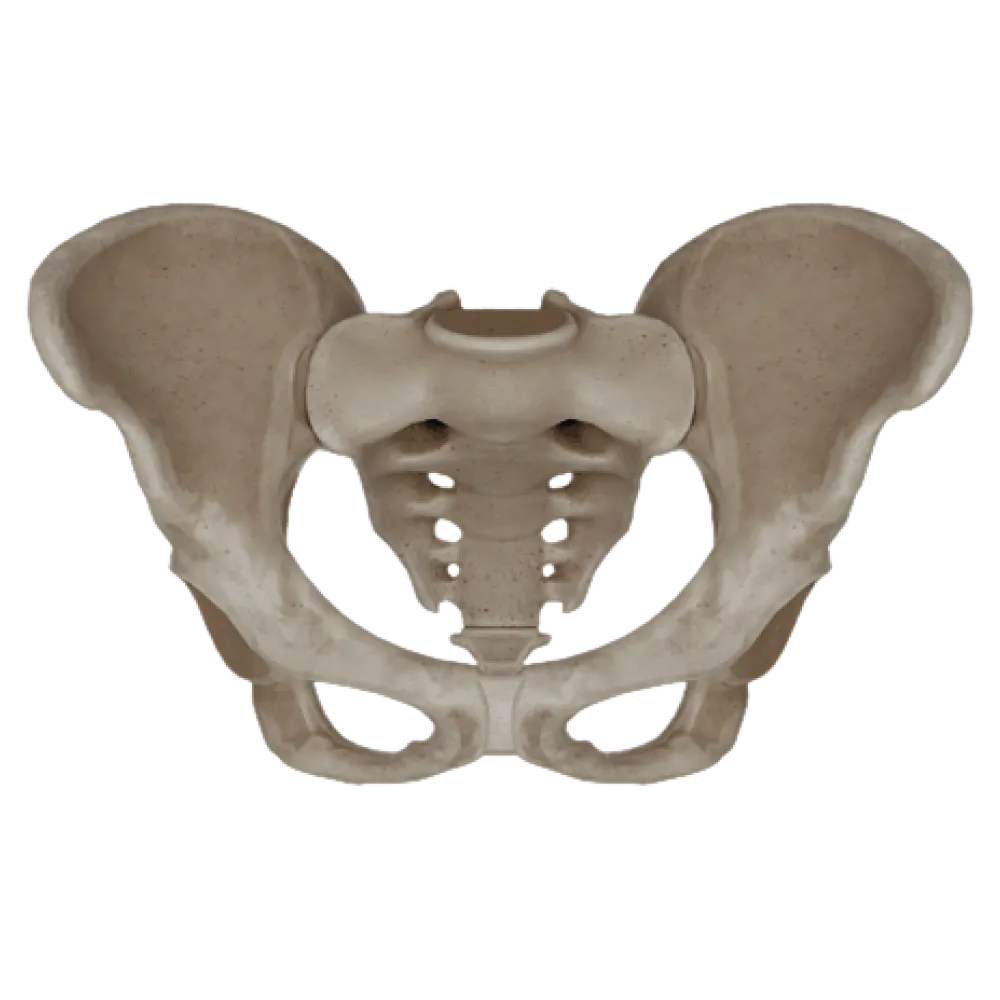
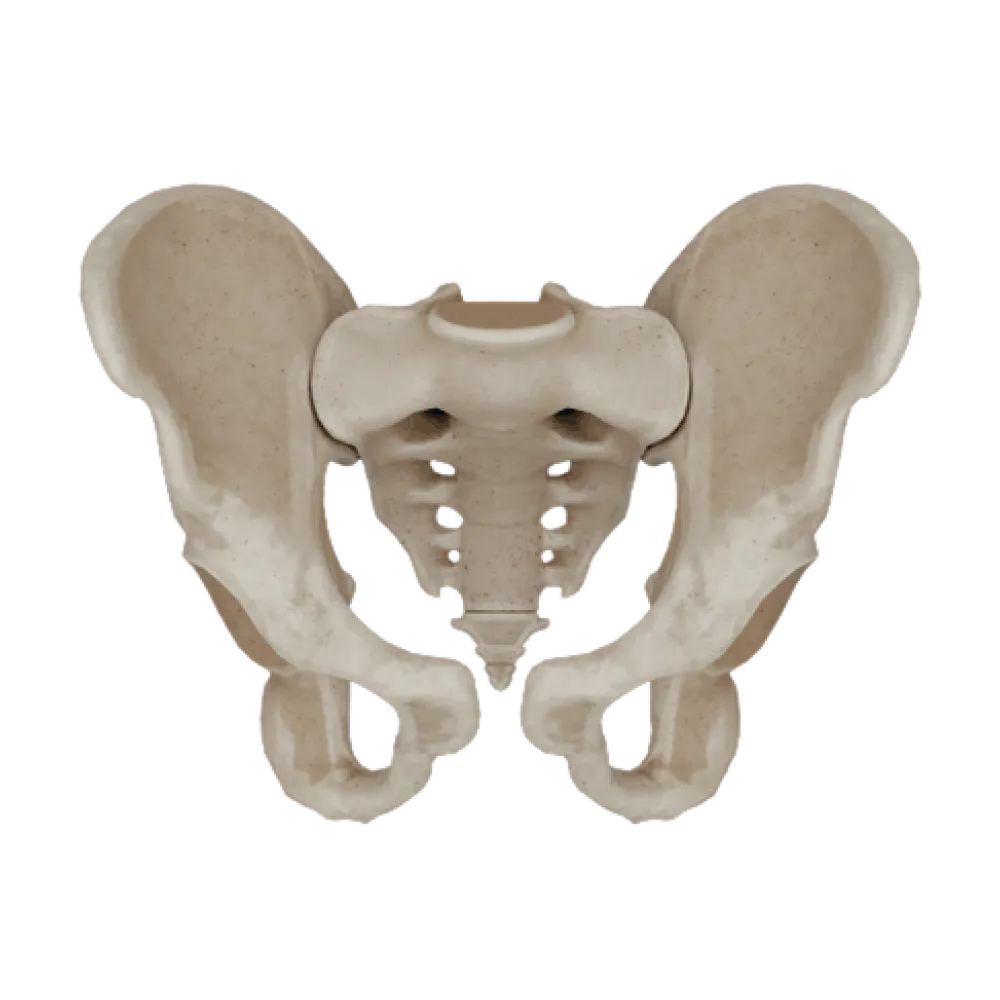
Anatomy test of the abdominal and pelvic skeleton.
Assess knowledge of osteology of the abdomen and pelvis. The test assesses the topography, structure of the pelvic bones, their connections, dimensions, and gender differences.
1. Which anatomical structure separates the greater and lesser pelvis?
-
Terminal line (linea terminalis).
The greater and lesser pelvis are separated by the boundary line formed by the sacral promontory, arcuate lines of the ilia, pubic crests, and the upper edge of the pubic symphysis.
-
Linea alba of the abdomen (linea alba).
The greater and lesser pelvis are separated by the boundary line formed by the sacral promontory, arcuate lines of the ilia, pubic crests, and the upper edge of the pubic symphysis.
-
Arcuate line of ilium (linea arcuata).
The greater and lesser pelvis are separated by the boundary line formed by the sacral promontory, arcuate lines of the ilia, pubic crests, and the upper edge of the pubic symphysis.
-
Pectineal line (linea pectinea).
The greater and lesser pelvis are separated by the boundary line formed by the sacral promontory, arcuate lines of the ilia, pubic crests, and the upper edge of the pubic symphysis.
-
I find it difficult to answer
The greater and lesser pelvis are separated by the boundary line formed by the sacral promontory, arcuate lines of the ilia, pubic crests, and the upper edge of the pubic symphysis.
2. The fusion of which bones forms the acetabulum?
-
Ilium, sacrum, and ischium.
The acetabulum is formed by the fusion of the bodies of three pelvic bones: ilium, ischium, and pubis.
-
Pubis, ischium, and femur.
The acetabulum is formed by the fusion of the bodies of three pelvic bones: ilium, ischium, and pubis.
-
Ilium, ischium, and pubis.
The acetabulum is formed by the fusion of the bodies of three pelvic bones: ilium, ischium, and pubis.
-
Ilium, pubis, and sacrum.
The acetabulum is formed by the fusion of the bodies of three pelvic bones: ilium, ischium, and pubis.
-
I find it difficult to answer
The acetabulum is formed by the fusion of the bodies of three pelvic bones: ilium, ischium, and pubis.
3. What is the promontory in the osteology of the pelvis?
-
Anteriorly projecting edge of the body of the fifth lumbar vertebra and the base of the sacrum.
The promontory is the projection formed by the junction of the fifth lumbar vertebra with the base of the sacrum projecting into the pelvic cavity.
-
Projection on the posterior surface of the sacrum.
The promontory is the projection formed by the junction of the fifth lumbar vertebra with the base of the sacrum projecting into the pelvic cavity.
-
Most protruding part of the iliac crest.
The promontory is the projection formed by the junction of the fifth lumbar vertebra with the base of the sacrum projecting into the pelvic cavity.
-
Tubercle on the pubis.
The promontory is the projection formed by the junction of the fifth lumbar vertebra with the base of the sacrum projecting into the pelvic cavity.
-
I find it difficult to answer
The promontory is the projection formed by the junction of the fifth lumbar vertebra with the base of the sacrum projecting into the pelvic cavity.
4. What is the average size of the true conjugate in women?
-
13 cm
The true (gynecological) conjugate is the distance from the sacral promontory to the most posterior point of the pubic symphysis, which is normally about 11 cm.
-
11 cm
The true (gynecological) conjugate is the distance from the sacral promontory to the most posterior point of the pubic symphysis, which is normally about 11 cm.
-
9 cm
The true (gynecological) conjugate is the distance from the sacral promontory to the most posterior point of the pubic symphysis, which is normally about 11 cm.
-
15 cm
The true (gynecological) conjugate is the distance from the sacral promontory to the most posterior point of the pubic symphysis, which is normally about 11 cm.
-
I find it difficult to answer
The true (gynecological) conjugate is the distance from the sacral promontory to the most posterior point of the pubic symphysis, which is normally about 11 cm.
5. What bounds the greater sciatic foramen inferiorly?
-
Sacrotuberous ligament.
The greater sciatic foramen is bounded by the greater sciatic notch and the sacrospinous ligament, which encloses it inferiorly.
-
Iliolumbar ligament.
The greater sciatic foramen is bounded by the greater sciatic notch and the sacrospinous ligament, which encloses it inferiorly.
-
Sacrospinous ligament.
The greater sciatic foramen is bounded by the greater sciatic notch and the sacrospinous ligament, which encloses it inferiorly.
-
Inguinal ligament.
The greater sciatic foramen is bounded by the greater sciatic notch and the sacrospinous ligament, which encloses it inferiorly.
-
I find it difficult to answer
The greater sciatic foramen is bounded by the greater sciatic notch and the sacrospinous ligament, which encloses it inferiorly.
6. What angle is formed by the inferior branches of the pubic bones in males?
-
Right or obtuse angle (subpubic arch).
In males, the inferior branches of the pubic bones converge at an acute angle (angulus subpubicus) of 70-75 degrees, whereas in females, they form a broader subpubic arch (arcus pubis).
-
Acute angle (subpubic angle).
In males, the inferior branches of the pubic bones converge at an acute angle (angulus subpubicus) of 70-75 degrees, whereas in females, they form a broader subpubic arch (arcus pubis).
-
Obtuse angle.
In males, the inferior branches of the pubic bones converge at an acute angle (angulus subpubicus) of 70-75 degrees, whereas in females, they form a broader subpubic arch (arcus pubis).
-
No angle; branches run parallel.
In males, the inferior branches of the pubic bones converge at an acute angle (angulus subpubicus) of 70-75 degrees, whereas in females, they form a broader subpubic arch (arcus pubis).
-
I find it difficult to answer
In males, the inferior branches of the pubic bones converge at an acute angle (angulus subpubicus) of 70-75 degrees, whereas in females, they form a broader subpubic arch (arcus pubis).
7. To which structures is the inguinal ligament attached?
-
From the anterior superior iliac spine to the pubic tubercle.
The inguinal ligament is stretched between the anterior superior iliac spine (ASIS) and the pubic tubercle.
-
From the posterior superior iliac spine to the ischial tuberosity.
The inguinal ligament is stretched between the anterior superior iliac spine (ASIS) and the pubic tubercle.
-
From the anterior inferior iliac spine to the pubic symphysis.
The inguinal ligament is stretched between the anterior superior iliac spine (ASIS) and the pubic tubercle.
-
From the sacrum to the ischial spine.
The inguinal ligament is stretched between the anterior superior iliac spine (ASIS) and the pubic tubercle.
-
I find it difficult to answer
The inguinal ligament is stretched between the anterior superior iliac spine (ASIS) and the pubic tubercle.
8. What structure separates the greater and lesser sciatic notches?
-
Ischial tuberosity.
The ischial spine (spina ischiadica) projects between the greater sciatic notch (above) and the lesser sciatic notch (below).
-
Iliac crest.
The ischial spine (spina ischiadica) projects between the greater sciatic notch (above) and the lesser sciatic notch (below).
-
Obturator foramen
The ischial spine (spina ischiadica) projects between the greater sciatic notch (above) and the lesser sciatic notch (below).
-
Ischial spine.
The ischial spine (spina ischiadica) projects between the greater sciatic notch (above) and the lesser sciatic notch (below).
-
I find it difficult to answer
The ischial spine (spina ischiadica) projects between the greater sciatic notch (above) and the lesser sciatic notch (below).
9. At which vertebral level is the highest point of the iliac crests (crista iliaca) located?
-
Spinous process level L2.
The line connecting the highest points of the iliac crests (Jacobi's line) corresponds to the level of the body and the spinous process of the fourth lumbar vertebra.
-
Spinous process level L4.
The line connecting the highest points of the iliac crests (Jacobi's line) corresponds to the level of the body and the spinous process of the fourth lumbar vertebra.
-
Spinous process level S1.
The line connecting the highest points of the iliac crests (Jacobi's line) corresponds to the level of the body and the spinous process of the fourth lumbar vertebra.
-
Spinous process level T12.
The line connecting the highest points of the iliac crests (Jacobi's line) corresponds to the level of the body and the spinous process of the fourth lumbar vertebra.
-
I find it difficult to answer
The line connecting the highest points of the iliac crests (Jacobi's line) corresponds to the level of the body and the spinous process of the fourth lumbar vertebra.
10. Which bone branches bound the obturator foramen?
-
Pubis and ilium.
The obturator foramen is formed by the bodies and branches of the pubis and ischium.
-
Ilium and ischium.
The obturator foramen is formed by the bodies and branches of the pubis and ischium.
-
Sacrum and pubis.
The obturator foramen is formed by the bodies and branches of the pubis and ischium.
-
Pubis and ischium.
The obturator foramen is formed by the bodies and branches of the pubis and ischium.
-
I find it difficult to answer
The obturator foramen is formed by the bodies and branches of the pubis and ischium.
11. What is the normal pelvic inclination angle in standing women?
-
30-40 degrees
The pelvic inclination angle in women is normally 55-60 degrees, which is somewhat greater than in men.
-
45-50 degrees
The pelvic inclination angle in women is normally 55-60 degrees, which is somewhat greater than in men.
-
55-60 degrees
The pelvic inclination angle in women is normally 55-60 degrees, which is somewhat greater than in men.
-
70-80 degrees
The pelvic inclination angle in women is normally 55-60 degrees, which is somewhat greater than in men.
-
I find it difficult to answer
The pelvic inclination angle in women is normally 55-60 degrees, which is somewhat greater than in men.
12. The distance between the anterior superior spines of the ilia (distantia spinarum) is normally in women:
-
28-29 cm
Distantia spinarum is the interspinous distance, normally equal to 25-26 cm in women.
-
30-31 cm
Distantia spinarum is the interspinous distance, normally equal to 25-26 cm in women.
-
20-21 cm
Distantia spinarum is the interspinous distance, normally equal to 25-26 cm in women.
-
25-26 cm
Distantia spinarum is the interspinous distance, normally equal to 25-26 cm in women.
-
I find it difficult to answer
Distantia spinarum is the interspinous distance, normally equal to 25-26 cm in women.
13. What cartilage predominantly composes the interpubic disc of the pubic symphysis?
-
Elastic cartilage.
Interpubic disc is formed of fibrocartilage, within which there is often a cleft-like cavity.
-
Fibrocartilage.
Interpubic disc is formed of fibrocartilage, within which there is often a cleft-like cavity.
-
Hyaline cartilage.
Interpubic disc is formed of fibrocartilage, within which there is often a cleft-like cavity.
-
Reticular cartilage.
Interpubic disc is formed of fibrocartilage, within which there is often a cleft-like cavity.
-
I find it difficult to answer
Interpubic disc is formed of fibrocartilage, within which there is often a cleft-like cavity.
14. With which structure of the pelvic bone does the auricular surface of the sacrum articulate?
-
Auricular surface of the ilium.
The sacroiliac joint is formed by the articulation of the auricular surfaces of the sacrum and ilium.
-
Ischial tuberosity.
The sacroiliac joint is formed by the articulation of the auricular surfaces of the sacrum and ilium.
-
Body of the ilium.
The sacroiliac joint is formed by the articulation of the auricular surfaces of the sacrum and ilium.
-
Symphyseal surface of the pubis.
The sacroiliac joint is formed by the articulation of the auricular surfaces of the sacrum and ilium.
-
I find it difficult to answer
The sacroiliac joint is formed by the articulation of the auricular surfaces of the sacrum and ilium.
15. Which ligament transforms the lesser sciatic notch into the lesser sciatic foramen?
-
Sacrotuberous and inguinal ligaments.
The lesser sciatic foramen is bounded by the lesser sciatic notch, sacrotuberous and sacrospinous ligaments.
-
Sacrotuberous and iliolumbar ligaments.
The lesser sciatic foramen is bounded by the lesser sciatic notch, sacrotuberous and sacrospinous ligaments.
-
Sacrotuberous and sacrospinous ligaments.
The lesser sciatic foramen is bounded by the lesser sciatic notch, sacrotuberous and sacrospinous ligaments.
-
Obturator membrane.
The lesser sciatic foramen is bounded by the lesser sciatic notch, sacrotuberous and sacrospinous ligaments.
-
I find it difficult to answer
The lesser sciatic foramen is bounded by the lesser sciatic notch, sacrotuberous and sacrospinous ligaments.
16. The anatomical conjugate is the distance from the sacral promontory to:
-
Lower edge of the pubic symphysis.
The anatomical conjugate is measured from the promontory to the upper edge of the pubic symphysis and is normally about 11.5 cm.
-
The most posterior point of the pubic symphysis.
The anatomical conjugate is measured from the promontory to the upper edge of the pubic symphysis and is normally about 11.5 cm.
-
Upper edge of the pubic symphysis.
The anatomical conjugate is measured from the promontory to the upper edge of the pubic symphysis and is normally about 11.5 cm.
-
Obturator foramen.
The anatomical conjugate is measured from the promontory to the upper edge of the pubic symphysis and is normally about 11.5 cm.
-
I find it difficult to answer
The anatomical conjugate is measured from the promontory to the upper edge of the pubic symphysis and is normally about 11.5 cm.
17. At what age does the synostosis (fusion) of the bones forming the pelvic bone usually complete in humans?
-
3-5 years
The final fusion of the ilium, ischium, and pubis in the area of the acetabulum usually occurs by ages 14-16.
-
8-10 years
The final fusion of the ilium, ischium, and pubis in the area of the acetabulum usually occurs by ages 14-16.
-
14-16 years
The final fusion of the ilium, ischium, and pubis in the area of the acetabulum usually occurs by ages 14-16.
-
25-30 years
The final fusion of the ilium, ischium, and pubis in the area of the acetabulum usually occurs by ages 14-16.
-
I find it difficult to answer
The final fusion of the ilium, ischium, and pubis in the area of the acetabulum usually occurs by ages 14-16.
18. Which muscle or ligament attaches to the ischial tuberosity (tuber ischiadicum)?
-
Sacrospinous ligament
The powerful sacrotuberous ligament (ligamentum sacrotuberale) and the posterior group of thigh muscles attach to the ischial tuberosity.
-
Sacrotuberous ligament
The powerful sacrotuberous ligament (ligamentum sacrotuberale) and the posterior group of thigh muscles attach to the ischial tuberosity.
-
Inguinal ligament
The powerful sacrotuberous ligament (ligamentum sacrotuberale) and the posterior group of thigh muscles attach to the ischial tuberosity.
-
Iliofemoral ligament.
The powerful sacrotuberous ligament (ligamentum sacrotuberale) and the posterior group of thigh muscles attach to the ischial tuberosity.
-
I find it difficult to answer
The powerful sacrotuberous ligament (ligamentum sacrotuberale) and the posterior group of thigh muscles attach to the ischial tuberosity.
19. Out of how many vertebrae is the normal sacrum (os sacrum) formed?
-
4
The adult human sacrum is a single bone formed by the fusion of five sacral vertebrae.
-
6
The adult human sacrum is a single bone formed by the fusion of five sacral vertebrae.
-
3
The adult human sacrum is a single bone formed by the fusion of five sacral vertebrae.
-
5
The adult human sacrum is a single bone formed by the fusion of five sacral vertebrae.
-
I find it difficult to answer
The adult human sacrum is a single bone formed by the fusion of five sacral vertebrae.
20. What line borders the anterior side of the pelvic inlet (apertura pelvis inferior)?
-
The inferior edge of the pubic symphysis and the inferior rami of the pubic bones
The exit from the lesser pelvis (lower aperture) is bordered anteriorly by the pubic arch (the inferior edge of the symphysis and the inferior rami of the pubic bones).
-
Terminal (boundary) line
The exit from the lesser pelvis (lower aperture) is bordered anteriorly by the pubic arch (the inferior edge of the symphysis and the inferior rami of the pubic bones).
-
Sacrotuberous ligaments
The exit from the lesser pelvis (lower aperture) is bordered anteriorly by the pubic arch (the inferior edge of the symphysis and the inferior rami of the pubic bones).
-
Promontory of the sacrum
The exit from the lesser pelvis (lower aperture) is bordered anteriorly by the pubic arch (the inferior edge of the symphysis and the inferior rami of the pubic bones).
-
I find it difficult to answer
The exit from the lesser pelvis (lower aperture) is bordered anteriorly by the pubic arch (the inferior edge of the symphysis and the inferior rami of the pubic bones).
Retake this quiz?
Your current progress will be reset.
Skeleton of the abdomen and pelvis.
Male pelvic bone
0/20