


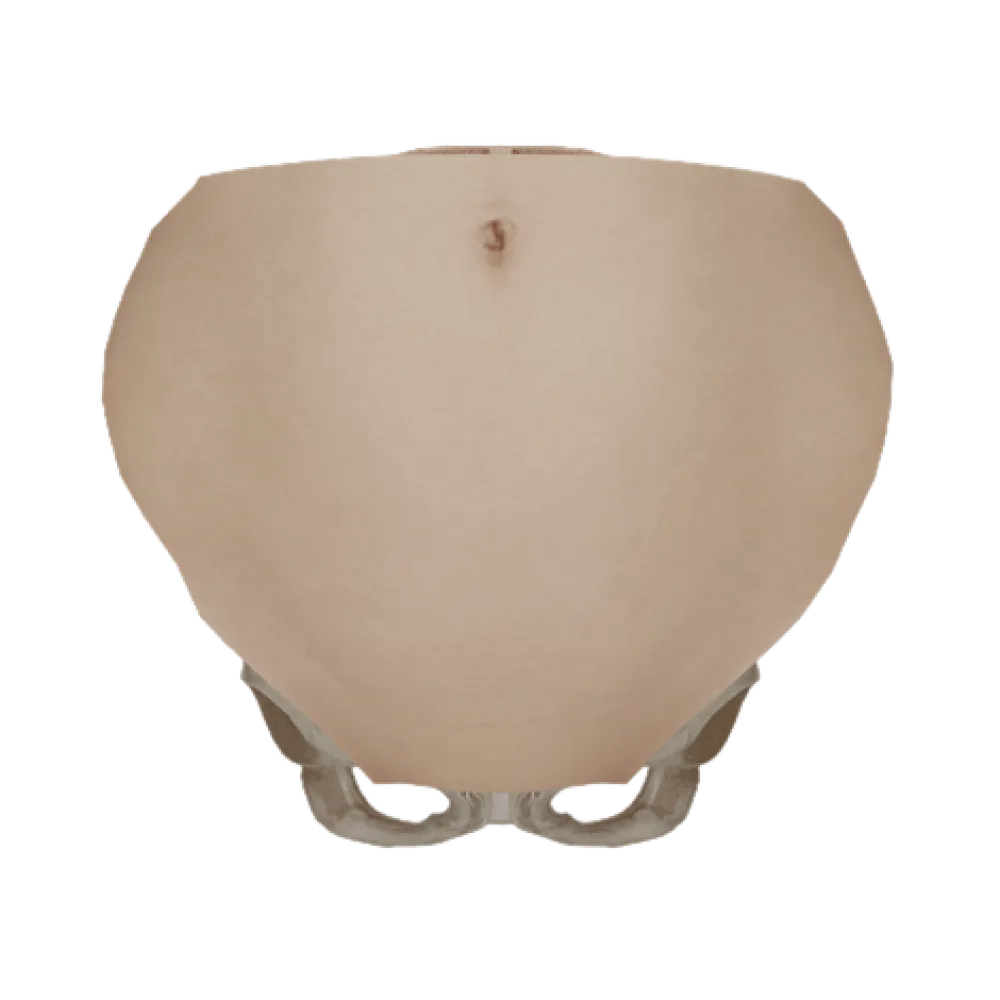

Test on the anatomy of the female abdominal peritoneum
Evaluate the knowledge of the topography of the peritoneum of the anterior abdominal wall in females. The test assesses umbilical folds, fossae, and inguinal canal projections.
1/20
bold
text
1. Which anatomical structure is located within the plica umbilicalis mediana?
-
Obliterated umbilical artery
The median umbilical fold is unpaired and contains the obliterated urachus extending from the apex of the urinary bladder to the umbilicus
-
Obliterated urinary tract (urachus)
The median umbilical fold is unpaired and contains the obliterated urachus extending from the apex of the urinary bladder to the umbilicus
-
Inferior epigastric vessels
The median umbilical fold is unpaired and contains the obliterated urachus extending from the apex of the urinary bladder to the umbilicus
-
Obliterated umbilical vein
The median umbilical fold is unpaired and contains the obliterated urachus extending from the apex of the urinary bladder to the umbilicus
-
I find it difficult to answer
The median umbilical fold is unpaired and contains the obliterated urachus extending from the apex of the urinary bladder to the umbilicus
2. What forms the medial umbilical fold (plica umbilicalis medialis)?
-
Inferior epigastric artery and vein
The paired medial umbilical fold contains the obliterated umbilical artery (chorda a. umbilicalis), ascending to the umbilical ring.
-
Round ligament of the uterus
The paired medial umbilical fold contains the obliterated umbilical artery (chorda a. umbilicalis), ascending to the umbilical ring.
-
Median umbilical ligament
The paired medial umbilical fold contains the obliterated umbilical artery (chorda a. umbilicalis), ascending to the umbilical ring.
-
Obliterated umbilical artery
The paired medial umbilical fold contains the obliterated umbilical artery (chorda a. umbilicalis), ascending to the umbilical ring.
-
I find it difficult to answer
The paired medial umbilical fold contains the obliterated umbilical artery (chorda a. umbilicalis), ascending to the umbilical ring.
3. Which structure is located inside the lateral umbilical fold (plica umbilicalis lateralis)?
-
Inferior epigastric vessels
The lateral umbilical fold contains functioning inferior epigastric artery and veins (vasa epigastrica inferiora).
-
Obliterated umbilical vein
The lateral umbilical fold contains functioning inferior epigastric artery and veins (vasa epigastrica inferiora).
-
Obliterated umbilical artery
The lateral umbilical fold contains functioning inferior epigastric artery and veins (vasa epigastrica inferiora).
-
Ilioinguinal nerve
The lateral umbilical fold contains functioning inferior epigastric artery and veins (vasa epigastrica inferiora).
-
I find it difficult to answer
The lateral umbilical fold contains functioning inferior epigastric artery and veins (vasa epigastrica inferiora).
4. Which fossa is located between the median and medial umbilical folds?
-
Supravesical fossa (fossa supravesicalis)
The supravesical fossae are paired above the urinary bladder's apex, bounded by the median and medial umbilical folds.
-
Medial inguinal fossa (fossa inguinalis medialis)
The supravesical fossae are paired above the urinary bladder's apex, bounded by the median and medial umbilical folds.
-
Lateral inguinal fossa (fossa inguinalis lateralis)
The supravesical fossae are paired above the urinary bladder's apex, bounded by the median and medial umbilical folds.
-
Femoral fossa (fossa femoralis)
The supravesical fossae are paired above the urinary bladder's apex, bounded by the median and medial umbilical folds.
-
I find it difficult to answer
The supravesical fossae are paired above the urinary bladder's apex, bounded by the median and medial umbilical folds.
5. Which fossa is bounded medially by the medial umbilical fold and laterally by the lateral umbilical fold?
-
Supravesical fossa.
The medial inguinal fossa (fossa inguinalis medialis) is strictly between the plica umbilicalis medialis and plica umbilicalis lateralis.
-
Medial inguinal fossa.
The medial inguinal fossa (fossa inguinalis medialis) is strictly between the plica umbilicalis medialis and plica umbilicalis lateralis.
-
Lateral inguinal fossa.
The medial inguinal fossa (fossa inguinalis medialis) is strictly between the plica umbilicalis medialis and plica umbilicalis lateralis.
-
Iliac fossa
The medial inguinal fossa (fossa inguinalis medialis) is strictly between the plica umbilicalis medialis and plica umbilicalis lateralis.
-
I find it difficult to answer
The medial inguinal fossa (fossa inguinalis medialis) is strictly between the plica umbilicalis medialis and plica umbilicalis lateralis.
6. To which anatomical structure of the anterior abdominal wall does the medial inguinal fossa correspond?
-
Deep inguinal ring
The medial inguinal fossa is a projection of the superficial inguinal ring on the internal surface of the anterior abdominal wall.
-
Superficial inguinal ring
The medial inguinal fossa is a projection of the superficial inguinal ring on the internal surface of the anterior abdominal wall.
-
Femoral ring
The medial inguinal fossa is a projection of the superficial inguinal ring on the internal surface of the anterior abdominal wall.
-
Umbilical ring
The medial inguinal fossa is a projection of the superficial inguinal ring on the internal surface of the anterior abdominal wall.
-
I find it difficult to answer
The medial inguinal fossa is a projection of the superficial inguinal ring on the internal surface of the anterior abdominal wall.
7. Which anatomical structure corresponds to the lateral inguinal fossa (fossa inguinalis lateralis)?
-
Superficial inguinal ring
The lateral inguinal fossa is located lateral to the lateral umbilical fold and corresponds to the deep inguinal ring.
-
Femoral ring
The lateral inguinal fossa is located lateral to the lateral umbilical fold and corresponds to the deep inguinal ring.
-
Deep inguinal ring
The lateral inguinal fossa is located lateral to the lateral umbilical fold and corresponds to the deep inguinal ring.
-
Obturator canal
The lateral inguinal fossa is located lateral to the lateral umbilical fold and corresponds to the deep inguinal ring.
-
I find it difficult to answer
The lateral inguinal fossa is located lateral to the lateral umbilical fold and corresponds to the deep inguinal ring.
8. Which anatomical structure in females passes through the deep inguinal ring from the abdominal cavity?
-
Round ligament of the uterus
In females, the round ligament of the uterus (ligamentum teres uteri) enters the deep inguinal ring (in the region of the lateral inguinal fossa).
-
Proper ovarian ligament
In females, the round ligament of the uterus (ligamentum teres uteri) enters the deep inguinal ring (in the region of the lateral inguinal fossa).
-
Broad ligament of the uterus
In females, the round ligament of the uterus (ligamentum teres uteri) enters the deep inguinal ring (in the region of the lateral inguinal fossa).
-
Uterine tube
In females, the round ligament of the uterus (ligamentum teres uteri) enters the deep inguinal ring (in the region of the lateral inguinal fossa).
-
I find it difficult to answer
In females, the round ligament of the uterus (ligamentum teres uteri) enters the deep inguinal ring (in the region of the lateral inguinal fossa).
9. To which fascia is the parietal peritoneum of the anterior abdominal wall immediately adjacent below the arcuate line?
-
To the superficial fascia
Below the arcuate line (linea arcuata), the posterior wall of the rectus abdominis sheath is absent, and the peritoneum is adjacent to the transversalis fascia.
-
To the transversalis fascia
Below the arcuate line (linea arcuata), the posterior wall of the rectus abdominis sheath is absent, and the peritoneum is adjacent to the transversalis fascia.
-
To the fascia of the external oblique muscle
Below the arcuate line (linea arcuata), the posterior wall of the rectus abdominis sheath is absent, and the peritoneum is adjacent to the transversalis fascia.
-
To the endoabdominal fascia
Below the arcuate line (linea arcuata), the posterior wall of the rectus abdominis sheath is absent, and the peritoneum is adjacent to the transversalis fascia.
-
I find it difficult to answer
Below the arcuate line (linea arcuata), the posterior wall of the rectus abdominis sheath is absent, and the peritoneum is adjacent to the transversalis fascia.
10. Where do all umbilical folds of the internal surface of the anterior abdominal wall converge?
-
At the xiphoid process
The median, two medial, and two lateral umbilical folds ascend and converge in the umbilical ring region (anulus umbilicalis).
-
At the pubic symphysis
The median, two medial, and two lateral umbilical folds ascend and converge in the umbilical ring region (anulus umbilicalis).
-
At the umbilical ring
The median, two medial, and two lateral umbilical folds ascend and converge in the umbilical ring region (anulus umbilicalis).
-
At the anterior superior iliac spine
The median, two medial, and two lateral umbilical folds ascend and converge in the umbilical ring region (anulus umbilicalis).
-
I find it difficult to answer
The median, two medial, and two lateral umbilical folds ascend and converge in the umbilical ring region (anulus umbilicalis).
11. Which ligament, covered by peritoneum, extends from the umbilicus upward along the anterior abdominal wall to the liver?
-
Coronary ligament
The falciform ligament (lig. falciforme hepatis) is a duplication of the peritoneum extending from the anterior abdominal wall and diaphragm to the liver.
-
Falciform ligament
The falciform ligament (lig. falciforme hepatis) is a duplication of the peritoneum extending from the anterior abdominal wall and diaphragm to the liver.
-
Round ligament of the liver
The falciform ligament (lig. falciforme hepatis) is a duplication of the peritoneum extending from the anterior abdominal wall and diaphragm to the liver.
-
Triangular ligament
The falciform ligament (lig. falciforme hepatis) is a duplication of the peritoneum extending from the anterior abdominal wall and diaphragm to the liver.
-
I find it difficult to answer
The falciform ligament (lig. falciforme hepatis) is a duplication of the peritoneum extending from the anterior abdominal wall and diaphragm to the liver.
12. What is located in the free inferior edge of the falciform ligament on the internal surface of the abdominal wall?
-
Obliterated umbilical artery
The round ligament of the liver, formed by the obliteration of the umbilical vein, runs in the free edge of the falciform ligament.
-
Obliterated venous duct
The round ligament of the liver, formed by the obliteration of the umbilical vein, runs in the free edge of the falciform ligament.
-
Round ligament of the liver (obliterated umbilical vein)
The round ligament of the liver, formed by the obliteration of the umbilical vein, runs in the free edge of the falciform ligament.
-
Obliterated urinary duct
The round ligament of the liver, formed by the obliteration of the umbilical vein, runs in the free edge of the falciform ligament.
-
I find it difficult to answer
The round ligament of the liver, formed by the obliteration of the umbilical vein, runs in the free edge of the falciform ligament.
13. From which blood vessel does the artery passing through the plica umbilicalis lateralis originate?
-
From the internal iliac artery
The inferior epigastric artery, forming the lateral umbilical fold, arises from the external iliac artery just before the inguinal ligament.
-
From the external iliac artery
The inferior epigastric artery, forming the lateral umbilical fold, arises from the external iliac artery just before the inguinal ligament.
-
From the femoral artery
The inferior epigastric artery, forming the lateral umbilical fold, arises from the external iliac artery just before the inguinal ligament.
-
From the internal thoracic artery
The inferior epigastric artery, forming the lateral umbilical fold, arises from the external iliac artery just before the inguinal ligament.
-
I find it difficult to answer
The inferior epigastric artery, forming the lateral umbilical fold, arises from the external iliac artery just before the inguinal ligament.
14. From where do the vessels, whose obliterated remnants form the plicae umbilicales mediales, arise?
-
From the external iliac artery.
The medial umbilical folds contain obliterated umbilical arteries, which are branches of the internal iliac arteries.
-
From the internal iliac artery.
The medial umbilical folds contain obliterated umbilical arteries, which are branches of the internal iliac arteries.
-
From the abdominal aorta
The medial umbilical folds contain obliterated umbilical arteries, which are branches of the internal iliac arteries.
-
From the inferior mesenteric artery.
The medial umbilical folds contain obliterated umbilical arteries, which are branches of the internal iliac arteries.
-
I find it difficult to answer
The medial umbilical folds contain obliterated umbilical arteries, which are branches of the internal iliac arteries.
15. Which nerves provide sensory innervation to the parietal peritoneum of the anterior abdominal wall?
-
Vagus nerves
The parietal peritoneum of the anterior abdominal wall is innervated by branches of the lower intercostal, subcostal, and iliohypogastric and ilioinguinal nerves.
-
Lower intercostal nerves (Th7-Th11) and subcostal nerve (Th12)
The parietal peritoneum of the anterior abdominal wall is innervated by branches of the lower intercostal, subcostal, and iliohypogastric and ilioinguinal nerves.
-
Genitofemoral nerve
The parietal peritoneum of the anterior abdominal wall is innervated by branches of the lower intercostal, subcostal, and iliohypogastric and ilioinguinal nerves.
-
Obturator nerve.
The parietal peritoneum of the anterior abdominal wall is innervated by branches of the lower intercostal, subcostal, and iliohypogastric and ilioinguinal nerves.
-
I find it difficult to answer
The parietal peritoneum of the anterior abdominal wall is innervated by branches of the lower intercostal, subcostal, and iliohypogastric and ilioinguinal nerves.
16. Which peritoneal fold separates the medial inguinal fossa from the lateral inguinal fossa?
-
Median umbilical fold
The lateral umbilical fold (with inferior epigastric vessels) is the boundary between the medial and lateral inguinal fossae.
-
Transverse fold
The lateral umbilical fold (with inferior epigastric vessels) is the boundary between the medial and lateral inguinal fossae.
-
Medial umbilical fold
The lateral umbilical fold (with inferior epigastric vessels) is the boundary between the medial and lateral inguinal fossae.
-
Lateral umbilical fold
The lateral umbilical fold (with inferior epigastric vessels) is the boundary between the medial and lateral inguinal fossae.
-
I find it difficult to answer
The lateral umbilical fold (with inferior epigastric vessels) is the boundary between the medial and lateral inguinal fossae.
17. The process of peritoneal protrusion into the inguinal canal in females (analogous to the vaginal process in males) is called:
-
Canal of Nuck
In women, a small protrusion of the peritoneum, accompanying the round ligament of the uterus in the inguinal canal, is called the canal of Nuck.
-
Meckel's diverticulum
In women, a small protrusion of the peritoneum, accompanying the round ligament of the uterus in the inguinal canal, is called the canal of Nuck.
-
Gartner's duct
In women, a small protrusion of the peritoneum, accompanying the round ligament of the uterus in the inguinal canal, is called the canal of Nuck.
-
Alcock's canal
In women, a small protrusion of the peritoneum, accompanying the round ligament of the uterus in the inguinal canal, is called the canal of Nuck.
-
I find it difficult to answer
In women, a small protrusion of the peritoneum, accompanying the round ligament of the uterus in the inguinal canal, is called the canal of Nuck.
18. Which fossa is located most medially on the internal surface of the anterior abdominal wall?
-
Lateral inguinal fossa.
The supravesical fossa (fossa supravesicalis) is situated between the median and medial umbilical folds, being the most medial of all mentioned.
-
Medial inguinal fossa.
The supravesical fossa (fossa supravesicalis) is situated between the median and medial umbilical folds, being the most medial of all mentioned.
-
Supravesical fossa.
The supravesical fossa (fossa supravesicalis) is situated between the median and medial umbilical folds, being the most medial of all mentioned.
-
Femoral fossa
The supravesical fossa (fossa supravesicalis) is situated between the median and medial umbilical folds, being the most medial of all mentioned.
-
I find it difficult to answer
The supravesical fossa (fossa supravesicalis) is situated between the median and medial umbilical folds, being the most medial of all mentioned.
19. The syntopy of the inferior epigastric vessels (in the lateral umbilical fold) relative to the internal inguinal ring:
-
They pass laterally to the deep inguinal ring
The inferior epigastric vessels, forming the lateral umbilical fold, pass along the medial edge of the deep inguinal ring.
-
They pass medially to the deep inguinal ring
The inferior epigastric vessels, forming the lateral umbilical fold, pass along the medial edge of the deep inguinal ring.
-
They pass through the deep inguinal ring
The inferior epigastric vessels, forming the lateral umbilical fold, pass along the medial edge of the deep inguinal ring.
-
They pass above the deep inguinal ring
The inferior epigastric vessels, forming the lateral umbilical fold, pass along the medial edge of the deep inguinal ring.
-
I find it difficult to answer
The inferior epigastric vessels, forming the lateral umbilical fold, pass along the medial edge of the deep inguinal ring.
20. What forms the floor of the medial inguinal fossa, lacking muscle coverage (Hesselbach's triangle)?
-
Aponeurosis of the external oblique muscle of the abdomen
In the area of the inguinal triangle (projection of the medial inguinal fossa), the muscular layer is absent, and the wall is formed by the transversalis fascia and the parietal peritoneum.
-
Intra-abdominal fascia and peritoneum
In the area of the inguinal triangle (projection of the medial inguinal fossa), the muscular layer is absent, and the wall is formed by the transversalis fascia and the parietal peritoneum.
-
Transversalis fascia and peritoneum
In the area of the inguinal triangle (projection of the medial inguinal fossa), the muscular layer is absent, and the wall is formed by the transversalis fascia and the parietal peritoneum.
-
Rectus abdominis muscle
In the area of the inguinal triangle (projection of the medial inguinal fossa), the muscular layer is absent, and the wall is formed by the transversalis fascia and the parietal peritoneum.
-
I find it difficult to answer
In the area of the inguinal triangle (projection of the medial inguinal fossa), the muscular layer is absent, and the wall is formed by the transversalis fascia and the parietal peritoneum.
Retake this quiz?
Your current progress will be reset.