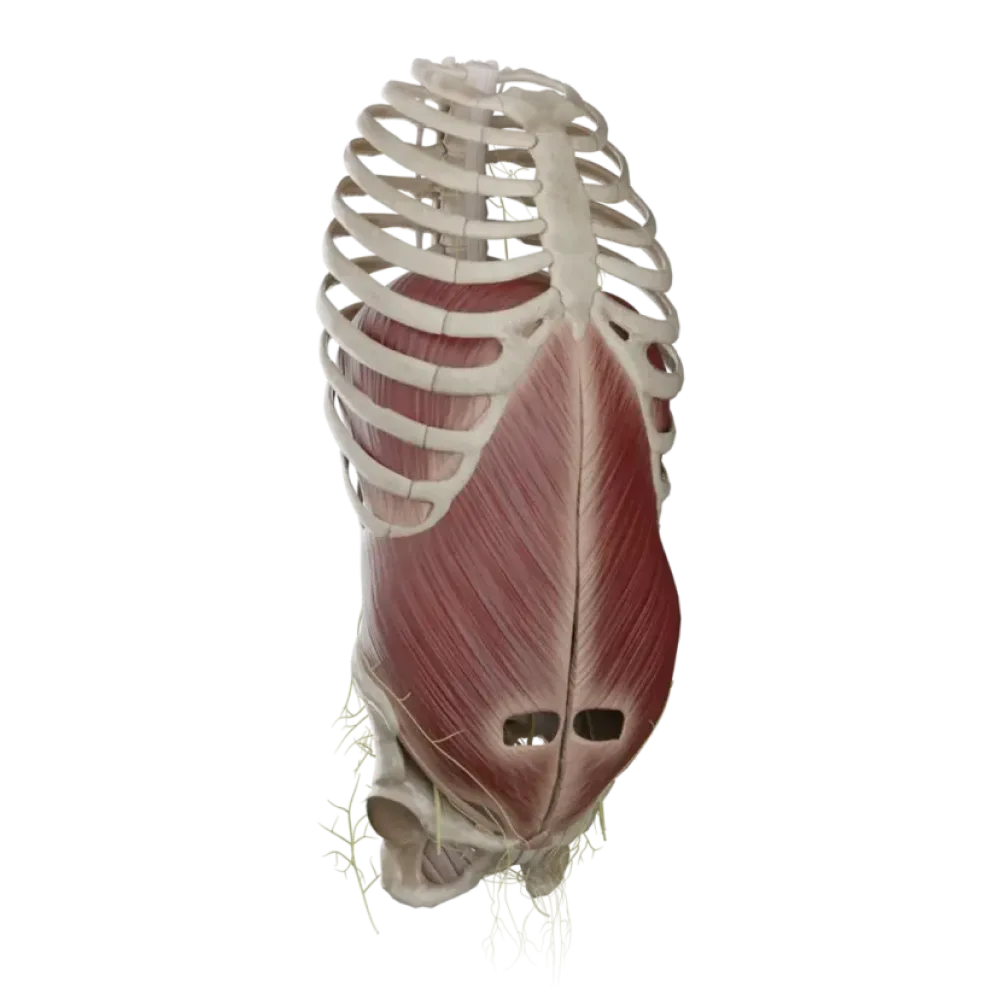


Test on the anatomy of male abdominal and pelvic nerves
Evaluate the knowledge of the anatomy of male abdominal and pelvic nerves. The test examines the topology and branching of nerves and plexuses.
1/20
bold
text
1. Which branch of the genitofemoral nerve (n. genitofemoralis) in men passes through the inguinal canal as part of the spermatic cord?
-
R. femoralis
The genital branch (r. genitalis) penetrates the inguinal canal through the deep ring, travels as part of the spermatic cord and innervates the m. cremaster and testicular membranes.
-
R. genitalis
The genital branch (r. genitalis) penetrates the inguinal canal through the deep ring, travels as part of the spermatic cord and innervates the m. cremaster and testicular membranes.
-
N. ilioinguinalis
The genital branch (r. genitalis) penetrates the inguinal canal through the deep ring, travels as part of the spermatic cord and innervates the m. cremaster and testicular membranes.
-
N. scrotalis anterior
The genital branch (r. genitalis) penetrates the inguinal canal through the deep ring, travels as part of the spermatic cord and innervates the m. cremaster and testicular membranes.
-
I find it difficult to answer
The genital branch (r. genitalis) penetrates the inguinal canal through the deep ring, travels as part of the spermatic cord and innervates the m. cremaster and testicular membranes.
2. Which autonomic plexus is the primary source of innervation for the prostate and seminal vesicles?
-
Celiac plexus
The inferior hypogastric (pelvic) plexus gives rise to derivative plexuses, including the prostatic plexus and deferential plexus, which innervate the organs of the male pelvis.
-
Superior hypogastric plexus
The inferior hypogastric (pelvic) plexus gives rise to derivative plexuses, including the prostatic plexus and deferential plexus, which innervate the organs of the male pelvis.
-
Inferior mesenteric plexus
The inferior hypogastric (pelvic) plexus gives rise to derivative plexuses, including the prostatic plexus and deferential plexus, which innervate the organs of the male pelvis.
-
Inferior hypogastric plexus
The inferior hypogastric (pelvic) plexus gives rise to derivative plexuses, including the prostatic plexus and deferential plexus, which innervate the organs of the male pelvis.
-
I find it difficult to answer
The inferior hypogastric (pelvic) plexus gives rise to derivative plexuses, including the prostatic plexus and deferential plexus, which innervate the organs of the male pelvis.
3. Through which anatomical formation does the pudendal nerve (n. pudendus) pass on the lateral wall of the ischioanal fossa?
-
Canalis pudendalis (Alcock's canal)
The pudendal nerve along with the internal pudendal vessels passes in the pudendal canal (Alcock's canal), which is formed by the splitting of the fascia of the internal obturator muscle.
-
Canalis adductorius
The pudendal nerve along with the internal pudendal vessels passes in the pudendal canal (Alcock's canal), which is formed by the splitting of the fascia of the internal obturator muscle.
-
Canalis obturatorius
The pudendal nerve along with the internal pudendal vessels passes in the pudendal canal (Alcock's canal), which is formed by the splitting of the fascia of the internal obturator muscle.
-
Lacuna vasorum
The pudendal nerve along with the internal pudendal vessels passes in the pudendal canal (Alcock's canal), which is formed by the splitting of the fascia of the internal obturator muscle.
-
I find it difficult to answer
The pudendal nerve along with the internal pudendal vessels passes in the pudendal canal (Alcock's canal), which is formed by the splitting of the fascia of the internal obturator muscle.
4. Which nerves provide sensory innervation to the anterior surface of the scrotum in men?
-
Nn. scrotales posteriores from n. pudendus
The anterior scrotal nerves (nn. scrotales anteriores) are the terminal branches of the ilioinguinal nerve (n. ilioinguinalis).
-
Nn. scrotales anteriores from n. ilioinguinalis
The anterior scrotal nerves (nn. scrotales anteriores) are the terminal branches of the ilioinguinal nerve (n. ilioinguinalis).
-
Rr. perineales from n. posterior femoral cutaneous nerve
The anterior scrotal nerves (nn. scrotales anteriores) are the terminal branches of the ilioinguinal nerve (n. ilioinguinalis).
-
N. iliohypogastricus
The anterior scrotal nerves (nn. scrotales anteriores) are the terminal branches of the ilioinguinal nerve (n. ilioinguinalis).
-
I find it difficult to answer
The anterior scrotal nerves (nn. scrotales anteriores) are the terminal branches of the ilioinguinal nerve (n. ilioinguinalis).
5. From which nerve do the posterior scrotal nerves (nn. scrotales posteriores) arise?
-
N. pudendus
The posterior scrotal nerves originate from the perineal branches of the pudendal nerve (n. pudendus) and innervate the posterior surface of the scrotum.
-
N. ilioinguinalis
The posterior scrotal nerves originate from the perineal branches of the pudendal nerve (n. pudendus) and innervate the posterior surface of the scrotum.
-
N. genitofemoralis
The posterior scrotal nerves originate from the perineal branches of the pudendal nerve (n. pudendus) and innervate the posterior surface of the scrotum.
-
N. ischiadicus
The posterior scrotal nerves originate from the perineal branches of the pudendal nerve (n. pudendus) and innervate the posterior surface of the scrotum.
-
I find it difficult to answer
The posterior scrotal nerves originate from the perineal branches of the pudendal nerve (n. pudendus) and innervate the posterior surface of the scrotum.
6. On which surface of the stomach are the branches of the anterior vagal trunk (truncus vagalis anterior) primarily distributed?
-
On the posterior wall
The anterior vagal trunk, as a continuation of the left vagus nerve, lies on the anterior wall of the stomach along the lesser curvature.
-
Along the greater curvature
The anterior vagal trunk, as a continuation of the left vagus nerve, lies on the anterior wall of the stomach along the lesser curvature.
-
Only in the pyloric region
The anterior vagal trunk, as a continuation of the left vagus nerve, lies on the anterior wall of the stomach along the lesser curvature.
-
On the anterior wall and lesser curvature
The anterior vagal trunk, as a continuation of the left vagus nerve, lies on the anterior wall of the stomach along the lesser curvature.
-
I find it difficult to answer
The anterior vagal trunk, as a continuation of the left vagus nerve, lies on the anterior wall of the stomach along the lesser curvature.
7. Where are the lumbar ganglia of the sympathetic trunk (ganglia lumbalia) topographically located?
-
In the thickness of the m. psoas major
The lumbar sympathetic ganglia lie retroperitoneally on the anterolateral surface of the vertebral bodies, medial to the border of the psoas major muscle.
-
On the posterior surface of the m. quadratus lumborum
The lumbar sympathetic ganglia lie retroperitoneally on the anterolateral surface of the vertebral bodies, medial to the border of the psoas major muscle.
-
Between the crura of the diaphragm
The lumbar sympathetic ganglia lie retroperitoneally on the anterolateral surface of the vertebral bodies, medial to the border of the psoas major muscle.
-
On the anterolateral surface of the bodies of the lumbar vertebrae medial to the m. psoas major
The lumbar sympathetic ganglia lie retroperitoneally on the anterolateral surface of the vertebral bodies, medial to the border of the psoas major muscle.
-
I find it difficult to answer
The lumbar sympathetic ganglia lie retroperitoneally on the anterolateral surface of the vertebral bodies, medial to the border of the psoas major muscle.
8. From which segments of the spinal cord do the preganglionic fibers that form the greater splanchnic nerve (n. splanchnicus major) originate?
-
Th5 - Th9
The greater splanchnic nerve is formed from the branches of the 5th to 9th (sometimes 10th) thoracic sympathetic trunk ganglia.
-
Th1 - Th4
The greater splanchnic nerve is formed from the branches of the 5th to 9th (sometimes 10th) thoracic sympathetic trunk ganglia.
-
Th10 - Th11
The greater splanchnic nerve is formed from the branches of the 5th to 9th (sometimes 10th) thoracic sympathetic trunk ganglia.
-
L1 - L2
The greater splanchnic nerve is formed from the branches of the 5th to 9th (sometimes 10th) thoracic sympathetic trunk ganglia.
-
I find it difficult to answer
The greater splanchnic nerve is formed from the branches of the 5th to 9th (sometimes 10th) thoracic sympathetic trunk ganglia.
9. What anatomical structures primarily form the afferent pathways (roots) of the celiac plexus (plexus celiacus)?
-
Nn. splanchnici pelvici and truncus sympathicus
The celiac plexus is formed by the greater and lesser splanchnic nerves (sympathetic) and branches of the vagal trunks (parasympathetic).
-
Nn. splanchnici major et minor and trunci vagales
The celiac plexus is formed by the greater and lesser splanchnic nerves (sympathetic) and branches of the vagal trunks (parasympathetic).
-
N. phrenicus and n. intercostalis
The celiac plexus is formed by the greater and lesser splanchnic nerves (sympathetic) and branches of the vagal trunks (parasympathetic).
-
N. pudendus and n. ischiadicus
The celiac plexus is formed by the greater and lesser splanchnic nerves (sympathetic) and branches of the vagal trunks (parasympathetic).
-
I find it difficult to answer
The celiac plexus is formed by the greater and lesser splanchnic nerves (sympathetic) and branches of the vagal trunks (parasympathetic).
10. Through which foramen does the obturator nerve (n. obturatorius) exit the pelvic cavity to the thigh?
-
Foramen ischiadicum majus
The obturator nerve leaves the lesser pelvic cavity, passing through the obturator canal along with the eponymous vessels.
-
Canalis obturatorius
The obturator nerve leaves the lesser pelvic cavity, passing through the obturator canal along with the eponymous vessels.
-
Foramen ischiadicum minus
The obturator nerve leaves the lesser pelvic cavity, passing through the obturator canal along with the eponymous vessels.
-
Lacuna musculorum
The obturator nerve leaves the lesser pelvic cavity, passing through the obturator canal along with the eponymous vessels.
-
I find it difficult to answer
The obturator nerve leaves the lesser pelvic cavity, passing through the obturator canal along with the eponymous vessels.
11. What muscle of the anterior abdominal wall is pierced by the iliohypogastric nerve (n. iliohypogastricus) to exit into the subcutaneous tissue?
-
M. rectus abdominis
The iliohypogastric nerve pierces the aponeurosis of the external oblique muscle of the abdomen above the superficial inguinal ring.
-
M. transversus abdominis
The iliohypogastric nerve pierces the aponeurosis of the external oblique muscle of the abdomen above the superficial inguinal ring.
-
M. obliquus internus abdominis
The iliohypogastric nerve pierces the aponeurosis of the external oblique muscle of the abdomen above the superficial inguinal ring.
-
M. obliquus externus abdominis
The iliohypogastric nerve pierces the aponeurosis of the external oblique muscle of the abdomen above the superficial inguinal ring.
-
I find it difficult to answer
The iliohypogastric nerve pierces the aponeurosis of the external oblique muscle of the abdomen above the superficial inguinal ring.
12. What is the main source of parasympathetic innervation for the corpora cavernosa of the penis (vasodilator fibers)?
-
Truncus vagalis posterior
The erectile function is ensured by parasympathetic fibers (nn. cavernosi penis), originating from the pelvic splanchnic nerves (nn. splanchnici pelvici, S2-S4).
-
Nn. splanchnici sacrales
The erectile function is ensured by parasympathetic fibers (nn. cavernosi penis), originating from the pelvic splanchnic nerves (nn. splanchnici pelvici, S2-S4).
-
Nn. splanchnici pelvici
The erectile function is ensured by parasympathetic fibers (nn. cavernosi penis), originating from the pelvic splanchnic nerves (nn. splanchnici pelvici, S2-S4).
-
N. pudendus
The erectile function is ensured by parasympathetic fibers (nn. cavernosi penis), originating from the pelvic splanchnic nerves (nn. splanchnici pelvici, S2-S4).
-
I find it difficult to answer
The erectile function is ensured by parasympathetic fibers (nn. cavernosi penis), originating from the pelvic splanchnic nerves (nn. splanchnici pelvici, S2-S4).
13. What is the name of the nerve cord connecting the superior hypogastric plexus (plexus hypogastricus superior) with the inferior hypogastric plexus (plexus hypogastricus inferior)?
-
N. hypogastricus
The right and left hypogastric nerves (nn. hypogastrici) descend into the pelvic cavity, connecting the superior and inferior hypogastric plexuses.
-
N. splanchnicus lumbalis
The right and left hypogastric nerves (nn. hypogastrici) descend into the pelvic cavity, connecting the superior and inferior hypogastric plexuses.
-
N. presacralis
The right and left hypogastric nerves (nn. hypogastrici) descend into the pelvic cavity, connecting the superior and inferior hypogastric plexuses.
-
Sympathetic trunk
The right and left hypogastric nerves (nn. hypogastrici) descend into the pelvic cavity, connecting the superior and inferior hypogastric plexuses.
-
I find it difficult to answer
The right and left hypogastric nerves (nn. hypogastrici) descend into the pelvic cavity, connecting the superior and inferior hypogastric plexuses.
14. What nerve is the continuation of the dorsal nerve of the penis (n. dorsalis penis)?
-
N. ilioinguinalis
The dorsal nerve of the penis is the terminal branch of the pudendal nerve, passing below the pubic symphysis to the dorsum of the penis.
-
N. genitofemoralis
The dorsal nerve of the penis is the terminal branch of the pudendal nerve, passing below the pubic symphysis to the dorsum of the penis.
-
N. pudendus
The dorsal nerve of the penis is the terminal branch of the pudendal nerve, passing below the pubic symphysis to the dorsum of the penis.
-
N. ischiadicus
The dorsal nerve of the penis is the terminal branch of the pudendal nerve, passing below the pubic symphysis to the dorsum of the penis.
-
I find it difficult to answer
The dorsal nerve of the penis is the terminal branch of the pudendal nerve, passing below the pubic symphysis to the dorsum of the penis.
15. Near which artery are the aorticorenal ganglia (ganglia aortorenalia) located?
-
At the splenic hilum
The aorticorenal ganglia (part of the celiac plexus) are located at the origin of the renal arteries from the abdominal aorta.
-
At the origin of the a. renalis from the aorta
The aorticorenal ganglia (part of the celiac plexus) are located at the origin of the renal arteries from the abdominal aorta.
-
At the aortic bifurcation
The aorticorenal ganglia (part of the celiac plexus) are located at the origin of the renal arteries from the abdominal aorta.
-
Around the inferior mesenteric artery
The aorticorenal ganglia (part of the celiac plexus) are located at the origin of the renal arteries from the abdominal aorta.
-
I find it difficult to answer
The aorticorenal ganglia (part of the celiac plexus) are located at the origin of the renal arteries from the abdominal aorta.
16. Which plexus branches accompany the a. rectalis superior for the innervation of the upper part of the rectum?
-
Celiac plexus
The superior rectal plexus (plexus rectalis superior) is a direct continuation of the inferior mesenteric plexus.
-
Inferior hypogastric plexus
The superior rectal plexus (plexus rectalis superior) is a direct continuation of the inferior mesenteric plexus.
-
Inferior mesenteric plexus
The superior rectal plexus (plexus rectalis superior) is a direct continuation of the inferior mesenteric plexus.
-
Renal plexus
The superior rectal plexus (plexus rectalis superior) is a direct continuation of the inferior mesenteric plexus.
-
I find it difficult to answer
The superior rectal plexus (plexus rectalis superior) is a direct continuation of the inferior mesenteric plexus.
17. Under which ligament does the lateral cutaneous nerve of the thigh (n. cutaneus femoris lateralis) emerge on the thigh from the abdominal cavity?
-
Lig lacunare
The nerve emerges on the thigh under the inguinal ligament (lig. inguinale) near the anterior superior iliac spine.
-
Lig pectineum
The nerve emerges on the thigh under the inguinal ligament (lig. inguinale) near the anterior superior iliac spine.
-
Lig sacrospinale
The nerve emerges on the thigh under the inguinal ligament (lig. inguinale) near the anterior superior iliac spine.
-
Lig inguinale
The nerve emerges on the thigh under the inguinal ligament (lig. inguinale) near the anterior superior iliac spine.
-
I find it difficult to answer
The nerve emerges on the thigh under the inguinal ligament (lig. inguinale) near the anterior superior iliac spine.
18. Which nerve structures form the prostatic plexus (plexus prostaticus) in men?
-
Branches of the inferior hypogastric plexus
The prostatic plexus is formed by branches of the inferior hypogastric (pelvic) plexus and innervates the prostate gland.
-
Branches of the superior mesenteric plexus
The prostatic plexus is formed by branches of the inferior hypogastric (pelvic) plexus and innervates the prostate gland.
-
Branches of the celiac plexus
The prostatic plexus is formed by branches of the inferior hypogastric (pelvic) plexus and innervates the prostate gland.
-
Somatic branches of the pudendal nerve
The prostatic plexus is formed by branches of the inferior hypogastric (pelvic) plexus and innervates the prostate gland.
-
I find it difficult to answer
The prostatic plexus is formed by branches of the inferior hypogastric (pelvic) plexus and innervates the prostate gland.
19. Which trunk, involved in the formation of the sacral plexus, descends into the pelvic cavity along the anterior surface of the sacroiliac joint?
-
Truncus vagalis anterior
The lumbosacral trunk (L4-L5) descends into the small pelvis, crossing the linea terminalis, and joins the sacral plexus.
-
Sympathetic trunk
The lumbosacral trunk (L4-L5) descends into the small pelvis, crossing the linea terminalis, and joins the sacral plexus.
-
Truncus lumbosacralis
The lumbosacral trunk (L4-L5) descends into the small pelvis, crossing the linea terminalis, and joins the sacral plexus.
-
Truncus celiacus
The lumbosacral trunk (L4-L5) descends into the small pelvis, crossing the linea terminalis, and joins the sacral plexus.
-
I find it difficult to answer
The lumbosacral trunk (L4-L5) descends into the small pelvis, crossing the linea terminalis, and joins the sacral plexus.
20. Which autonomic plexus accompanies the ductus deferens (vas deferens) within the spermatic cord?
-
Plexus prostaticus
The plexus of the ductus deferens (plexus deferentialis), a derivative of the inferior hypogastric plexus, accompanies the duct throughout its course.
-
Plexus vesicalis
The plexus of the ductus deferens (plexus deferentialis), a derivative of the inferior hypogastric plexus, accompanies the duct throughout its course.
-
Plexus deferentialis
The plexus of the ductus deferens (plexus deferentialis), a derivative of the inferior hypogastric plexus, accompanies the duct throughout its course.
-
Plexus rectalis medius
The plexus of the ductus deferens (plexus deferentialis), a derivative of the inferior hypogastric plexus, accompanies the duct throughout its course.
-
I find it difficult to answer
The plexus of the ductus deferens (plexus deferentialis), a derivative of the inferior hypogastric plexus, accompanies the duct throughout its course.
Retake this quiz?
Your current progress will be reset.