
Vessels of the abdomen and pelvis
0/20
By topic

Abdominal aorta and branches in men
0/20

Abdominal aorta and branches of the female
0/20
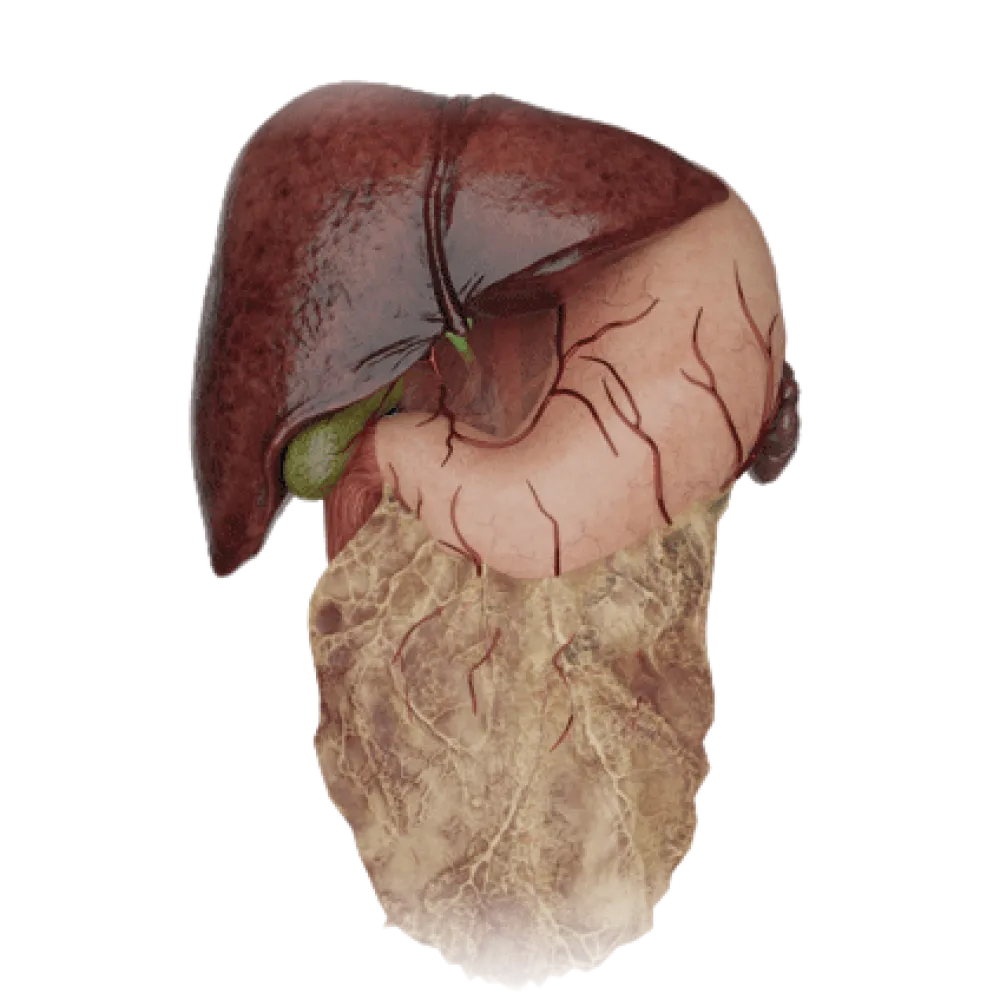
Celiac trunk
0/20

Female pelvic vessels and lymph nodes
0/20

Inferior vena cava and tributaries in females
0/20

Inferior vena cava and tributaries of the male
0/20

Portal vein and its tributaries
0/20

Vessels and lymph nodes of the male pelvis
0/20

Vessels of the abdomen and pelvis of the woman
0/20

Vessels of the male abdomen and pelvis
0/20
Anatomy quiz of the female's abdominal aorta and its branches
Evaluate the knowledge of the female abdominal aorta anatomy. The test evaluates topography, branches, blood supply zones, and the course of the ovarian arteries.
1/20
bold
text
1. At which skeletal level does the abdominal part of the aorta pass through the aortic opening of the diaphragm?
-
At the level of the tenth thoracic vertebra
The abdominal aorta begins at the aortic opening of the diaphragm, located at the level of the body of the twelfth thoracic vertebra (Th12).
-
At the level of the twelfth thoracic vertebra
The abdominal aorta begins at the aortic opening of the diaphragm, located at the level of the body of the twelfth thoracic vertebra (Th12).
-
At the level of the first lumbar vertebra
The abdominal aorta begins at the aortic opening of the diaphragm, located at the level of the body of the twelfth thoracic vertebra (Th12).
-
At the level of the second lumbar vertebra
The abdominal aorta begins at the aortic opening of the diaphragm, located at the level of the body of the twelfth thoracic vertebra (Th12).
-
I find it difficult to answer
The abdominal aorta begins at the aortic opening of the diaphragm, located at the level of the body of the twelfth thoracic vertebra (Th12).
2. At what vertebral level does the bifurcation of the abdominal aorta into the common iliac arteries occur?
-
At the level of the twelfth thoracic vertebra
The bifurcation of the abdominal aorta (bifurcatio aortae) is located at the level of the midbody of the fourth lumbar vertebra (L4).
-
At the level of the second lumbar vertebra
The bifurcation of the abdominal aorta (bifurcatio aortae) is located at the level of the midbody of the fourth lumbar vertebra (L4).
-
At the level of the fourth lumbar vertebra
The bifurcation of the abdominal aorta (bifurcatio aortae) is located at the level of the midbody of the fourth lumbar vertebra (L4).
-
At the level of the first sacral vertebra
The bifurcation of the abdominal aorta (bifurcatio aortae) is located at the level of the midbody of the fourth lumbar vertebra (L4).
-
I find it difficult to answer
The bifurcation of the abdominal aorta (bifurcatio aortae) is located at the level of the midbody of the fourth lumbar vertebra (L4).
3. Which blood vessels correspond to the unpaired visceral branches of the abdominal aorta?
-
Celiac trunk, superior and inferior mesenteric arteries
The unpaired visceral branches of the abdominal aorta include the celiac trunk, superior mesenteric, and inferior mesenteric arteries.
-
Renal, middle adrenal, and ovarian arteries
The unpaired visceral branches of the abdominal aorta include the celiac trunk, superior mesenteric, and inferior mesenteric arteries.
-
Inferior phrenic and lumbar arteries
The unpaired visceral branches of the abdominal aorta include the celiac trunk, superior mesenteric, and inferior mesenteric arteries.
-
Hepatic, gastric and splenic arteries
The unpaired visceral branches of the abdominal aorta include the celiac trunk, superior mesenteric, and inferior mesenteric arteries.
-
I find it difficult to answer
The unpaired visceral branches of the abdominal aorta include the celiac trunk, superior mesenteric, and inferior mesenteric arteries.
4. Identify the paired visceral branches of the abdominal aorta in females:
-
Internal genital, uterine, and umbilical arteries
The paired visceral branches of the female abdominal aorta are middle suprarenal, renal, and ovarian arteries.
-
Inferior phrenic, lumbar, median sacral arteries
The paired visceral branches of the female abdominal aorta are middle suprarenal, renal, and ovarian arteries.
-
Middle suprarenal, renal, ovarian arteries
The paired visceral branches of the female abdominal aorta are middle suprarenal, renal, and ovarian arteries.
-
Celiac trunk, superior and inferior mesenteric arteries
The paired visceral branches of the female abdominal aorta are middle suprarenal, renal, and ovarian arteries.
-
I find it difficult to answer
The paired visceral branches of the female abdominal aorta are middle suprarenal, renal, and ovarian arteries.
5. What is the syntopy of the abdominal aorta relative to the inferior vena cava?
-
Located to the left of the inferior vena cava
The abdominal aorta is located in the retroperitoneal space on the anterior surface of the lumbar vertebral bodies, to the left of the inferior vena cava.
-
Located to the right of the inferior vena cava
The abdominal aorta is located in the retroperitoneal space on the anterior surface of the lumbar vertebral bodies, to the left of the inferior vena cava.
-
It is situated behind the inferior vena cava
The abdominal aorta is located in the retroperitoneal space on the anterior surface of the lumbar vertebral bodies, to the left of the inferior vena cava.
-
Located anterior to the inferior vena cava
The abdominal aorta is located in the retroperitoneal space on the anterior surface of the lumbar vertebral bodies, to the left of the inferior vena cava.
-
I find it difficult to answer
The abdominal aorta is located in the retroperitoneal space on the anterior surface of the lumbar vertebral bodies, to the left of the inferior vena cava.
6. At what level do the ovarian arteries (aa. ovaricae) usually branch from the abdominal aorta?
-
From the renal arteries at level L1
The ovarian arteries branch from the anterolateral surface of the abdominal aorta slightly below the renal arteries, at the level of the second lumbar vertebra.
-
On the anterior surface of the aorta at level Th12
The ovarian arteries branch from the anterolateral surface of the abdominal aorta slightly below the renal arteries, at the level of the second lumbar vertebra.
-
Just above the bifurcation of the aorta at level L4
The ovarian arteries branch from the anterolateral surface of the abdominal aorta slightly below the renal arteries, at the level of the second lumbar vertebra.
-
On the anterolateral surface of the aorta at the level of the body L2
The ovarian arteries branch from the anterolateral surface of the abdominal aorta slightly below the renal arteries, at the level of the second lumbar vertebra.
-
I find it difficult to answer
The ovarian arteries branch from the anterolateral surface of the abdominal aorta slightly below the renal arteries, at the level of the second lumbar vertebra.
7. What arteries are branches of the celiac trunk?
-
Left gastric, common hepatic, splenic
The celiac trunk divides into the left gastric, common hepatic, and splenic arteries.
-
Right gastric, gastroduodenal, splenic
The celiac trunk divides into the left gastric, common hepatic, and splenic arteries.
-
Superior mesenteric, common hepatic, left gastric
The celiac trunk divides into the left gastric, common hepatic, and splenic arteries.
-
Left gastro-omental, right gastric, common hepatic
The celiac trunk divides into the left gastric, common hepatic, and splenic arteries.
-
I find it difficult to answer
The celiac trunk divides into the left gastric, common hepatic, and splenic arteries.
8. Within which anatomical structure does the ovarian artery descend into the pelvic cavity?
-
Round ligament of the uterus
The ovarian artery descends into the minor pelvis and approaches the ovary in the thickness of the suspensory ligament of the ovary (ligamentum suspensorium ovarii).
-
Suspensory ligament of the ovary
The ovarian artery descends into the minor pelvis and approaches the ovary in the thickness of the suspensory ligament of the ovary (ligamentum suspensorium ovarii).
-
Proper ovarian ligament
The ovarian artery descends into the minor pelvis and approaches the ovary in the thickness of the suspensory ligament of the ovary (ligamentum suspensorium ovarii).
-
Broad ligament of the uterus (its base)
The ovarian artery descends into the minor pelvis and approaches the ovary in the thickness of the suspensory ligament of the ovary (ligamentum suspensorium ovarii).
-
I find it difficult to answer
The ovarian artery descends into the minor pelvis and approaches the ovary in the thickness of the suspensory ligament of the ovary (ligamentum suspensorium ovarii).
9. At what level does the superior mesenteric artery branch off?
-
At the level of the III lumbar vertebra
The superior mesenteric artery branches from the anterior surface of the abdominal aorta at the level of the first lumbar vertebra (L1).
-
At the level of the first lumbar vertebra
The superior mesenteric artery branches from the anterior surface of the abdominal aorta at the level of the first lumbar vertebra (L1).
-
At the level of the twelfth thoracic vertebra
The superior mesenteric artery branches from the anterior surface of the abdominal aorta at the level of the first lumbar vertebra (L1).
-
At the level of the sacral promontory
The superior mesenteric artery branches from the anterior surface of the abdominal aorta at the level of the first lumbar vertebra (L1).
-
I find it difficult to answer
The superior mesenteric artery branches from the anterior surface of the abdominal aorta at the level of the first lumbar vertebra (L1).
10. Which anatomical structures are located directly anterior to the abdominal part of the aorta?
-
Stomach, transverse colon, right ureter
In front of the abdominal aorta are the body of the pancreas, left renal vein, and horizontal part of the duodenum.
-
Head of the pancreas, right renal vein, portal vein
In front of the abdominal aorta are the body of the pancreas, left renal vein, and horizontal part of the duodenum.
-
Body of the pancreas, left renal vein, horizontal part of the duodenum
In front of the abdominal aorta are the body of the pancreas, left renal vein, and horizontal part of the duodenum.
-
Tail of the pancreas, splenic vein, left adrenal gland
In front of the abdominal aorta are the body of the pancreas, left renal vein, and horizontal part of the duodenum.
-
I find it difficult to answer
In front of the abdominal aorta are the body of the pancreas, left renal vein, and horizontal part of the duodenum.
11. Indicate the parietal branches of the abdominal aorta:
-
Intercostal, subcostal, and lumbar arteries
The parietal branches include the inferior phrenic arteries, four pairs of lumbar arteries, and the median sacral artery
-
Lumbar, superior phrenic, and iliolumbar arteries
The parietal branches include the inferior phrenic arteries, four pairs of lumbar arteries, and the median sacral artery
-
Median sacral, lateral sacral, and inferior phrenic arteries
The parietal branches include the inferior phrenic arteries, four pairs of lumbar arteries, and the median sacral artery
-
Inferior phrenic, lumbar, median sacral arteries
The parietal branches include the inferior phrenic arteries, four pairs of lumbar arteries, and the median sacral artery
-
I find it difficult to answer
The parietal branches include the inferior phrenic arteries, four pairs of lumbar arteries, and the median sacral artery
12. Which artery forms a pronounced anastomosis with the ovarian artery in the region of the uterine appendages?
-
With the uterine artery (its ovarian branch)
The ovarian artery widely anastomoses with the ovarian branch of the uterine artery in the mesovarium
-
With the vaginal artery
The ovarian artery widely anastomoses with the ovarian branch of the uterine artery in the mesovarium
-
With the internal pudendal artery
The ovarian artery widely anastomoses with the ovarian branch of the uterine artery in the mesovarium
-
With the obturator artery
The ovarian artery widely anastomoses with the ovarian branch of the uterine artery in the mesovarium
-
I find it difficult to answer
The ovarian artery widely anastomoses with the ovarian branch of the uterine artery in the mesovarium
13. Where does the median sacral artery originate?
-
From the posterior surface of the aorta just above its bifurcation
The median sacral artery branches from the posterior surface of the abdominal aorta at the level of L4 and is its rudimentary continuation.
-
From the celiac trunk
The median sacral artery branches from the posterior surface of the abdominal aorta at the level of L4 and is its rudimentary continuation.
-
From the internal iliac artery.
The median sacral artery branches from the posterior surface of the abdominal aorta at the level of L4 and is its rudimentary continuation.
-
From the inferior mesenteric artery.
The median sacral artery branches from the posterior surface of the abdominal aorta at the level of L4 and is its rudimentary continuation.
-
I find it difficult to answer
The median sacral artery branches from the posterior surface of the abdominal aorta at the level of L4 and is its rudimentary continuation.
14. What is the peculiarity of the topography of the right renal artery compared to the left?
-
It is shorter and passes anterior to the inferior vena cava
The right renal artery is longer than the left and passes behind the inferior vena cava to the hilum of the right kidney.
-
It is longer and passes behind the inferior vena cava
The right renal artery is longer than the left and passes behind the inferior vena cava to the hilum of the right kidney.
-
It is longer and passes anterior to the inferior vena cava
The right renal artery is longer than the left and passes behind the inferior vena cava to the hilum of the right kidney.
-
It is shorter and passes behind the abdominal aorta
The right renal artery is longer than the left and passes behind the inferior vena cava to the hilum of the right kidney.
-
I find it difficult to answer
The right renal artery is longer than the left and passes behind the inferior vena cava to the hilum of the right kidney.
15. What is the topographical feature of the middle suprarenal artery departure?
-
It arises from the inferior phrenic artery
The middle suprarenal artery originates from the lateral wall of the abdominal aorta at the level of the origin of the superior mesenteric artery (L1).
-
It originates from the anterior surface of the aorta, below the renal arteries
The middle suprarenal artery originates from the lateral wall of the abdominal aorta at the level of the origin of the superior mesenteric artery (L1).
-
It originates from the lateral surface of the aorta at the level of the superior mesenteric artery
The middle suprarenal artery originates from the lateral wall of the abdominal aorta at the level of the origin of the superior mesenteric artery (L1).
-
It arises from the renal artery at the renal hilum
The middle suprarenal artery originates from the lateral wall of the abdominal aorta at the level of the origin of the superior mesenteric artery (L1).
-
I find it difficult to answer
The middle suprarenal artery originates from the lateral wall of the abdominal aorta at the level of the origin of the superior mesenteric artery (L1).
16. At what level does the inferior mesenteric artery branch from the abdominal aorta?
-
At the Th12 level
The inferior mesenteric artery branches off from the left anterolateral surface of the abdominal aorta at the level of the body of the third lumbar vertebra (L3).
-
At the L1 level
The inferior mesenteric artery branches off from the left anterolateral surface of the abdominal aorta at the level of the body of the third lumbar vertebra (L3).
-
At the L5 level
The inferior mesenteric artery branches off from the left anterolateral surface of the abdominal aorta at the level of the body of the third lumbar vertebra (L3).
-
At the L3 level
The inferior mesenteric artery branches off from the left anterolateral surface of the abdominal aorta at the level of the body of the third lumbar vertebra (L3).
-
I find it difficult to answer
The inferior mesenteric artery branches off from the left anterolateral surface of the abdominal aorta at the level of the body of the third lumbar vertebra (L3).
17. How does the right ovarian artery pass in relation to the inferior vena cava and ureter?
-
Behind the inferior vena cava and behind the right ureter
The right ovarian artery descends along the anterior surface of the inferior vena cava and crosses in front of the right ureter.
-
In front of the inferior vena cava and in front of the right ureter
The right ovarian artery descends along the anterior surface of the inferior vena cava and crosses in front of the right ureter.
-
In front of the inferior vena cava and behind the right ureter
The right ovarian artery descends along the anterior surface of the inferior vena cava and crosses in front of the right ureter.
-
Behind the inferior vena cava and in front of the right ureter
The right ovarian artery descends along the anterior surface of the inferior vena cava and crosses in front of the right ureter.
-
I find it difficult to answer
The right ovarian artery descends along the anterior surface of the inferior vena cava and crosses in front of the right ureter.
18. Which vessels are branches of the inferior mesenteric artery?
-
Left colic, sigmoid, and superior rectal arteries
The inferior mesenteric artery gives rise to the left colic, sigmoid, and superior rectal arteries.
-
Ileocolic, right and middle colic arteries
The inferior mesenteric artery gives rise to the left colic, sigmoid, and superior rectal arteries.
-
Middle rectal, inferior rectal, and sigmoid arteries
The inferior mesenteric artery gives rise to the left colic, sigmoid, and superior rectal arteries.
-
Left gastric, middle colic, and superior rectal arteries
The inferior mesenteric artery gives rise to the left colic, sigmoid, and superior rectal arteries.
-
I find it difficult to answer
The inferior mesenteric artery gives rise to the left colic, sigmoid, and superior rectal arteries.
19. Which artery involved in the adrenal gland's blood supply originates from the inferior phrenic artery?
-
Superior suprarenal artery
The superior suprarenal arteries originate from the inferior phrenic artery.
-
Middle suprarenal artery
The superior suprarenal arteries originate from the inferior phrenic artery.
-
Inferior suprarenal artery
The superior suprarenal arteries originate from the inferior phrenic artery.
-
Accessory renal artery
The superior suprarenal arteries originate from the inferior phrenic artery.
-
I find it difficult to answer
The superior suprarenal arteries originate from the inferior phrenic artery.
20. How are the lumbar arteries positioned in relation to the sympathetic trunk?
-
Pass in front of the sympathetic trunk
The lumbar arteries curve around the bodies of the lumbar vertebrae and pass posteriorly to the sympathetic trunks and the psoas major muscle.
-
Pierce through the sympathetic trunk
The lumbar arteries curve around the bodies of the lumbar vertebrae and pass posteriorly to the sympathetic trunks and the psoas major muscle.
-
Pass behind the sympathetic trunk
The lumbar arteries curve around the bodies of the lumbar vertebrae and pass posteriorly to the sympathetic trunks and the psoas major muscle.
-
Are located laterally to the sympathetic trunk, without crossing it
The lumbar arteries curve around the bodies of the lumbar vertebrae and pass posteriorly to the sympathetic trunks and the psoas major muscle.
-
I find it difficult to answer
The lumbar arteries curve around the bodies of the lumbar vertebrae and pass posteriorly to the sympathetic trunks and the psoas major muscle.
Retake this quiz?
Your current progress will be reset.