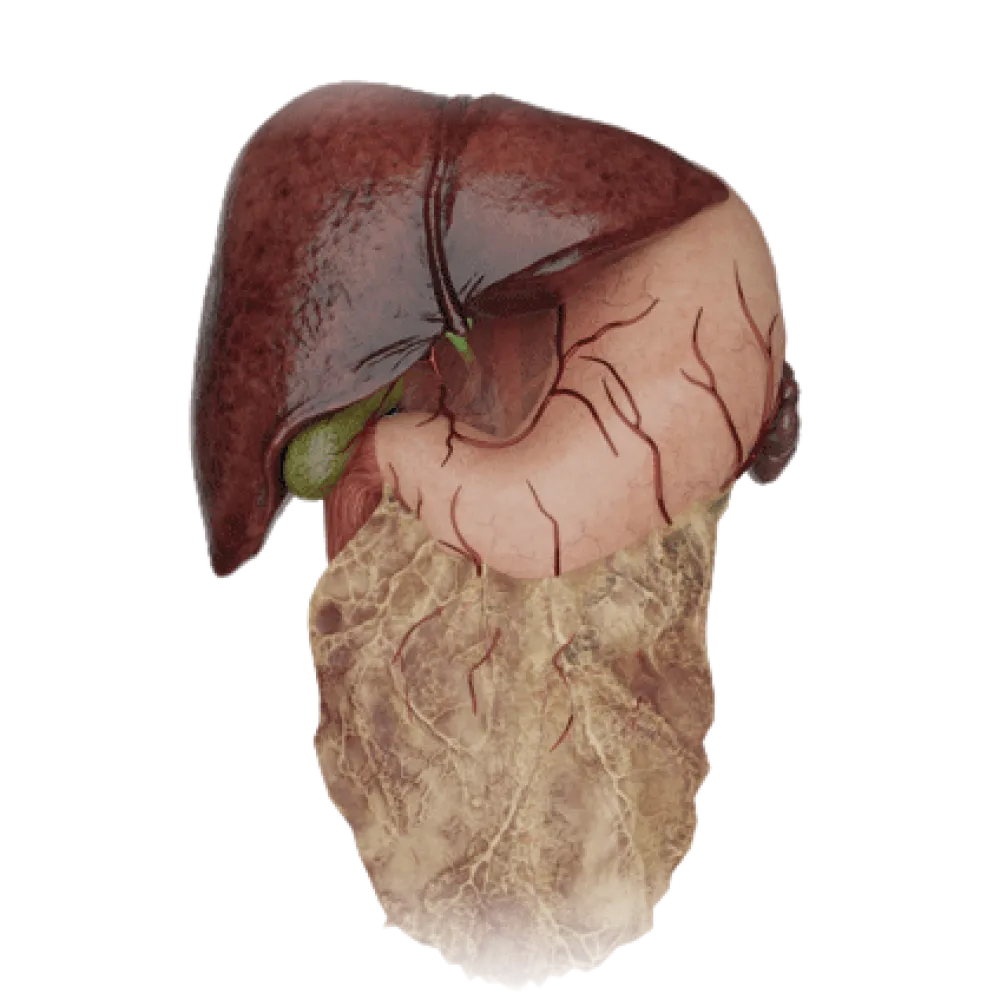
Test on the anatomy of the abdominal and pelvic vessels
Evaluate knowledge of the anatomy of the abdominal and pelvic vessels. The test covers the topography, branching, blood supply areas and anastomoses of arteries and veins.
1/20
0%
bold
text
1. Which of the following arteries is a paired visceral branch of the abdominal aorta?
Superior mesenteric artery
The paired visceral branches of the abdominal aorta are the middle suprarenal, renal and testicular (ovarian) arteries.
Middle suprarenal artery
The paired visceral branches of the abdominal aorta are the middle suprarenal, renal and testicular (ovarian) arteries.
Inferior phrenic artery
The paired visceral branches of the abdominal aorta are the middle suprarenal, renal and testicular (ovarian) arteries.
Median sacral artery
The paired visceral branches of the abdominal aorta are the middle suprarenal, renal and testicular (ovarian) arteries.
I find it difficult to answer
The paired visceral branches of the abdominal aorta are the middle suprarenal, renal and testicular (ovarian) arteries.
2. Which arteries arise directly from the celiac trunk?
Right gastric, proper hepatic, splenic
The celiac trunk typically divides into three branches: the left gastric, common hepatic, and splenic arteries.
Left gastro-omental, left gastric, common hepatic
The celiac trunk typically divides into three branches: the left gastric, common hepatic, and splenic arteries.
Left gastric, common hepatic, splenic
The celiac trunk typically divides into three branches: the left gastric, common hepatic, and splenic arteries.
Superior mesenteric, common hepatic, left gastric
The celiac trunk typically divides into three branches: the left gastric, common hepatic, and splenic arteries.
I find it difficult to answer
The celiac trunk typically divides into three branches: the left gastric, common hepatic, and splenic arteries.
3. From which artery does the cystic artery most frequently branch off?
From the left branch of the proper hepatic artery
The cystic artery usually branches from the right branch of the proper hepatic artery within the hepatocystic triangle.
From the gastroduodenal artery
The cystic artery usually branches from the right branch of the proper hepatic artery within the hepatocystic triangle.
From the common hepatic artery
The cystic artery usually branches from the right branch of the proper hepatic artery within the hepatocystic triangle.
From the right branch of the proper hepatic artery
The cystic artery usually branches from the right branch of the proper hepatic artery within the hepatocystic triangle.
I find it difficult to answer
The cystic artery usually branches from the right branch of the proper hepatic artery within the hepatocystic triangle.
4. Which vein forms a portocaval anastomosis at the cardia of the stomach, connecting the portal vein system with the superior vena cava?
Left gastric vein = Coronary vein (with right gastric vein)
The left gastric vein (tributary of the portal vein) anastomoses with esophageal veins, which carry blood into the azygos vein (system of the superior vena cava).
Right gastroomental vein = Right gastroepiploic vein = Right gastro-epiploic vein
The left gastric vein (tributary of the portal vein) anastomoses with esophageal veins, which carry blood into the azygos vein (system of the superior vena cava).
Splenic vein
The left gastric vein (tributary of the portal vein) anastomoses with esophageal veins, which carry blood into the azygos vein (system of the superior vena cava).
Short gastric veins
The left gastric vein (tributary of the portal vein) anastomoses with esophageal veins, which carry blood into the azygos vein (system of the superior vena cava).
I find it difficult to answer
The left gastric vein (tributary of the portal vein) anastomoses with esophageal veins, which carry blood into the azygos vein (system of the superior vena cava).
5. What is the topography of the left renal vein in relation to the abdominal aorta and superior mesenteric artery?
It passes behind the aorta and in front of the spine
The left renal vein crosses the aorta anteriorly, located in the aortomesenteric pinch behind the superior mesenteric artery.
It passes in front of the aorta and behind the superior mesenteric artery
The left renal vein crosses the aorta anteriorly, located in the aortomesenteric pinch behind the superior mesenteric artery.
It passes in front of the superior mesenteric artery
The left renal vein crosses the aorta anteriorly, located in the aortomesenteric pinch behind the superior mesenteric artery.
It passes behind the inferior vena cava
The left renal vein crosses the aorta anteriorly, located in the aortomesenteric pinch behind the superior mesenteric artery.
I find it difficult to answer
The left renal vein crosses the aorta anteriorly, located in the aortomesenteric pinch behind the superior mesenteric artery.
6. Indicate the sources of arterial blood supply to the suprarenal gland:
Celiac trunk, renal artery, lumbar arteries
The suprarenal gland is supplied by the superior suprarenal artery (from the inferior phrenic), the middle (from the abdominal aorta) and the inferior (from the renal artery).
Superior mesenteric artery, abdominal aorta, inferior phrenic artery
The suprarenal gland is supplied by the superior suprarenal artery (from the inferior phrenic), the middle (from the abdominal aorta) and the inferior (from the renal artery).
Renal artery, gonadal artery, abdominal aorta
The suprarenal gland is supplied by the superior suprarenal artery (from the inferior phrenic), the middle (from the abdominal aorta) and the inferior (from the renal artery).
The suprarenal gland is supplied by the superior suprarenal artery (from the inferior phrenic), the middle (from the abdominal aorta) and the inferior (from the renal artery).
I find it difficult to answer
The suprarenal gland is supplied by the superior suprarenal artery (from the inferior phrenic), the middle (from the abdominal aorta) and the inferior (from the renal artery).
7. Which of the following arteries is a parietal branch of the internal iliac artery?
Middle rectal artery
The obturator artery is classified as a parietal branch of the internal iliac artery, supplying the muscles of the pelvis and thigh.
Uterine artery
The obturator artery is classified as a parietal branch of the internal iliac artery, supplying the muscles of the pelvis and thigh.
Obturator artery
The obturator artery is classified as a parietal branch of the internal iliac artery, supplying the muscles of the pelvis and thigh.
Inferior vesical artery
The obturator artery is classified as a parietal branch of the internal iliac artery, supplying the muscles of the pelvis and thigh.
I find it difficult to answer
The obturator artery is classified as a parietal branch of the internal iliac artery, supplying the muscles of the pelvis and thigh.
8. Which vein drains directly into the left renal vein?
Left testicular (ovarian) vein
The left gonadal vein drains into the left renal vein at a right angle, whereas the right gonadal vein drains directly into the inferior vena cava.
Right testicular (ovarian) vein
The left gonadal vein drains into the left renal vein at a right angle, whereas the right gonadal vein drains directly into the inferior vena cava.
Inferior mesenteric vein
The left gonadal vein drains into the left renal vein at a right angle, whereas the right gonadal vein drains directly into the inferior vena cava.
Left hepatic vein
The left gonadal vein drains into the left renal vein at a right angle, whereas the right gonadal vein drains directly into the inferior vena cava.
I find it difficult to answer
The left gonadal vein drains into the left renal vein at a right angle, whereas the right gonadal vein drains directly into the inferior vena cava.
9. At what vertebral level does the bifurcation of the abdominal aorta into the common iliac arteries typically occur?
At the level of the twelfth thoracic vertebra
The bifurcation of the aorta is located at the level of the body of the fourth lumbar vertebra.
At the level of the second lumbar vertebra
The bifurcation of the aorta is located at the level of the body of the fourth lumbar vertebra.
At the level of the sacral promontory
The bifurcation of the aorta is located at the level of the body of the fourth lumbar vertebra.
At the level of the fourth lumbar vertebra
The bifurcation of the aorta is located at the level of the body of the fourth lumbar vertebra.
I find it difficult to answer
The bifurcation of the aorta is located at the level of the body of the fourth lumbar vertebra.
10. Through which anatomical structure does the internal pudendal artery exit the lesser pelvis?
Suprapiriform foramen
The internal pudendal artery exits the lesser pelvis through the infrapiriformis foramen, circles the ischial spine, and returns to the perineum.
Infrapiriform foramen
The internal pudendal artery exits the lesser pelvis through the infrapiriformis foramen, circles the ischial spine, and returns to the perineum.
Obturator canal
The internal pudendal artery exits the lesser pelvis through the infrapiriformis foramen, circles the ischial spine, and returns to the perineum.
Lesser sciatic foramen
The internal pudendal artery exits the lesser pelvis through the infrapiriformis foramen, circles the ischial spine, and returns to the perineum.
I find it difficult to answer
The internal pudendal artery exits the lesser pelvis through the infrapiriformis foramen, circles the ischial spine, and returns to the perineum.
11. From which merging veins is the hepatic portal vein primarily formed?
Superior and inferior mesenteric veins
The portal vein is formed behind the head of the pancreas by the merging of the superior mesenteric and splenic veins.
Right and left gastric veins
The portal vein is formed behind the head of the pancreas by the merging of the superior mesenteric and splenic veins.
Superior mesenteric vein and splenic vein
The portal vein is formed behind the head of the pancreas by the merging of the superior mesenteric and splenic veins.
Hepatic veins and inferior vena cava
The portal vein is formed behind the head of the pancreas by the merging of the superior mesenteric and splenic veins.
I find it difficult to answer
The portal vein is formed behind the head of the pancreas by the merging of the superior mesenteric and splenic veins.
12. Which artery forms Riolan's anastomosis between the basins of the superior and inferior mesenteric arteries?
Left colic artery and middle colic artery
Riolan's anastomosis connects the middle colic artery (from the superior mesenteric) and the left colic artery (from the inferior mesenteric).
Ileocolic artery and right colic artery
Riolan's anastomosis connects the middle colic artery (from the superior mesenteric) and the left colic artery (from the inferior mesenteric).
Sigmoid arteries and superior rectal artery
Riolan's anastomosis connects the middle colic artery (from the superior mesenteric) and the left colic artery (from the inferior mesenteric).
Right colic artery and middle colic artery
Riolan's anastomosis connects the middle colic artery (from the superior mesenteric) and the left colic artery (from the inferior mesenteric).
I find it difficult to answer
Riolan's anastomosis connects the middle colic artery (from the superior mesenteric) and the left colic artery (from the inferior mesenteric).
13. Specify the correct topography of the uterine artery in relation to the ureter:
The artery passes behind the ureter
The uterine artery crosses the ureter anteriorly and superiorly at the base of the broad ligament of the uterus.
The artery passes in front and above the ureter, crossing it
The uterine artery crosses the ureter anteriorly and superiorly at the base of the broad ligament of the uterus.
The artery passes medially to the ureter, not crossing it
The uterine artery crosses the ureter anteriorly and superiorly at the base of the broad ligament of the uterus.
The artery and the ureter run parallel, not intersecting
The uterine artery crosses the ureter anteriorly and superiorly at the base of the broad ligament of the uterus.
I find it difficult to answer
The uterine artery crosses the ureter anteriorly and superiorly at the base of the broad ligament of the uterus.
14. Which vein drains blood from the lower third of the rectum into the inferior vena cava?
Superior rectal vein
The inferior rectal vein drains into the internal pudendal vein, which is a tributary of the internal iliac vein (system of the inferior vena cava).
Middle rectal vein
The inferior rectal vein drains into the internal pudendal vein, which is a tributary of the internal iliac vein (system of the inferior vena cava).
Median sacral vein
The inferior rectal vein drains into the internal pudendal vein, which is a tributary of the internal iliac vein (system of the inferior vena cava).
Inferior rectal vein
The inferior rectal vein drains into the internal pudendal vein, which is a tributary of the internal iliac vein (system of the inferior vena cava).
I find it difficult to answer
The inferior rectal vein drains into the internal pudendal vein, which is a tributary of the internal iliac vein (system of the inferior vena cava).
15. Which artery continues from the inferior mesenteric artery in the lesser pelvis?
Middle rectal artery
The superior rectal artery is the terminal branch of the inferior mesenteric artery, supplying the rectal ampulla.
Inferior rectal artery
The superior rectal artery is the terminal branch of the inferior mesenteric artery, supplying the rectal ampulla.
Superior rectal artery
The superior rectal artery is the terminal branch of the inferior mesenteric artery, supplying the rectal ampulla.
Left colic artery
The superior rectal artery is the terminal branch of the inferior mesenteric artery, supplying the rectal ampulla.
I find it difficult to answer
The superior rectal artery is the terminal branch of the inferior mesenteric artery, supplying the rectal ampulla.
16. From which vessel does the appendicular artery originate?
From the ileocolic artery
The appendicular artery is most frequently a branch of the ileocolic artery.
From the right colic artery
The appendicular artery is most frequently a branch of the ileocolic artery.
Directly from the superior mesenteric artery
The appendicular artery is most frequently a branch of the ileocolic artery.
From the middle colic artery
The appendicular artery is most frequently a branch of the ileocolic artery.
I find it difficult to answer
The appendicular artery is most frequently a branch of the ileocolic artery.
17. How is the splenic artery positioned in relation to the pancreas?
It runs along the inferior border of the pancreas body
The splenic artery has a tortuous course and moves leftwards along the superior edge of the pancreas towards the hilum of the spleen.
It runs within the parenchyma of the head of the pancreas
The splenic artery has a tortuous course and moves leftwards along the superior edge of the pancreas towards the hilum of the spleen.
Passes anteriorly to the head of the pancreas
The splenic artery has a tortuous course and moves leftwards along the superior edge of the pancreas towards the hilum of the spleen.
Passes along the superior border of the body and tail of the pancreas
The splenic artery has a tortuous course and moves leftwards along the superior edge of the pancreas towards the hilum of the spleen.
I find it difficult to answer
The splenic artery has a tortuous course and moves leftwards along the superior edge of the pancreas towards the hilum of the spleen.
18. Which of the following is a tributary of the inferior vena cava in the abdominal cavity?
Splenic vein
The hepatic veins collect blood from the liver parenchyma and flow directly into the inferior vena cava within its corresponding groove.
Hepatic veins
The hepatic veins collect blood from the liver parenchyma and flow directly into the inferior vena cava within its corresponding groove.
Left gastric vein = Coronary vein (with right gastric vein)
The hepatic veins collect blood from the liver parenchyma and flow directly into the inferior vena cava within its corresponding groove.
Superior mesenteric vein
The hepatic veins collect blood from the liver parenchyma and flow directly into the inferior vena cava within its corresponding groove.
I find it difficult to answer
The hepatic veins collect blood from the liver parenchyma and flow directly into the inferior vena cava within its corresponding groove.
19. Which structure is supplied by branches of the gastroduodenal artery?
Tail of the pancreas and spleen
Branches of the gastroduodenal artery give rise to the superior pancreaticoduodenal arteries, which supply the duodenum and the head of the pancreas.
Fundus of the stomach and diaphragm
Branches of the gastroduodenal artery give rise to the superior pancreaticoduodenal arteries, which supply the duodenum and the head of the pancreas.
Head of the pancreas and duodenum
Branches of the gastroduodenal artery give rise to the superior pancreaticoduodenal arteries, which supply the duodenum and the head of the pancreas.
Gallbladder and right lobe of the liver
Branches of the gastroduodenal artery give rise to the superior pancreaticoduodenal arteries, which supply the duodenum and the head of the pancreas.
I find it difficult to answer
Branches of the gastroduodenal artery give rise to the superior pancreaticoduodenal arteries, which supply the duodenum and the head of the pancreas.
20. Which artery branching from the internal iliac has a functioning part in adults and an obliterated distal part forming the medial umbilical fold?
Umbilical artery
In adults, the umbilical artery retains a lumen in the proximal section, but distally it obliterates, forming the medial umbilical ligament.
Uterine artery
In adults, the umbilical artery retains a lumen in the proximal section, but distally it obliterates, forming the medial umbilical ligament.
Obturator artery
In adults, the umbilical artery retains a lumen in the proximal section, but distally it obliterates, forming the medial umbilical ligament.
Psoas artery (iliolumbar artery)
In adults, the umbilical artery retains a lumen in the proximal section, but distally it obliterates, forming the medial umbilical ligament.
I find it difficult to answer
In adults, the umbilical artery retains a lumen in the proximal section, but distally it obliterates, forming the medial umbilical ligament.