


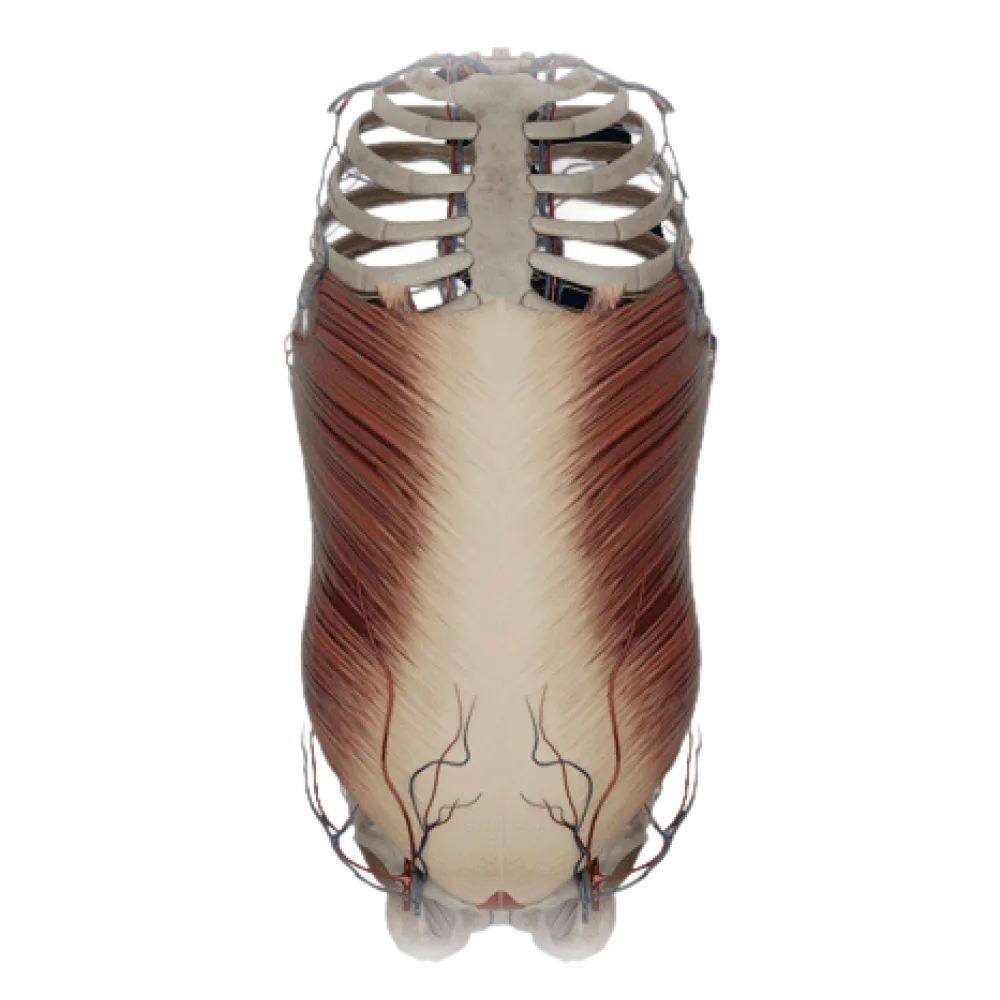

Anatomy test of female abdominal and pelvic muscles
Check knowledge of female abdominal and pelvic muscles. The test covers the topography of the pelvic floor, perineum, fascia, and structural features.
1/20
bold
text
1. Which muscle bundles accompany the round ligament of the uterus in the female inguinal canal?
-
Branches of m. pyramidalis
In females, muscle bundles analogous to m. cremaster in males are weakly developed and accompany the round ligament of the uterus in the inguinal canal.
-
Bundles of m. cremaster
In females, muscle bundles analogous to m. cremaster in males are weakly developed and accompany the round ligament of the uterus in the inguinal canal.
-
Fibers of m. rectus abdominis
In females, muscle bundles analogous to m. cremaster in males are weakly developed and accompany the round ligament of the uterus in the inguinal canal.
-
Bundles of m. transversus perinei profundus
In females, muscle bundles analogous to m. cremaster in males are weakly developed and accompany the round ligament of the uterus in the inguinal canal.
-
I find it difficult to answer
In females, muscle bundles analogous to m. cremaster in males are weakly developed and accompany the round ligament of the uterus in the inguinal canal.
2. What characteristic of the bulbospongiosus muscle (m. bulbospongiosus) is typical for women?
-
It is not divided into two halves and completely covers the clitoris
Unlike in men, in women, m. bulbospongiosus is divided into two symmetrical halves surrounding the vaginal opening and bulb of the vestibule.
-
It is absent in women
Unlike in men, in women, m. bulbospongiosus is divided into two symmetrical halves surrounding the vaginal opening and bulb of the vestibule.
-
It splits, surrounding the vagina and bulb of the vestibule
Unlike in men, in women, m. bulbospongiosus is divided into two symmetrical halves surrounding the vaginal opening and bulb of the vestibule.
-
It only weaves into the external anal sphincter
Unlike in men, in women, m. bulbospongiosus is divided into two symmetrical halves surrounding the vaginal opening and bulb of the vestibule.
-
I find it difficult to answer
Unlike in men, in women, m. bulbospongiosus is divided into two symmetrical halves surrounding the vaginal opening and bulb of the vestibule.
3. Which part of the muscle that lifts the anus forms a loop around the vagina, functioning as its sphincter in women?
-
M. iliococcygeus
The pubovaginal muscle (m. pubovaginalis) is the medial portion of the pubococcygeus muscle and encompasses the vagina.
-
M. pubococcygeus (pars pubovaginalis)
The pubovaginal muscle (m. pubovaginalis) is the medial portion of the pubococcygeus muscle and encompasses the vagina.
-
M. ischiococcygeus
The pubovaginal muscle (m. pubovaginalis) is the medial portion of the pubococcygeus muscle and encompasses the vagina.
-
M. puborectalis
The pubovaginal muscle (m. pubovaginalis) is the medial portion of the pubococcygeus muscle and encompasses the vagina.
-
I find it difficult to answer
The pubovaginal muscle (m. pubovaginalis) is the medial portion of the pubococcygeus muscle and encompasses the vagina.
4. Which muscle is located in the deep perineal space (spatium perinei profundum) in women, encircling the urethra and vagina?
-
M. sphincter urethrovaginalis
The urethrovaginal sphincter (m. sphincter urethrovaginalis) is situated in the deep pouch of the perineum and encircles both the urethra and vagina.
-
M. bulbospongiosus
The urethrovaginal sphincter (m. sphincter urethrovaginalis) is situated in the deep pouch of the perineum and encircles both the urethra and vagina.
-
M. ischiocavernosus
The urethrovaginal sphincter (m. sphincter urethrovaginalis) is situated in the deep pouch of the perineum and encircles both the urethra and vagina.
-
M. pubococcygeus
The urethrovaginal sphincter (m. sphincter urethrovaginalis) is situated in the deep pouch of the perineum and encircles both the urethra and vagina.
-
I find it difficult to answer
The urethrovaginal sphincter (m. sphincter urethrovaginalis) is situated in the deep pouch of the perineum and encircles both the urethra and vagina.
5. What structure does the ischiocavernosus muscle (m. ischiocavernosus) cover in the female perineum?
-
Bulb of vestibule
In women, m. ischiocavernosus starts at the ischial tuberosities and covers the crura of the clitoris (crura clitoridis), participating in its erection.
-
Greater vestibular glands
In women, m. ischiocavernosus starts at the ischial tuberosities and covers the crura of the clitoris (crura clitoridis), participating in its erection.
-
External opening of the urethra
In women, m. ischiocavernosus starts at the ischial tuberosities and covers the crura of the clitoris (crura clitoridis), participating in its erection.
-
Crura of the clitoris
In women, m. ischiocavernosus starts at the ischial tuberosities and covers the crura of the clitoris (crura clitoridis), participating in its erection.
-
I find it difficult to answer
In women, m. ischiocavernosus starts at the ischial tuberosities and covers the crura of the clitoris (crura clitoridis), participating in its erection.
6. Which muscle does NOT attach to the perineal body (centrum tendineum perinei) in women?
-
M. bulbospongiosus
The ischiocavernosus muscle attaches to the ischiopubic rami and crura of the clitoris, not reaching the perineal body.
-
M. transversus perinei superficialis
The ischiocavernosus muscle attaches to the ischiopubic rami and crura of the clitoris, not reaching the perineal body.
-
M. ischiocavernosus
The ischiocavernosus muscle attaches to the ischiopubic rami and crura of the clitoris, not reaching the perineal body.
-
M. sphincter ani externus
The ischiocavernosus muscle attaches to the ischiopubic rami and crura of the clitoris, not reaching the perineal body.
-
I find it difficult to answer
The ischiocavernosus muscle attaches to the ischiopubic rami and crura of the clitoris, not reaching the perineal body.
7. How is the posterior layer of the rectus sheath formed below the arcuate line (linea arcuata)?
-
Represented only by the aponeurosis of the transverse muscle
Below the arcuate line, all aponeuroses of the broad muscles transition to the anterior wall, thus posteriorly covering the rectus abdominis with only the transverse fascia.
-
Formed only by the Toldt's fascia
Below the arcuate line, all aponeuroses of the broad muscles transition to the anterior wall, thus posteriorly covering the rectus abdominis with only the transverse fascia.
-
Represented only by the transverse fascia (fascia transversalis)
Below the arcuate line, all aponeuroses of the broad muscles transition to the anterior wall, thus posteriorly covering the rectus abdominis with only the transverse fascia.
-
Formed by the aponeuroses of the internal oblique and transversus muscles
Below the arcuate line, all aponeuroses of the broad muscles transition to the anterior wall, thus posteriorly covering the rectus abdominis with only the transverse fascia.
-
I find it difficult to answer
Below the arcuate line, all aponeuroses of the broad muscles transition to the anterior wall, thus posteriorly covering the rectus abdominis with only the transverse fascia.
8. Of which artery is a branch epigastrica inferior, supplying the rectus abdominis from below?
-
A. iliaca interna
The inferior epigastric artery branches from the external iliac artery (a. iliaca externa) just before its passage under the inguinal ligament
-
A. femoralis
The inferior epigastric artery branches from the external iliac artery (a. iliaca externa) just before its passage under the inguinal ligament
-
A. obturatoria
The inferior epigastric artery branches from the external iliac artery (a. iliaca externa) just before its passage under the inguinal ligament
-
A. iliaca externa
The inferior epigastric artery branches from the external iliac artery (a. iliaca externa) just before its passage under the inguinal ligament
-
I find it difficult to answer
The inferior epigastric artery branches from the external iliac artery (a. iliaca externa) just before its passage under the inguinal ligament
9. Which small pelvis muscle passes through the greater sciatic foramen (foramen ischiadicum majus)?
-
M. obturatorius internus
The piriformis muscle originates on the anterior surface of the sacrum and exits the pelvis via the greater sciatic foramen.
-
M. levator ani
The piriformis muscle originates on the anterior surface of the sacrum and exits the pelvis via the greater sciatic foramen.
-
M. piriformis
The piriformis muscle originates on the anterior surface of the sacrum and exits the pelvis via the greater sciatic foramen.
-
M. coccygeus
The piriformis muscle originates on the anterior surface of the sacrum and exits the pelvis via the greater sciatic foramen.
-
I find it difficult to answer
The piriformis muscle originates on the anterior surface of the sacrum and exits the pelvis via the greater sciatic foramen.
10. What exits through the superficial inguinal ring in females?
-
Round ligament of the uterus
In females, the inguinal canal is significantly narrower than in males and contains the round ligament of the uterus (lig. teres uteri) and n. ilioinguinalis.
-
Proper ovarian ligament
In females, the inguinal canal is significantly narrower than in males and contains the round ligament of the uterus (lig. teres uteri) and n. ilioinguinalis.
-
Iliohypogastric nerve
In females, the inguinal canal is significantly narrower than in males and contains the round ligament of the uterus (lig. teres uteri) and n. ilioinguinalis.
-
Uterine artery
In females, the inguinal canal is significantly narrower than in males and contains the round ligament of the uterus (lig. teres uteri) and n. ilioinguinalis.
-
I find it difficult to answer
In females, the inguinal canal is significantly narrower than in males and contains the round ligament of the uterus (lig. teres uteri) and n. ilioinguinalis.
11. Which muscles form the pelvic diaphragm (diaphragma pelvis)?
-
M. levator ani and m. coccygeus
The pelvic diaphragm (pelvic floor) is composed of the levator ani muscle (m. levator ani) and the coccygeus muscle (m. coccygeus).
-
M. obturatorius internus and m. piriformis
The pelvic diaphragm (pelvic floor) is composed of the levator ani muscle (m. levator ani) and the coccygeus muscle (m. coccygeus).
-
M. transversus perinei profundus et m. sphincter urethrae externus
The pelvic diaphragm (pelvic floor) is composed of the levator ani muscle (m. levator ani) and the coccygeus muscle (m. coccygeus).
-
M. ischiocavernosus and m. bulbospongiosus
The pelvic diaphragm (pelvic floor) is composed of the levator ani muscle (m. levator ani) and the coccygeus muscle (m. coccygeus).
-
I find it difficult to answer
The pelvic diaphragm (pelvic floor) is composed of the levator ani muscle (m. levator ani) and the coccygeus muscle (m. coccygeus).
12. Which muscle exits to the thigh through the muscular lacuna (lacuna musculorum)?
-
M. pectineus
The iliopsoas muscle, together with the femoral nerve, exits the pelvic cavity passing under the inguinal ligament through the muscular lacuna.
-
M. obturatorius externus
The iliopsoas muscle, together with the femoral nerve, exits the pelvic cavity passing under the inguinal ligament through the muscular lacuna.
-
M. iliopsoas
The iliopsoas muscle, together with the femoral nerve, exits the pelvic cavity passing under the inguinal ligament through the muscular lacuna.
-
M. gracilis
The iliopsoas muscle, together with the femoral nerve, exits the pelvic cavity passing under the inguinal ligament through the muscular lacuna.
-
I find it difficult to answer
The iliopsoas muscle, together with the femoral nerve, exits the pelvic cavity passing under the inguinal ligament through the muscular lacuna.
13. Where is the linea alba most wide but thin
-
At the level of the xiphoid process
The linea alba is formed by the intertwining of the aponeuroses of the broad muscles and is the widest (up to 2-2.5 cm) and thinnest above the umbilical ring.
-
Above the navel
The linea alba is formed by the intertwining of the aponeuroses of the broad muscles and is the widest (up to 2-2.5 cm) and thinnest above the umbilical ring.
-
Below the navel
The linea alba is formed by the intertwining of the aponeuroses of the broad muscles and is the widest (up to 2-2.5 cm) and thinnest above the umbilical ring.
-
Directly above the pubic symphysis
The linea alba is formed by the intertwining of the aponeuroses of the broad muscles and is the widest (up to 2-2.5 cm) and thinnest above the umbilical ring.
-
I find it difficult to answer
The linea alba is formed by the intertwining of the aponeuroses of the broad muscles and is the widest (up to 2-2.5 cm) and thinnest above the umbilical ring.
14. The lower edge of the aponeurosis of which muscle folds inward to form the inguinal ligament (lig. inguinale)?
-
External oblique muscle of the abdomen
The inguinal ligament (Poupart's ligament) is the thickened lower border of the external oblique muscle aponeurosis of the abdomen.
-
Internal oblique muscle of the abdomen
The inguinal ligament (Poupart's ligament) is the thickened lower border of the external oblique muscle aponeurosis of the abdomen.
-
Transversus abdominis muscle
The inguinal ligament (Poupart's ligament) is the thickened lower border of the external oblique muscle aponeurosis of the abdomen.
-
Rectus abdominis muscle
The inguinal ligament (Poupart's ligament) is the thickened lower border of the external oblique muscle aponeurosis of the abdomen.
-
I find it difficult to answer
The inguinal ligament (Poupart's ligament) is the thickened lower border of the external oblique muscle aponeurosis of the abdomen.
15. Which nerve provides the main motor innervation to the perineal muscles (m. transversus perinei, m. bulbospongiosus, m. ischiocavernosus)?
-
N. ilioinguinalis
The pudendal nerve (n. pudendus), a branch of the sacral plexus, provides perineal branches for the innervation of the striped muscle of the perineum.
-
N. genitofemoralis
The pudendal nerve (n. pudendus), a branch of the sacral plexus, provides perineal branches for the innervation of the striped muscle of the perineum.
-
N. obturatorius
The pudendal nerve (n. pudendus), a branch of the sacral plexus, provides perineal branches for the innervation of the striped muscle of the perineum.
-
N. pudendus
The pudendal nerve (n. pudendus), a branch of the sacral plexus, provides perineal branches for the innervation of the striped muscle of the perineum.
-
I find it difficult to answer
The pudendal nerve (n. pudendus), a branch of the sacral plexus, provides perineal branches for the innervation of the striped muscle of the perineum.
16. The fascia of which lateral pelvic wall muscle forms the tendinous arch (arcus tendineus m. levatoris ani), from which the muscle that lifts the anus originates?
-
M. piriformis
M. levator ani originates from the tendinous arch of the levator ani muscle, which is a thickening of the fascia of the obturator internus muscle.
-
M. psoas major
M. levator ani originates from the tendinous arch of the levator ani muscle, which is a thickening of the fascia of the obturator internus muscle.
-
M. gluteus maximus
M. levator ani originates from the tendinous arch of the levator ani muscle, which is a thickening of the fascia of the obturator internus muscle.
-
M. obturatorius internus
M. levator ani originates from the tendinous arch of the levator ani muscle, which is a thickening of the fascia of the obturator internus muscle.
-
I find it difficult to answer
M. levator ani originates from the tendinous arch of the levator ani muscle, which is a thickening of the fascia of the obturator internus muscle.
17. To which anatomical structure does the apex of the pyramidalis muscle (m. pyramidalis) attach?
-
To the pubic symphysis
The pyramidalis muscle originates from the pubic crest and intertwines its apex with the linea alba, tensioning it.
-
To the umbilical ring
The pyramidalis muscle originates from the pubic crest and intertwines its apex with the linea alba, tensioning it.
-
To the linea alba
The pyramidalis muscle originates from the pubic crest and intertwines its apex with the linea alba, tensioning it.
-
To the anterior superior iliac spine
The pyramidalis muscle originates from the pubic crest and intertwines its apex with the linea alba, tensioning it.
-
I find it difficult to answer
The pyramidalis muscle originates from the pubic crest and intertwines its apex with the linea alba, tensioning it.
18. In which muscle's thickness does the lumbar plexus (plexus lumbalis) form?
-
M. quadratus lumborum
The lumbar plexus (T12-L4) forms within the thickness of the psoas major muscle (m. psoas major), from where its branches emerge on its surface.
-
M. psoas major
The lumbar plexus (T12-L4) forms within the thickness of the psoas major muscle (m. psoas major), from where its branches emerge on its surface.
-
M. iliacus
The lumbar plexus (T12-L4) forms within the thickness of the psoas major muscle (m. psoas major), from where its branches emerge on its surface.
-
M. transversus abdominis
The lumbar plexus (T12-L4) forms within the thickness of the psoas major muscle (m. psoas major), from where its branches emerge on its surface.
-
I find it difficult to answer
The lumbar plexus (T12-L4) forms within the thickness of the psoas major muscle (m. psoas major), from where its branches emerge on its surface.
19. In which pelvic fascia's splitting is Alcock's canal (pudendal canal) located?
-
Fascia obturatoria
Alcock's canal runs along the lateral wall of the ischiorectal fossa and is formed by a splitting of the obturator internus fascia (fascia obturatoria).
-
Superficial fascia of the perineum
Alcock's canal runs along the lateral wall of the ischiorectal fossa and is formed by a splitting of the obturator internus fascia (fascia obturatoria).
-
Fascia presacralis
Alcock's canal runs along the lateral wall of the ischiorectal fossa and is formed by a splitting of the obturator internus fascia (fascia obturatoria).
-
Fascia diaphragmatis pelvis superior
Alcock's canal runs along the lateral wall of the ischiorectal fossa and is formed by a splitting of the obturator internus fascia (fascia obturatoria).
-
I find it difficult to answer
Alcock's canal runs along the lateral wall of the ischiorectal fossa and is formed by a splitting of the obturator internus fascia (fascia obturatoria).
20. Which structure crosses the deep space of the perineum in women?
-
Only the vagina
Unlike in males, the deep perineal space in females is perforated not only by the urethra but also by the vagina.
-
Only the urethra
Unlike in males, the deep perineal space in females is perforated not only by the urethra but also by the vagina.
-
Rectum
Unlike in males, the deep perineal space in females is perforated not only by the urethra but also by the vagina.
-
Urethra and vagina
Unlike in males, the deep perineal space in females is perforated not only by the urethra but also by the vagina.
-
I find it difficult to answer
Unlike in males, the deep perineal space in females is perforated not only by the urethra but also by the vagina.
Retake this quiz?
Your current progress will be reset.