


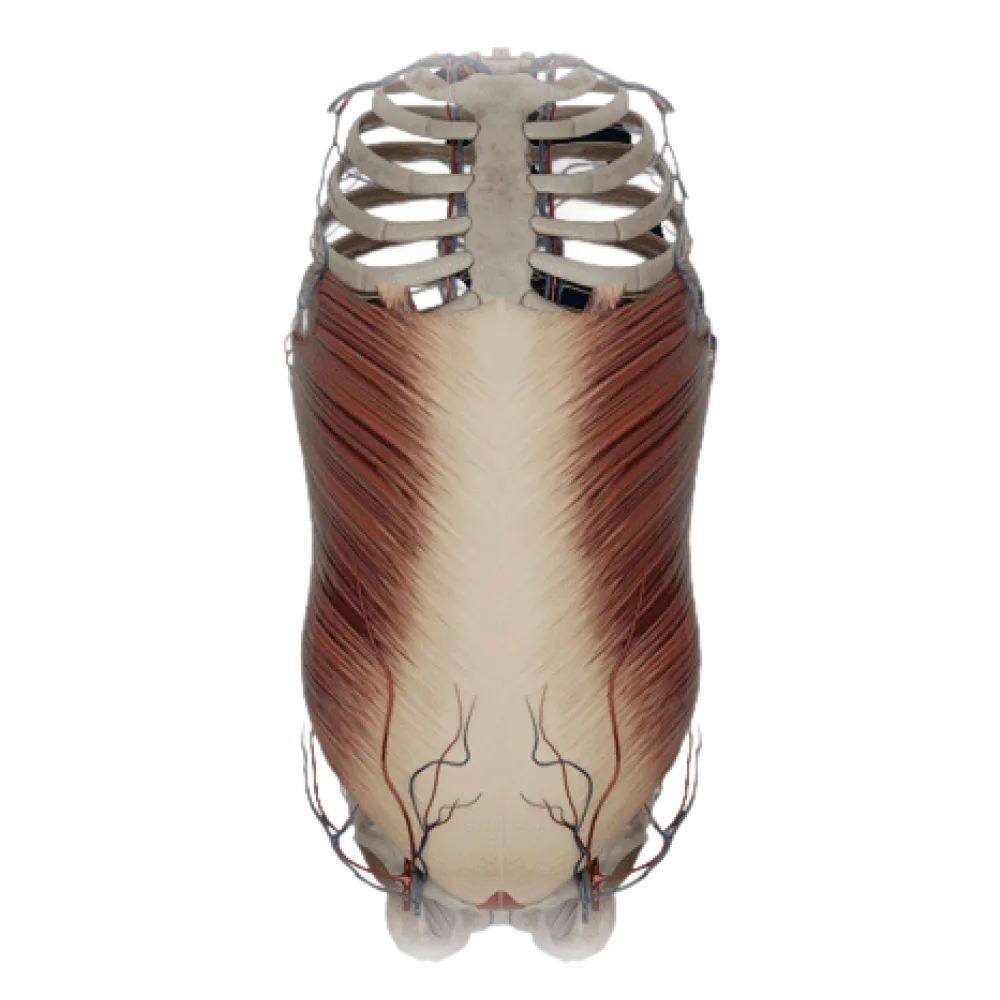

Anatomy test of the muscles of abdomen and pelvis of men.
Evaluate knowledge of the anatomy of abdominal and pelvic muscles in men. The test checks the inguinal canal, perineum, fasciae, and innervation.
1/20
bold
text
1. Which muscle forms the muscular sheath of the spermatic cord (m. cremaster) in men?
-
Internal oblique and transverse muscles of abdomen.
Muscle that lifts the testis (m. cremaster), comprised of bundles derived from the internal oblique and transverse muscles of the abdomen within the inguinal canal.
-
External oblique muscle of the abdomen
Muscle that lifts the testis (m. cremaster), comprised of bundles derived from the internal oblique and transverse muscles of the abdomen within the inguinal canal.
-
Rectus abdominis muscle
Muscle that lifts the testis (m. cremaster), comprised of bundles derived from the internal oblique and transverse muscles of the abdomen within the inguinal canal.
-
Pyramidalis muscle
Muscle that lifts the testis (m. cremaster), comprised of bundles derived from the internal oblique and transverse muscles of the abdomen within the inguinal canal.
-
I find it difficult to answer
Muscle that lifts the testis (m. cremaster), comprised of bundles derived from the internal oblique and transverse muscles of the abdomen within the inguinal canal.
2. Which perineal muscle in men originates from the perineal body and median raphe to encompass the bulb of the penis?
-
M. ischiocavernosus
The bulbospongiosus muscle (m. bulbospongiosus) in men is paired and surrounds the bulb of the penis, aiding ejaculation and urination.
-
M. transversus perinei superficialis
The bulbospongiosus muscle (m. bulbospongiosus) in men is paired and surrounds the bulb of the penis, aiding ejaculation and urination.
-
M. bulbospongiosus
The bulbospongiosus muscle (m. bulbospongiosus) in men is paired and surrounds the bulb of the penis, aiding ejaculation and urination.
-
M. sphincter ani externus
The bulbospongiosus muscle (m. bulbospongiosus) in men is paired and surrounds the bulb of the penis, aiding ejaculation and urination.
-
I find it difficult to answer
The bulbospongiosus muscle (m. bulbospongiosus) in men is paired and surrounds the bulb of the penis, aiding ejaculation and urination.
3. Which portion is the medial part of the muscle elevating the anus and forms a muscle loop around the rectum?
-
M. iliococcygeus
The puborectalis muscle (m. puborectalis) is the medial portion of m. levator ani and forms a loop facilitating fecal continence.
-
M. puborectalis
The puborectalis muscle (m. puborectalis) is the medial portion of m. levator ani and forms a loop facilitating fecal continence.
-
M. pubococcygeus
The puborectalis muscle (m. puborectalis) is the medial portion of m. levator ani and forms a loop facilitating fecal continence.
-
M. ischiococcygeus
The puborectalis muscle (m. puborectalis) is the medial portion of m. levator ani and forms a loop facilitating fecal continence.
-
I find it difficult to answer
The puborectalis muscle (m. puborectalis) is the medial portion of m. levator ani and forms a loop facilitating fecal continence.
4. Which structures bound the superficial inguinal ring (anulus inguinalis superficialis) in men above and below?
-
Inguinal and lacunar ligaments.
The superficial inguinal ring is bounded above by the medial crus, and below by the lateral crus of the aponeurosis of the external oblique abdominal muscle.
-
Lower edge of internal oblique and transverse muscles.
The superficial inguinal ring is bounded above by the medial crus, and below by the lateral crus of the aponeurosis of the external oblique abdominal muscle.
-
Iliopectineal arch and pectineal ligament.
The superficial inguinal ring is bounded above by the medial crus, and below by the lateral crus of the aponeurosis of the external oblique abdominal muscle.
-
Medial and lateral crura of the aponeurosis of the external oblique muscle.
The superficial inguinal ring is bounded above by the medial crus, and below by the lateral crus of the aponeurosis of the external oblique abdominal muscle.
-
I find it difficult to answer
The superficial inguinal ring is bounded above by the medial crus, and below by the lateral crus of the aponeurosis of the external oblique abdominal muscle.
5. What is located in the deep perineal space (spatium perinei profundum) in men?
-
Prostate gland
In the deep perineal pouch in men, the bulbourethral (Cowper's) glands are situated, with their ducts opening into the spongy part of the urethra.
-
Seminal vesicles
In the deep perineal pouch in men, the bulbourethral (Cowper's) glands are situated, with their ducts opening into the spongy part of the urethra.
-
Bulbourethral glands (Cowper's glands)
In the deep perineal pouch in men, the bulbourethral (Cowper's) glands are situated, with their ducts opening into the spongy part of the urethra.
-
Testes and epididymides.
In the deep perineal pouch in men, the bulbourethral (Cowper's) glands are situated, with their ducts opening into the spongy part of the urethra.
-
I find it difficult to answer
In the deep perineal pouch in men, the bulbourethral (Cowper's) glands are situated, with their ducts opening into the spongy part of the urethra.
6. How is the posterior wall of the rectus sheath formed below the arcuate line (linea arcuata)?
-
By the aponeuroses of all three flat abdominal muscles.
Below the arcuate line (Douglas' line), the aponeuroses of all the flat muscles shift to the anterior wall, while the posterior wall is represented solely by the transverse fascia.
-
It is absent, with the muscle adjacent to the transverse fascia.
Below the arcuate line (Douglas' line), the aponeuroses of all the flat muscles shift to the anterior wall, while the posterior wall is represented solely by the transverse fascia.
-
By the peritoneum and preperitoneal connective tissue.
Below the arcuate line (Douglas' line), the aponeuroses of all the flat muscles shift to the anterior wall, while the posterior wall is represented solely by the transverse fascia.
-
Only by the aponeurosis of the transverse abdominal muscle.
Below the arcuate line (Douglas' line), the aponeuroses of all the flat muscles shift to the anterior wall, while the posterior wall is represented solely by the transverse fascia.
-
I find it difficult to answer
Below the arcuate line (Douglas' line), the aponeuroses of all the flat muscles shift to the anterior wall, while the posterior wall is represented solely by the transverse fascia.
7. Which perineal muscle in men covers the crura of the penis and aids in erection when contracted?
-
M. ischiocavernosus
The ischiocavernosus muscle (m. ischiocavernosus) clamps the root of the penis against the pelvic bones, impeding venous outflow and maintaining erection.
-
M. bulbospongiosus
The ischiocavernosus muscle (m. ischiocavernosus) clamps the root of the penis against the pelvic bones, impeding venous outflow and maintaining erection.
-
M. transversus perinei profundus
The ischiocavernosus muscle (m. ischiocavernosus) clamps the root of the penis against the pelvic bones, impeding venous outflow and maintaining erection.
-
M. sphincter urethrae externus
The ischiocavernosus muscle (m. ischiocavernosus) clamps the root of the penis against the pelvic bones, impeding venous outflow and maintaining erection.
-
I find it difficult to answer
The ischiocavernosus muscle (m. ischiocavernosus) clamps the root of the penis against the pelvic bones, impeding venous outflow and maintaining erection.
8. Through which foramen does the tendon of the internal obturator muscle (m. obturatorius internus) exit the lesser pelvis?
-
Foramen ischiadicum majus
The internal obturator muscle originates from the pelvic surface and exits the femur through the lesser sciatic foramen (foramen ischiadicum minus).
-
Canalis obturatorius
The internal obturator muscle originates from the pelvic surface and exits the femur through the lesser sciatic foramen (foramen ischiadicum minus).
-
Foramen suprapiriforme
The internal obturator muscle originates from the pelvic surface and exits the femur through the lesser sciatic foramen (foramen ischiadicum minus).
-
Foramen ischiadicum minus
The internal obturator muscle originates from the pelvic surface and exits the femur through the lesser sciatic foramen (foramen ischiadicum minus).
-
I find it difficult to answer
The internal obturator muscle originates from the pelvic surface and exits the femur through the lesser sciatic foramen (foramen ischiadicum minus).
9. Which anatomical feature corresponds to the deep inguinal ring on the inner surface of the anterior abdominal wall?
-
Medial inguinal fossa.
The deep inguinal ring corresponds to the lateral inguinal fossa (fossa inguinalis lateralis) located outside the lateral umbilical fold.
-
Lateral inguinal fossa.
The deep inguinal ring corresponds to the lateral inguinal fossa (fossa inguinalis lateralis) located outside the lateral umbilical fold.
-
Supravesical fossa.
The deep inguinal ring corresponds to the lateral inguinal fossa (fossa inguinalis lateralis) located outside the lateral umbilical fold.
-
Vascular lacuna.
The deep inguinal ring corresponds to the lateral inguinal fossa (fossa inguinalis lateralis) located outside the lateral umbilical fold.
-
I find it difficult to answer
The deep inguinal ring corresponds to the lateral inguinal fossa (fossa inguinalis lateralis) located outside the lateral umbilical fold.
10. Which muscle does NOT interweave with the perineal body (centrum perinei)?
-
M. bulbospongiosus
The ischiocavernosus muscle (m. ischiocavernosus) attaches to the branches of the ischium and the tunica albuginea of the cavernous body, bypassing the perineal body.
-
M. sphincter ani externus
The ischiocavernosus muscle (m. ischiocavernosus) attaches to the branches of the ischium and the tunica albuginea of the cavernous body, bypassing the perineal body.
-
M. transversus perinei superficialis
The ischiocavernosus muscle (m. ischiocavernosus) attaches to the branches of the ischium and the tunica albuginea of the cavernous body, bypassing the perineal body.
-
M. ischiocavernosus
The ischiocavernosus muscle (m. ischiocavernosus) attaches to the branches of the ischium and the tunica albuginea of the cavernous body, bypassing the perineal body.
-
I find it difficult to answer
The ischiocavernosus muscle (m. ischiocavernosus) attaches to the branches of the ischium and the tunica albuginea of the cavernous body, bypassing the perineal body.
11. Which nerve provides motor innervation to the pyramidalis muscle (m. pyramidalis)?
-
Ilioinguinal nerve
The pyramidalis muscle, a rudimentary muscle of the anterior abdominal wall, is innervated by the subcostal nerve (n. subcostalis) - the anterior branch of the 12th thoracic nerve.
-
Iliohypogastric nerve
The pyramidalis muscle, a rudimentary muscle of the anterior abdominal wall, is innervated by the subcostal nerve (n. subcostalis) - the anterior branch of the 12th thoracic nerve.
-
Subcostal nerve (n. subcostalis)
The pyramidalis muscle, a rudimentary muscle of the anterior abdominal wall, is innervated by the subcostal nerve (n. subcostalis) - the anterior branch of the 12th thoracic nerve.
-
Genitofemoral nerve
The pyramidalis muscle, a rudimentary muscle of the anterior abdominal wall, is innervated by the subcostal nerve (n. subcostalis) - the anterior branch of the 12th thoracic nerve.
-
I find it difficult to answer
The pyramidalis muscle, a rudimentary muscle of the anterior abdominal wall, is innervated by the subcostal nerve (n. subcostalis) - the anterior branch of the 12th thoracic nerve.
12. From which structure of the anterior abdominal wall is the internal spermatic fascia (fascia spermatica interna) derived?
-
Transverse fascia (fascia transversalis)
The internal spermatic fascia forms as an evagination of the transverse abdominal fascia (fascia transversalis) at the deep inguinal ring.
-
Aponeurosis of the external oblique muscle of the abdomen.
The internal spermatic fascia forms as an evagination of the transverse abdominal fascia (fascia transversalis) at the deep inguinal ring.
-
Peritoneum
The internal spermatic fascia forms as an evagination of the transverse abdominal fascia (fascia transversalis) at the deep inguinal ring.
-
Superficial abdominal fascia.
The internal spermatic fascia forms as an evagination of the transverse abdominal fascia (fascia transversalis) at the deep inguinal ring.
-
I find it difficult to answer
The internal spermatic fascia forms as an evagination of the transverse abdominal fascia (fascia transversalis) at the deep inguinal ring.
13. Which branch of nerve performs motor innervation for the cremaster muscle (m. cremaster)?
-
N. ilioinguinalis
Motor innervation of the cremaster is provided by the genital branch (ramus genitalis) of the genitofemoral nerve, which underpins the cremaster reflex.
-
N. pudendus
Motor innervation of the cremaster is provided by the genital branch (ramus genitalis) of the genitofemoral nerve, which underpins the cremaster reflex.
-
Ramus genitalis n. genitofemoralis originate
Motor innervation of the cremaster is provided by the genital branch (ramus genitalis) of the genitofemoral nerve, which underpins the cremaster reflex.
-
N. iliohypogastricus
Motor innervation of the cremaster is provided by the genital branch (ramus genitalis) of the genitofemoral nerve, which underpins the cremaster reflex.
-
I find it difficult to answer
Motor innervation of the cremaster is provided by the genital branch (ramus genitalis) of the genitofemoral nerve, which underpins the cremaster reflex.
14. To which structure is the upper edge of the quadratus lumborum muscle (m. quadratus lumborum) attached?
-
To the 10th rib.
The quadratus lumborum muscle originates from the iliac crest and attaches to the inferior edge of the 12th rib and the transverse processes of the upper lumbar vertebrae.
-
To the 12th rib.
The quadratus lumborum muscle originates from the iliac crest and attaches to the inferior edge of the 12th rib and the transverse processes of the upper lumbar vertebrae.
-
To the diaphragm.
The quadratus lumborum muscle originates from the iliac crest and attaches to the inferior edge of the 12th rib and the transverse processes of the upper lumbar vertebrae.
-
To the medial arcuate ligament.
The quadratus lumborum muscle originates from the iliac crest and attaches to the inferior edge of the 12th rib and the transverse processes of the upper lumbar vertebrae.
-
I find it difficult to answer
The quadratus lumborum muscle originates from the iliac crest and attaches to the inferior edge of the 12th rib and the transverse processes of the upper lumbar vertebrae.
15. Which fascia covers the superior (internal) surface of the muscle lifting the anus (m. levator ani)?
-
Fascia perinei.
The superior fascia of the pelvic diaphragm (part of fascia pelvis parietalis) covers m. levator ani on the side of the lesser pelvis.
-
Fascia obturatoria
The superior fascia of the pelvic diaphragm (part of fascia pelvis parietalis) covers m. levator ani on the side of the lesser pelvis.
-
Fascia presacralis
The superior fascia of the pelvic diaphragm (part of fascia pelvis parietalis) covers m. levator ani on the side of the lesser pelvis.
-
Fascia pelvis parietalis.
The superior fascia of the pelvic diaphragm (part of fascia pelvis parietalis) covers m. levator ani on the side of the lesser pelvis.
-
I find it difficult to answer
The superior fascia of the pelvic diaphragm (part of fascia pelvis parietalis) covers m. levator ani on the side of the lesser pelvis.
16. Which nerves provide the primary motor innervation to the rectus abdominis muscle?
-
Intercostal nerves (Th7-Th12)
The rectus abdominis muscle is primarily innervated by the anterior branches of the lower six thoracic spinal nerves (nn. intercostales VII-XII).
-
Branches of the lumbar plexus (L1-L3)
The rectus abdominis muscle is primarily innervated by the anterior branches of the lower six thoracic spinal nerves (nn. intercostales VII-XII).
-
Ilioinguinal nerve
The rectus abdominis muscle is primarily innervated by the anterior branches of the lower six thoracic spinal nerves (nn. intercostales VII-XII).
-
Branches of the sacral plexus.
The rectus abdominis muscle is primarily innervated by the anterior branches of the lower six thoracic spinal nerves (nn. intercostales VII-XII).
-
I find it difficult to answer
The rectus abdominis muscle is primarily innervated by the anterior branches of the lower six thoracic spinal nerves (nn. intercostales VII-XII).
17. Where is the external urethral sphincter (m. sphincter urethrae externus) located in men?
-
In the prostate gland.
The external urethral sphincter consists of striated muscle fibers and is located in the deep perineal space (formerly the urogenital diaphragm).
-
In the deep perineal space.
The external urethral sphincter consists of striated muscle fibers and is located in the deep perineal space (formerly the urogenital diaphragm).
-
In the bulb of the penis.
The external urethral sphincter consists of striated muscle fibers and is located in the deep perineal space (formerly the urogenital diaphragm).
-
Around the neck of the urinary bladder.
The external urethral sphincter consists of striated muscle fibers and is located in the deep perineal space (formerly the urogenital diaphragm).
-
I find it difficult to answer
The external urethral sphincter consists of striated muscle fibers and is located in the deep perineal space (formerly the urogenital diaphragm).
18. In which fold of the peritoneum does the inferior epigastric artery, supplying the rectus abdominis muscle, pass?
-
Plica umbilicalis mediana
The inferior epigastric artery (a. epigastrica inferior) passes in the lateral umbilical fold (plica umbilicalis lateralis) on the inner surface of the abdominal wall.
-
Plica umbilicalis medialis
The inferior epigastric artery (a. epigastrica inferior) passes in the lateral umbilical fold (plica umbilicalis lateralis) on the inner surface of the abdominal wall.
-
Plica umbilicalis lateralis
The inferior epigastric artery (a. epigastrica inferior) passes in the lateral umbilical fold (plica umbilicalis lateralis) on the inner surface of the abdominal wall.
-
Plica epigastrica
The inferior epigastric artery (a. epigastrica inferior) passes in the lateral umbilical fold (plica umbilicalis lateralis) on the inner surface of the abdominal wall.
-
I find it difficult to answer
The inferior epigastric artery (a. epigastrica inferior) passes in the lateral umbilical fold (plica umbilicalis lateralis) on the inner surface of the abdominal wall.
19. Which muscle consists of smooth muscle fibers interweaving into the skin around the anal opening?
-
M. sphincter ani externus
The muscle that wrinkles the skin of the anus (m. corrugator cutis ani) consists of smooth muscle fibers that are a continuation of the rectal layer.
-
M. puborectalis
The muscle that wrinkles the skin of the anus (m. corrugator cutis ani) consists of smooth muscle fibers that are a continuation of the rectal layer.
-
M. levator ani
The muscle that wrinkles the skin of the anus (m. corrugator cutis ani) consists of smooth muscle fibers that are a continuation of the rectal layer.
-
M. corrugator cutis ani
The muscle that wrinkles the skin of the anus (m. corrugator cutis ani) consists of smooth muscle fibers that are a continuation of the rectal layer.
-
I find it difficult to answer
The muscle that wrinkles the skin of the anus (m. corrugator cutis ani) consists of smooth muscle fibers that are a continuation of the rectal layer.
20. Which structure forms the anterior boundary of the lumbar triangle (trigonum lumbale) of Petit?
-
M. obliquus externus abdominis
The lumbar triangle is bounded anteriorly by the posterior edge of the external oblique muscle, posteriorly by the latissimus dorsi, and inferiorly by the iliac crest.
-
M. latissimus dorsi
The lumbar triangle is bounded anteriorly by the posterior edge of the external oblique muscle, posteriorly by the latissimus dorsi, and inferiorly by the iliac crest.
-
Crista iliaca
The lumbar triangle is bounded anteriorly by the posterior edge of the external oblique muscle, posteriorly by the latissimus dorsi, and inferiorly by the iliac crest.
-
M. obliquus internus abdominis
The lumbar triangle is bounded anteriorly by the posterior edge of the external oblique muscle, posteriorly by the latissimus dorsi, and inferiorly by the iliac crest.
-
I find it difficult to answer
The lumbar triangle is bounded anteriorly by the posterior edge of the external oblique muscle, posteriorly by the latissimus dorsi, and inferiorly by the iliac crest.
Retake this quiz?
Your current progress will be reset.