


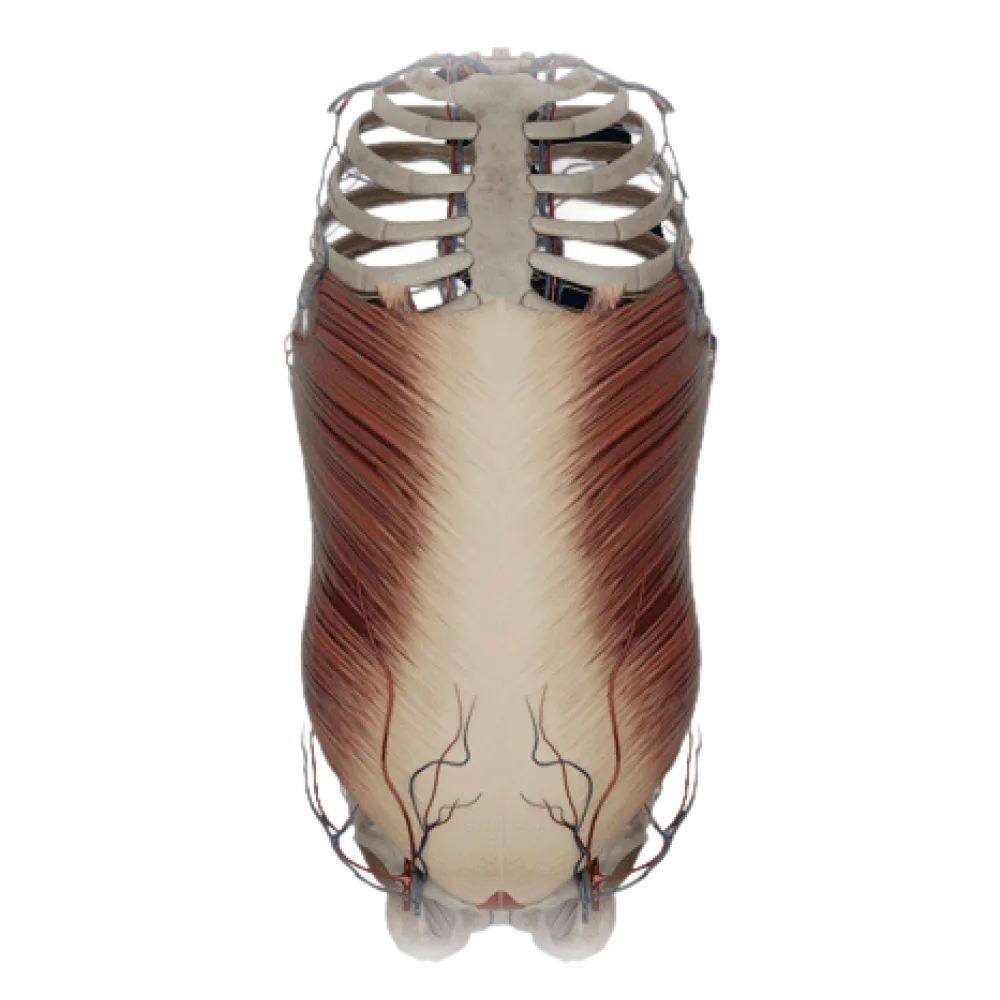

Test on the anatomy of the abdominal muscles
Evaluate the knowledge of the anatomy of the abdominal muscles. The test examines their arterial blood supply, venous drainage, innervation by the branches of the spinal nerves and plexuses.
1/20
bold
text
1. Which artery supplies the upper part of the rectus abdominis muscle?
-
Inferior epigastric artery
The superior epigastric artery is the terminal branch of the internal thoracic artery and supplies the upper part of the rectus abdominis muscle.
-
Superior epigastric artery
The superior epigastric artery is the terminal branch of the internal thoracic artery and supplies the upper part of the rectus abdominis muscle.
-
Superficial epigastric artery
The superior epigastric artery is the terminal branch of the internal thoracic artery and supplies the upper part of the rectus abdominis muscle.
-
Deep circumflex iliac artery
The superior epigastric artery is the terminal branch of the internal thoracic artery and supplies the upper part of the rectus abdominis muscle.
-
I find it difficult to answer
The superior epigastric artery is the terminal branch of the internal thoracic artery and supplies the upper part of the rectus abdominis muscle.
2. Which artery is the inferior epigastric artery a branch of, supplying the rectus abdominis muscle?
-
External iliac artery
The inferior epigastric artery arises from the external iliac artery immediately before the inguinal ligament.
-
Internal iliac artery
The inferior epigastric artery arises from the external iliac artery immediately before the inguinal ligament.
-
The femoral artery
The inferior epigastric artery arises from the external iliac artery immediately before the inguinal ligament.
-
The obturator artery
The inferior epigastric artery arises from the external iliac artery immediately before the inguinal ligament.
-
I find it difficult to answer
The inferior epigastric artery arises from the external iliac artery immediately before the inguinal ligament.
3. Which nerves are involved in the innervation of the rectus abdominis muscle?
-
Ilioinguinal nerve
The rectus abdominis muscle is innervated by the anterior branches of the 7-12 thoracic spinal nerves (intercostal and subcostal).
-
Femoral nerve.
The rectus abdominis muscle is innervated by the anterior branches of the 7-12 thoracic spinal nerves (intercostal and subcostal).
-
Obturator nerve.
The rectus abdominis muscle is innervated by the anterior branches of the 7-12 thoracic spinal nerves (intercostal and subcostal).
-
Intercostal nerves (Th7-Th12)
The rectus abdominis muscle is innervated by the anterior branches of the 7-12 thoracic spinal nerves (intercostal and subcostal).
-
I find it difficult to answer
The rectus abdominis muscle is innervated by the anterior branches of the 7-12 thoracic spinal nerves (intercostal and subcostal).
4. Which artery is the superficial epigastric artery a branch of?
-
External iliac artery
The superficial epigastric artery arises from the femoral artery below the inguinal ligament and ascends towards the umbilical ring.
-
Internal iliac artery
The superficial epigastric artery arises from the femoral artery below the inguinal ligament and ascends towards the umbilical ring.
-
The femoral artery
The superficial epigastric artery arises from the femoral artery below the inguinal ligament and ascends towards the umbilical ring.
-
Internal thoracic artery
The superficial epigastric artery arises from the femoral artery below the inguinal ligament and ascends towards the umbilical ring.
-
I find it difficult to answer
The superficial epigastric artery arises from the femoral artery below the inguinal ligament and ascends towards the umbilical ring.
5. Between which muscles does the deep circumflex iliac artery pass?
-
External and internal oblique muscles of the abdomen
The deep circumflex iliac artery is located in the tissue between the internal oblique and transverse abdominal muscles.
-
Internal oblique and transverse abdominal muscles
The deep circumflex iliac artery is located in the tissue between the internal oblique and transverse abdominal muscles.
-
Transverse abdominal muscle and inner abdominal fascia
The deep circumflex iliac artery is located in the tissue between the internal oblique and transverse abdominal muscles.
-
Within the thickness of the rectus abdominis muscle
The deep circumflex iliac artery is located in the tissue between the internal oblique and transverse abdominal muscles.
-
I find it difficult to answer
The deep circumflex iliac artery is located in the tissue between the internal oblique and transverse abdominal muscles.
6. Which nerve innervates the pyramidalis muscle?
-
Iliohypogastric nerve
The pyramidalis muscle is innervated by the subcostal nerve (12th intercostal nerve).
-
Ilioinguinal nerve
The pyramidalis muscle is innervated by the subcostal nerve (12th intercostal nerve).
-
Subcostal nerve (Th12)
The pyramidalis muscle is innervated by the subcostal nerve (12th intercostal nerve).
-
Genitofemoral nerve
The pyramidalis muscle is innervated by the subcostal nerve (12th intercostal nerve).
-
I find it difficult to answer
The pyramidalis muscle is innervated by the subcostal nerve (12th intercostal nerve).
7. Which of the following does NOT participate in the innervation of the external oblique muscle of the abdomen?
-
Lumbar nerve L3
The external oblique muscle of the abdomen is innervated by intercostal nerves (Th7-Th11), subcostal and iliohypogastric nerves (L1).
-
Subcostal nerve (Th12)
The external oblique muscle of the abdomen is innervated by intercostal nerves (Th7-Th11), subcostal and iliohypogastric nerves (L1).
-
Iliohypogastric nerve
The external oblique muscle of the abdomen is innervated by intercostal nerves (Th7-Th11), subcostal and iliohypogastric nerves (L1).
-
Lower intercostal nerves (Th7-Th11)
The external oblique muscle of the abdomen is innervated by intercostal nerves (Th7-Th11), subcostal and iliohypogastric nerves (L1).
-
I find it difficult to answer
The external oblique muscle of the abdomen is innervated by intercostal nerves (Th7-Th11), subcostal and iliohypogastric nerves (L1).
8. Where are the anastomoses between the superior and inferior epigastric arteries located?
-
In the subcutaneous tissue of the anterior abdominal wall
The anastomosis between the superior and inferior epigastric arteries forms within the sheath of the rectus abdominis muscle, providing collateral blood flow.
-
Between the internal oblique and transverse abdominal muscles
The anastomosis between the superior and inferior epigastric arteries forms within the sheath of the rectus abdominis muscle, providing collateral blood flow.
-
In the retroperitoneal space
The anastomosis between the superior and inferior epigastric arteries forms within the sheath of the rectus abdominis muscle, providing collateral blood flow.
-
Within the thickness of the rectus abdominis muscle or within its sheath
The anastomosis between the superior and inferior epigastric arteries forms within the sheath of the rectus abdominis muscle, providing collateral blood flow.
-
I find it difficult to answer
The anastomosis between the superior and inferior epigastric arteries forms within the sheath of the rectus abdominis muscle, providing collateral blood flow.
9. Which vein collects blood from the lateral parts of the abdominal wall and drains into the axillary vein?
-
Superficial epigastric vein
The thoracoepigastric vein (v. thoracoepigastrica) collects venous blood from the lateral abdominal wall and drains into the axillary vein.
-
Inferior epigastric vein
The thoracoepigastric vein (v. thoracoepigastrica) collects venous blood from the lateral abdominal wall and drains into the axillary vein.
-
Thoracoepigastric vein
The thoracoepigastric vein (v. thoracoepigastrica) collects venous blood from the lateral abdominal wall and drains into the axillary vein.
-
Paraumbilical vein
The thoracoepigastric vein (v. thoracoepigastrica) collects venous blood from the lateral abdominal wall and drains into the axillary vein.
-
I find it difficult to answer
The thoracoepigastric vein (v. thoracoepigastrica) collects venous blood from the lateral abdominal wall and drains into the axillary vein.
10. Which nerve plexus is the iliohypogastric nerve, innervating the abdominal muscles, a branch of?
-
Lumbar plexus
The iliohypogastric nerve is formed from the branches of T12 and L1 spinal nerves and is a short branch of the lumbar plexus.
-
Brachial plexus
The iliohypogastric nerve is formed from the branches of T12 and L1 spinal nerves and is a short branch of the lumbar plexus.
-
Cervical plexus
The iliohypogastric nerve is formed from the branches of T12 and L1 spinal nerves and is a short branch of the lumbar plexus.
-
Sacral plexus
The iliohypogastric nerve is formed from the branches of T12 and L1 spinal nerves and is a short branch of the lumbar plexus.
-
I find it difficult to answer
The iliohypogastric nerve is formed from the branches of T12 and L1 spinal nerves and is a short branch of the lumbar plexus.
11. Which arteries supply the quadratus lumborum muscle?
-
Inferior epigastric artery, deep circumflex iliac artery
The quadratus lumborum muscle receives blood supply from the subcostal artery, lumbar arteries, and ilio-lumbar artery.
-
Lumbar arteries, subcostal artery, ilio-lumbar artery
The quadratus lumborum muscle receives blood supply from the subcostal artery, lumbar arteries, and ilio-lumbar artery.
-
Superficial epigastric artery, superior epigastric artery
The quadratus lumborum muscle receives blood supply from the subcostal artery, lumbar arteries, and ilio-lumbar artery.
-
Inferior phrenic artery, middle suprarenal artery
The quadratus lumborum muscle receives blood supply from the subcostal artery, lumbar arteries, and ilio-lumbar artery.
-
I find it difficult to answer
The quadratus lumborum muscle receives blood supply from the subcostal artery, lumbar arteries, and ilio-lumbar artery.
12. Through which anatomical structure does the ilioinguinal nerve exit the skin, first innervating the abdominal muscles?
-
Deep inguinal ring
The ilioinguinal nerve passes through the inguinal canal and exits the skin via the superficial inguinal ring.
-
Umbilical ring
The ilioinguinal nerve passes through the inguinal canal and exits the skin via the superficial inguinal ring.
-
Femoral ring
The ilioinguinal nerve passes through the inguinal canal and exits the skin via the superficial inguinal ring.
-
Superficial inguinal ring
The ilioinguinal nerve passes through the inguinal canal and exits the skin via the superficial inguinal ring.
-
I find it difficult to answer
The ilioinguinal nerve passes through the inguinal canal and exits the skin via the superficial inguinal ring.
13. Where does the superior epigastric vein drain into?
-
Into the azygos vein.
The superior epigastric vein collects blood from the anterior abdominal wall and drains into the internal thoracic vein.
-
Into the internal thoracic vein
The superior epigastric vein collects blood from the anterior abdominal wall and drains into the internal thoracic vein.
-
Into the external iliac vein
The superior epigastric vein collects blood from the anterior abdominal wall and drains into the internal thoracic vein.
-
Into the portal vein
The superior epigastric vein collects blood from the anterior abdominal wall and drains into the internal thoracic vein.
-
I find it difficult to answer
The superior epigastric vein collects blood from the anterior abdominal wall and drains into the internal thoracic vein.
14. Which nerve branch is the genital branch, innervating the cremaster muscle (m. cremaster)?
-
Ilioinguinal nerve
The cremaster muscle (m. cremaster) is innervated by the genital branch of the genitofemoral nerve (n. genitofemoralis).
-
Iliohypogastric nerve
The cremaster muscle (m. cremaster) is innervated by the genital branch of the genitofemoral nerve (n. genitofemoralis).
-
Genitofemoral nerve
The cremaster muscle (m. cremaster) is innervated by the genital branch of the genitofemoral nerve (n. genitofemoralis).
-
Obturator nerve
The cremaster muscle (m. cremaster) is innervated by the genital branch of the genitofemoral nerve (n. genitofemoralis).
-
I find it difficult to answer
The cremaster muscle (m. cremaster) is innervated by the genital branch of the genitofemoral nerve (n. genitofemoralis).
15. Which muscle branches of the lumbar plexus participate in the innervation of the transverse abdominal muscle?
-
Branches from T12 and L1 (iliohypogastric and ilioinguinal nerves)
In addition to intercostal nerves, the transverse abdominal muscle is innervated by branches of the lumbar plexus (L1) — the iliohypogastric and ilioinguinal nerves.
-
Only branches from L4-L5
In addition to intercostal nerves, the transverse abdominal muscle is innervated by branches of the lumbar plexus (L1) — the iliohypogastric and ilioinguinal nerves.
-
Branches from the sacral plexus
In addition to intercostal nerves, the transverse abdominal muscle is innervated by branches of the lumbar plexus (L1) — the iliohypogastric and ilioinguinal nerves.
-
Only lower intercostal nerves
In addition to intercostal nerves, the transverse abdominal muscle is innervated by branches of the lumbar plexus (L1) — the iliohypogastric and ilioinguinal nerves.
-
I find it difficult to answer
In addition to intercostal nerves, the transverse abdominal muscle is innervated by branches of the lumbar plexus (L1) — the iliohypogastric and ilioinguinal nerves.
16. Which artery supplies the lateral parts of the anterior abdominal wall and anastomoses with the musculophrenic artery?
-
Superficial epigastric artery
The deep circumflex iliac artery supplies the lateral sections of the abdominal muscles and forms anastomoses with the branches of the musculophrenic artery.
-
Inferior mesenteric artery
The deep circumflex iliac artery supplies the lateral sections of the abdominal muscles and forms anastomoses with the branches of the musculophrenic artery.
-
The external pudendal artery
The deep circumflex iliac artery supplies the lateral sections of the abdominal muscles and forms anastomoses with the branches of the musculophrenic artery.
-
Deep circumflex iliac artery
The deep circumflex iliac artery supplies the lateral sections of the abdominal muscles and forms anastomoses with the branches of the musculophrenic artery.
-
I find it difficult to answer
The deep circumflex iliac artery supplies the lateral sections of the abdominal muscles and forms anastomoses with the branches of the musculophrenic artery.
17. Into which venous system do the paraumbilical veins (vv. paraumbilicales), involved in portocaval anastomoses, drain?
-
Into the system of the superior vena cava
The paraumbilical veins are located in the round ligament of the liver and transport blood from the umbilical ring to the portal vein.
-
Into the system of the inferior vena cava
The paraumbilical veins are located in the round ligament of the liver and transport blood from the umbilical ring to the portal vein.
-
Into the portal vein system of the liver
The paraumbilical veins are located in the round ligament of the liver and transport blood from the umbilical ring to the portal vein.
-
Into the azygos vein system
The paraumbilical veins are located in the round ligament of the liver and transport blood from the umbilical ring to the portal vein.
-
I find it difficult to answer
The paraumbilical veins are located in the round ligament of the liver and transport blood from the umbilical ring to the portal vein.
18. Which of the listed muscles is innervated by short branches of the lumbar plexus (Th12, L1-L4) and not innervated by the ilioinguinal nerve?
-
Internal oblique muscle of the abdomen
The quadratus lumborum muscle is innervated directly by the short muscular branches of the anterior branches of the spinal nerves Th12, L1-L4.
-
Quadratus lumborum muscle
The quadratus lumborum muscle is innervated directly by the short muscular branches of the anterior branches of the spinal nerves Th12, L1-L4.
-
Transversus abdominis muscle
The quadratus lumborum muscle is innervated directly by the short muscular branches of the anterior branches of the spinal nerves Th12, L1-L4.
-
External oblique muscle of the abdomen
The quadratus lumborum muscle is innervated directly by the short muscular branches of the anterior branches of the spinal nerves Th12, L1-L4.
-
I find it difficult to answer
The quadratus lumborum muscle is innervated directly by the short muscular branches of the anterior branches of the spinal nerves Th12, L1-L4.
19. Which artery branches from the internal thoracic artery and supplies the upper part of the lateral abdominal wall?
-
Musculophrenic artery
The musculophrenic artery (a. musculophrenica) is the terminal branch of the internal thoracic artery and gives branches to the upper sections of the lateral abdominal wall.
-
Superior epigastric artery
The musculophrenic artery (a. musculophrenica) is the terminal branch of the internal thoracic artery and gives branches to the upper sections of the lateral abdominal wall.
-
Pericardiacophrenic artery
The musculophrenic artery (a. musculophrenica) is the terminal branch of the internal thoracic artery and gives branches to the upper sections of the lateral abdominal wall.
-
Inferior epigastric artery
The musculophrenic artery (a. musculophrenica) is the terminal branch of the internal thoracic artery and gives branches to the upper sections of the lateral abdominal wall.
-
I find it difficult to answer
The musculophrenic artery (a. musculophrenica) is the terminal branch of the internal thoracic artery and gives branches to the upper sections of the lateral abdominal wall.
20. Which nerve transmits motor impulses to the lower muscular bundles of the internal oblique muscle of the abdomen, adjacent to the inguinal canal?
-
Obturator nerve.
The ilioinguinal nerve innervates the lower bundles of the internal oblique and transverse abdominal muscles, which form the roof of the inguinal canal.
-
Femoral nerve.
The ilioinguinal nerve innervates the lower bundles of the internal oblique and transverse abdominal muscles, which form the roof of the inguinal canal.
-
Ilioinguinal nerve
The ilioinguinal nerve innervates the lower bundles of the internal oblique and transverse abdominal muscles, which form the roof of the inguinal canal.
-
Sciatic nerve
The ilioinguinal nerve innervates the lower bundles of the internal oblique and transverse abdominal muscles, which form the roof of the inguinal canal.
-
I find it difficult to answer
The ilioinguinal nerve innervates the lower bundles of the internal oblique and transverse abdominal muscles, which form the roof of the inguinal canal.
Retake this quiz?
Your current progress will be reset.